
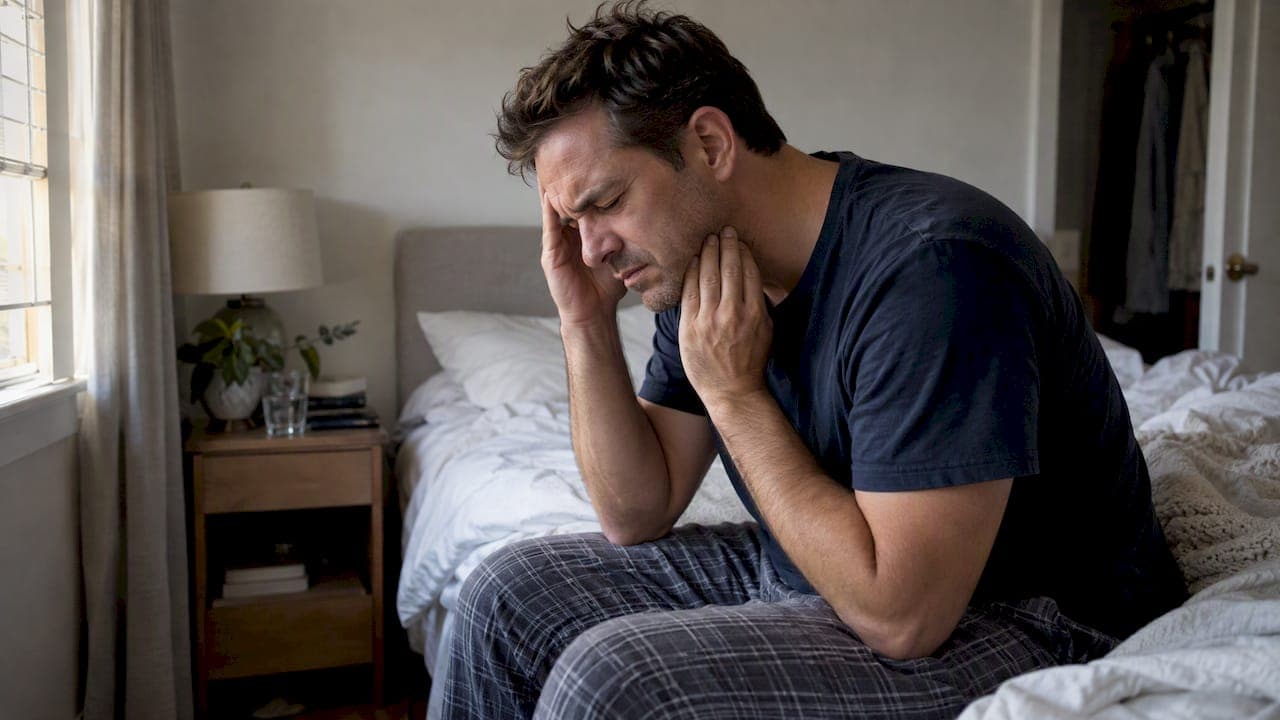
Clenching your jaw can cause headaches, usually a dull, tight ache at the temples or along the side of the head, often worst in the morning. The link is real but not simple: research shows that bruxism, jaw joint disorders and headache often occur together, and it is still debated how much one causes the other. What you can do is find out whether your jaw is part of the problem, calm it down, and protect your teeth while you do.
This guide explains how clenching produces head pain, how to tell it from other headaches, what helps, and which signs mean a dentist should examine you soon.
TL;DR
- Clenching or grinding overworks the chewing muscles, and that strain can show up as temple, forehead or one-sided headaches, especially on waking.
- Headache, bruxism and jaw joint problems (TMD) frequently overlap, but the evidence on cause and effect is mixed, so a proper exam matters more than guessing.
- Start with the basics: rest the jaw, apply heat, cut back on gum and hard foods, and ask a dentist about a custom night guard.
- See a dentist if you have worn or cracked teeth, a jaw that clicks, locks or hurts, or headaches that keep returning.
- Seek urgent medical care for a sudden, severe headache unlike any you have had, or one with fever, confusion, weakness or vision changes. That is not a dental problem.
Table of Contents
- How clenching turns into a headache
- Is it a clenching headache? Signs to look for
- What actually helps
- Botox for clenching: what the research shows
- When to see a dentist, and when it is an emergency
- Our perspective: look at the whole bite, not just the headache
- Get your jaw checked in Tallahassee
- Frequently asked questions
- Sources
How clenching turns into a headache
The muscles that close your jaw are some of the strongest in your body. The masseter sits along the cheek and the temporalis fans across the temple. Both are involved in bruxism, which is characterized by clenching or grinding caused by contraction of these muscles. Hold them tight for hours, awake or asleep, and they behave like any overworked muscle: they get sore, tender and sometimes go into spasm.
Because the temporalis covers the side of your head, that soreness is easily felt as a headache. A dental association guide on bruxism explains that this kind of pressure on the teeth is called bruxism and can cause problems beyond the teeth themselves. The NIDCR also notes that temporomandibular disorders (TMDs) are a group of more than 30 conditions affecting the jaw joint and the muscles that move it, so jaw muscle pain and joint trouble are often tangled together.
Two things are worth knowing about this:
- Clenching is not always grinding. Many people clench silently, pressing the teeth together without any noise. There is no sound for a partner to hear, so the first clue is often a headache or a tired jaw.
- It happens awake and asleep. Daytime clenching tends to follow concentration or stress: driving, screens, deadlines. Sleep bruxism happens without you knowing. A published case report on headache and sleep-related bruxism notes that in practice it can be hard to tell this headache from other causes.
What the evidence does and does not say
We want to be straight with you here. A 2024 narrative review of correlations and causalities found that bruxism, TMD and headache commonly show up together in the same patients, but the evidence is conflicting on whether that is a true cause-and-effect link or simply because each is so common. In plain terms: clenching may well be behind your headaches, but it may also be one of several contributors. That is why a good exam looks at your jaw, your teeth, your sleep and your headache pattern together.
Is it a clenching headache? Signs to look for
Headaches have many causes, and a jaw-related one has a recognizable pattern. A general practice review of TMD describes symptoms such as diffuse, intermittent pain reported in several areas of the head and neck, and tenderness or pain in the muscles of the jaw.
Clues that point toward the jaw:
- A dull, pressing ache at the temples or one or both sides of the head, often present on waking
- A sore, tight or tired jaw, especially in the morning or after chewing
- Tenderness when you press on the cheek muscle or in front of the ear
- Clicking, popping or catching when you open and close
- Flattened, chipped or sensitive teeth, or small cracks
- Ear fullness or aching with no sign of infection (our guide to TMJ ear pain versus an ear infection explains how to sort these out)
- Indentations along the edge of your tongue or ridges inside your cheeks
A simple self-check: for a few days, notice when the headache starts. If it is there when you open your eyes and eases by mid-morning, nighttime clenching is a strong suspect. If it builds through the afternoon at your desk, daytime clenching or posture may be the driver. Also, check whether your teeth are touching right now. At rest, your lips should be closed and your teeth slightly apart.
Table: jaw-related headache versus other common patterns
| Pattern | Typical feel | Jaw clue | Who to see |
|---|---|---|---|
| Clenching or TMD-related headache | Dull ache at temples or sides, often worse on waking | Sore jaw, clicking, worn teeth | Dentist, then physician if needed |
| Tension-type headache | Band-like pressure | May overlap with jaw tension | Primary care physician |
| Migraine | Throbbing, often with nausea or light sensitivity | Jaw pain can coexist | Primary care physician or neurologist |
| Toothache or infection | Localized throbbing, heat or cold sensitivity, swelling | Pain at one tooth | Dentist promptly |
| Sudden severe "worst ever" headache | Abrupt and intense | None | Emergency care immediately |
This table is a sorting aid, not a diagnosis. Overlap is common, and a person can have more than one type.
What actually helps
Most mild cases improve with conservative care. The NIDCR's bruxism guidance for jaw disorders emphasizes that many cases are mild, and a dentist can tell you where you fall. A careful professional's order of operations looks like this.
Step 1: Take the load off the muscles
- Rest the jaw. Keep teeth apart, lips together, tongue resting gently on the roof of the mouth.
- Soften your diet for a week or two: soups, eggs, pasta, cooked vegetables. Skip gum, ice chewing, tough bread and big bites.
- Use heat. A warm, damp towel on the cheek and temple for 10 to 15 minutes can ease tight muscles. Some people find a cold pack better after a flare. Use whichever feels better.
- Gentle stretching. Slowly open and close without forcing, and avoid yawning wide.
- Over-the-counter pain relievers can help short term if they are safe for you. Check with your pharmacist or physician if you take other medicines or have stomach, kidney or heart conditions. Frequent use of pain medicine for headaches can itself cause problems, so do not rely on it as the plan.
Step 2: Look at the triggers
Stress, poor sleep, caffeine and alcohol late in the day, and smoking are often discussed as contributors to bruxism. Because the research on exact triggers is mixed, treat this as a personal experiment: change one thing at a time and track your mornings for two weeks. If you snore, gasp or wake unrefreshed, mention it to your physician, since sleep problems and nighttime clenching can travel together.
Step 3: Protect your teeth with an oral appliance
The most common dental treatment is a custom-fitted night guard or splint. The evidence deserves honest framing. A review in a dental sleep medicine journal says that despite ambiguous evidence for treating TMD and bruxism, oral appliance therapy is an important treatment option and should be delivered with care. Separately, an overview of systematic reviews found that there is not enough evidence to define a single standard approach for treating sleep bruxism.
What that means for you: a guard is a sensible way to shield enamel, fillings and crowns from the forces of clenching, and many people feel better with one, but it may not stop the clenching itself. Over-the-counter boil-and-bite guards can be bulky and may not fit your bite. A dentist can make one that fits your teeth and check your bite as you use it.

Step 4: Consider other options if the pain persists
When conservative steps are not enough, a dentist or physician may talk about physical therapy, medication for muscle pain, bite adjustments in selected cases, or botulinum toxin injections into the jaw muscles.
Botox for clenching: what the research shows
People often ask whether Botox can help. The evidence is promising but not settled. A systematic review of botulinum toxin for bruxism identified 68 studies and selected four randomized controlled trials. Those trials showed injections can reduce how often bruxism episodes occur, lower pain levels and decrease the maximum force the bite generates. A 2025 overview of systematic reviews set out to compare botulinum toxin type A against placebo, no treatment or other interventions in adults.
The practical takeaways: it is a consideration for selected patients, not a first step, and it works on the muscle overactivity rather than on the habit. A candid conversation about expected benefit, how long effects last, and side effects should come before any injection. If you want to read more, we have written about masseter Botox for grinding and how clinicians use Botox for TMJ.

When to see a dentist, and when it is an emergency
Book a dental visit if any of these apply:
- Headaches on waking several times a week
- Jaw soreness, clicking or limited opening that lasts more than a couple of weeks
- Teeth that look shorter, flatter, chipped or are newly sensitive
- A filling, crown or veneer that keeps chipping or loosening
- Pain when chewing that does not follow a particular tooth
If you are unsure whether a problem is routine or urgent, our guide to dental emergencies versus routine pain lays out the signs. A few situations need prompt action:
- A cracked or broken tooth. Clenching can fracture teeth, and a crack that is left alone can get worse. See why a cracked tooth is a dental emergency.
- Throbbing tooth pain, facial swelling or a bad taste. These can point to infection. Read about abscess symptoms that need same-day care.
- Jaw locked open or closed, or a sudden change in your bite.
- Pain at night that keeps you awake. Our piece on tooth pain at night covers when to seek care.
Call 911 or go to an emergency department for a sudden, severe headache unlike any you have had, or a headache with fever and stiff neck, confusion, weakness, trouble speaking or vision changes. Those are medical emergencies and not jaw problems.
Our perspective: look at the whole bite, not just the headache
We see jaw clenching as a pattern, not a diagnosis. A patient arrives saying "I get headaches," and the cause may sit in the muscles, a joint, a cracked tooth or an unrelated source. The first job is to sort those apart.
Our approach is built around comfort and access. We offer same-day emergency appointments, because a broken tooth or sharp pain should not wait weeks. We also provide TMJ treatment, Botox for cosmetic and therapeutic purposes, and a full range of restorative care under one roof, so if clenching has worn or cracked teeth, the same team can repair them. Families are welcome at every age, and we provide dental care for veterans.
We think the honest message to patients is this: the research on bruxism treatment is still evolving, and no single device or injection is a guaranteed cure. The best plan is the least invasive one that protects your teeth and eases your pain, and it is adjusted as you respond. If cosmetic work is part of your goals, a balanced bite matters for how long results last, as we explain in how cosmetic dentistry improves your bite and smile.
— Kayle
Get your jaw checked in Tallahassee
If you wake up with headaches, a sore jaw or teeth that look worn, we can examine your teeth and jaw and talk through next steps, from protecting your enamel to TMJ treatment. Learn more on our services page, or if something hurts right now, see our emergency dentist page for same-day care. Pricing is not published online, so ask our team about costs and your insurance when you call. Regular visits help too: a routine teeth cleaning and exam is a good time to have wear and bite checked. Not sure it is time? Our list of 10 clear signs you need a dental check-up can help you decide.
Frequently asked questions
Can jaw clenching cause headaches every day?
It can contribute to frequent headaches, particularly when the temple and jaw muscles are overworked for long periods. However, the research on the link is mixed, and daily headaches have many possible causes. A dentist can check your jaw and teeth, and a physician can look at other causes.
What does a clenching headache feel like?
Most people describe a dull, pressing ache at the temples or along one or both sides of the head, often with a tired or tender jaw. It is frequently worse in the morning. Pain that is throbbing at one tooth, or that comes with swelling or fever, points to a different problem and needs prompt attention.
Can Botox help with bruxism?
Some evidence says yes. A systematic review of randomized trials found injections can reduce episodes of bruxism and lower pain. It is usually considered after simpler measures, and it should follow an exam and a discussion of benefits and risks.
What happens if bruxism is left untreated?
Over time, bruxism can lead to worn teeth, fractured teeth or restorations, and enlarged jaw muscles. It can also cause jaw pain and headache. Mild cases may need only monitoring, while heavier ones benefit from protection and treatment.
Sources
- Bruxism, temporomandibular disorders, and headache: a narrative review (PubMed)
- Sleep bruxism: an overview for clinicians (British Dental Journal)
- Bruxism (The Journal of the American Dental Association)
- TMD (NIDCR)
- Headache secondary to sleep-related bruxism: a case report (PMC)
- The management of temporomandibular disorders: a headache in general practice (PMC)
- Oral Appliance Therapy in the Management of Temporomandibular Disorders and Bruxism (Taylor & Francis)
- The Current Trend in Management of Bruxism and Chronic Pain (PMC)
- Efficacy of botulinum toxin in the treatment of bruxism: systematic review (PMC)
- Botulinum Toxin for Bruxism: An Overview (MDPI)