
A dental abscess most commonly causes a severe, constant throbbing toothache paired with visible gum swelling or a small "pimple" on the gum near the tooth. Add facial swelling, fever, or a foul taste in the mouth, and the pattern is hard to mistake. If you also have a fever, trouble breathing or swallowing, or swelling that's spreading fast, that's an emergency room visit, not a next-week dental appointment.
TL;DR:
- A sudden loss of pain in a severe toothache often indicates nerve death and ongoing infection spread, requiring prompt dental evaluation.
- Visible signs such as facial swelling, gum boils, and a loose or discolored tooth reliably indicate an active abscess needing treatment.
- Fever above 100.4°F, difficulty swallowing, trouble breathing, or rapidly spreading swelling demand immediate emergency room care due to airway risk.
- Most abscesses can be effectively treated with drainage, antibiotics, and possibly root canal or extraction, but untreated infections may lead to serious complications.
- Same-day emergency dental appointments are crucial for symptoms like worsening pain, facial swelling, or fever, especially for vulnerable groups like immunosuppressed patients.
Table of Contents
- What Does Pain From a Dental Abscess Feel Like?
- What Are the Visible Signs of a Tooth Infection?
- When Do Dental Abscess Symptoms Become an Emergency?
- How Do Dentists Diagnose a Dental Abscess?
- How Is a Dental Abscess Treated?
- Why Untreated Abscesses Get Dangerous Fast
- Getting Same-Day Care When You Need It Most
- What This Article's Evidence Actually Points To
- How to Book Same-Day Emergency Dental Care
- Sources
- FAQ
What Does Pain From a Dental Abscess Feel Like?
The pain usually announces itself before anything else does. It's typically a deep, throbbing ache that doesn't let up, unlike the sharp, fleeting zing of a cavity hitting a cold drink. Many people notice it gets worse when they lie down at night, because blood flow to the head increases and pressure builds inside the confined space around the tooth root.
Biting down or chewing on the affected side often triggers a sharp spike of pain, and hot or cold foods can set off a lingering ache rather than a quick jolt. The pain frequently doesn't stay put. It radiates:
- To the jaw, making the whole side of the face feel tender
- Up toward the ear, sometimes mimicking an ear infection
- Down into the neck, which can suggest the infection is tracking beyond the tooth
Here's the part almost nobody expects: the pain can suddenly stop. That's not always good news. When the Cleveland Clinic explains what happens, it notes that a dying nerve can go silent even while the infection keeps spreading through the bone underneath. Quiet pain is not the same as a resolved problem.
Pro Tip: If a severe toothache suddenly disappears without any treatment, don't assume it healed itself. Call a dentist that same day. This is one of the more dangerous, and most misread, symptoms of tooth infection.
What Are the Visible Signs of a Tooth Infection?
Your mouth and face often show the infection before you can even pin down the pain. Watch for these signs:
- A gum boil (parulis). A small, pimple-like bump on the gum near the sore tooth, sometimes draining pus with a foul, salty taste.
- Facial or cheek swelling. Skin over the area may look puffy, feel warm, and appear reddened.
- A loose or discolored tooth. The affected tooth may darken or feel slightly mobile compared to its neighbors.
- Persistent bad breath or a bad taste. Mayo Clinic lists foul-smelling breath and a metallic or salty taste among the classic signs of an abscess.
If the boil ruptures on its own, pain often drops fast and dramatically. That relief is temporary. Rupture decompresses the pocket of pus, but it doesn't clear the infection from the surrounding tissue, so a dental visit is still necessary.
When Do Dental Abscess Symptoms Become an Emergency?
Most abscesses call for prompt dental care, not a trip to the ER. But a smaller subset of cases crosses into medical emergency territory, and knowing the difference can matter more than any other piece of information in this article.
Get to an emergency room immediately if you notice:
- Fever
- Difficulty breathing
- Trouble swallowing
- Facial swelling that's spreading rapidly or affecting the eye or neck
- Confusion or unusual drowsiness
The Cleveland Clinic is direct about this threshold: these signs suggest the infection has moved beyond the tooth and into tissue that can compromise your airway, a genuinely life-threatening scenario.
Same-day dental care, rather than the ER, fits cases with localized swelling that isn't threatening the airway, fever without breathing trouble, or pain severe enough to disrupt sleep and eating. People who are immunosuppressed, managing uncontrolled diabetes, or caring for a young child with these symptoms should lean toward faster evaluation in every case. Infections progress faster in these groups, and a "wait and see" day can cost more than it seems to.
How Do Dentists Diagnose a Dental Abscess?
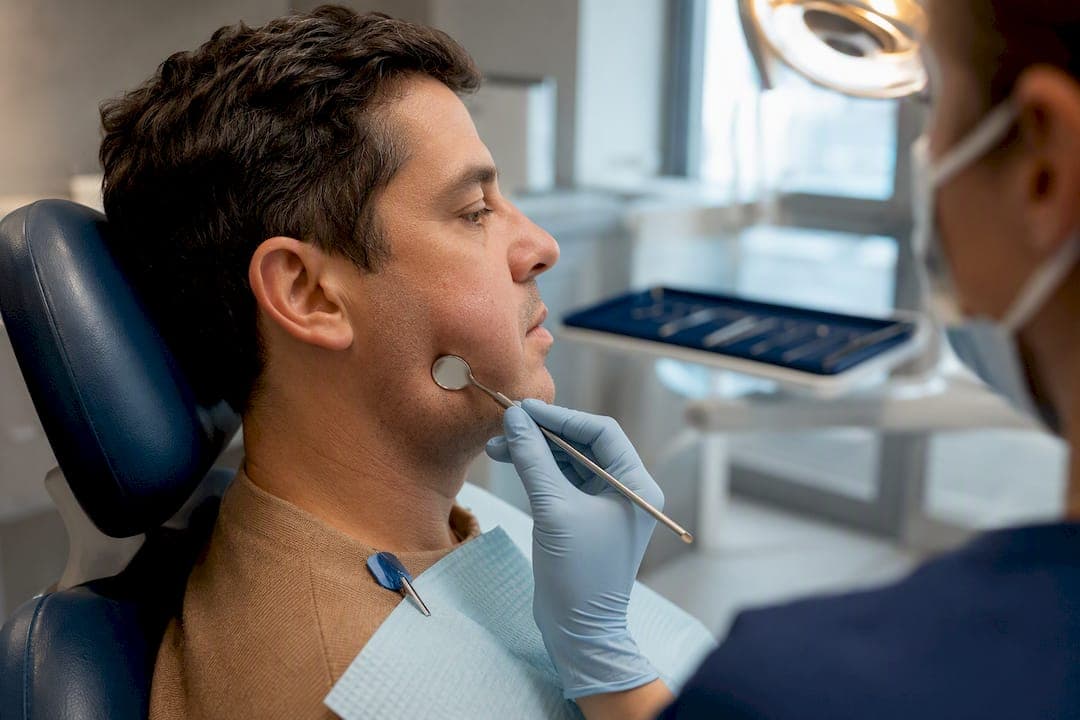
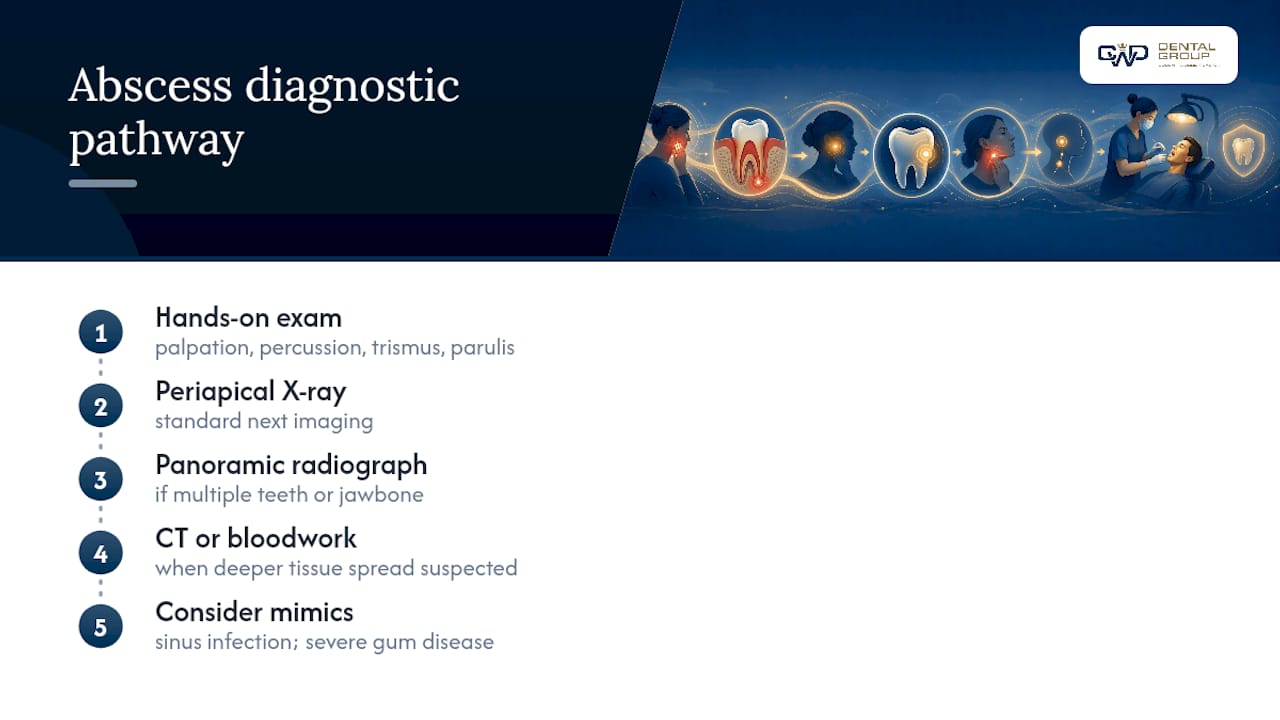
Diagnosis usually starts with a hands-on exam. A dentist will palpate the gum and tap on the suspected tooth (percussion), checking for the sharp, localized pain that points to an abscess. They'll also check for trismus, difficulty opening the mouth fully, and look for a parulis or visible swelling.
A periapical X-ray is the standard next step, and a panoramic radiograph may follow if multiple teeth or the jawbone need a wider look. When swelling suggests the infection has spread into deeper tissue, CT imaging or bloodwork may come into play. Sinus infections and severe gum disease can mimic some of these symptoms, which is part of why the exam matters as much as the imaging.
How Is a Dental Abscess Treated?
Treatment happens in two phases: getting you out of acute pain, and eliminating the infection at its source.
Immediate measures typically include:
- Draining the abscess, sometimes through a small incision
- Prescribing pain relievers to manage discomfort
- Stabilizing the tooth if it's loose or fractured
Definitive care depends on whether the tooth can be saved. Root canal therapy removes the infected pulp and preserves the natural tooth in many cases; when the damage is too extensive, extraction becomes the more realistic option. Antibiotics support this process but don't replace it. StatPearls notes that clinicians select antibiotics covering a broad mix of oral bacteria, and reserve IV antibiotics or hospital admission for patients showing systemic symptoms like high fever or spreading swelling.
Pro Tip: Don't stop antibiotics early just because the pain fades. Untreated infection can persist even after symptoms calm down, and stopping treatment early is a common reason abscesses come back.
Most people notice meaningful relief within a few days of drainage and definitive treatment, though full healing and follow-up imaging can take weeks.
Why Untreated Abscesses Get Dangerous Fast
Left alone, an abscess doesn't stay contained. Mayo Clinic outlines the potential spread: osteomyelitis in the jawbone, deep neck space infections, sinus involvement, and in rare but serious cases, sepsis. Facial and neck swelling severe enough to press on the airway is one of the more frightening escalations, and it's exactly why the fever and breathing thresholds above aren't arbitrary.
Delay also raises the odds you'll lose the tooth entirely, trading a root canal for extraction and, sometimes, bone grafting later. And that quiet period after the pain stops? It's not the infection resolving. It's often the infection working uninterrupted.
Getting Same-Day Care When You Need It Most
Finding a dentist who can see you the same day you notice red flags shouldn't be the hard part of an already painful situation. Same-day emergency dental appointments are available for cases like a swelling jaw or a toothache that's gotten worse overnight, backed by a full range of restorative and emergency dental services.
What This Article's Evidence Actually Points To
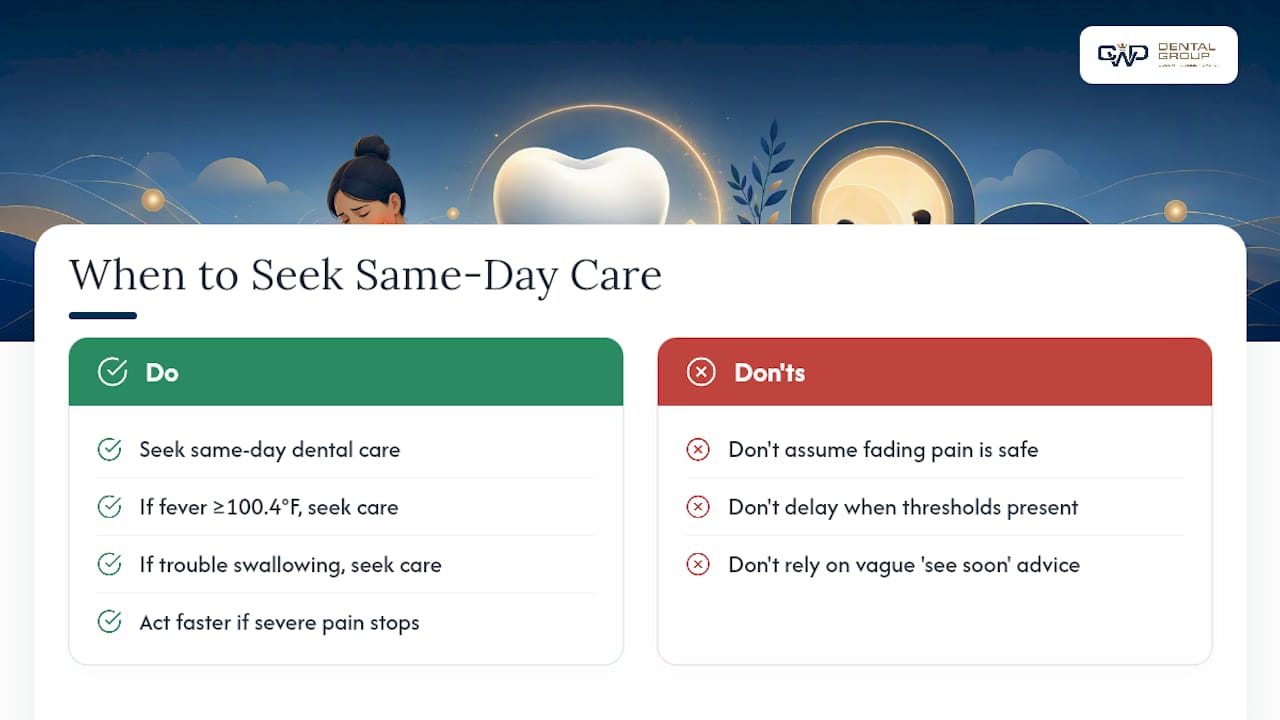
The conventional advice on tooth pain tends to focus on the ache itself, and that's a mistake. The most clinically useful information here isn't "does it hurt," it's the handful of specific thresholds: a 100.4°F fever, trouble swallowing, swelling that's moving fast. Those are the details that separate a same-day dental problem from a hospital problem, and most general health content buries them under vague advice to "see a dentist soon."
The bigger blind spot is the pain-relief trap. People treat a fading toothache as good news, when it's frequently the opposite. If there's one thing worth prioritizing from everything here, it's this: a severe toothache that suddenly goes quiet is not a signal to relax. It's a signal to move faster, not slower, especially if any swelling or fever shows up alongside it. The tooth stopped talking to you. That doesn't mean the infection did.
— Kayle
How to Book Same-Day Emergency Dental Care
If your symptoms match the red flags above, the fastest path forward is a same-day appointment, not a wait-and-see approach. CWD Dental Group's emergency dentist service is built for exactly this: a throbbing tooth, a swollen jaw, or a gum boil that won't quit.

Booking is simple. Call the office or schedule your visit online and describe your symptoms so the team can prioritize your case. Bring a list of your current medications and, if you have one, any recent dental X-rays. Symptoms that make same-day booking worth acting on immediately include facial swelling, a fever, a tooth that's suddenly gone from painful to silent, or pain sharp enough to disrupt eating and sleep. If you're also experiencing difficulty breathing or swallowing, go to an emergency room first, then follow up with a dentist once you're stable. For everything short of that, same-day care means you're not spending another night wondering if it's getting worse.
This article is general information, not a substitute for advice from a qualified doctor. Consult a qualified healthcare professional about your own circumstances before acting on anything here.
Sources
- Tooth abscess - Symptoms & causes - Mayo Clinic
- Tooth Abscess: Symptoms, Causes & Treatments - Cleveland Clinic
- StatPearls / NCBI - Dental abscess
FAQ
What does the start of a dental abscess feel like?
It usually begins as a sharp sensitivity to hot or cold that shifts into a constant, throbbing ache, often worse when lying down or chewing on that side.
What are the symptoms of a tooth abscess spreading?
Spreading infection shows up as facial swelling that grows quickly, fever at or above 100.4°F, difficulty swallowing or breathing, and swollen lymph nodes under the jaw; any of these warrant emergency care.
Can a dental abscess go away without treatment?
No. Home remedies may dull the pain temporarily, but the infection needs professional drainage and removal of its source, whether through root canal therapy or extraction, to actually resolve.
Is a gum boil always a sign of an abscess?
A parulis, or gum boil, is a strong sign of an active infection draining from the tooth root or nearby tissue, and it should be evaluated even if it isn't painful.
How urgent is same-day dental care for these symptoms?
If you have severe pain, visible swelling, or fever without breathing or swallowing trouble, same-day dental care is appropriate; airway symptoms mean the emergency room instead.