
Sudden tooth pain hits differently than other pain. It's sharp, often relentless, and almost always comes at the worst possible time. Knowing what is a dental emergency versus a problem that can wait until Tuesday morning could mean the difference between saving a tooth and losing it permanently. It could also mean the difference between a focused dental visit and an expensive, frustrating ER trip that still leaves you needing a dentist. This article cuts through the confusion and tells you exactly what to watch for, what to do first, and where to go.
Table of Contents
- Key takeaways
- What is a dental emergency? Definitions, symptoms, and types
- How to identify a true dental emergency
- First aid steps for common dental emergencies
- Where to go when you need urgent dental care
- My honest take on dental emergency mistakes
- Get immediate dental care in Tallahassee
- FAQ
Key takeaways
| Point | Details |
|---|---|
| Know the true definition | Dental emergencies involve uncontrolled bleeding, severe infection, trauma, or pain that cannot be managed at home. |
| Act fast on knocked-out teeth | Reimplantation works best within 20 minutes — storage in milk buys you critical time. |
| Call your dentist first | For most urgent dental issues, your dentist is the right first call before heading to an ER. |
| ERs have limits | Emergency rooms treat symptoms but cannot perform dental procedures like fillings or extractions. |
| Infections can be life-threatening | Swelling that spreads to your jaw, neck, or causes fever is a medical and dental emergency simultaneously. |
What is a dental emergency? Definitions, symptoms, and types
The term "dental emergency" gets thrown around loosely, but clinically it refers to a specific category of oral health crisis. The American Dental Association classifies emergencies as life-threatening conditions requiring immediate treatment to stop bleeding, treat infections, and alleviate severe pain. These are not problems you schedule for next week.
California's Medi-Cal program offers one of the clearest public definitions available. Covered emergency services include bleeding that does not stop, painful swelling around the mouth, infections with pain, injuries to the face or jawbone, broken or knocked-out teeth, and injuries related to braces. That list is a useful benchmark for anyone trying to decide whether their situation qualifies.
Most dental emergencies fall into three broad categories:
- Traumatic emergencies: Knocked-out teeth, broken teeth, fractured jaw, lacerations to the mouth or gums from accidents, falls, or sports injuries.
- Infectious emergencies: Dental abscesses, severe gum infections, swelling that spreads beyond the tooth into surrounding tissue or the jaw.
- Post-procedural complications: Uncontrolled bleeding after an extraction, dry socket with severe pain, or significant swelling following oral surgery.
"Emergency dental services are those needed immediately to stop severe pain or treat sudden serious problems." — Medi-Cal Dental Program
Understanding these categories matters because the type of emergency shapes what you do next. A knocked-out tooth demands you act within minutes. A spreading jaw infection requires you to consider whether a hospital ER is your faster path to care. A loose crown does not belong in either category.
How to identify a true dental emergency
Not every painful mouth situation is a true emergency, and recognizing the difference prevents both dangerous delays and unnecessary ER visits. The key question to ask yourself is this: Is this situation getting worse by the hour, or is it uncomfortable but stable?

TRICARE's dental guidance lists four conditions that always require immediate attention: bleeding that will not stop, pain that medication cannot relieve, broken facial bones, and swelling or gum infections accompanied by pain. If your situation matches any of these, stop reading and call a dentist or 911 right now.
Signs that point to a genuine dental emergency include:
- Uncontrolled bleeding in the mouth that persists beyond 10 to 15 minutes of direct pressure.
- Severe swelling that extends to your cheek, jaw, or neck, especially if it affects your ability to swallow or breathe.
- Fever combined with tooth pain or swelling, which suggests a spreading infection that can become life-threatening if not treated urgently.
- A completely knocked-out permanent tooth with the socket intact.
- Trauma to the face or jaw involving possible fractures.
Situations that are urgent but not emergencies include a lost filling, a cracked tooth with mild sensitivity, or a dull ache that started this morning. These need same-day or next-day appointments, but they do not require the ER or an emergency dental line at midnight.
Pro Tip: If you have tooth pain that spikes when lying down, that often signals pulp inflammation or an early abscess. It is urgent and warrants a next-day call, but it rarely becomes critical overnight. Sleeping with your head slightly elevated reduces pressure and makes the night more manageable.
Learning how to identify dental pain causes early can also help you track whether a situation is worsening versus stabilizing, which is key information your dentist will ask for when you call.
First aid steps for common dental emergencies
What you do in the first 30 minutes after a dental emergency often determines the outcome. Preparation matters here far more than most people expect.
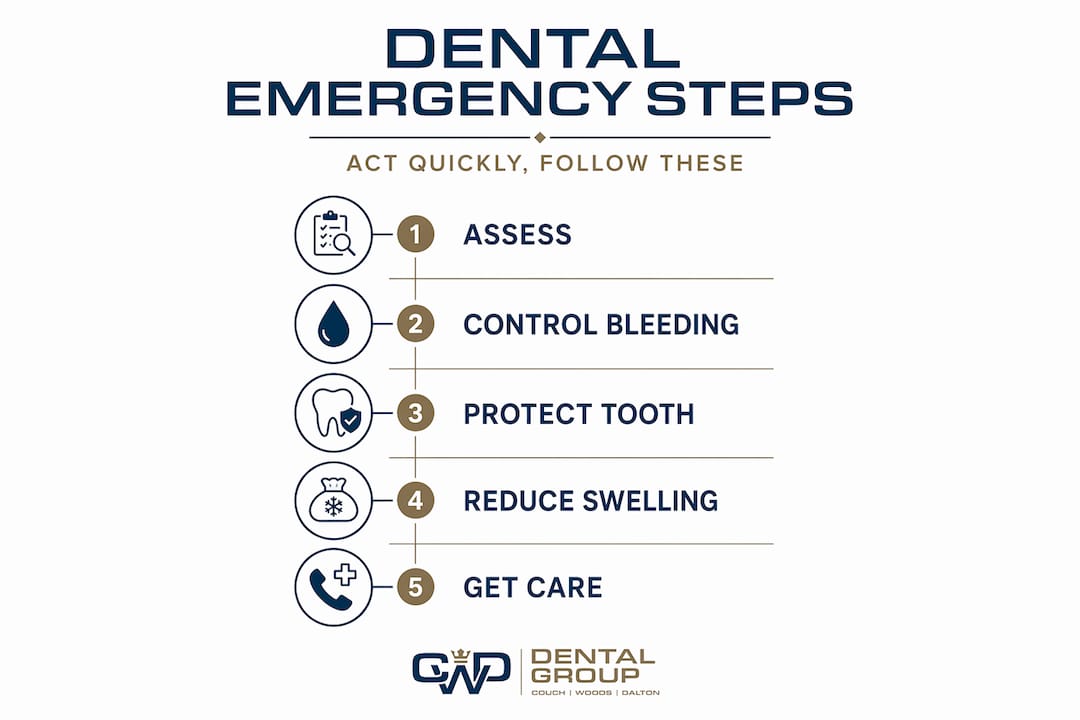
Knocked-out permanent tooth
This is the one situation where seconds genuinely count. Optimal reimplantation happens within 20 to 30 minutes. After two hours, the chances of saving the tooth drop dramatically. Here is exactly what to do:
- Pick up the tooth by the crown, never the root.
- If it's dirty, rinse it briefly under cool water. Do not scrub it.
- Store it in milk or a commercial tooth-preservation solution (HBSS). Never use plain water, which destroys the periodontal ligament cells you need for successful reattachment.
- If you're within minutes of a dentist, try gently placing it back in the socket yourself and biting down gently on a clean cloth to hold it.
- Get to a dentist or ER immediately.
Even with perfect handling, root canal therapy is often needed afterward, so managing expectations matters. But proper first aid still gives you the best possible shot.
Severe bleeding after extraction
Bite firmly on a clean gauze pad for 30 to 45 minutes without peeking. If bleeding continues after an hour of sustained pressure, call your dentist. Do not rinse, spit forcefully, or use a straw, as all three disrupt the clot forming in the socket.
Swelling or suspected abscess
Apply a cold pack to the outside of your cheek in 20-minute intervals to reduce swelling. Do not apply heat. Do not try to drain an abscess at home. Call a dentist immediately and monitor for fever or difficulty breathing, both of which require an emergency room visit.
Pro Tip: Keep a small dental emergency kit at home: gauze pads, a small container with a lid, dental cement (available at most pharmacies), and ibuprofen. That kit costs under $15 and can make a significant difference while you reach professional care.
Where to go when you need urgent dental care
One of the most expensive and frustrating mistakes people make during a dental emergency is choosing the wrong care setting. Emergency rooms lack dental specialists and the equipment needed for procedures like fillings, extractions, or root canals. They can offer pain medication and antibiotics, but that is temporary relief, not treatment. You will still need a dentist.
Here is a clear breakdown of when to go where:
| Situation | Best setting | Why |
|---|---|---|
| Knocked-out permanent tooth | Dentist immediately | Needs reimplantation equipment and expertise |
| Uncontrolled bleeding (post-surgery) | Dentist or ER | Depends on severity and dentist availability |
| Broken facial bones | ER | Requires imaging and surgical evaluation |
| Spreading jaw/neck swelling with fever | ER | Airway compromise risk needs immediate triage |
| Severe pain, no swelling or fever | Dentist same day | Medication and definitive care available |
| Cracked tooth, mild sensitivity | Dentist next day | Urgent but not immediately critical |
| Lost crown or filling | Dentist within 48 hours | Uncomfortable but not dangerous |
TRICARE advises patients to call their dentist first in nearly all situations. The dentist can assess severity over the phone, direct you appropriately, and often get you in faster than an ER wait. For after-hours situations, many dental practices, including walk-in emergency dental offices, maintain after-hours lines for exactly this reason.
For families with children, knowing what constitutes a pediatric dental emergency differs slightly from adult situations. Children's developing teeth require specialized assessment, and a knocked-out baby tooth is actually not reimplanted the same way as a permanent tooth.
Types of dental emergencies at a glance
| Emergency type | Urgency level | Recommended action |
|---|---|---|
| Knocked-out permanent tooth | Critical (minutes) | Store in milk, see dentist immediately |
| Dental abscess with spreading swelling | Critical | Call dentist or go to ER if fever present |
| Uncontrolled bleeding | Critical | Apply pressure, call dentist or 911 |
| Severe toothache, no fever | High (hours) | Call dentist for same-day appointment |
| Broken or chipped tooth | Moderate | Contact dentist within 24 hours |
| Lost crown or filling | Low to moderate | See dentist within 48 hours |
| Loose or broken orthodontic wire | Low | Call orthodontist next business day |
My honest take on dental emergency mistakes
I've watched people make the same two mistakes over and over. The first is waiting too long. Someone gets a toothache on a Friday evening, decides it can wait, and arrives at the dentist Monday morning with an abscess that has moved into their jaw. What started as a manageable dental issue is now a multi-visit, multi-hundred-dollar situation, and in serious cases, a hospitalization.
The second mistake is the opposite: driving straight to the ER for pain that turns out to be a cracked molar or a lost filling. I understand the impulse. Pain is frightening, and the ER feels reassuring. But the reality of ER dental care is that you will wait hours, pay significantly more, and leave with pain medication and a referral to call a dentist in the morning. The ER cannot fix your tooth.
What I've learned is that the single most valuable thing anyone can do before they are in pain is to establish a relationship with a dentist who offers same-day emergency appointments. Knowing exactly who to call at 7 PM on a Friday changes everything about how a dental crisis feels and how fast it gets resolved. The time to find your emergency dentist is not during the emergency.
— Kayle
Get immediate dental care in Tallahassee
When a dental emergency hits, the last thing you want to do is spend 20 minutes searching for a provider who can actually see you today.

Cwddentalgroup offers same-day emergency appointments in Tallahassee for patients dealing with severe tooth pain, infections, broken teeth, trauma, and more. The team is experienced in both traumatic and infectious dental emergencies, which means you are not describing your situation to someone who will just refer you elsewhere. If you are in pain right now or trying to figure out your next step, visit the emergency dentist page to book a same-day appointment or call directly. You can also learn more about how walk-in emergencies are handled at Cwddentalgroup so you know exactly what to expect when you walk through the door.
FAQ
What qualifies as a dental emergency?
A dental emergency is any situation involving uncontrolled bleeding, severe pain unrelieved by medication, spreading infection with fever, broken facial bones, or a knocked-out permanent tooth. These require immediate professional attention.
Should I go to the ER for dental pain?
Go to the ER only if you have broken facial bones, swelling affecting your breathing or swallowing, or uncontrolled bleeding. For most dental pain, your dentist is the faster and more effective choice.
How long do I have to save a knocked-out tooth?
Reimplantation is most successful within 20 to 30 minutes. Store the tooth in milk and get to a dentist immediately. After two hours, the prognosis drops significantly.
Can a dental infection become life-threatening?
Yes. A dental abscess that spreads to the jaw, neck, or airway can become a serious systemic threat. Fever, spreading swelling, and difficulty swallowing are warning signs that require emergency care right away.
What is a pediatric dental emergency?
A pediatric dental emergency involves trauma, severe pain, infection, or significant bleeding in a child's mouth. Unlike adults, a knocked-out baby tooth is generally not reimplanted. Children should see a pediatric dentist or emergency dental provider for proper assessment.