

An after hours emergency dentist is a licensed dental professional who provides urgent dental care services outside standard office hours, including evenings, weekends, and holidays. Knowing how to find after hours emergency dentist options before pain strikes is the difference between saving a tooth and losing it. Delayed treatment by even a few hours can reduce your chances of a successful outcome. This guide walks you through recognizing true emergencies, locating care fast, managing symptoms safely, and knowing exactly what to expect when you arrive.
How to find an after hours emergency dentist quickly
The first step is calling your regular dentist's office, even after hours. Most practices that advertise 24/7 or after-hours service use on-call answering services rather than a dentist physically on site. That means calling ahead is not optional. It is the only way to trigger triage, confirm availability, and get instructions before you drive anywhere.
If your regular dentist has no after-hours coverage, search for "urgent dental care near me" or "emergency dentist open late" and filter results by verified hours for the current day. Google Maps shows live business hours and often lists whether a practice accepts walk-ins. Call before you go. Confirm the clinic is staffed, not just listed as open.

Emergency patients are typically seen within 30 minutes to 2 hours of the initial call when standard triage protocol is followed. That window gives you time to prepare. Gather your insurance card, a list of current medications, and a brief description of your symptoms before you leave home. Preparation speeds up your intake and gets you into the chair faster.
Pro Tip: Save your dentist's after-hours number in your phone now, before you need it. Most practices record a voicemail message with triage instructions and an emergency callback number. That recording can guide you through the first critical minutes.
How to recognize a true dental emergency
Not every toothache requires a midnight drive to a clinic. Dental pain is not always a true emergency, but all toothaches need dental attention to prevent worsening conditions. The key is knowing which symptoms demand action tonight and which can wait until morning.
These situations require immediate contact with an after hours dental clinic or emergency room:
- Knocked-out permanent tooth. You have a 60-minute window to save it. Every minute past that mark reduces the chance of successful replantation.
- Severe, unrelenting pain that does not respond to over-the-counter medication and is spreading to your jaw, ear, or neck.
- Uncontrolled bleeding that continues beyond 30 minutes of steady pressure.
- Swelling affecting your ability to breathe or swallow. This is a life-threatening sign.
- Abscess or facial swelling that is spreading toward your eye or neck.
These situations require a hospital emergency room, not a dental office. True dental emergencies requiring ER care include difficulty breathing or swallowing, swelling spreading toward the eye or neck, fever over 101°F, suspected jaw fracture, or uncontrolled bleeding past 30 minutes. A dental office cannot manage an obstructed airway. Go directly to the ER.
Pro Tip: A dental abscess that causes facial swelling is not just a tooth problem. It is a spreading infection that can become life-threatening within hours. Do not wait for a morning appointment if swelling is growing.
Mild sensitivity to hot or cold, a lost filling with no pain, or a small chip with no sharp edges can all wait until the next business day. Recognizing this distinction helps you avoid unnecessary ER visits and get the right level of care.
Step-by-step approach to locating available after-hours care
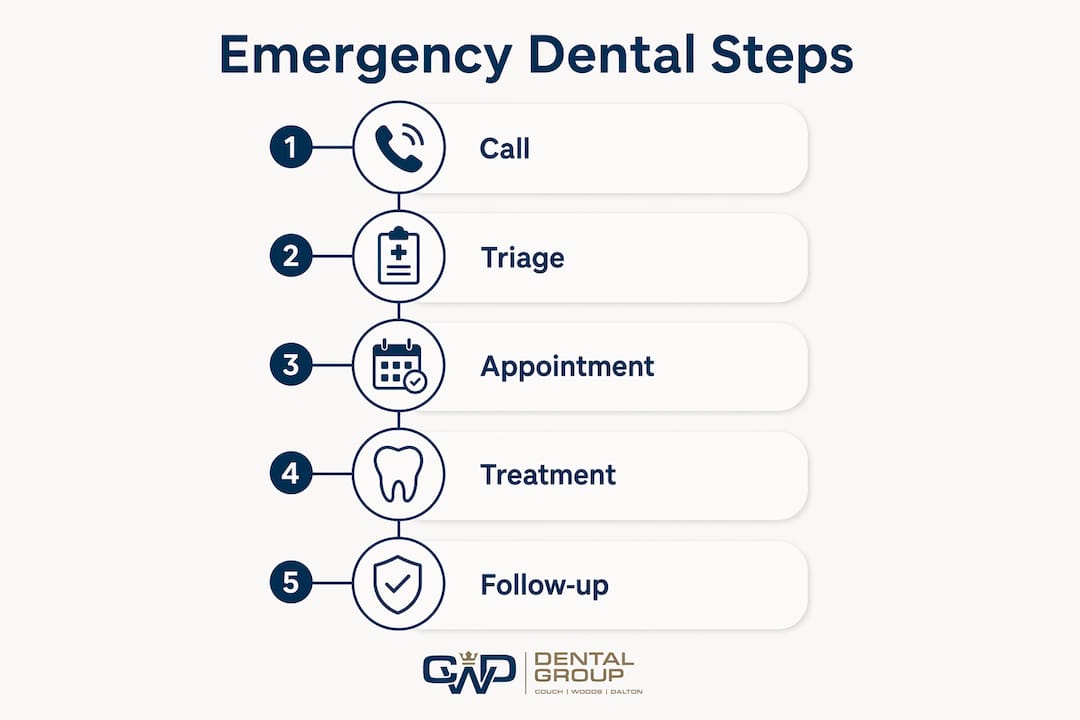
Follow these steps in order when a dental emergency strikes outside regular hours.
- Call your regular dentist first. Listen to the voicemail. Most practices leave an emergency callback number or triage instructions. Follow them exactly.
- Search for a 24 hour emergency dentist in your area. Use Google Maps or your dental insurance's provider directory. Filter by "open now" and verify the hours directly on the practice's website.
- Call the clinic before leaving. Confirm a dentist is physically present, not just an answering service. Ask whether your specific issue (knocked-out tooth, abscess, broken crown) can be treated tonight.
- Describe your symptoms clearly. Tell the triage staff your pain level on a scale of 1–10, how long symptoms have been present, and any relevant medical history such as blood thinners or allergies.
- Assess whether the ER is the right destination. If you have any of the red-flag symptoms listed above, skip the dental office and go directly to the nearest hospital emergency room.
- Prepare before you leave. Bring your insurance card, a photo ID, your medication list, and any broken tooth fragments stored in cold milk or a sealed container.
After-hours dental care often involves phone triage with no immediate walk-in availability. Preparation before arrival ensures faster intervention once you get there.
How to manage pain and symptoms safely while you wait
Safe home care buys you time without making the problem worse. The wrong move, like placing aspirin directly on your gum, can cause a chemical burn and complicate treatment.
For severe toothache pain, combining 400–600mg of ibuprofen with 500–1000mg of acetaminophen every 6 hours is the recommended approach when an immediate appointment is unavailable. Take both together only if you have no contraindications such as kidney disease, liver conditions, or stomach ulcers. This combination works better than either drug alone for dental pain.
For a knocked-out tooth, do not scrub the root. Store the tooth in cold milk or hold it under your tongue. The 60-minute replantation window is firm. Get to a dentist immediately.
Avoid placing aspirin directly on your gum or tooth. Aspirin is an acid. Direct contact causes tissue burns that your dentist will need to treat separately. Swallow it with water instead, or skip it entirely in favor of ibuprofen and acetaminophen.
For bleeding after an extraction, bite on moistened gauze or a used tea bag for 20–30 minutes continuously while sitting upright. The tannic acid in tea helps constrict blood vessels. Do not rinse, spit, or use a straw during this period. If bleeding continues past 30 minutes, call the ER.
For swelling, apply a cold compress to the outside of your face in 10-minute intervals. Keep your head elevated above your heart, especially when lying down. Elevation reduces blood pressure in the area and slows swelling. For additional guidance on managing urgent dental pain before your appointment, endodontic pain relief techniques can help you understand what works and what to avoid.
What to expect during your emergency dental visit
Arriving prepared reduces stress and speeds up your care. Here is what typically happens during an emergency dental visit.
| Stage | What happens | Typical duration |
|---|---|---|
| Intake and triage | Staff collect your symptoms, medical history, and insurance | 5–10 minutes |
| Clinical assessment | Dentist examines the area, takes X-rays if needed | 10–20 minutes |
| Pain stabilization | Local anesthetic administered to control pain | 5–10 minutes |
| Emergency treatment | Extraction, temporary filling, drainage, or splinting | 20–60 minutes |
| Discharge and follow-up | Instructions given, follow-up appointment scheduled | 5–10 minutes |
Emergency dental care aims to stabilize symptoms rapidly to reduce the need for more invasive procedures later. The goal of an emergency visit is not always a permanent fix. It is pain relief, infection control, and preservation of the tooth or surrounding tissue until a full treatment can be completed.
Expect the dentist to prioritize cases by severity. A patient with a spreading infection or uncontrolled bleeding is seen before someone with a lost crown. If you arrive at a busy after hours dental clinic, a mild case may wait longer. Communicate any worsening symptoms to the front desk while you wait.
Understanding how dentists handle walk-in emergencies helps you set realistic expectations and communicate more clearly with the care team.
Key Takeaways
Acting within the first hour of a dental emergency, calling ahead for triage, and managing symptoms correctly are the three factors that most determine whether a tooth can be saved and whether complications are avoided.
| Point | Details |
|---|---|
| Call before you go | Most after-hours services use on-call triage, not walk-in access. Always call first. |
| Know your ER red flags | Spreading swelling, fever over 101°F, or breathing difficulty require a hospital, not a dental office. |
| Act within 60 minutes for avulsed teeth | A knocked-out tooth stored in cold milk has the best chance of replantation within one hour. |
| Use the right pain relief | Ibuprofen 400–600mg combined with acetaminophen 500–1000mg every 6 hours is the recommended approach for severe dental pain. |
| Prepare before you arrive | Bring insurance, medications list, and tooth fragments to speed up intake and treatment. |
Why I think most people wait too long
People delay calling an after hours emergency dentist for two reasons: they assume the pain will pass, and they do not want to bother anyone late at night. Both instincts work against them.
Dental infections do not resolve on their own. An abscess that feels manageable at 10 p.m. can spread to the jaw, neck, or airway by morning. I have seen patients arrive at emergency appointments describing pain that started "a few days ago" and was now affecting their ability to swallow. That is not a dental problem anymore. That is a medical emergency that could have been stopped earlier with a single phone call.
The other mistake I see regularly is people going straight to the hospital ER for dental pain that a dentist could handle in 30 minutes. ERs can prescribe antibiotics and pain medication, but they cannot perform dental procedures. You leave with temporary relief and still need a dentist the next day. Knowing what qualifies as a dental emergency before you are in pain means you make better decisions when you are.
My honest advice: treat dental pain after hours the same way you would treat chest pain. Do not wait to see if it gets better. Call, describe your symptoms, and let a professional tell you whether it can wait. That call takes two minutes. The consequences of skipping it can last years.
— Kayle
Cwddentalgroup is ready when dental emergencies happen
Dental emergencies do not follow a schedule, and neither does Cwddentalgroup. Patients in Tallahassee count on Cwddentalgroup for same-day emergency appointments backed by a team that takes urgent dental issues seriously from the first call.
Cwddentalgroup offers a full range of emergency dental services designed to address pain fast, stabilize your oral health, and prevent small problems from becoming major ones. Whether you are dealing with a knocked-out tooth, a severe abscess, or a broken crown, the team at Cwddentalgroup is equipped to treat it. Call the office directly to confirm same-day availability and get the care you need without the wait.
FAQ
What counts as a dental emergency after hours?
A dental emergency after hours includes severe unrelenting pain, a knocked-out tooth, uncontrolled bleeding, facial swelling, or a dental abscess. Symptoms like difficulty breathing or swallowing require an ER visit, not a dental office.
How fast can I be seen by an emergency dentist?
Emergency patients are typically seen within 30 minutes to 2 hours of the initial call when triage protocol is followed. Calling ahead and describing your symptoms clearly speeds up that process.
Can I go to the ER for a toothache?
You can, but a hospital ER cannot perform dental procedures. ERs treat life-threatening symptoms like spreading infection or airway obstruction. For isolated tooth pain, an after hours dental clinic is the faster and more effective option.
How do I preserve a knocked-out tooth until I reach a dentist?
Store the tooth in cold milk or hold it under your tongue without scrubbing the root. The 60-minute window for successful replantation is firm, so contact a dentist immediately.
Is it safe to take ibuprofen and acetaminophen together for dental pain?
Yes, for most adults without contraindications. Combining 400–600mg of ibuprofen with 500–1000mg of acetaminophen every 6 hours is the recommended approach for managing severe dental pain before an appointment. Check with a pharmacist if you take other medications.