

If your tooth mainly hurts after you lie down, the most likely culprits are nerve inflammation (pulpitis), a dental abscess, a cracked tooth, or nighttime teeth grinding, and sinus pressure can mimic the same ache in your upper teeth. Swelling, fever, or trouble breathing or swallowing means you need emergency care now, not a home remedy. For everything short of that, cold compresses, OTC pain relievers, and head elevation can get you through the night until a dentist can see you.
TL;DR:
- Nighttime tooth pain often worsens due to increased blood flow, reduced cortisol, and teeth grinding during sleep, amplifying nerve pressure.
- Tooth decay, pulpitis, abscesses, and cracked teeth each show specific symptoms like persistent throbbing, swelling, or pain on pressure, guiding urgency.
- OTC NSAIDs, cold compresses, and head elevation are effective short-term remedies, but avoid direct aspirin contact and remember to time medication doses strategically.
- Signs requiring immediate emergency care include facial swelling, difficulty breathing or swallowing, fever, or pain lasting over 48 hours despite medication.
- Visiting the dentist for diagnosis and timely treatment prevents infections from spreading and minimizes future flare-ups caused by untreated underlying issues.
Table of Contents
- Why Does Tooth Pain Get Worse at Night?
- What's Actually Causing Your Nighttime Toothache?
- How Do You Relieve Tooth Pain at Night Safely?
- When Is Tooth Pain a Dental Emergency?
- What Happens at the Dentist's Office?
- Finding Care Fast and Preventing the Next Flare
- Could This Be a TMJ or Jaw Disorder Instead?
- Does Your Sleep Position Make Tooth Pain Worse?
- What Stops Nighttime Toothaches From Coming Back?
- A Clinic's View on Emergency Nighttime Tooth Pain
- Same-Day Relief When a Toothache Won't Let You Sleep
- Sources
Why Does Tooth Pain Get Worse at Night?
Lying flat sends more blood to your head, and that extra volume presses against an already inflamed or infected nerve inside the tooth. Add the fact that daytime noise, conversation, and tasks usually mask minor discomfort, and once you're in a quiet, dark bedroom, that same pain signal has nowhere to hide. Cortisol, the hormone your body uses partly to dampen inflammation and pain sensitivity, drops in the evening hours, which can make nerve pain feel sharper right when you're trying to sleep.
Timing matters too. If your last dose of ibuprofen or acetaminophen wore off hours ago and you're not due for another until morning, you're riding out the worst of it unmedicated. On top of that, plenty of people clench or grind their teeth once they fall asleep, adding mechanical pressure to a tooth that's already inflamed. A clinical review of dental pain and infection notes that pulpitis and periapical abscesses commonly intensify at night for exactly this combination of reasons.
- Blood pooling in the head increases pressure inside an inflamed tooth
- Fewer daytime distractions let your brain focus fully on the pain signal
- Falling evening cortisol may lower your pain threshold
- Grinding or clenching during sleep adds mechanical stress to the sore tooth
What's Actually Causing Your Nighttime Toothache?
Matching your symptom pattern to a likely cause helps you judge urgency and gives your dentist a head start before you even sit in the chair. The Cleveland Clinic lists tooth decay, pulpitis, abscesses, cracked teeth, loose fillings, and gum disease as the standard suspects behind a toothache, and each tends to show up a little differently.
Irreversible pulpitis feels like a constant, deep throb that gets noticeably worse when you lie down. Hot or cold food might trigger a lingering ache that sticks around for a minute or more after the trigger is gone, which is a telltale sign the nerve itself is inflamed beyond repair.
A dental abscess brings sharper, more relentless throbbing, often with visible swelling in the gum or cheek, a bad taste or drainage in your mouth, and sometimes a low fever. One quirk worth knowing: pain from a dying nerve can briefly fade before returning worse once the infection builds pressure around the root tip, a pattern the Merck Manual describes as the nerve dying followed by periapical inflammation.
A cracked or fractured tooth usually causes sharp, jabbing pain specifically when you bite down, and it can come and go rather than staying constant, worsening whenever pressure or lying flat stresses the fracture line.
Other patterns to know:
- Periodontal (gum) abscess: localized gum swelling, visible pus, and tenderness right at the gumline rather than deep in the tooth
- Bruxism or TMJ disorder: diffuse jaw and temple soreness, morning stiffness, and tooth sensitivity with no visible decay
- Sinus-related pain: aching across the upper back teeth that tracks with congestion or sinus pressure rather than one specific tooth
How Do You Relieve Tooth Pain at Night Safely?
Getting through the night without making things worse comes down to a short list of measures that actually have backing, plus a few things to avoid entirely.
- Take an OTC NSAID like ibuprofen or naproxen at the labeled dose, or acetaminophen if NSAIDs aren't an option for you. The ADA's living guideline on acute dental pain supports NSAIDs, alone or combined appropriately with acetaminophen, as an effective first-line option when you can't get to a dentist right away.
- Apply a cold compress to the outside of your cheek for 20 minutes on, 20 minutes off, to blunt swelling and throbbing.
- Prop your head up with an extra pillow. Reducing the blood pooling that comes with lying flat takes real pressure off the nerve.
- Rinse with warm salt water to calm inflammation and clear out any trapped food debris; gentle flossing can dislodge anything wedged between teeth that's aggravating the area.
- Skip the hot, acidic, or hard foods before bed, and avoid alcohol or driving if you've taken a higher-dose pain reliever.
A few cautions matter as much as the relief steps themselves. Topical numbing gels offer limited, short-lived benefit, and benzocaine products carry specific warnings against use in children under two. Clove oil (eugenol) has documented analgesic properties for pulpitis-related pain, but it needs cautious, limited application since misuse can irritate soft tissue. Never place aspirin directly against your gum. It doesn't numb anything locally and can cause a chemical burn, according to Mayo Clinic's first-aid guidance.
Pro Tip: Take your NSAID or acetaminophen dose roughly 30 to 45 minutes before you plan to lie down, so peak effect lines up with the time your pain typically spikes. Never exceed the labeled dose or mix medications that carry overlap warnings.
For a longer walkthrough of these steps, Cwddentalgroup's guide to controlling severe toothache at home covers safe dosing and food choices in more detail.
When Is Tooth Pain a Dental Emergency?
Some symptoms mean you stop trying home remedies and get seen immediately. Mayo Clinic's first-aid guidance is direct on this point: pain lasting more than a couple of days, or pain paired with facial or neck swelling that affects breathing, swallowing, or speaking, calls for emergency care right away.
Watch for these signs specifically:
- Facial or neck swelling that's visibly spreading
- Any difficulty breathing or swallowing
- Fever accompanying facial swelling
- Severe pain that OTC medication doesn't touch
- Swelling below the eye or any change in vision
- Pain that has lasted more than 48 hours despite medication
If you have any of the true emergency signs (breathing, swallowing, or spreading swelling), go to the nearest emergency department, not a dentist's answering machine. For the second tier, pain past 48 hours, worsening despite medication, a bad taste with drainage, call your dentist and describe exactly what's happening. Have this ready when you call: your symptom list, when it started, what medication you've taken and when, and any allergies. Cwddentalgroup's guide on why tooth pain needs urgent care breaks down this triage line in more detail.
What Happens at the Dentist's Office?
A dentist works through a fairly standard sequence to pin down the source: a focused history of your symptoms, a visual exam, percussion and bite testing to find the exact tooth, cold or electric pulp testing to check nerve status, and a periapical X-ray, with a CBCT scan reserved for more complicated cases.
Treatment depends entirely on what they find. A cavity gets a filling. An inflamed or infected nerve typically needs root canal therapy, which you can read more about here. A tooth too damaged to save gets extracted. An abscess usually needs incision and drainage, and antibiotics come into play only when there's a systemic infection, not as a routine add-on, according to the Merck Manual.
- Diagnostic exam, percussion testing, and X-rays pinpoint the source
- Fillings, root canals, extractions, or drainage address the underlying problem
- Antibiotics are reserved for confirmed spreading infection
- Same-visit temporary fillings or analgesic injections can control pain immediately
Treating the cause earlier matters beyond comfort. Untreated infection can spread into surrounding bone and soft tissue, and delay tends to mean more extensive (and expensive) treatment later.
Finding Care Fast and Preventing the Next Flare
Start with your regular dentist's office, even after hours, since most practices have an emergency line or answering service that routes urgent calls. If that's not an option and your symptoms include breathing or swallowing trouble, go straight to the ER; that's not a dental office's job to handle.
- Call and describe duration, severity, swelling, fever, and any breathing or swallowing difficulty.
- List every medication you've taken, when, and any known allergies.
- Bring ID, insurance information, a written medication list, and photos of visible swelling if you have any.
- Once treated, prevent a repeat: get restorative work done promptly, ask about a nightguard if grinding is a factor, keep up routine checkups, and avoid chewing ice or hard candy.
Cwddentalgroup's guide to finding after-hours emergency care walks through exactly how to locate same-day help wherever you are.
Could This Be a TMJ or Jaw Disorder Instead?
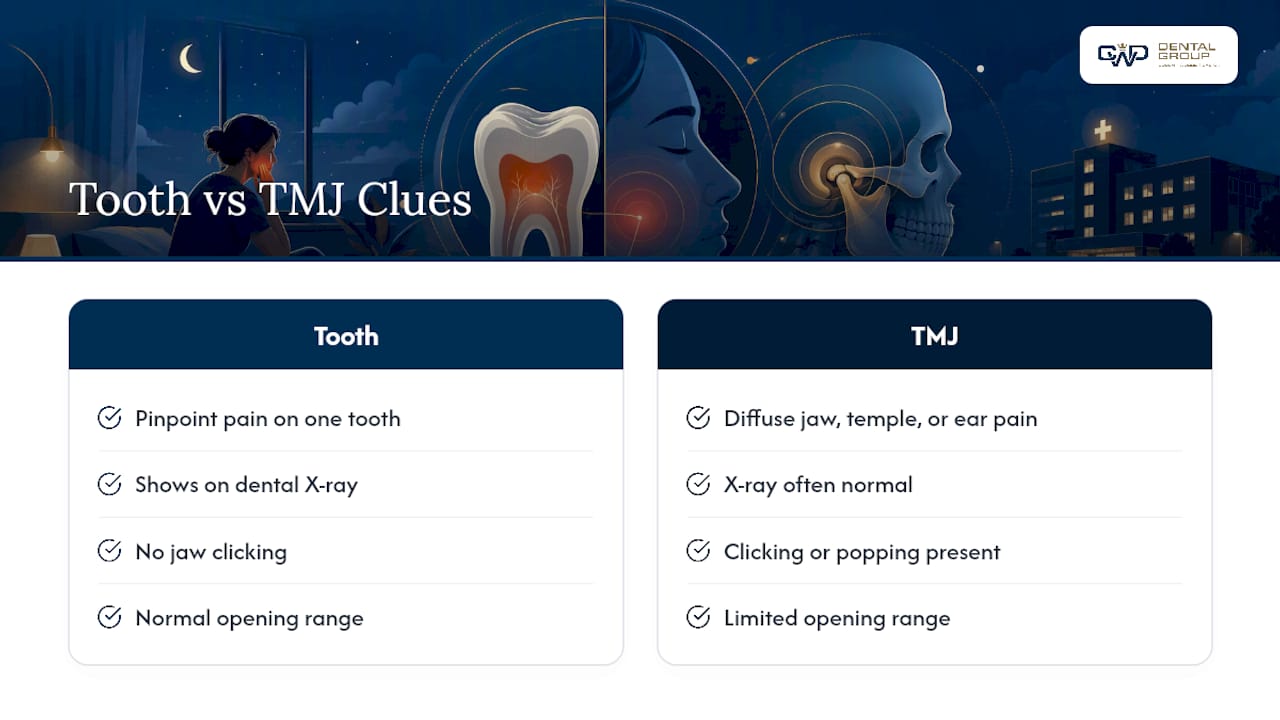
Not every nighttime ache traces back to a single tooth. Temporomandibular joint disorders, problems with the hinge joint connecting your jaw to your skull, produce pain that mimics a toothache closely enough to fool people for months. The pain tends to sit diffusely across the jaw, temple, or ear rather than pinpointing one tooth, and it's often worse in the morning after a night of clenching.
TMJ pain gets misdiagnosed as a dental problem fairly often because the referred pain genuinely radiates into the teeth themselves. If you've had multiple teeth checked and nothing shows up on an X-ray, but you also notice jaw clicking, popping, or a limited range of motion when you open wide, that's a strong signal the joint, not the tooth, is the actual source.
Chronic bruxism and TMJ disorders feed each other. Grinding strains the joint, and joint dysfunction can trigger more clenching as your jaw tries to find a comfortable resting position, especially overnight when you have no conscious control over it. Left unaddressed, this cycle produces the exact nighttime pattern people mistake for tooth decay: pain that's mild or absent during the day and sharp by the time you're trying to sleep.
A dentist evaluating unexplained nighttime jaw or tooth pain should check joint function alongside the teeth themselves. TMJ therapy, ranging from a custom nightguard to more involved joint treatment, addresses the mechanical source rather than just numbing the symptom, which matters because painkillers alone won't stop the clenching that's driving the damage.
Does Your Sleep Position Make Tooth Pain Worse?
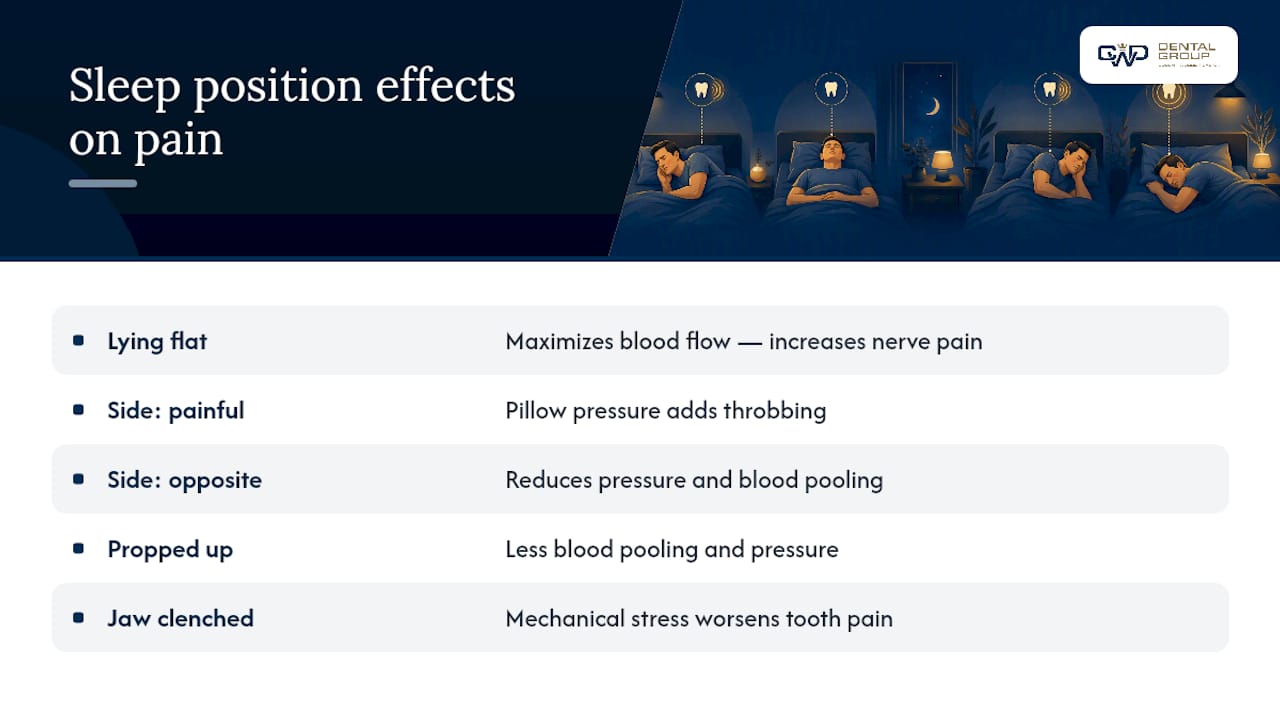
Your sleep position changes how much pressure and blood volume sits around an already inflamed tooth, and that difference is often the reason pain that felt manageable at 6 p.m. feels unbearable at midnight.
Sleeping fully flat maximizes blood flow to the head, which is exactly the mechanism behind why lying down amplifies nerve pain in the first place. Side sleeping adds a second variable: if you're resting on the same side as the painful tooth, direct pressure from the pillow against your jaw can intensify a throb that would otherwise be tolerable. Switching to the opposite side, or sleeping propped up at an angle rather than flat, reduces both the pressure and the blood pooling at once.
Mouth position matters too. People who sleep with their jaw clenched, common among habitual grinders, place ongoing mechanical stress on a tooth that may already have a crack or an inflamed nerve. Even without a diagnosed grinding habit, an unconsciously tense jaw overnight can turn a mild ache into a wake-up-at-3 a.m. problem.
Elevating your head with an extra pillow or two remains one of the simplest position changes with a real mechanical basis: less blood pooling, less pressure, less throb. It won't fix a cracked tooth or a spreading abscess, but on a night when you're waiting for a morning dental appointment, it's a genuinely useful lever that costs nothing and takes ten seconds to set up.
What Stops Nighttime Toothaches From Coming Back?
Preventing the next 2 a.m. wake-up call starts with treating whatever caused this one. A filled cavity, a completed root canal, or a nightguard for grinding removes the mechanism that was producing pain in the first place, rather than just managing the symptom.
Routine dental checkups catch decay and cracks while they're small and painless, long before they progress to the kind of nerve involvement that wakes you up at night. Fluoride treatments and consistent brushing and flossing reduce decay risk directly, and they're cheap compared to the cost of a root canal or extraction down the line.
If grinding is part of your pattern, a custom nightguard is one of the more effective long-term fixes available, since it removes the mechanical stress on your teeth even if the underlying clenching habit doesn't fully go away. Avoiding hard foods like ice, unpopped popcorn kernels, and hard candy protects against the cracked-tooth scenario that so often shows up as sharp, biting-triggered nighttime pain.
Finally, don't let mild, intermittent tooth pain go unaddressed just because it's tolerable during the day. That's frequently the early stage of pulpitis, and catching it before the nerve is unsalvageable is the difference between a simple filling and a root canal.
A Clinic's View on Emergency Nighttime Tooth Pain
Nighttime tooth pain is one of the most common reasons people delay care, mostly because it hits when offices are closed and options feel limited. Same-day emergency appointments for dental situations like this, including emergency exams, root canal therapy, extractions, and pain control, can help patients avoid waiting through a weekend on OTC medication alone.
If you're trying to figure out whether tonight's pain warrants a call now or can wait until morning, the practice's blog resources on safe short-term pain control and finding after-hours care walk through the same triage logic covered above. If you're local and symptoms are escalating, calling ahead for guidance beats guessing.
— Kayle
Same-Day Relief When a Toothache Won't Let You Sleep
Dental practices exist to help with situations like a tooth throbbing late at night without a clear plan for morning. Instead of sitting on hold with a general office or driving to an ER for something that isn't airway-threatening, patients can call and potentially get seen the same day for an emergency exam, pain control, and whatever definitive treatment the tooth needs, whether that's a root canal, an extraction, or drainage of an abscess.
Dental practices may offer a full range of services that a nighttime dental crisis might require, from diagnostic imaging to endodontic therapy to surgical extraction, so patients can avoid being bounced between specialists while still in pain. If your tooth has been keeping you up and OTC medication is barely holding it back, book a same-day emergency appointment and get an actual diagnosis instead of another sleepless night guessing.
This article is general information, not a substitute for advice from a qualified doctor. Consult a qualified healthcare professional about your own circumstances before acting on anything here.
Sources
- Toothache: First aid - Mayo Clinic
- Adult/Adolescent acute dental pain management for toothaches | ADA
- Toothache — Cleveland Clinic
- How to get rid of toothache at night, causes, and FAQ — Medical News Today