
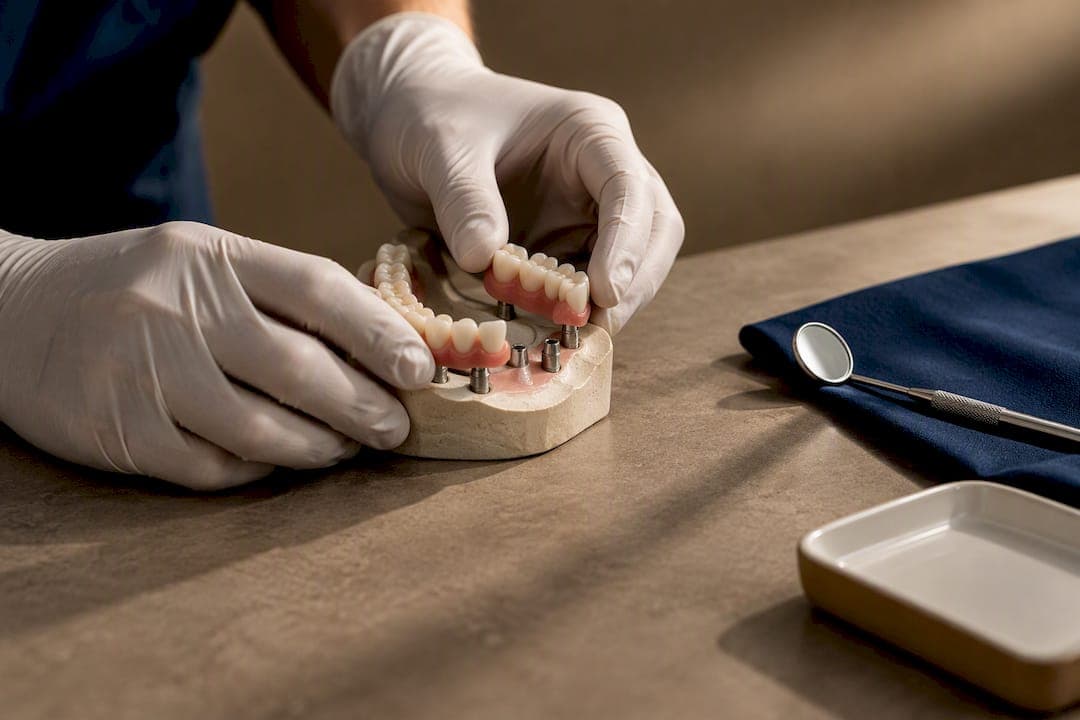
Implant supported dentures are prostheses anchored to dental implants that provide far greater stability and chewing function than conventional dentures resting on gum tissue alone. They come in fixed and removable forms, and providers typically recommend them for patients who have lost most or all of their teeth and want a secure, long-term alternative to plates that slip or need adhesive.
TL;DR:
- Fixed hybrid dentures usually cost more due to higher implant numbers and material quality, while removable overdentures are generally less expensive and easier to clean.
- The success of implant therapy depends on adequate bone volume, good systemic health, and daily maintenance, with grafting required if bone has resorbed.
- Implants typically last for decades when properly cared for, but prosthesis wear, hygiene habits, and attachment component replacements affect longevity.
- Immediate loading options like All-on-4 can shorten treatment time but require careful case selection based on bone quality and implant stability.
- Regular professional maintenance, including biannual cleanings and replacing wear parts, is essential to prevent peri-implant disease and prolong implant lifespan.
Table of Contents
- Types of implant-supported dentures and attachment systems
- How implant support improves function and quality of life
- Are you a good candidate for implant dentures?
- What happens during treatment and how long it takes
- Risks and complications to watch for
- What to expect in the days and weeks after surgery
- Keeping implants and dentures healthy for the long term
- What implant dentures cost and how to budget for them
- What the research and clinical guidance show
- How implant dentures affect speech and everyday comfort
- How long implant dentures last and what affects durability
- What patients say about switching to implant support
- Getting ready for implant surgery
- Choosing between fixed and removable: a quick framework
- Getting evaluated for implant dentures at CWD Dental Group
- Sources
- FAQ
Types of implant-supported dentures and attachment systems
Two main categories exist. A fixed (hybrid or screw-retained) denture is bolted onto implants and stays in place permanently, removable only by a dentist. A removable overdenture snaps onto implants using attachments and comes out for cleaning each night. Fixed options generally use four to six implants per arch, while overdentures can function with as few as two.
Attachment choice shapes the daily experience. Bar attachments give the strongest retention but need more hygiene effort around the bar. Locator and ball attachments are easier to clean and adjust. Telescopic systems, when well-made, tend to score high on patient satisfaction. According to a systematic review of attachment systems, attachment selection should match the patient's priorities rather than a single default choice.
- Fixed hybrid dentures stay in the mouth permanently and mimic natural teeth most closely.
- Removable overdentures snap onto implants and come out nightly for cleaning.
- Bar, locator, ball, and telescopic attachments each trade off retention strength against ease of maintenance.
How implant support improves function and quality of life
Chewing efficiency and confidence improve noticeably once dentures are anchored to implants instead of floating on gum tissue. Because the jawbone stays stimulated by the implants, it resists the shrinkage that gradually changes facial shape in patients wearing conventional dentures. That preserved bone also keeps the prosthesis fitting well for longer.
Implant-supported prostheses, fixed and removable alike, produce statistically higher patient satisfaction and functional stability than conventional complete dentures, according to a systematic review of prosthetic modalities for edentulous patients. Patients who switch from conventional to implant-supported options often describe eating and speaking with far less hesitation, a shift documented in the same review's quality-of-life comparisons. Many also report a boost in confidence tied to a more natural appearance once the prosthesis stops shifting during conversation or meals.
Are you a good candidate for implant dentures?
Candidacy hinges on bone volume, systemic health, and a willingness to keep up with maintenance. Smoking and uncontrolled diabetes slow healing and raise implant failure risk, so providers usually address these factors before scheduling surgery. Patients need enough jawbone to anchor implants securely, and when bone has resorbed, a graft or sinus lift can rebuild the site before placement.
- Adequate bone density and volume in the implant site, confirmed by imaging.
- Manageable systemic health factors, including blood sugar control and smoking status.
- Ability to maintain daily hygiene and attend recall visits.
- Realistic expectations about timeline, cost, and the difference between fixed and removable options.
Pro Tip: Ask your provider to show you your CBCT scan and explain, in plain terms, whether you'll need a bone graft before implants can be placed.
What happens during treatment and how long it takes
Treatment starts with a full evaluation, including a CBCT scan that maps bone density and nerve position. From there, the process generally follows a predictable sequence, though timing varies by case.
- Planning and imaging. Your provider reviews the CBCT scan, plans implant positions, and decides whether extractions or grafting come first.
- Extraction and grafting, if needed. Failing teeth are removed and bone graft material is placed to rebuild volume where the jaw has thinned.
- Implant placement. Implants are surgically positioned into the jawbone, sometimes at the same visit as extraction.
- Healing and osseointegration. The bone fuses to the implant surface, a process that commonly takes three to six months depending on bone quality and implant stability.
- Temporary denture phase. A provisional denture protects the surgical site and keeps you functional while healing finishes.
- Final prosthesis delivery. The permanent fixed or removable denture is fitted, adjusted, and delivered once healing is confirmed.
Some cases qualify for immediate loading, including All-on-4 style protocols that attach a temporary prosthesis the same day implants are placed. A systematic review of fixed and removable implant prostheses notes that immediate loading can shorten time-to-function, but it depends on specific bone quality and implant stability, and outcomes stay favorable mainly when cases are selected carefully.
Risks and complications to watch for
Surgical risks include infection, delayed healing, and, less commonly, nerve or sinus involvement depending on implant location. Prosthetic complications tend to show up later: loose retaining screws, worn attachment components, or a denture that no longer snaps in securely.
- Persistent swelling, pain, or discharge around an implant site after the first week warrants a call to your provider.
- A denture that feels loose, clicks, or rocks signals worn attachments or a fit problem needing adjustment.
- Red, bleeding, or puffy gum tissue around implants can indicate early peri-implant disease and needs prompt attention.
- Daily brushing and interdental cleaning around implant abutments help prevent the bacterial buildup that drives peri-implant disease.
What to expect in the days and weeks after surgery
The first 48 to 72 hours bring the most swelling and tenderness, managed with prescribed medication, ice, and a soft diet. Most patients return to work within a few days, though strenuous activity is usually paused for about a week.
Chewing ability improves in stages. Soft foods dominate the first few weeks, with a gradual return to a normal diet as the temporary or final prosthesis stabilizes. Follow-up visits check healing progress, and once the final prosthesis is delivered, recall exams and radiographs continue on a schedule your provider sets based on your individual risk.
Keeping implants and dentures healthy for the long term
Hygiene routines differ by prosthesis type. Removable overdentures come out nightly for brushing and soaking, while fixed dentures require threading floss or using a water flosser under the bridge to clear food and plaque around abutments.
Professional maintenance follows a risk-based schedule. The ACP's clinical practice guidelines recommend recall visits commonly every two to six months for implant-borne restorations, and the guidance discourages routinely removing fixed full-arch prostheses for maintenance unless hygiene or mechanical problems make it necessary.
- Nylon inserts and locator housings wear out over time and typically need replacement every few years as routine maintenance.
- Bar-retained and telescopic attachments should be checked at each recall visit for looseness or wear.
- Biannual professional cleanings help catch early gum and implant issues before they progress.
Pro Tip: Keep a copy of your prosthesis's component list (attachment type, insert size) so replacement parts can be ordered quickly if one wears out.
What implant dentures cost and how to budget for them
Prices vary widely by case complexity, implant count, and materials. Patient education content online cites U.S. snap-in denture costs at $5,000 to $16,000 per arch, a range that reflects differences in implant number, grafting needs, and lab work.
Fixed full-arch restorations typically cost more than removable overdentures because they use more implants and higher-grade materials. Dental insurance rarely covers the full cost of implant surgery, though it may help with the crown or denture portion, so ask for an itemized quote before committing.
- Implant count and whether grafting or a sinus lift is needed drive much of the cost difference.
- Fixed hybrid dentures generally cost more than removable overdentures due to material and lab complexity.
- Financing plans and phased treatment (implants now, final prosthesis later) can spread out the expense.
What the research and clinical guidance show
The evidence base is consistent: implant-supported prostheses outperform conventional dentures on satisfaction and function, and fixed full-arch restorations show implant survival rates reported between 96.2% and 100% across multi-year follow-up in the studies included in a recent systematic review. The ADA's guidance on prosthetic joint patients notes that routine antibiotic prophylaxis before dental procedures is generally not indicated for these patients, though care should be individualized.
Fixed full-arch implant-supported restorations show consistently high implant survival across multi-year follow-up, while long-term quality of life gains favor implant support over conventional dentures.
CWD Dental Group's own immediate implant survival data reports rates in a similar range, alongside a comprehensive slate of surgical, restorative, and same-day emergency services.
How implant dentures affect speech and everyday comfort
A well-fitted implant denture affects speech far less than a traditional plate. Loose conventional dentures shift during talking, which can cause clicking sounds or a lisp as the tongue compensates for movement. Because implant-supported dentures stay anchored, that movement disappears, and speech typically normalizes within a few weeks as the tongue and lips adjust to the new prosthesis shape.
Comfort improves for a related reason: pressure points. Conventional dentures rely on suction and gum contact, which can create sore spots, especially on the lower jaw where suction is weaker. Implant support removes most of that pressure, since chewing forces transfer through the implants into the bone rather than compressing soft tissue.
Fixed dentures feel closest to natural teeth, since there is no movable base plate covering the palate. Some patients notice a brief adjustment period with fixed prostheses as the tongue learns the new contours, but most describe it as far less disruptive than adapting to a conventional denture. Removable overdentures still cover some palate or ridge tissue, so speech adjustment can take slightly longer than with a fixed hybrid design, though both options outperform conventional dentures on this measure.

Patients switching from years of loose dentures often report the biggest comfort gains simply from not needing adhesive paste and not worrying about a denture slipping during a meal or conversation.
How long implant dentures last and what affects durability
The implants themselves, when they integrate successfully, often function for decades. The prosthesis attached to them, whether fixed or removable, has a shorter practical lifespan because the denture material wears with chewing forces and repeated cleaning cycles.
Several factors determine how long a given restoration lasts. Bone quality and volume at placement affect how well the implant integrates initially. Daily hygiene habits and attendance at recall visits catch small problems, like a loosening screw or early gum inflammation, before they become implant-threatening. Attachment components such as locator inserts and housings are expected wear items, and ADA overdenture coding guidance treats their replacement every few years as routine, not a sign of failure.
Grinding habits, diet, and smoking status also influence durability. Patients who grind their teeth put extra mechanical stress on attachment components and the prosthesis base, shortening replacement intervals. Smoking slows healing and has been linked to higher implant failure risk in the broader implant literature, which is one reason providers address it during candidacy evaluation.
Material choice matters for the denture base itself. Higher-grade acrylics and hybrid materials resist wear better than budget alternatives, though they typically cost more upfront. Providers who recommend risk-based radiographic follow-up, generally every one to two years unless symptoms suggest sooner, are following the kind of maintenance framework outlined in prosthodontic maintenance guidance for full-arch restorations, which helps catch wear before it turns into a bigger repair.

What patients say about switching to implant support
Patients who move from conventional dentures to implant-supported options consistently describe two changes: they stop thinking about their teeth during meals, and they stop worrying about a denture slipping in public. Those two shifts show up repeatedly across the quality-of-life research comparing implant-supported and conventional prostheses.
The adjustment period varies. Some patients adapt to a new fixed or removable denture within days, while others need a few weeks to get comfortable with speech and chewing patterns, particularly if they went years without any teeth in the area. Reports of renewed confidence in social situations, tied to a more secure and natural-looking smile, come up often in patient accounts of implant treatment.
It is worth setting realistic expectations alongside the positive accounts. Implant surgery involves a real recovery period, and fixed prostheses require a hygiene routine that takes some getting used to. Patients who go into treatment understanding both the upside and the maintenance commitment tend to report higher satisfaction than those expecting a maintenance-free result.
Getting ready for implant surgery
Preparation starts weeks before the surgical date. Your provider will typically order a CBCT scan to finalize implant positions and confirm whether grafting is needed first. Blood work or medical clearance may be requested if you have diabetes, take blood thinners, or have another condition that affects healing.
In the days before surgery, most providers ask patients to avoid alcohol, stop smoking if possible, and confirm any medication adjustments with their physician. If sedation is planned, you will need someone to drive you home and should arrange to have soft foods, ice packs, and prescribed medication ready at home in advance.
Patients with joint replacements sometimes ask whether they need antibiotics before dental surgery. The ADA's guidance for prosthetic joint patients states that routine antibiotic prophylaxis is generally not indicated, though your dentist should coordinate with your orthopedic provider if your case has specific risk factors. Veterans coordinating dental care between VA appointments should bring their VA dental records to the consultation so both providers have a full picture.
On surgery day, wear comfortable clothing, eat as instructed based on your sedation plan, and bring a list of current medications. Clear communication about your medical history at this stage prevents delays and helps your surgical team plan around any complicating factors.
Choosing between fixed and removable: a quick framework
If chewing power and a natural feel matter most, lean fixed. If easy nightly cleaning and lower cost matter more, a removable overdenture often fits better. Bring your actual priorities, not just your budget, into the consultation with a prosthodontist.
— Kayle
Getting evaluated for implant dentures at CWD Dental Group
CWD Dental Group provides surgical dentistry, including implants and bone graft surgery, alongside denture services and same-day emergency appointments for patients dealing with urgent issues before implant planning begins. A consultation typically includes imaging to assess bone volume and a discussion of fixed versus removable options based on your goals and budget.
| Service | What it covers |
|---|---|
| Dental Implants | Surgical placement of implants for fixed or removable dentures |
| Bone Graft Surgery | Rebuilding bone volume before implant placement |
| Dentures | Fixed and removable prosthesis fitting and delivery |
| Emergency Dental Care | Same-day appointments for urgent issues |
Ask about phased treatment and financing options during your visit so the cost fits your timeline. You can review the full range of dental services and request a consultation to get a personalized plan.
This article is general information, not a substitute for advice from a qualified doctor. Consult a qualified healthcare professional about your own circumstances before acting on anything here.
FAQ
What is the average cost of implant-supported dentures?
Costs vary by case, but CWD Dental Group's patient education content cites $5,000 to $16,000 per arch for snap-in dentures, depending on implant count and grafting needs. Fixed full-arch restorations usually cost more due to additional implants and lab work.
Are implant-supported dentures worth it?
For most patients who have lost most or all of their teeth, implant support delivers meaningfully better stability, chewing function, and satisfaction than conventional dentures, according to a systematic review of prosthetic outcomes. Whether it is worth it depends on your budget, health, and how much stability matters to your daily life.
Can implant-supported dentures be removed?
It depends on the type. Removable overdentures snap onto implants and come out nightly for cleaning, while fixed hybrid dentures stay in place permanently and are removed only by a dentist for maintenance, which ACP guidance recommends avoiding unless hygiene or mechanical issues require it.
What are the disadvantages of implant-supported dentures?
The main drawbacks are cost, a surgical healing period, and an ongoing maintenance commitment that includes regular professional recall visits and periodic replacement of attachment components. Fixed prostheses also require more complex hygiene routines and can present more technical complications over time than removable overdentures.