

Immediate implant placement right after a tooth comes out is real, but it only works for a narrow slice of cases. You need an intact buccal bone wall, healthy tissue with no active infection, enough bone beyond the socket to anchor the implant, and strong primary stability at insertion. A same-day crown is a separate decision that depends on those same stability numbers. A CBCT scan and clinical exam are essential to determine patient suitability.
TL;DR:
- Immediate implant placement requires intact buccal bone, strong primary stability, and no active infection, making case selection very strict.
- Proper planning involves CBCT scans, careful atraumatic extraction, and filling gaps with graft material to preserve ridge contours.
- Healing takes three to six months for osseointegration, with aftercare emphasizing hygiene, avoiding biting on temporary crowns, and quitting smoking.
- For most cases, staged or delayed placement is safer if the socket walls are compromised or if there are signs of bone or tissue damage.
Table of Contents
- What immediate implant placement means (and how it differs from immediate loading)
- Who is actually a candidate for this procedure?
- What are the real benefits of immediate placement?
- What are the risks of getting an implant the same day?
- What happens during the appointment: step by step
- Does immediate placement actually work as well as waiting?
- How long does healing take, and what does aftercare involve?
- When should you wait instead of going immediate?
- Our take on immediate implants at the clinic
- Ready for an implant consultation? Here's how CWD Dental Group helps
- Key studies and guidance to read next
- Sources
What immediate implant placement means (and how it differs from immediate loading)
Dentists call this Type 1 placement: the implant goes into the socket the same day the tooth is removed, before the bone has any chance to remodel. That's different from immediate loading, sometimes called immediate provisionalization, which means attaching a temporary crown that same day. You can have one without the other. Plenty of patients get an immediate implant with a healing cap and wait months for a tooth, because the bone qualified for placement but the implant wasn't stable enough for a crown.
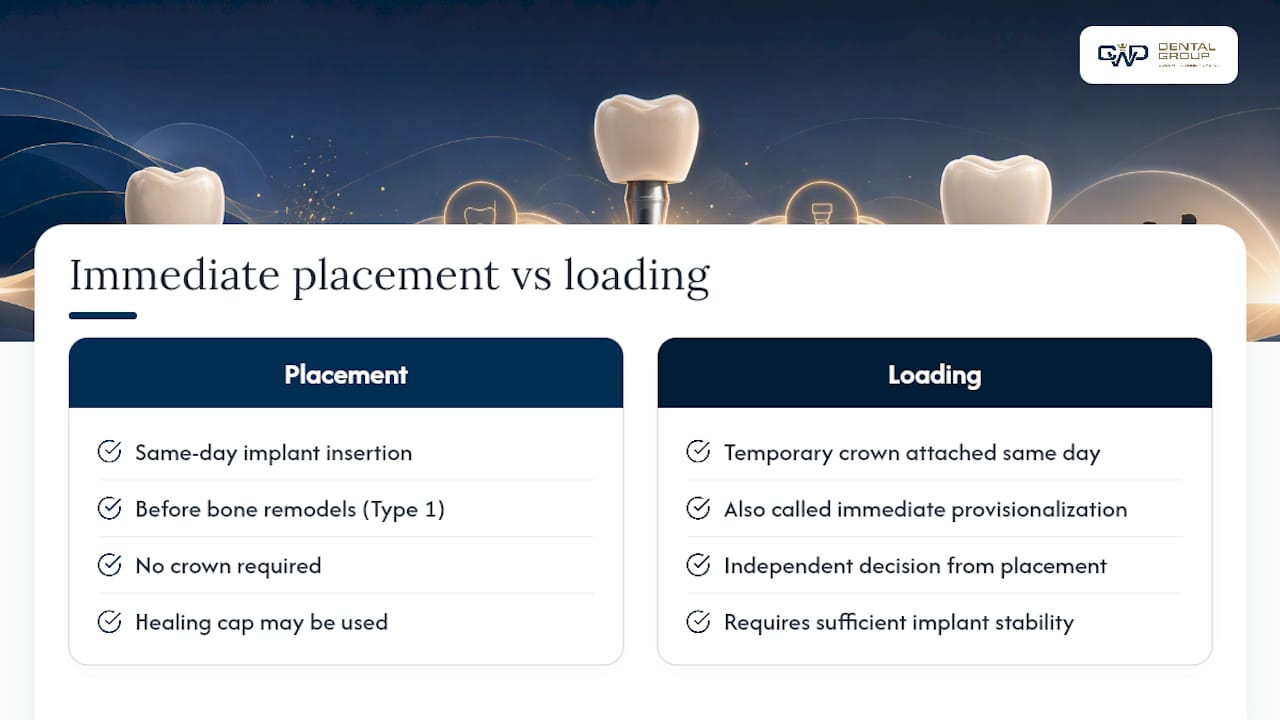
Positioning is restorative-driven, not socket-driven. The implant gets placed where the final tooth needs to sit, which in the esthetic zone usually means angling it slightly palatal rather than following the socket's natural path. That creates a small buccal gap, known as the jumping distance, which gets filled with graft material to preserve the ridge contour.
Who is actually a candidate for this procedure?
The checklist clinicians use is stricter than most patients expect, and for good reason. An ITI-guided review points to a specific set of anatomical and health conditions that need to line up before immediate placement is even on the table.
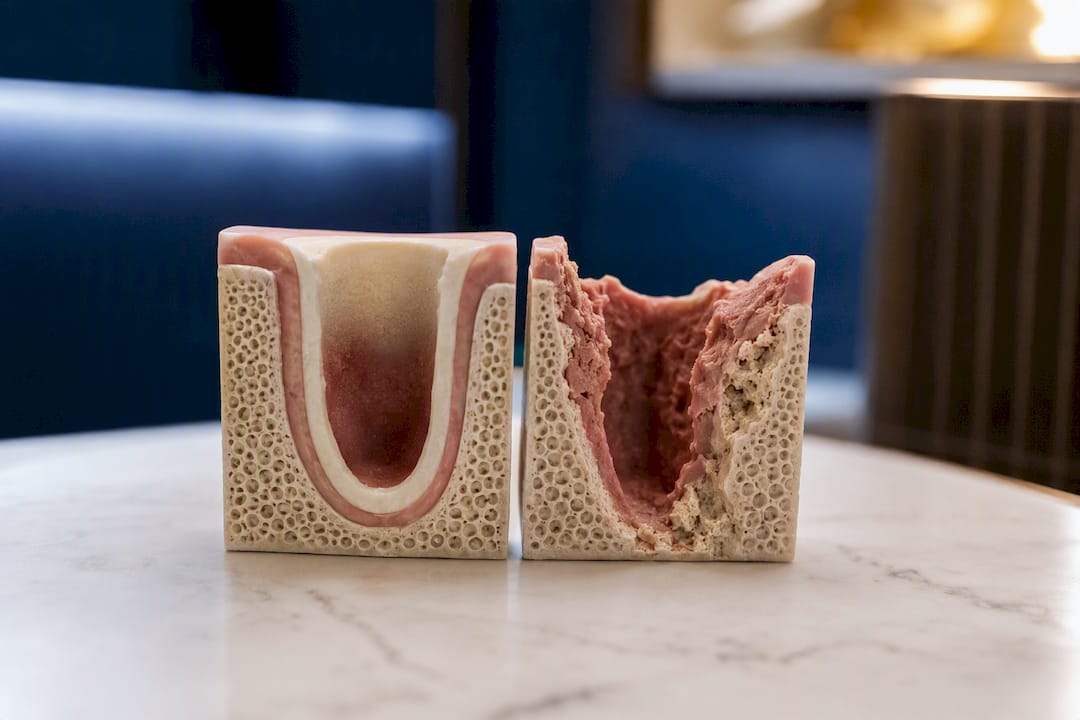
- An intact facial (buccal) bone plate with no fracture or fenestration
- A thick gingival biotype rather than thin, translucent tissue
- Sufficient apical and palatal bone to anchor the implant apex
- No acute, draining infection at the site (chronic, fully debrided infection can sometimes still qualify)
- Insertion torque and ISQ readings that confirm real primary stability
- Controlled systemic health, since uncontrolled diabetes, active smoking, and certain bisphosphonate use raise the risk of early failure
Pro Tip: Thick facial bone in the front teeth is rarer than you'd think. One CBCT study found it in only about 4.6% of central incisor sites, which is why so many anterior cases get staged instead of rushed.
If the wall is thin, fractured, or missing, the plan shifts to early or delayed placement almost automatically.
What are the real benefits of immediate placement?
Done in the right case, immediate placement genuinely simplifies treatment.
- Fewer surgical visits, since extraction and implant placement happen in one appointment
- A shorter overall timeline from missing tooth to functioning implant
- Better odds of preserving ridge height and soft-tissue contour when the socket walls are intact
- Lower cumulative morbidity, since patients heal from one surgical event instead of two
- The option of an immediate provisional crown, which helps protect esthetics during healing
These upsides show up most reliably in single-tooth esthetic zone cases with a thick biotype and undamaged walls, exactly the scenario the ITI's clinical guidance treats as the sweet spot. Outside that scenario, the benefits shrink fast.
What are the risks of getting an implant the same day?
Immediate placement isn't free of downside, and pretending otherwise does patients a disservice.
- A modestly higher early failure rate in some cohorts compared with delayed placement
- Midfacial recession, which can expose a gray implant collar or create an uneven gumline
- Loss of buccal contour, particularly with thin biotype or an already-damaged wall
- Higher risk when combined with poor primary stability, active infection, smoking, or uncontrolled systemic disease
One meta-analysis found immediate implant survival was somewhat lower than delayed placement, though both had high success rates.
That difference tends to shrink when clinicians select cases carefully and prescribe post-operative antibiotics, according to subgroup data from the same review. When complications do occur, the fix usually involves removing the implant, grafting the site, and staging a second attempt later rather than forcing a save.
What happens during the appointment: step by step
Here's the actual sequence, from consult to temporary tooth.
- Pre-op planning. A CBCT scan and periapical X-rays confirm bone volume and wall integrity, and the restorative plan gets mapped out before anyone touches the tooth.
- Atraumatic extraction. The dentist removes the tooth with minimal trauma to the socket walls, then inspects the socket directly. This is the real decision point. Even a perfect pre-op scan can be overridden by what the walls actually look like once the tooth is out.
- Implant placement. The implant goes in at the restorative-driven angle, engaging apical bone for stability, with torque and ISQ readings checked before moving forward.
- Gap management. Graft material fills the buccal jumping distance, and a connective tissue graft gets added if the soft tissue is thin.
- Temporary restoration. Depending on the stability numbers, the dentist places either an immediate provisional crown or a simple healing cap, followed by clear post-op instructions.
Pro Tip: Ask your dentist what your insertion torque reading actually was. A number above roughly 35 Ncm, or an ISQ above 70, is generally what allows a same-day crown instead of a healing cap.
For a broader walkthrough of the stages involved, see this step-by-step implant process guide.
Does immediate placement actually work as well as waiting?
The honest answer is: almost, but not quite, and the gap depends heavily on who you are. Survival data compiled from recent analyses put immediate placement in the 94.9% to 98.4% range, while delayed placement lands slightly higher, around 97.5% to 98.9%.
A separate meta-analysis found the same pattern: 94.9% survival for immediate placement versus 98.9% for delayed, a statistically real but clinically small difference in well-selected patients.
The ITI's consensus position treats immediate placement (their Type 1) as one option among four timing categories, reserved for ideal anatomy and evaluated case by case through their SAC complexity tool. Their guidance doesn't recommend it broadly. It recommends it selectively, and only for clinicians experienced enough to judge the socket in real time.
The takeaway that matters most: in properly screened cases, the numbers converge. Selection and surgical technique, not the calendar date of placement, drive most of the difference in outcomes.
How long does healing take, and what does aftercare involve?
Osseointegration, the process where bone fuses to the implant surface, typically takes about three to six months before a final crown goes on. Your dentist will schedule follow-up visits with imaging to confirm the implant is stable before finalizing the restoration.
- Stick to a soft diet and avoid biting directly on a temporary crown
- Keep the site clean with the hygiene routine your dentist gives you, which may differ from normal brushing for the first few weeks
- Expect a course of analgesics, and antibiotics if infection risk was a factor at placement
- Quit smoking, or at minimum pause it, since it measurably slows healing at implant sites
Pro Tip: Increasing pain, visible swelling, drainage, or any looseness in the implant after the first few days isn't normal healing. Call the clinic the same day you notice it.
When should you wait instead of going immediate?
Sometimes the safer move is patience, and a good clinician will say so plainly.
- Early placement (roughly 4 to 8 weeks out) suits sites with a thin or slightly damaged buccal wall where soft tissue needs time to heal before implant placement
- Delayed placement, done after bone grafting or guided bone regeneration, applies when there simply isn't enough bone volume yet
- Socket preservation grafting at the time of extraction protects the ridge even when implant placement itself gets postponed
- Any sign of an absent or fenestrated buccal wall is a signal to stage the case rather than force an immediate implant into a socket that can't support it
Our take on immediate implants at the clinic
Immediate placement gets marketed as a same-day miracle, and that framing does patients a disservice. The real story is narrower and, honestly, more interesting: it's a precision decision built on bone anatomy and stability readings, not enthusiasm.
We approach every extraction site the same way, checking wall integrity and stability numbers before committing to anything, and we'd rather stage a case over two visits than force an implant into a socket that can't hold it long term. If you're weighing this option, bring any prior X-rays, your current medication list, and a rundown of your health history to the consult. We also keep same-day appointments open for urgent extractions, so a painful tooth doesn't have to wait for a routine opening.
— Kayle
Ready for an implant consultation? Here's how CWD Dental Group helps
Skipping months of uncertainty starts with a real exam, not a guess based on a photo you send in. Cwddentalgroup runs CBCT-based planning in-house, so you get an actual answer about buccal wall thickness and bone volume before anyone talks about surgery dates.
A consult here means a same-day emergency appointment if your tooth needs to come out now, followed by a CBCT scan, a clear conversation about whether immediate or staged placement fits your anatomy, and a provisionalization plan if your stability numbers support one. We'd rather tell you honestly that your case needs staging than oversell a same-day result your bone can't back up. If you're dealing with a painful or failing tooth and want a real answer on timing, book a visit through Cwddentalgroup's emergency dental service and get your CBCT scheduled before you decide anything.
Key studies and guidance to read next
For deeper reading beyond this overview: the systematic survival-rate analysis covers numeric outcomes across cohorts, the ITI clinical considerations post lays out indications and the SAC classification, and the JCPE meta-analysis breaks down how antibiotics and case selection affect early failure rates.
This article is general information, not a substitute for advice from a qualified doctor. Consult a qualified healthcare professional about your own circumstances before acting on anything here.
Sources
- Immediate implant survival rates (systematic analyses)
- Immediate implant placement: clinical considerations (ITI Blog)
- Immediate implant placement protocol & case selection | Periospot