

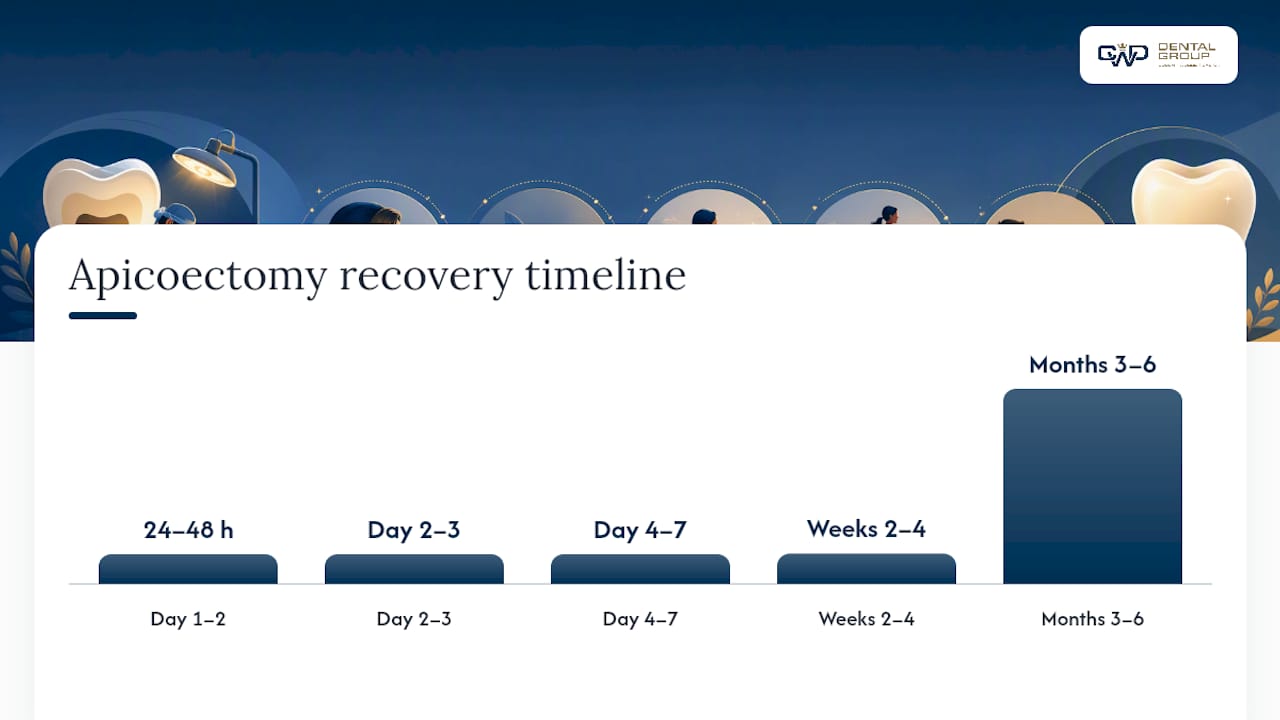
Most people return to normal daily activities within 24 to 48 hours of an apicoectomy, with gum tissue closing over the next two to four weeks and the underlying bone rebuilding over three to six months. Your first job is controlling swelling, protecting the surgical site, and taking any prescribed medication exactly as directed.
- Day 1-2: rest, ice, soft foods, no rinsing
- Week 1: swelling fades, sutures checked around day 5-7
- Weeks 2-4: gum tissue closes, normal diet resumes
- Months 3-6: bone fills in, confirmed by x-ray
Call your dentist right away if you notice worsening pain after day three, a fever, bleeding that won't stop, or pus or foul drainage from the site.
Key Takeaways
Apicoectomy recovery follows a predictable pattern: daily activities resume in 24 to 48 hours, gum tissue closes in two to four weeks, and bone regeneration takes three to six months to complete.
| Point | Details |
|---|---|
| Early timeline | Most patients resume normal activities within 24 to 48 hours after surgery. |
| Soft tissue vs. bone | Gums close in 2-4 weeks, but bone regeneration can take 3-6 months. |
| Pain management | OTC anti-inflammatories like ibuprofen are often sufficient for most patients. |
| Red flags | Worsening pain after day 3, fever, or pus mean it's time to call your dentist. |
| Local support | Cwddentalgroup offers same-day emergency care and endodontic follow-up in-office. |
Where to Read More on Apicoectomy Healing
- Apicoectomy: Healing Time, Procedure, and Recovery for a broad overview of pain management data
- Apicoectomy Recovery: A Day-by-Day Patient Guide for a detailed daily breakdown
- How Long Is the Recovery After an Apicoectomy? for follow-up scheduling details
- How to Care for Your Tooth After Endodontic Surgery for aftercare specifics
Bring any lingering questions from these sources to your follow-up appointment. It's the easiest way to fill in the gaps specific to your case.
This article is general information, not a substitute for advice from a qualified doctor. Consult a qualified healthcare professional about your own circumstances before acting on anything here.
Table of Contents
- What Happens During an Apicoectomy?
- How Long Does Apicoectomy Recovery Take Week by Week?
- Is Apicoectomy Pain Usually Manageable Without Strong Medication?
- What Should You Do (and Avoid) After Surgery?
- What Are the Warning Signs of a Complication?
- When Are Follow-Up Visits Scheduled After an Apicoectomy?
- What Are the Best Tips for a Smooth Apicoectomy Recovery?
- Sources
What Happens During an Apicoectomy?
An apicoectomy is root-end surgery. Your dentist or endodontist removes the tip of the tooth's root along with any infected tissue around it, then seals the root canal from that end.
- A small incision opens the gum near the affected tooth
- The root tip and surrounding infected tissue are removed
- The canal is sealed, and the gum is closed with sutures (sometimes with bone grafting if the defect is large)
This differs from a standard root canal because it involves cutting into gum and bone rather than working through the crown of the tooth. That's why apicoectomy recovery involves soft-tissue and bone healing on top of the usual root canal aftermath.
How Long Does Apicoectomy Recovery Take Week by Week?
Healing happens in layers. The gum closes fast; the bone underneath takes much longer, and that mismatch trips people up more than anything else. You'll often feel "back to normal" weeks before an x-ray would confirm the bone has filled in.
The first 24 to 48 hours are the roughest part. Expect some blood-tinged saliva, mild oozing, lingering numbness from the anesthesia, and jaw tightness. That's normal for day one, not a sign anything went wrong. Ice the area in 20-minute intervals and keep activity to a minimum for the rest of the day.
Days 2 to 3 are when swelling typically peaks before it starts easing. Switching from ice to a warm compress around 36 hours out helps move that swelling along.
Days 4 to 7 are the turning point for most patients. Pain and puffiness noticeably drop off, and if your dentist used non-dissolving sutures, this is the window for a check and removal, commonly around day 5 to 7.
Weeks 2 to 4 bring gum tissue closure and a return to your regular diet and routine. You might feel completely fine here, but the surgical site is still fragile underneath, and this is only soft-tissue healing, not the full picture.
Months 3 to 6 cover the slow part: bone regeneration. This is where an x-ray becomes the real measure of success, since symptoms usually resolve long before the bone has visibly filled back in.
| Stage | Expected Signs | What To Do |
|---|---|---|
| Day 1-2 | Oozing, numbness, jaw tightness | Ice, rest, soft foods, no rinsing |
| Day 2-3 | Swelling peaks | Switch to warm compress after 36 hours |
| Day 4-7 | Pain and swelling drop | Suture check/removal if needed |
| Week 2-4 | Gum tissue closes | Resume normal diet and activity |
| Month 3-6 | Bone regenerates | Confirm healing with follow-up x-ray |
Recovery speed also depends on factors outside your control, like the size of the original infection and which tooth was treated, and factors you can influence, like whether you smoke and how closely you stick to aftercare instructions.
Is Apicoectomy Pain Usually Manageable Without Strong Medication?
Yes, for most patients. A lot of people brace for opioid-level pain after hearing "root-end surgery" and are surprised when ibuprofen handles it fine. Pain generally peaks in the first two days and tapers steadily after that, tracking right alongside the swelling curve above.
- Ibuprofen or another OTC anti-inflammatory is the first-line option for most patients
- Your dentist may prescribe a short course of stronger medication if the surgery was more extensive
- Take your first dose before the local anesthesia fully wears off if your provider recommends that timing
- Tell your dentist about any blood thinners before surgery, since they can affect both bleeding risk and medication choice
More than one-third of apicoectomy patients in a published patient summary chose to skip pain medication entirely, and over-the-counter anti-inflammatories were frequently enough for the rest. Healthline, on apicoectomy healing
That's a small, patient-reported figure, not a clinical trial, but it lines up with what modern microsurgical technique tends to produce: less tissue trauma and a milder pain course than older surgical approaches. For more on managing discomfort after endodontic work generally, see our guide to endodontic pain relief.
What Should You Do (and Avoid) After Surgery?
Do this:
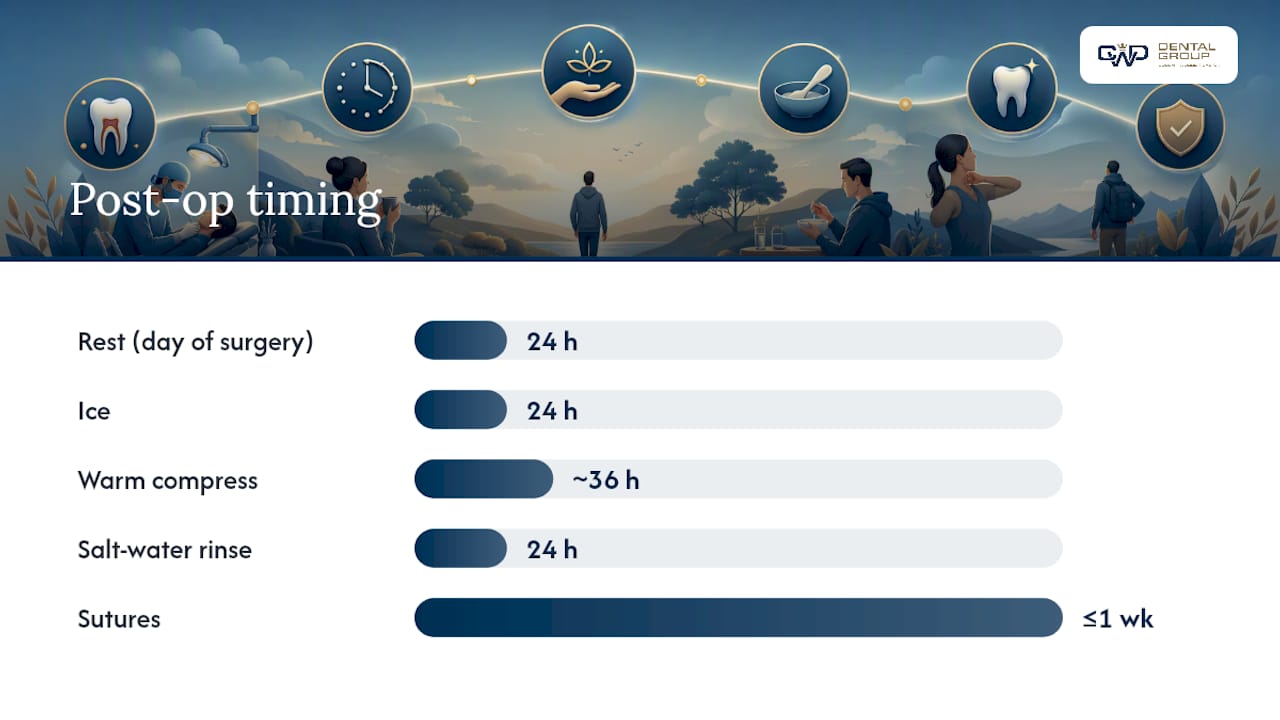
- Rest the day of surgery and keep your head elevated, even while sleeping
- Ice for the first 24 hours, then switch to warm compresses after about 36 hours
- Stick to soft, cool, or lukewarm foods for the first few days
- Start gentle warm salt-water rinses about 24 hours after surgery, never sooner
- Brush your other teeth normally, just avoid the surgical site
Skip this:
- No smoking or vaping. It's one of the biggest drags on healing speed
- No straws for several days, since suction can dislodge a healing clot
- No hard, crunchy, or spicy foods until the site has settled down
- No heavy lifting or strenuous exercise for at least a few days
Sutures either dissolve on their own or get removed at your follow-up, usually within a week. Clean around them gently. Never pick or floss directly at the site.
Pro Tip: Pick up any prescribed medication on your way home from the appointment, before the numbness wears off. Scrambling to find an open pharmacy while you're in pain is a completely avoidable problem.
What Are the Warning Signs of a Complication?
Most apicoectomy recovery goes exactly as expected. Still, know the signs that mean something's off, because catching a problem early almost always means an easier fix.
Call your dentist if you notice:
- Pain that gets worse after day 3 instead of better
- Fever or chills
- Swelling that keeps increasing past 48 to 72 hours
- Bleeding that won't stop with gentle pressure
- Pus, foul taste, or drainage from the site
- Numbness that persists for days or spreads beyond the original area
The complications behind these signs are uncommon but worth naming: infection, delayed bone healing, sinus involvement for upper back teeth, or, rarely, nerve irritation. If you suspect an allergic reaction to medication, save the packaging and call your provider or seek emergency care right away. Waiting rarely helps and can turn a minor issue into a bigger one.
When Are Follow-Up Visits Scheduled After an Apicoectomy?
Expect a short visit around 5 to 7 days out for a suture check, then a clinical check within a few weeks to confirm the gum has closed cleanly with no signs of infection.
- Suture check/removal: 5 to 7 days
- Clinical follow-up: 2 to 4 weeks
- Radiographic check: months later to confirm bone fill
Your dentist will look at soft-tissue closure, bite stability, and eventually an x-ray to track bone regrowth, since imaging tends to lag behind how you actually feel by a wide margin.
What Are the Best Tips for a Smooth Apicoectomy Recovery?
- Fill prescriptions before you leave the office, not after
- Stock your fridge with soft foods ahead of the procedure
- Block out the rest of the day for rest, no errands, no work calls
- Avoid smoking entirely during the healing window
- Keep a simple pain log for the first week to track what's improving
Pro Tip: Start your OTC anti-inflammatory on the schedule your dentist recommends rather than waiting until pain shows up. Staying ahead of inflammation is easier than chasing it down later.
A Note on Where This Guidance Comes From
This guide draws on published clinical and patient-care sources, along with the surgical and endodontic experience of the Cwddentalgroup team, to reflect realistic, evidence-based timelines rather than best-case guesses.
Recovery timelines vary by patient, but the pattern (soft tissue closing in weeks, bone rebuilding over months) holds consistently across the sources behind this guide.
Cwddentalgroup offers same-day emergency appointments alongside surgical and endodontic follow-up care, so questions about your healing don't have to wait for a routine opening.
A Clinician's Honest Take on Apicoectomy Worries
Most of the anxiety around apicoectomy recovery comes from not knowing what "normal" looks like day to day. Once patients see the timeline laid out, most of that worry disappears fast. If something feels off, call the office early. Waiting rarely makes the answer clearer.
How Cwddentalgroup Supports Your Recovery
Healing from an apicoectomy is mostly about staying ahead of small problems before they turn into bigger ones. That's exactly where a local practice with same-day availability makes the difference over waiting days for a callback. Cwddentalgroup handles endodontic surgery follow-up, suture checks, and surgical dentistry under one roof, so if swelling spikes or a suture feels loose on a Saturday, you're not stuck guessing whether it can wait until Monday.

If your recovery isn't tracking the way this guide describes, or you're due for a suture check or follow-up x-ray, schedule directly through our emergency dental services page for same-day attention when you need it. Most dental insurance plans cover follow-up visits, and our team can walk you through financing options for anything that isn't. Book your follow-up now rather than waiting to see if symptoms resolve on their own.
Sources
- Apicoectomy: Healing Time, Procedure, and Recovery — Healthline
- Apicoectomy Recovery: A Day-by-Day Patient Guide
- How Long Is the Recovery After an Apicoectomy?
- How Long Does It Take To Recover From An Apicoectomy?
- How to Care for Your Tooth After Endodontic Surgery