
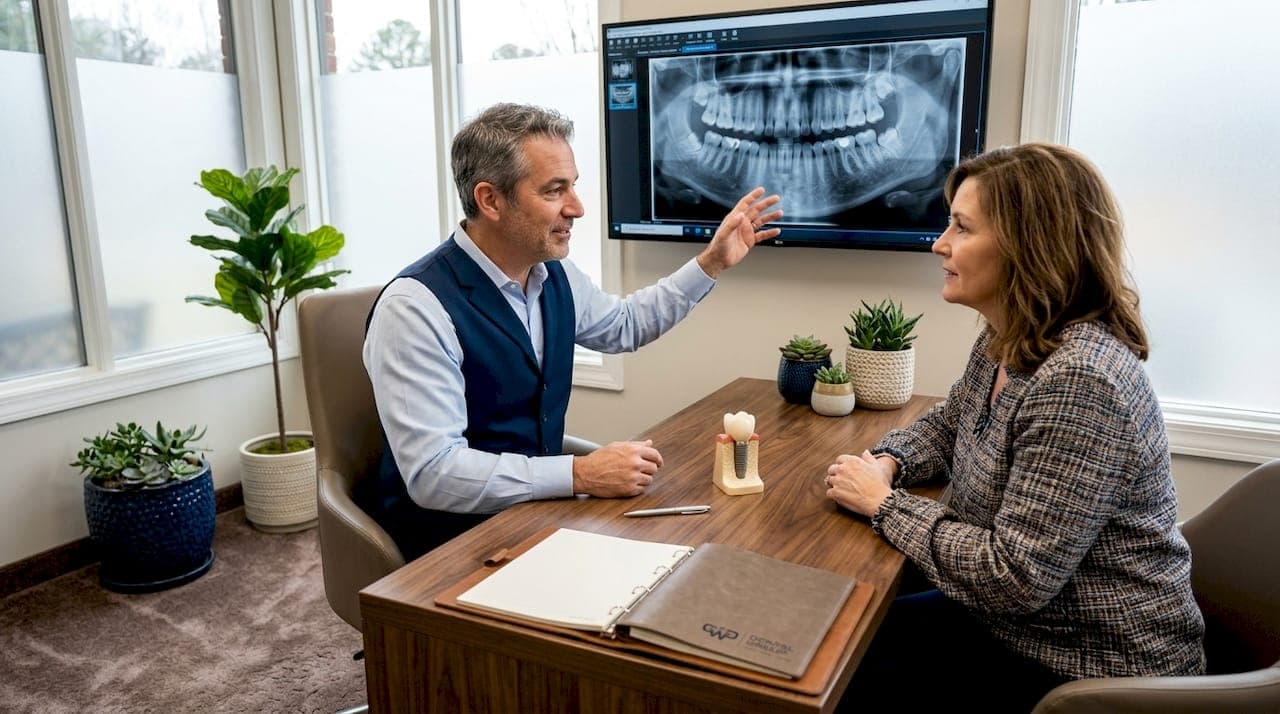
Most people assume dental implants are purely a functional fix. You lose a tooth, you get an implant, you can chew again. That's the extent of it, right? Not even close. Understanding how dental implants improve appearance goes much deeper than replacing a missing tooth. From the moment a tooth is lost, your facial structure begins to change in ways most patients never anticipate. This article breaks down the real science behind those changes, explains how implants restore far more than just a gap in your smile, and gives you the research-backed detail you need to make a confident, informed decision.
Table of Contents
- Key Takeaways
- How dental implants improve appearance by rebuilding facial structure
- What implants actually restore beneath the surface
- What clinical research says about appearance outcomes
- Confidence, quality of life, and the patient experience
- Prosthetic materials and the natural-looking result
- My take on what implants really give patients
- Get the smile you deserve at Cwddentalgroup
- FAQ
Key Takeaways
| Point | Details |
|---|---|
| Bone loss changes your face | Missing teeth trigger bone resorption that alters facial contour, symmetry, and volume within months. |
| Implants restore structure, not just teeth | Implants stimulate jawbone health and preserve the soft tissue support that keeps your face looking full and balanced. |
| Healing technique affects esthetics | Clinical research shows that soft tissue management during implant placement directly shapes long-term aesthetic outcomes. |
| Material choice matters for natural results | Prosthetic materials like zirconia deliver the color, translucency, and durability needed for a lifelike smile. |
| Maintenance protects your investment | Keeping peri-implant tissue healthy is the single most important factor in sustaining both appearance and confidence over time. |
How dental implants improve appearance by rebuilding facial structure
Here is something most patients are never told at the consultation: tooth loss is not just an oral health problem. It is a facial structural problem. When a tooth root is removed or falls out, the jawbone underneath it begins to shrink. This process is called bone resorption, and it starts faster than most people realize. Within the first year after tooth loss, you can lose up to 25% of the bone volume in that area.
That bone loss does not stay local. Over time, as the jaw loses density and height, the soft tissues that depend on that skeletal foundation begin to collapse inward. The result? Lips that appear thinner, cheeks that sink slightly, a shorter lower face, and in severe cases a prematurely aged look that no amount of skincare can address. Facial implants restore volume lost from bone and soft tissue resorption, improving contour, symmetry, and facial proportion after tooth loss.
This is why the dental implant aesthetic benefits go so far beyond a white crown sitting in a gap. The titanium implant post acts as a replacement tooth root, integrating directly with the jawbone in a process called osseointegration. That integration sends the biological signal to your body that the bone is still being used and still needs to be maintained. The result is preserved bone volume, preserved tissue support, and a face that continues to look like your face.
Consider the midface specifically. The upper jaw supports your lip and the area just beneath your nose. Lose multiple teeth in that zone and, over years, the lip loses its forward projection, the philtrum flattens, and the entire midface takes on a hollowed appearance. Implants can correct asymmetry and volume loss in the midface and jaw angles, improving facial balance and proportion in ways patients often describe as looking years younger.
- Missing teeth accelerate jawbone loss, which changes facial proportions
- Bone resorption reduces support for lips, cheeks, and the lower third of the face
- Dental implants stimulate the bone, preventing further volume loss
- Restored bone and tissue support re-establishes natural facial contours
- Symmetry and proportion improvements contribute directly to a more youthful, healthier appearance
Pro Tip: If you are researching implants and have already experienced some tooth loss, ask your dentist about bone grafting options before placement. Preserving or rebuilding existing bone volume is the foundation of every aesthetic outcome.
What implants actually restore beneath the surface
Understanding the mechanics behind implant placement helps explain why the aesthetic results are so different from other tooth replacement options. A bridge, for example, fills the visible gap but does nothing for the bone underneath. A denture sits on the gum tissue and, over time, the continued bone loss beneath it causes the denture to fit poorly and the face to look progressively more sunken. Implants are the only option that addresses the root cause of the structural change.
The titanium post replaces the tooth root, the abutment connects the post to the prosthetic crown, and the crown itself is designed to match the color, shape, and translucency of your natural teeth. But the real aesthetic work happens at the tissue level. When the implant is placed with careful management of the surrounding gum tissue, the soft tissue contour around the crown mirrors a natural tooth emergence. That gum architecture is what makes a finished implant look completely indistinguishable from a real tooth.
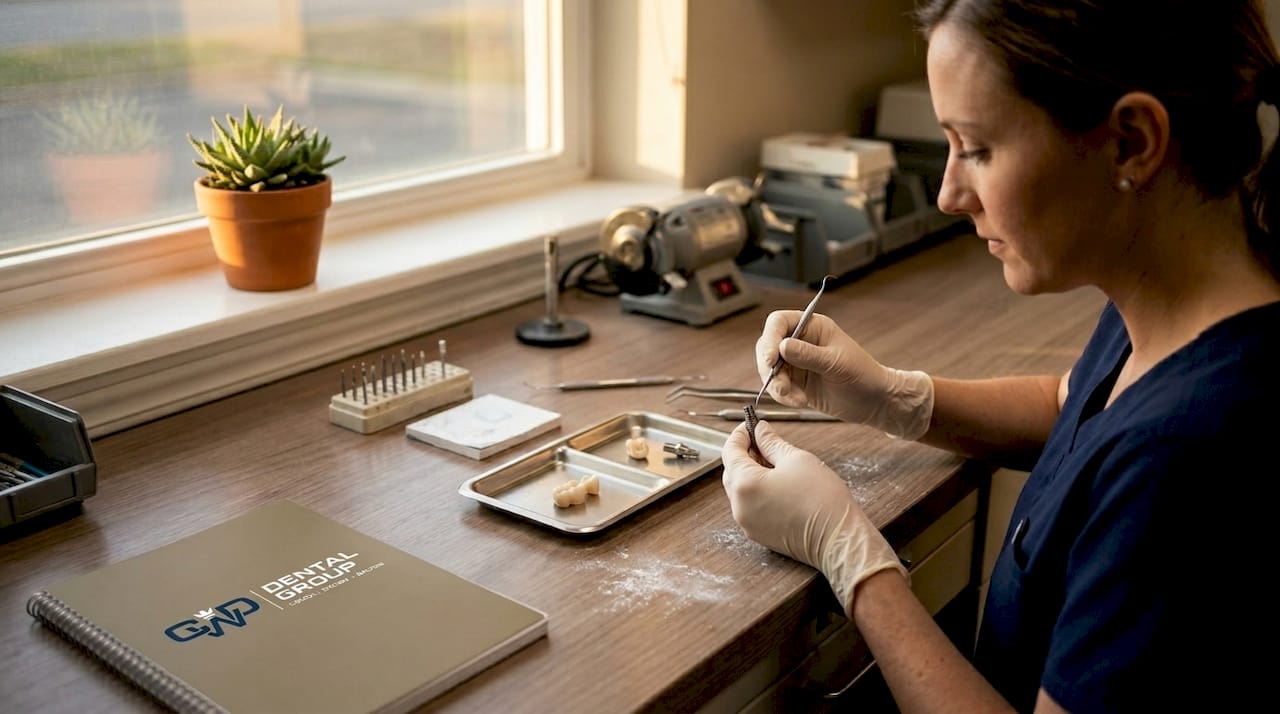
Here is how implants compare to alternatives on the key aesthetic factors:
| Factor | Dental implants | Dentures | Bridges |
|---|---|---|---|
| Bone preservation | Yes, stimulates bone | No, bone continues to shrink | No, bone loss continues |
| Facial volume support | Maintained long term | Declines over time | Partial, limited to adjacent teeth |
| Soft tissue appearance | Natural gum contour | Gum recession likely | Variable, no tissue support |
| Natural look | Very high | Moderate, can shift | Good, but fixed to adjacent teeth |
| Long-term stability | Highest | Requires refitting | May need replacement |
Pro Tip: When you see before and after photos of implant patients, the most dramatic changes are rarely in the crown itself. Look at the lip support and the lower third of the face. That is where bone and tissue restoration shows up most clearly.
The role of advanced dental technology in implant placement cannot be overstated. Digital imaging, cone beam CT scanning, and computer-guided placement allow clinicians to position implants with precision that protects surrounding bone and tissue, which directly supports better aesthetic outcomes.
What clinical research says about appearance outcomes
The science behind implant esthetics has become increasingly precise. Rather than relying on subjective assessments of whether something "looks good," clinicians now use standardized tools. The Pink Esthetic Score, or PES, is one of the most widely used. It evaluates soft tissue parameters including papilla fill, cervical contour, tissue color, and texture to quantify the quality of the tissue around an implant. This gives patients and clinicians an objective measure of aesthetic success.
A 2026 randomized controlled trial found that the healing technique used during immediate implant placement significantly affects the final appearance. Specifically, the open healing technique produced PES scores that were measurably better than the closed healing approach at both three and twelve months after placement, with a statistically significant difference.
| Healing method | PES outcome | Statistical significance |
|---|---|---|
| Open healing | Significantly higher PES | p = 0.0014 |
| Closed healing | Lower PES | Reference group |
| Baseline soft tissue quality | Strongest predictor | p = 0.0002 |
The same research confirmed that the initial soft tissue condition of the patient at the time of placement is the single strongest predictor of aesthetic outcomes. This means the health of your gums before and during treatment matters enormously, not just after.
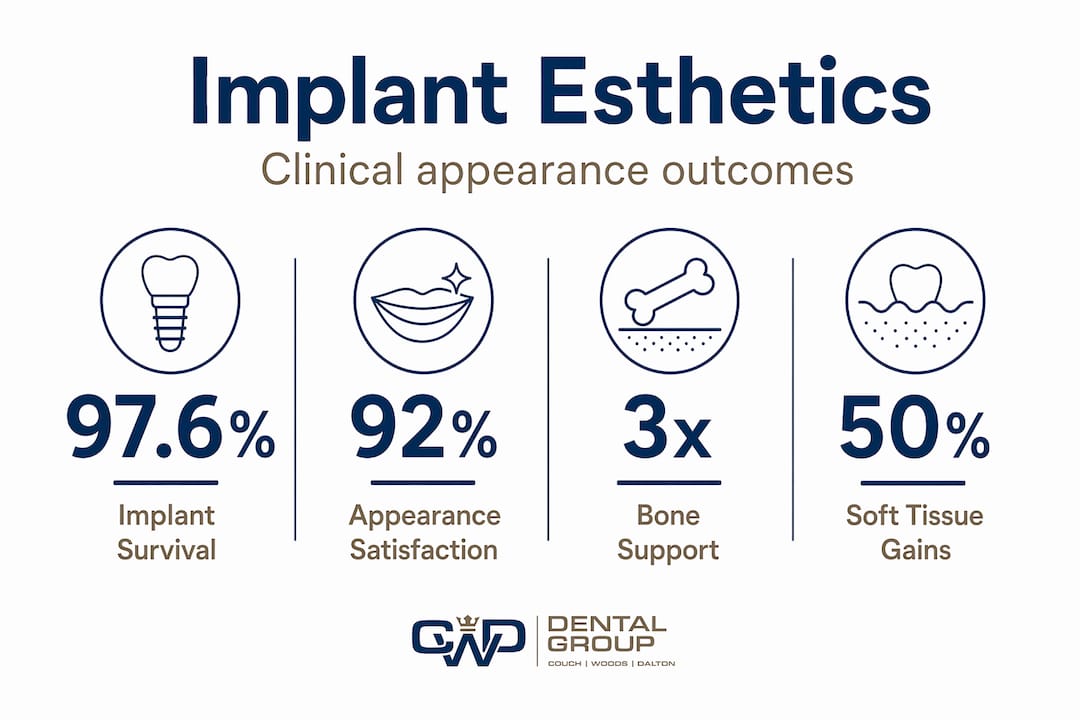
There is also encouraging data for patients who need immediate implant placement in sites where infection was present. Research shows that survival rates in inflamed sites are approximately 97.6%, virtually identical to the 97.8% seen in non-inflamed extraction sites, with no significant difference in esthetic outcomes at one year. This means even patients dealing with dental emergencies do not have to sacrifice appearance results.
Confidence, quality of life, and the patient experience
The clinical measurements are important, but they do not capture the full picture. When patients describe what dental implants have given them, they rarely start with bone density percentages. They talk about smiling in photos again. Eating at restaurants without anxiety. Not covering their mouth when they laugh. These are the real-world benefits of dental implants, and they are directly tied to how the treatment changes appearance.
Research makes the connection between implant health and psychological wellbeing impossible to ignore. Peri-implantitis significantly lowers patient satisfaction and quality-of-life scores. Peri-implantitis is inflammation of the tissue surrounding an implant, essentially a form of gum disease around the implant site, and its impact on confidence is measurable (p less than 0.001). Healthy tissue around an implant is not just about preventing complications. It is directly linked to how satisfied patients feel about their appearance long term.
Here is how you protect that investment:
- Brush twice daily with a soft-bristled brush, paying close attention to the gum line around the implant
- Use interdental brushes or water flossers to clean between implants and natural teeth
- Schedule professional cleanings every three to six months, not just annually
- Tell your provider immediately if you notice any swelling, bleeding, or changes around the implant
- Avoid smoking, which dramatically increases the risk of peri-implantitis and compromises tissue aesthetics
Choosing a skilled clinician is part of this equation too. When evaluating providers, ask specifically about their approach to soft tissue management and what aesthetic scoring methods they use. An implant dentist in Tallahassee who speaks in terms of PES and tissue architecture is one who understands that a successful implant is about far more than osseointegration.
Prosthetic materials and the natural-looking result
The crown sitting on top of the implant is the part the world sees. The material it is made from determines whether it blends seamlessly with your natural teeth or announces itself as a restoration. Modern prosthetic dentistry has raised the bar considerably.
- Zirconia is currently the gold standard for implant crowns and full-arch restorations. It delivers the translucency and light-scattering properties of natural enamel, resists staining, and holds up under chewing forces without the fracture risk of older ceramic options.
- Porcelain-fused-to-metal (PFM) crowns are still used but can show a dark line at the gum line over time as tissue recedes slightly with age, which affects the natural appearance.
- Lithium disilicate is a strong all-ceramic option used for individual crowns where high esthetics are prioritized, offering excellent color matching and translucency.
- Monolithic zirconia is particularly well-suited for full-arch implant restorations. A 2024 consensus statement covering literature from 2015 to 2024 confirmed that monolithic zirconia shows high survival and favorable esthetic outcomes in full-arch rehabilitations, making it the recommended choice for comprehensive cases.
The design of the prosthetic matters as much as the material. Proper crown contour supports the surrounding gum tissue, maintains the natural arch shape, and contributes to overall facial balance and smile esthetics in ways that extend beyond individual teeth. A well-designed restoration restores the proportions of your entire smile, not just a single gap.
My take on what implants really give patients
I have seen countless patients come in expecting a functional outcome and leave with something they did not fully anticipate: a restored sense of self. What strikes me most is how often patients do not connect their self-consciousness to the structural changes happening beneath the surface. They think they feel less confident because of a gap in their smile. What is actually happening is more complex. The face is changing, and they sense it without being able to name it.
What I have learned is that the most important conversation to have with a patient is not about the procedure. It is about what has already been lost and what restoration actually means. When people understand that an implant is not just filling a hole but actively preserving the architecture of their face, their relationship to the treatment changes entirely. The fear does not disappear, but it shifts. It becomes purposeful.
My honest advice: do not wait. Every month without an implant is a month of continued bone loss. The earlier the intervention, the more facial structure you preserve, and the better your aesthetic outcome will be. And if you have fears about how you will look during the healing phase, talk to your provider specifically about that. A skilled team will walk you through exactly what to expect, week by week.
— Kayle
Get the smile you deserve at Cwddentalgroup
If what you have read here has you thinking seriously about dental implants, the next step is a conversation with a team that specializes in exactly this kind of care.
At Cwddentalgroup in Tallahassee, the approach to implant dentistry is built around both function and aesthetics, including zirconia restorations and precise soft tissue management designed to deliver natural-looking, long-lasting results. Whether you are just beginning to explore your options or you need urgent attention for a failing tooth, the team offers same-day appointments for dental emergencies through their emergency dental services. Do not let another month pass while bone loss continues. Book your consultation and find out what is possible for your smile and your confidence.
FAQ
Do dental implants actually look like real teeth?
Yes. Modern implant crowns, particularly those made from zirconia, mimic the translucency and color of natural enamel so closely that most people cannot tell the difference. With proper tissue management, even the gum contour around the implant replicates the natural emergence of a real tooth.
How long does it take to see the appearance improvement?
Most patients notice a significant aesthetic improvement once the crown is placed and initial healing is complete, typically within a few months. Full tissue maturation and the complete stabilization of gum contour can take up to a year, with soft tissue outcomes measurable at both three and twelve months post-placement.
Can implants fix the sunken face look from missing teeth?
Implants prevent further bone loss and restore structural support, which halts and partially reverses the sunken appearance. The earlier implants are placed after tooth loss, the more facial volume is preserved. In cases of significant existing bone loss, bone grafting combined with implants can restore volume more fully.
Is it safe to get an implant if there was an infection at the site?
Yes, with proper case management. Research shows that implant survival in inflamed sites is approximately 97.6%, nearly identical to non-inflamed sites, with no significant difference in esthetic outcomes at one year.
What is the biggest threat to long-term implant appearance?
Peri-implantitis, which is inflammation of the tissue around the implant, is the leading cause of declining aesthetic outcomes and patient satisfaction. Maintaining peri-implant tissue health through regular professional care and good daily hygiene is the most important thing you can do to protect both your results and your confidence.