
Most dental plans do not fully cover implants. Some pay a percentage toward the crown or the surgery after you meet a deductible and clear a waiting period, but the implant fixture itself is often excluded outright. Medical insurance, Medicare, and Medicaid rarely pay unless the implant is tied to documented medical necessity, like trauma or tumor reconstruction. Your first move: pull your plan's Summary of Benefits and Coverage, get an itemized estimate with procedure codes, and ask your insurer for preauthorization before you schedule surgery.
TL;DR:
- Most dental plans exclude the implant fixture itself, covering only parts like crowns or the surgery at you paying out of pocket or up to low caps.
- Out-of-network providers often lead to higher costs and lower reimbursements, making in-network care preferable for affordable coverage.
- Medical insurance, Medicare, or Medicaid rarely pay for implants unless linked to medically necessary trauma or tumor reconstruction, not routine tooth loss.
- Each stage of the implant process, such as bone grafts or the fixture placement, may be billed separately, with coverage depending on procedure codes and plan specifics.
- Preauthorization, detailed estimates, and documentation are crucial to increase the chances of insurance approval and reduce unexpected expenses.
Table of Contents
- How Dental Insurance Typically Treats Dental Implants
- When Medical Insurance, Medicare, or Medicaid Might Pay
- What Parts of the Implant Process Get Billed Separately
- Plan Limits That Quietly Drive Up Your Bill
- Step-by-Step: How to Get Your Insurer to Pay for Implants
- Payment Alternatives When Insurance Doesn't Cover Implants
- Checklist: Exact Questions to Ask Before Treatment
- How CWD Dental Group Helps Patients Navigate Coverage
- Ready to Find Out What Your Plan Actually Covers?
- The Real Gap Nobody Talks About Enough
- Sources
How Dental Insurance Typically Treats Dental Implants
Most carriers classify implants as major restorative work, and some tuck them into a "cosmetic" bucket instead. That classification matters enormously, because basic dental plans built around cleanings and fillings often exclude major restorative procedures altogether, or cap what they'll pay so low it barely dents an implant bill.
When a plan does include implants, it usually pays a set percentage after you've met your annual deductible and only up to a fixed dollar cap for the year. Insurance coverage for dental implants also shifts based on network status. Staying in-network typically means your dentist has agreed to negotiated rates, which lowers your share of the bill even before insurance kicks in. Go out-of-network, and reimbursement often drops.
None of this is guesswork you should have to do yourself. Your plan's Summary of Benefits and Coverage document spells out the exact language:
- Whether "implant services" appear under covered procedures or exclusions
- The percentage paid for major restorative work versus basic care
- Annual maximums, deductibles, and any waiting period before major work is covered
- Whether the crown, abutment, and fixture are billed and covered separately
Carriers vary widely here, and the National Association of Dental Plans notes that benefit language differs plan to plan, which is exactly why two people with "dental insurance" can have wildly different experiences paying for the same implant.
When Medical Insurance, Medicare, or Medicaid Might Pay
Health insurance dental implant coverage through medical plans, Medicare, or Medicaid is the exception, not the rule. Medicare generally does not cover routine dental care, including dental implants, though Medicare Advantage plans sometimes bundle in optional dental benefits. Those vary a lot by plan, so you'd need to check the plan's evidence of coverage document directly.
Medicaid works similarly but with more moving parts. Adult dental benefits under Medicaid are optional and set state by state, and implants are rarely a covered service unless there's a narrowly defined medically necessary reason behind it.
What counts as medically necessary? Think trauma reconstruction after an accident, tumor removal that takes teeth with it, or a congenital condition where dental surgery is part of a larger covered medical treatment. Routine tooth loss from decay or gum disease almost never qualifies.
To verify where you stand:
- Review your Medicare Advantage evidence of coverage for dental riders
- Check your state's Medicaid benefit page for adult dental rules
- Ask your dentist's office to request preauthorization directly, rather than guessing
If you're a veteran, coverage rules shift again. It's worth reviewing what to check first for veterans seeking implant coverage before assuming standard Medicaid or Medicare rules apply to your situation.
What Parts of the Implant Process Get Billed Separately
An implant isn't one line item. It's a stack of procedures, and insurers often approve some pieces while denying others, which is exactly why itemized billing trips people up.
- Consultation and diagnostic imaging — X-rays or a CBCT scan to map bone structure
- Bone graft or sinus lift, if you don't have enough bone density to anchor the implant
- The implant fixture itself — the titanium post placed in the jaw
- The abutment — the connector piece between fixture and crown
- The crown — the visible replacement tooth
- Anesthesia and lab fees for fabricating the crown
Mayo Clinic's overview of dental implant surgery lays out how fixture placement, healing, and final restoration happen in stages, and each stage can carry its own billing code. Insurers sometimes cover the crown portion under restorative benefits while flatly excluding the surgical fixture placement. Bone grafts and sinus lifts, according to Cleveland Clinic's guidance on dental bone grafts, get billed as their own separate procedures too, and that can push total costs up substantially. Ask your dentist for the exact CDT and CPT codes tied to each step before you submit anything for preauthorization.
Plan Limits That Quietly Drive Up Your Bill
Annual maximums on most dental plans sit low, often within a modest dollar range, while a single implant frequently costs several thousand dollars once you add the crown and any bone grafting. Do the math: if your plan pays half up to a $1,500 cap, you're still covering the bulk of a $4,000 to $5,000 procedure yourself.
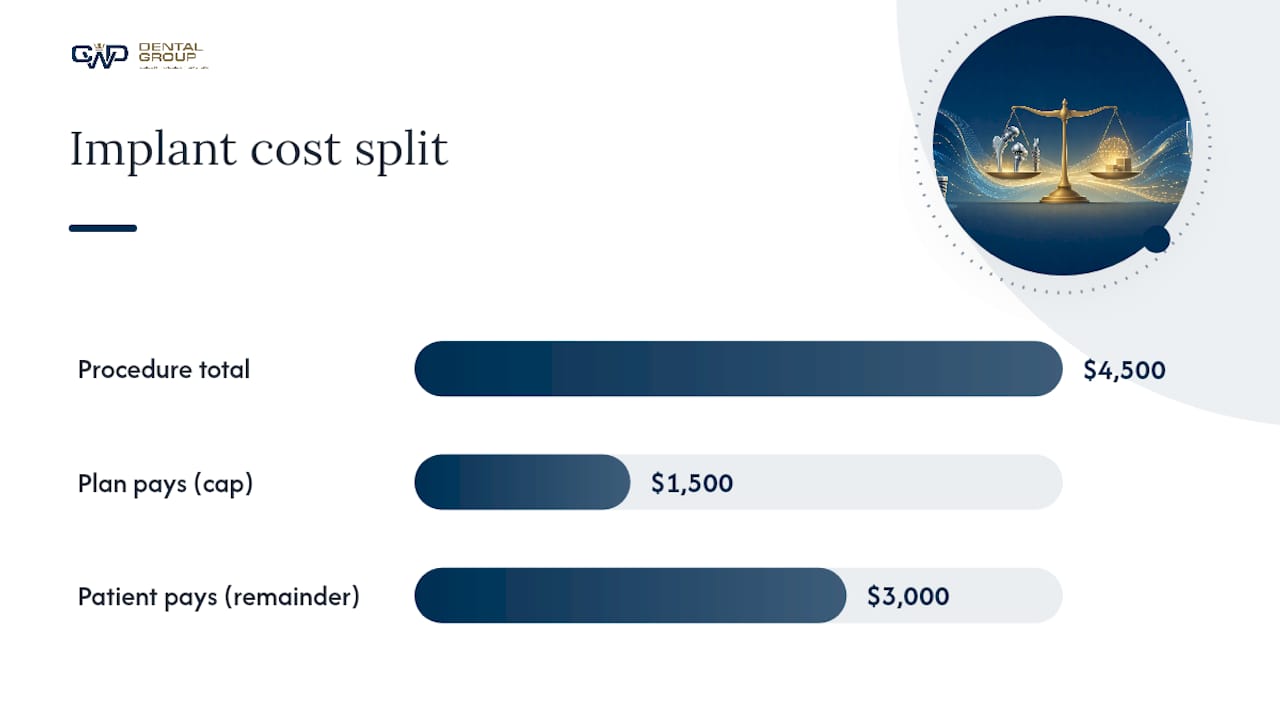
Quick example: Say your implant, abutment, and crown total $4,500.
Waiting periods add another wrinkle. Many plans make you wait six to twelve months after enrollment before major restorative work qualifies for any reimbursement at all.
- Deductibles apply before any percentage coverage kicks in
- Co-insurance means you're splitting the bill even after the deductible is met
- Out-of-network dentists often mean lower reimbursement and higher balance-billing
Staying in-network is one of the more reliable ways to shrink that gap, since negotiated rates apply before insurance even factors in.
Step-by-Step: How to Get Your Insurer to Pay for Implants
Getting a claim approved is mostly a documentation problem, not a luck problem. Here's the sequence that actually moves things forward.
- Request an itemized estimate with exact procedure codes (CDT and CPT) from your dentist's office before anything is scheduled.
- Ask for a letter of medical necessity along with supporting clinical records: radiographs, treatment notes, and any relevant medical history.
- Submit preauthorization before surgery, not after, and confirm whether your insurer requires a specific network provider.
- If denied, file a formal appeal with the supporting documentation attached, and request a peer-to-peer review between your dentist and the insurer's dental consultant. Loop in your employer's benefits administrator if you have group coverage.
Authoritative patient resources consistently point to the same lesson: collecting procedure codes and itemized estimates before filing speeds up claim accuracy, and it cuts down on the back-and-forth that stalls approvals for weeks.
Pro Tip: Keep a simple log of every call with your insurer, including the date, the representative's name, and the claim reference number. Appeals move faster when you can cite exactly who told you what and when.
Payment Alternatives When Insurance Doesn't Cover Implants
If your plan leaves you paying most of the bill, you've still got real options. A health savings account can cover qualified expenses, and HSAs are built specifically for eligible medical and dental costs, though it's worth confirming with your plan administrator that implant-related charges qualify under your specific account rules. FSAs work similarly but come with different use-it-or-lose-it timing.
- Many dental practices offer in-house payment plans or work with third-party financing companies; ask about APR and total repayment terms before signing anything
- Veterans should check VA dental benefits and eligibility rules, since coverage can differ sharply from civilian Medicaid or Medicare
- Community and charitable dental programs sometimes offer reduced-cost implant care for qualifying patients
Weigh these against the long-term value of restoring function and bone health, not just the sticker price today.
Checklist: Exact Questions to Ask Before Treatment
Walking into a call or email with the right questions saves weeks of back-and-forth later.
- Ask your insurer: Is implant surgery covered? Which procedure codes apply? Is there a waiting period? What's the annual or lifetime cap? Is preauthorization required?
- Ask your dentist's office: Can you provide the exact CDT/CPT codes, an itemized estimate, a letter of medical necessity, and supporting imaging?
- Track everything: save claim numbers, representative names, and appeal deadlines in one place so nothing falls through the cracks.
How CWD Dental Group Helps Patients Navigate Coverage
Some dental clinics help patients run benefits verifications, request preauthorization, and build itemized estimates before any surgery is scheduled. Clinics that manage this process directly, with full clinical documentation attached, tend to see stronger approval outcomes on submitted claims. This is in addition to clinics offering same-day emergency scheduling and a patient-first approach.
Ready to Find Out What Your Plan Actually Covers?
You don't have to decode your Summary of Benefits and Coverage alone or guess at procedure codes over the phone. Some dental practices run benefits checks and build itemized estimates for implant patients before a single dollar is committed, so patients know their real out-of-pocket number before surgery, not after the bill arrives.
That process includes confirming preauthorization requirements with your carrier, walking through what your plan's annual maximum will and won't stretch to cover, and laying out payment plan options if insurance leaves a gap. If you're weighing implants against other restorative work, the practice's emergency dentistry and surgical services team can also fit you in same-day if a tooth issue turns urgent while you're still sorting out coverage. Book a consultation to get your itemized estimate started and find out exactly where your plan stands before you commit to a treatment date.
The Real Gap Nobody Talks About Enough
Everyone focuses on whether a plan covers implants. The bigger question is whether the coverage that exists is even worth the premium you're paying for it. It's covering a fraction of one component, once, and resetting the following year as if that's generous.

I think the industry benefits from letting patients assume "insurance" and "coverage" mean the same thing they do for a hospital stay. They don't. Dental plans are closer to a discount club with a modest annual voucher attached. That's not a criticism of the plans themselves. It's a reason to stop treating your dental insurance card as the deciding factor in whether you get an implant, and start treating your itemized estimate and preauthorization letter as the documents that actually determine your bill.
The patients who come out ahead aren't the ones with the best insurance. They're the ones who asked for the procedure codes, requested preauthorization in writing, and had a clinic willing to walk through the letter of medical necessity with them before surgery day. That's a process advantage, not a luck advantage, and it's available to almost anyone willing to make a few extra phone calls before they sign consent forms.
— Kayle
This article is general information, not a substitute for advice from a qualified doctor. Consult a qualified healthcare professional about your own circumstances before acting on anything here.
Sources
For the federal and clinical rules behind everything above, go straight to the source. Medicare's dental services page spells out what original Medicare excludes. Medicaid's state contact directory routes you to your state's specific adult dental benefit rules. The NADP's guide to understanding dental benefits breaks down how plan exclusions typically read. For the clinical side, Mayo Clinic's implant surgery overview and Cleveland Clinic's page on dental implants cover what the procedure actually involves.
- Medicare
- Medicaid — About us / state-level contacts
- Healthcare
- NADP — Understanding dental benefits
- Mayo Clinic — Dental implant surgery overview