
Most dental insurance plans treat veneers as cosmetic and won't pay a dime toward them. The exception is when veneers repair genuine damage, like a fractured tooth or severe enamel loss from disease, in which case a plan may cover part of the cost as restorative treatment. Insurer rules vary widely on this, so the real work is checking your specific plan's language and, if you have a legitimate case for medical necessity, getting it documented before treatment starts.
TL;DR:
- Insurance coverage for veneers is rare unless they are used to repair damage caused by trauma, decay, or developmental defects, not for cosmetic enhancement.
- Most plans impose annual maximums of $1,000 to $2,500 and often cap payments at the cost of a less expensive alternative like composite bonding.
- The likelihood of approval depends heavily on correct coding, thorough documentation, and obtaining predetermination before treatment begins.
- Cosmetic cases such as whitening, gap closure, and smile makeovers typically fall under exclusions labeled "cosmetic" or "elective" in insurance policies.
- When insurance does not cover, HSA, FSA, discount plans, and financing options can help reduce out-of-pocket costs for veneers.
Table of Contents
- Why Does Insurance Cover Veneers So Rarely? The Cosmetic vs. Restorative Divide
- When Veneers Qualify as Restorative Care
- Codes, Predetermination, and Appeals: How to Improve Your Odds
- What Veneers Actually Cost After Insurance Math
- If Insurance Won't Pay: HSA, FSA, Discount Plans, and Financing
- Your Pre-Treatment Checklist: What to Ask and What to Collect
- How CWD Dental Group Helps Patients Navigate Coverage
- The Gap Between What Insurance Promises and What It Pays
- Ready to Find Out What Your Plan Actually Covers?
- Sources
Why Does Insurance Cover Veneers So Rarely? The Cosmetic vs. Restorative Divide
Dental insurers draw a hard line between two categories: procedures that fix a health problem and procedures that improve appearance. Veneers usually fall into the second bucket. A porcelain veneer placed over a healthy tooth to close a gap or brighten a smile reads as cosmetic to every carrier, no matter how the dentist bills it.
Part of the reason insurers get this much latitude traces back to federal policy. Adult dental benefits are not classified as essential health benefits under the Affordable Care Act, which means there's no federal mandate forcing plans to cover much of anything for adult teeth beyond basic care. Insurers write their own rules, and most write veneers out entirely.
Common exclusion scenarios include:
- Whitening-motivated veneers on structurally sound teeth
- Cosmetic gap closure (diastema correction) with no functional problem
- Veneers chosen purely to change tooth shape or color uniformity
- Elective smile makeovers involving six or more front teeth
You'll typically find this exclusion language under headings like "cosmetic services" or "elective procedures" in your plan's evidence of coverage document, often paired with a list of specifically excluded CDT codes.
When Veneers Qualify as Restorative Care
Insurers will occasionally pay toward veneers, but only when the clinical picture shows repair, not enhancement. Four scenarios come up most often:
- Trauma or fracture repair. A chipped or cracked front tooth from an accident, sports injury, or fall can qualify if the veneer restores structure the tooth lost.
- Severe enamel erosion. Acid erosion, certain medications, or eating disorders can wear enamel down to the point where a veneer protects the underlying dentin, not just the smile.
- Developmental defects. Conditions like enamel hypoplasia, where enamel didn't form properly in childhood, sometimes clear the bar for medical necessity.
- Failed prior restorations. Replacing a cracked or leaking bonding or crown with a veneer can count as restorative if the original work is documented as failing.
Even when a case qualifies, insurers rarely pay the full bill. Most dental plans that grant coverage still apply annual maximums between $1,000 and $2,500, and an alternative-benefit clause often caps payment at whatever the cheapest acceptable fix would cost, usually a composite bonding rather than porcelain. You may get partial reimbursement toward a porcelain veneer while paying the price difference yourself.
There's also a missing-tooth or prior-restoration clause worth knowing about: some plans deny any restorative claim tied to a tooth that had pre-existing damage before your coverage started, so timing matters as much as the diagnosis itself.
Codes, Predetermination, and Appeals: How to Improve Your Odds
Getting a claim approved often comes down to paperwork as much as clinical facts. Three CDT codes cover veneer procedures, and the one your dentist bills changes how the claim gets read.
- D2960 covers direct-application resin veneers done chairside.
- D2961 covers indirect resin veneers made in a lab.
- D2962 covers porcelain laminate veneers.
Insurers evaluate these differently, and using the wrong code is a common reason claims get denied or downgraded outright.
Before any drilling starts, ask your dentist to submit a predetermination request, sometimes called preauthorization. This isn't just a formality: a predetermination gives you an actual dollar estimate of what the insurer will pay, showing exactly how the claim applies against your deductible and annual maximum before you commit to treatment.
To support a medical-necessity claim, your dentist's office typically needs to submit a written clinical rationale, before-and-after treatment photos, X-rays showing the damage or defect, and notes on any prior failed restoration. Denials most often cite missing documentation or a code that reads as cosmetic on its face.
Pro Tip: Keep a copy of every X-ray and photo your dentist submits. If your first claim gets denied, you'll need that same documentation, plus anything new, to file an appeal without starting from scratch.
If a claim comes back denied, read the denial letter closely for the stated reason, gather whatever documentation it says was missing, resubmit with a cover letter addressing that specific gap, and escalate to a formal appeal if the second response still isn't satisfactory. A structured appeals process improves your odds far more than simply resubmitting the same paperwork twice.
What Veneers Actually Cost After Insurance Math
Veneer pricing swings widely by material and location. Composite veneers typically run cheaper than porcelain, with per-tooth prices spanning roughly $500 to $2,900 depending on the material and the dentist's market.
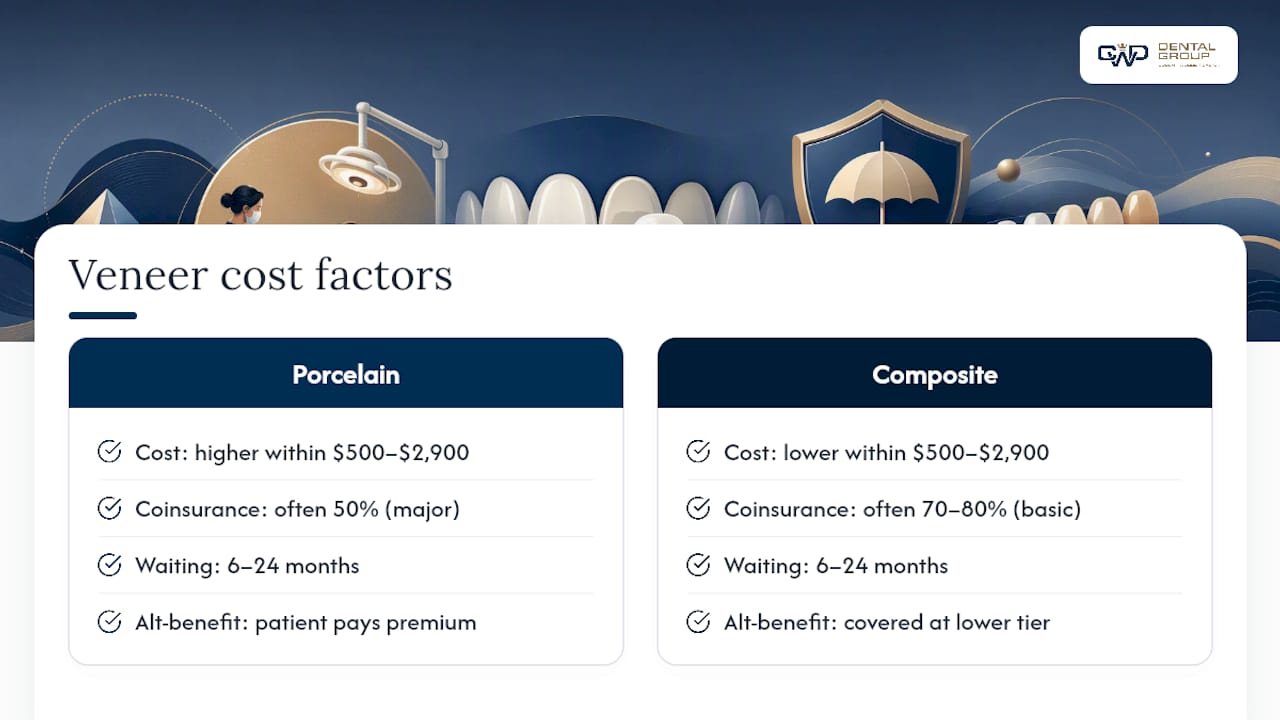
Even approved restorative claims run through a coinsurance structure. Major restorative work commonly falls in a benefit tier paying 50% coinsurance, while basic restorative procedures might pay 70-80%. Layer on waiting periods of 6 to 12 months before major work is covered at all, sometimes stretching to 24 months on newer policies, and the math gets complicated fast.
Notice the third row. That's the alternative-benefit rule at work: even a legitimate restorative case can leave you covering most of the porcelain premium yourself.
If Insurance Won't Pay: HSA, FSA, Discount Plans, and Financing
When coverage falls through, three routes can still cut your cost meaningfully.
- HSA or FSA funds can cover veneers, but only when the procedure qualifies as a medical expense rather than a cosmetic one under your account's rules. Save your dentist's clinical notes and any diagnostic photos, since administrators sometimes request proof the procedure treats or prevents disease before releasing funds.
- Dental discount plans aren't insurance. You pay an annual membership, typically $50 to $200, in exchange for negotiated fee reductions at participating dentists, and there's no waiting period to worry about.
- Financing options include in-office payment plans through your dentist, third-party medical credit cards like CareCredit, and personal financing through your bank. In-office plans tend to work best for smaller balances; third-party credit makes more sense for a full-mouth case spanning several thousand dollars.
Our financing options guide walks through how to compare these routes side by side before committing to one.
Your Pre-Treatment Checklist: What to Ask and What to Collect
- Ask your insurer which CDT codes your plan covers for veneers and whether an alternative-benefit clause applies.
- Ask about your remaining annual maximum, any active waiting period, and whether a missing-tooth clause could disqualify your case.
- Request a written treatment plan from your dentist listing the exact codes, clinical rationale, and diagnostic photos or X-rays.
- Submit a predetermination request before scheduling treatment, not after.
- Keep copies of everything. Our consultation preparation guide outlines exactly what to bring to that first appointment.
How CWD Dental Group Helps Patients Navigate Coverage
Patients calling our Tallahassee office about veneers get the same question first: cosmetic or restorative? That answer shapes everything, including which CDT code we submit and whether a predetermination makes sense before treatment. Our team builds out detailed treatment plans with clinical photos and rationale attached, submits predeterminations on your behalf, and helps draft appeal letters when a claim comes back denied. We also offer same-day emergency appointments for the trauma cases, fractured teeth and failed restorations, that most often qualify for actual coverage. For readers weighing whether their case fits the definition of cosmetic vs. restorative dentistry, that distinction is where the whole process starts.

The Gap Between What Insurance Promises and What It Pays
Here's what most guides on this topic get wrong: they treat "does my plan cover veneers" as a yes-or-no question. It isn't. It's a coding, documentation, and negotiation question, and the patients who get the best outcomes are the ones who treat it that way from the first phone call.
The alternative-benefit rule is the part nobody warns you about upfront. You can do everything right, get a legitimate trauma diagnosis, submit clean documentation, receive an approval letter, and still owe the difference between what a composite filling costs and what your porcelain veneer actually cost. That's not a loophole insurers hide. It's printed in the plan document, and almost nobody reads that far.
If there's one thing to prioritize, it's the predetermination request. Skip it, and you're gambling with a bill that could run into four figures. File it first, and you know the real number before you sit in the chair.
— Kayle
Ready to Find Out What Your Plan Actually Covers?
If a fracture, worn enamel, or a failed old restoration is behind your interest in veneers, the fastest way to know your real cost is a hands-on evaluation, not another phone call to your insurer's call center. CWD Dental Group builds the treatment plan, applies the correct CDT code, and files the predetermination request before you commit to anything.
Our Tallahassee office also handles same-day emergency visits for exactly the kind of trauma and fracture cases that tend to qualify for restorative coverage, so a chipped tooth doesn't have to wait weeks for an appointment while you're stuck guessing about cost. If your case doesn't clear the medical-necessity bar, our team can still walk you through financing and payment plan options that make porcelain veneers affordable without insurance in the picture at all. Schedule a consultation with our emergency dental team to get a clear treatment plan, a real cost estimate, and help filing whatever paperwork your insurer requires.
This article is general information, not a substitute for advice from a qualified doctor. Consult a qualified healthcare professional about your own circumstances before acting on anything here.