

Dental insurance sometimes covers Invisalign, but only when your plan includes an orthodontic rider, and even then, it usually pays a percentage toward a capped lifetime maximum rather than the full bill. Coverage typically runs from a few hundred dollars to around $3,000 lifetime, depending on your plan. Data from OrthoFi and Align shows average insurer contributions near $1,772, with 92% of qualifying patients capped at $3,000 or less.
The single most useful thing you can do before starting treatment: verify your orthodontic benefits directly with your insurer and request a preauthorization in writing. Skipping this step is the number one reason patients get hit with a bill they didn't expect.
- Confirm your plan has an orthodontic benefit (not just general dental coverage)
- Ask specifically whether clear aligners are treated the same as traditional braces
- Request a written pre-treatment estimate before you sign a financial agreement
Key Takeaways
Invisalign coverage depends entirely on whether your plan includes an orthodontic rider, and verifying benefits before treatment starts is what prevents most surprise bills.
| Point | Details |
|---|---|
| Coverage isn't automatic | Invisalign is covered only under a plan's orthodontic benefit, not standard dental coverage. |
| Lifetime caps apply | Most plans cap orthodontic benefits between $1,000 and $3,000 for life, not per year. |
| Verify before you commit | Call member services, check the My Invisalign app, and request a written preauthorization. |
| Adults face tighter limits | Employer PPOs vary widely on adult orthodontic riders, so confirm rather than assume. |
| Cwddentalgroup handles the legwork | The Tallahassee practice verifies benefits, submits preauthorizations, and sets up payment plans for patients. |
Table of Contents
- How Dental Insurance Classifies and Pays for Invisalign
- What Does Invisalign Cost With Insurance?
- How Do You Verify Invisalign Insurance Coverage?
- What If Insurance Doesn't Cover Invisalign?
- Special Cases: Adults, Medical Necessity, and Changing Plans
- How CWD Dental Group Helps Tallahassee Patients Navigate Invisalign Coverage
- Where to Check Invisalign Coverage Details
- The Real Problem Isn't Coverage. It's Assumption.
- Get Your Invisalign Coverage Verified in Tallahassee
- Sources
How Dental Insurance Classifies and Pays for Invisalign
Invisalign gets paid through your orthodontic benefit, which is a separate line item from your standard dental coverage for cleanings, fillings, and crowns. If your plan doesn't list orthodontic coverage as a category, Invisalign generally isn't covered at all, no matter how good your regular dental benefits look on paper.
Plans that do include orthodontic coverage almost always attach a lifetime orthodontic maximum, typically ranging from $1,000 to $3,000. This cap applies once, for your entire life, regardless of how many rounds of orthodontic treatment you need.
Two other plan features change the math significantly:
- Waiting periods. Many plans require six to 12 months of active enrollment before orthodontic benefits kick in, so switching insurers mid-search can cost you.
- Age restrictions. A large share of orthodontic riders are written for dependents under 18, which is why children's Invisalign coverage tends to be more generous than adult coverage.
- Medical necessity exceptions. Cases tied to bite reconstruction or jaw alignment sometimes unlock coverage that a purely cosmetic request wouldn't get.
MetLife's guidance on orthodontic benefits recommends checking these three details in your plan document before assuming anything about what you'll pay.
What Does Invisalign Cost With Insurance?
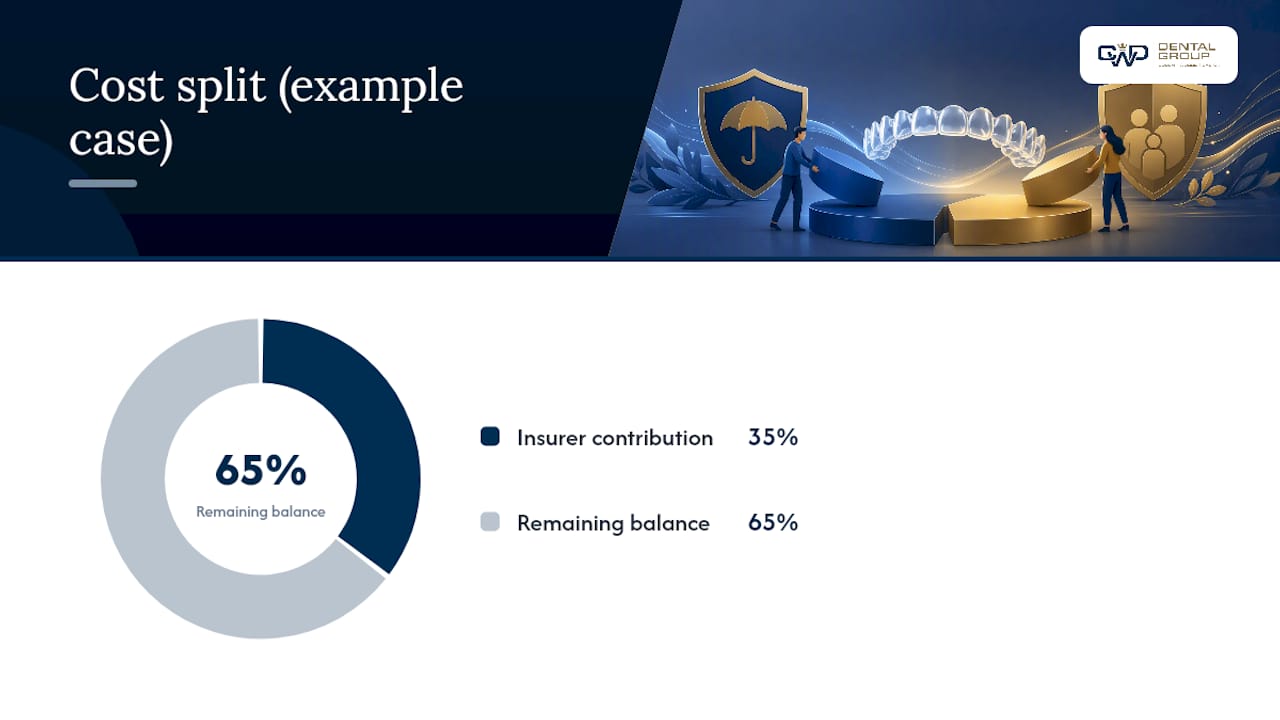
Invisalign typically runs $3,000 to $8,000 for a full course of treatment, depending on case complexity and your provider's location. With an orthodontic benefit in place, insurance usually knocks a meaningful chunk off that number, but rarely all of it.
Here's how the math tends to play out:
- Treatment cost: $5,000 (mid-range case)
- Insurer contribution: roughly $1,772 on average, per OrthoFi and Align data
- Remaining balance: around $3,228, before any payment plan or financing
That remaining balance is where deductibles and coinsurance matter. Some offices negotiate lower provider fees for insured patients, which can shrink the gap further, similar to how negotiated fees affect root canal costs.
Your actual contribution depends entirely on your specific plan's terms.
How Do You Verify Invisalign Insurance Coverage?
Verifying coverage before you start treatment takes maybe 20 minutes on the phone, and it's the difference between a predictable bill and an unpleasant surprise three months in.
- Call your insurer's member services line. Ask directly whether your plan covers orthodontic procedure codes D8080 (comprehensive orthodontic treatment for adolescents) or D8090 (comprehensive orthodontic treatment for adults). Ask about your lifetime maximum, any waiting period still active on your policy, and whether your provider needs to be in-network.
- Check your benefits portal and the My Invisalign app. Most insurers publish plan documents online, and the My Invisalign app can help estimate costs once you have a treatment plan from your provider. Neither replaces a phone call, but both speed up the process.
- Request a preauthorization or pre-treatment estimate. Ask your provider to submit this to your insurer before you commit to anything. Cigna specifically recommends this step because it locks in a written answer instead of a verbal guess from a call center rep.
- Review the EOB before signing. If coverage comes back limited or denied, ask about appeals, whether a spouse's plan can coordinate benefits, or whether a dental discount plan makes more sense.
Pro Tip: Save the confirmation number from every insurer call. If a claim gets denied later and the rep told you something different on the phone, that reference number is your evidence for an appeal.
What If Insurance Doesn't Cover Invisalign?
When your plan excludes clear aligners or caps out fast, you still have real options that don't involve paying full sticker price out of pocket.
- HSA or FSA funds. Invisalign qualifies as an eligible orthodontic expense, so pre-tax HSA or FSA dollars reduce your effective cost. Keep receipts and an itemized invoice from your provider for reimbursement.
- In-office payment plans. Most practices break the balance into monthly installments over the treatment period, often with no interest if paid on schedule.
- Third-party financing. Outside lenders offer longer terms, but read the contract for deferred-interest clauses that can spike your balance if a payment is late.
- Dental discount plans. These aren't insurance. You pay an annual membership fee for a negotiated discount rate, which can beat a weak insurance plan if your orthodontic benefit is thin or nonexistent.
Weigh these against a supplemental orthodontic policy if you're planning treatment more than a year out. Waiting periods make last-minute supplemental coverage nearly useless.
Special Cases: Adults, Medical Necessity, and Changing Plans
Adult coverage is genuinely less common than coverage for kids, mostly because employers choose whether to include an adult orthodontic rider at all. Some employer PPOs now offer it, but it's never guaranteed, so check your specific plan rather than assuming adult coverage matches a spouse's or coworker's.
- Medical necessity can unlock coverage that a purely cosmetic request wouldn't. Jaw surgery prep, severe bite reconstruction, or documented TMJ issues often need supporting notes from your dentist, not just a request form.
- Dual coverage between two dental plans (yours and a spouse's) can be coordinated to cover more of the lifetime max, but insurers coordinate benefits differently, so ask both companies how they calculate the split.
- Switching insurers mid-treatment resets waiting periods on the new plan and can leave you without orthodontic coverage for six to 12 months, even if your old plan was paying.
How CWD Dental Group Helps Tallahassee Patients Navigate Invisalign Coverage
Figuring out whether your plan covers Invisalign shouldn't require a insurance degree, and that's exactly the gap Cwddentalgroup's front office fills for Tallahassee patients.
- Insurance verification before treatment starts, so you know your estimated balance up front
- Preauthorization and pre-treatment estimate submissions handled by the office, not left to the patient
- Guidance on HSA and FSA documentation for orthodontic expenses
- Payment plan setup for whatever your insurance doesn't cover
Same-day emergency appointments and a patient-centered approach mean Tallahassee families don't wait weeks to get a straight answer on cost.
Pro Tip: Bring your insurance card and any prior orthodontic records to your first Invisalign consultation. It speeds up the preauthorization request significantly.
Where to Check Invisalign Coverage Details
- Invisalign's cost and insurance guidance covers payment options and the My Invisalign app
- Cigna's orthodontic insurance overview explains preauthorization steps
- Humana's Invisalign coverage page details common plan exclusions
- Checking in-network status before choosing a provider
The Real Problem Isn't Coverage. It's Assumption.
Most people don't get burned by bad insurance. They get burned by assuming their dental plan works like a friend's or a coworker's, when orthodontic riders vary wildly between employers, even within the same insurance carrier. The conventional advice, "just call your insurance," is technically correct and practically useless, because most reps read from a script that doesn't distinguish clear aligners from metal braces unless you ask the right question.

What actually matters is asking about procedure codes D8080 and D8090 by name, and getting a preauthorization in writing rather than a verbal estimate. That single habit, more than any amount of comparison shopping between plans, determines whether your final bill matches what you expected. Adults especially need to stop assuming their plan mirrors their kid's dependent coverage. It almost never does.
If you take one thing from this article, make it the phone call before the consultation, not after.
— Kayle
Get Your Invisalign Coverage Verified in Tallahassee
Instead of guessing what your insurance will actually pay, Cwddentalgroup handles the verification directly, calling your insurer, submitting the preauthorization, and reviewing the estimate with you before treatment starts.
That means no surprise balance after your third set of aligners arrives. The practice also walks patients through HSA and FSA documentation and sets up in-office payment plans for whatever your lifetime maximum doesn't cover. Same-day scheduling means you're not waiting weeks just to get a straight answer on cost. If you're in the Tallahassee area and ready to find out exactly what your plan covers, schedule a consultation with CWD Dental Group and get a written estimate before you commit to anything.
Sources
- Invisalign
- Orthodontics: What to Know About Braces for Kids and Adults | MetLife
- Does Dental Insurance Cover Orthodontics? | Cigna
- Does dental insurance cover Invisalign? | Humana