

With dental insurance, most patients pay a moderate out-of-pocket amount for the root canal procedure itself, and a higher out-of-pocket amount when you add a crown. Two caveats matter immediately: your annual maximum can cap what the insurer pays regardless of coverage percentage, and going out-of-network can add a balance-billing gap that your plan won't touch. Before you schedule anything, request a dated, itemized written estimate from your dentist (with ADA procedure codes) and ask your insurer for a formal predetermination in writing.
Quick note on crowns: Root canals and crowns are billed as two separate major procedures. Each one draws from the same annual maximum, so a single tooth can exhaust a $1,000–$1,500 yearly cap on its own. Plan for both costs from the start.
Key Takeaways
With dental insurance, most patients pay $200–$600 out of pocket for a root canal alone, and $500–$1,500 or more when a crown is added, depending on plan design, in-network status, and how much annual maximum remains.
| Point | Details |
|---|---|
| Typical out-of-pocket range | Root canal alone: $200–$600; root canal plus crown: $500–$1,500 with insurance. |
| Annual maximum is the hidden ceiling | A $1,000–$1,500 cap can be exhausted by a single root canal and crown combined. |
| In-network status changes the math | In-network providers eliminate balance billing; out-of-network adds a billed-vs-allowed gap you pay entirely. |
| Get a predetermination with ADA codes | A written insurer estimate before treatment is the only reliable way to know your actual patient share. |
| HSA/FSA reduces effective cost | Pre-tax dollars lower your net out-of-pocket by your marginal tax rate; HSA funds roll over year to year. |
| Cwddentalgroup verifies insurance upfront | The Tallahassee practice submits predeterminations, confirms allowed amounts, and provides written estimates before treatment. |
Table of Contents
- How dental insurance actually calculates what it pays
- Typical cost ranges by tooth type and how crowns are billed separately
- How to calculate your real out-of-pocket cost before you schedule
- How to get a reliable written estimate before treatment starts
- Practical ways to lower your out-of-pocket cost
- When you need an endodontist instead of a general dentist
- What to do if you can't afford a root canal right now
- How Cwddentalgroup helps patients get an accurate estimate before treatment
- Why predeterminations matter more than most patients realize
- Cwddentalgroup: insurance verification, endodontic care, and same-day appointments in Tallahassee
- Sources
How dental insurance actually calculates what it pays
Understanding the mechanics here saves you from sticker shock later. Most people assume their plan covers a straight percentage of the dentist's bill. It doesn't work that way.
The five terms that control your bill:
- Deductible: The fixed dollar amount you pay first before insurance contributes anything. Common individual deductibles run a moderate amount per year.
- Coinsurance / coverage percentage: The share your insurer pays after the deductible. For major services like root canals, Delta Dental notes that most plans cover 50%–80%, meaning you pay the remaining 20%–50%.
- Annual maximum / benefit cap: The ceiling on what your insurer will pay in a single benefit year. Once you hit it, you pay 100% of any additional work. Common caps sit at a moderate amount per year.
- Allowed amount (UCR / maximum allowable charge): The fee your insurer has decided is "reasonable" for a given procedure in your area. This is the number the coverage percentage applies to, not your dentist's billed fee.
- Waiting periods: Many plans impose a 6–12 month wait before covering major services. Treatment before the waiting period expires may be covered at a reduced rate or denied entirely, per NADP's overview of dental benefit design.
Why the allowed amount matters so much
Say your dentist charges $1,400 for a molar root canal. Your insurer's allowed amount for that procedure in your zip code is $1,100. The math:
- Insurer pays: 60% × $1,100 = $660
- You pay coinsurance: $440
- But if you're out-of-network, the dentist isn't bound by the allowed amount. That $300 gap ($1,400 billed minus $1,100 allowed) comes out of your pocket on top of the $440 coinsurance, for a total of $740.
In-network providers have contractual agreements to accept the insurer's allowed amount as full payment, which eliminates that extra gap entirely.
Policy language to look for in your plan documents:
- "Major restorative services" or "major services" (where root canals are usually classified)
- "Waiting period for major services"
- "Annual maximum benefit"
- "Allowed amount," "UCR," or "maximum allowable charge"
- "In-network" vs. "out-of-network" benefit levels
- "Pre-authorization" or "predetermination required"
Typical cost ranges by tooth type and how crowns are billed separately
The tooth's position in your mouth drives the base fee. Anterior (front) teeth have a single canal and are the least complex. Bicuspids (premolars) have one or two canals. Molars have three or four canals and take the most time, which is why they cost the most.
LegalClarity's analysis of dental insurance coverage confirms that root canals and crowns are treated as separate major services with different coverage levels, and their combined cost can exhaust a plan's annual maximum faster than most patients expect.
The table below shows typical uninsured fee ranges and illustrative out-of-pocket examples for a patient with a plan covering a typical percentage of major services after a moderate deductible and annual maximum. These are examples, not guarantees; your actual numbers depend on your plan's allowed amounts.
| Tooth type | Typical fee (no insurance) | Illustrative patient share (typical plan, in-network) |
|---|---|---|
| Anterior (front) | moderate fee range | moderate patient share range |
| Bicuspid (premolar) | moderate fee range | moderate patient share range |
| Molar | higher fee range | higher patient share range |
| Porcelain crown (any tooth) | moderate fee range | moderate patient share range (often partial coverage) |
A few things to note from these ranges. First, crowns often carry a lower coverage percentage than the root canal itself. A plan might cover the root canal at a higher percentage but the crown at a somewhat lower percentage. Second, both procedures count against the same annual maximum. A molar root canal plus a crown can easily total a few thousand dollars in billed fees, and if your annual maximum is around a typical cap, you'll hit the ceiling before the insurer covers its full share. Third, Humana's dental resources confirm that patients can use HSAs or FSAs to cover these out-of-pocket amounts, which reduces the effective cost by your marginal tax rate.
How to calculate your real out-of-pocket cost before you schedule
This is the math most dental offices won't walk you through unprompted. Run it yourself before you sit in the chair.
Step-by-step calculation:
-
Get an itemized estimate with ADA codes. Ask your dental office for a written fee estimate listing each procedure by its ADA code. A molar root canal is typically D3330; a porcelain crown is D2740 or D2750. Having the codes means your insurer can look up the exact allowed amount.
-
Request your insurer's allowed amount for each code. Call the member services number on your insurance card and ask: "What is your allowed amount for ADA code D3330 at an in-network provider in my zip code?" Write it down with the representative's name and the date.
-
Check your deductible status. Ask: "How much of my deductible have I met this year?" If you haven't met it, subtract the remaining deductible from the insurer's payment before calculating.
-
Check your remaining annual maximum. Ask: "How much of my annual maximum benefit is still available?" If you've already used $800 of a $1,500 cap, only $700 remains for the insurer to pay.
-
Apply the coverage percentage to the allowed amount. Multiply the allowed amount by the plan's coverage percentage for major services. That's the insurer's share, subject to the remaining annual maximum.
-
Add any billed vs. allowed gap if out-of-network. If your dentist is out-of-network, subtract the allowed amount from the billed fee and add that difference to your patient share.
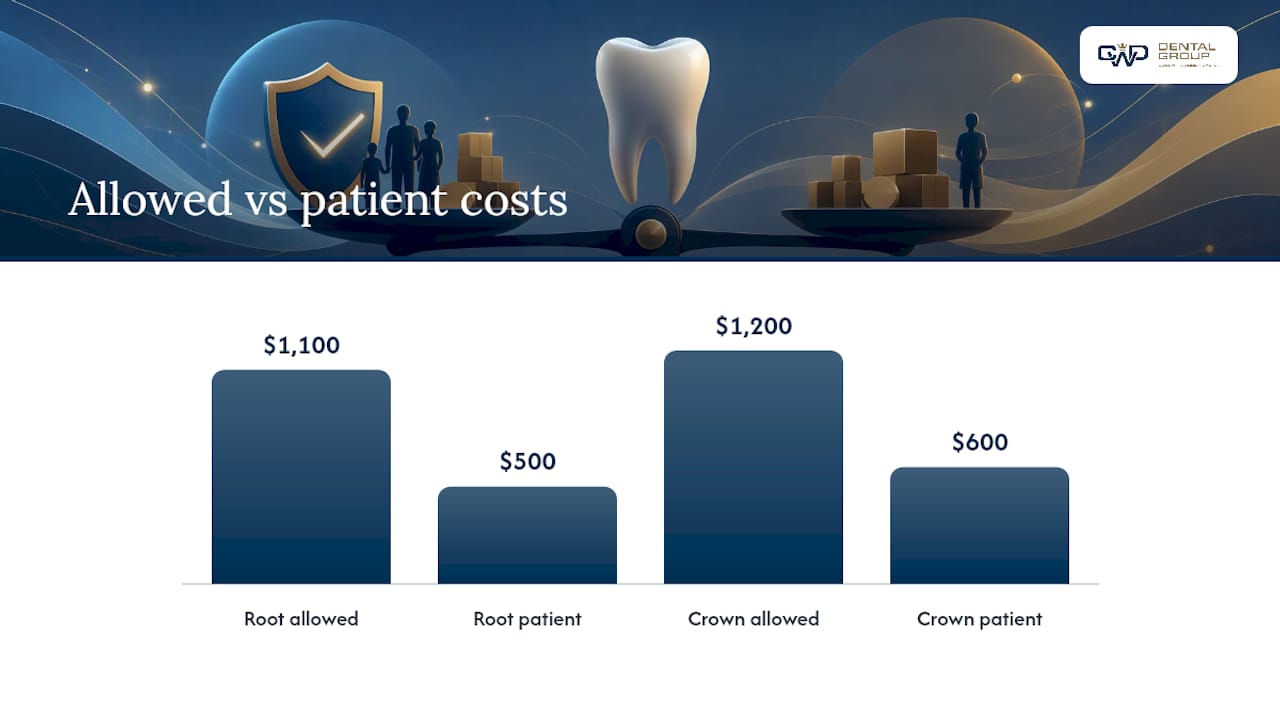
Worked example: Molar root canal + crown, in-network
- Molar root canal billed fee: $1,300 | Insurer's allowed amount: $1,100
- Crown billed fee: $1,400 | Insurer's allowed amount: $1,200
- Annual maximum: $1,500 | Deductible remaining: $100
- Root canal coverage: 60% | Crown coverage: 50%
Root canal math: Allowed amount: $1,100 minus $100 deductible = $1,000 subject to coverage. Patient pays $400 + $100 deductible = $500.
Crown math: Allowed amount: $1,200. Insurer has $1,500 max minus $600 already paid = $900 remaining. But only $900 remains, so the full $600 is covered.
Total patient out-of-pocket: $500 + $600 = $1,100.
If the annual maximum had been $1,000 instead of $1,500, the insurer's payments would have been capped at $1,000 total, and the patient would have owed $1,300 or more.
Pro Tip: Request the insurer's allowed amount in writing, not just verbally. Ask the dental office to submit a predetermination using the specific ADA codes before treatment begins. A predetermination is the insurer's written estimate of what it will pay, and it locks in the math before you're committed to the chair.
How to get a reliable written estimate before treatment starts
A verbal quote from the front desk is not the same as a predetermination. The difference matters.
An informal estimate is based on the office's experience with your plan. It can be wrong. A predetermination (also called a pre-authorization or pre-treatment estimate) is a formal written response from your insurer that states exactly what it will pay for the planned procedures, based on the submitted ADA codes, your current deductible status, and your remaining annual maximum. It's not a guarantee of payment, but it's far more accurate than any verbal estimate.
What to request from the dental office:
- A written, itemized fee estimate listing each ADA procedure code, the tooth number, the crown material (porcelain, zirconia, PFM), and any anticipated additional procedures like a buildup (D2950) or post (D2952)
- Confirmation that the office will submit a predetermination to your insurer before scheduling the procedure
- A note on whether the crown will be placed in the same benefit year as the root canal (this affects how much annual maximum is available)
Sample script for your call or email to the dental office:
Pro Tip: When the predetermination comes back from the insurer, check the date on the letter and ask for a reference number. Predeterminations typically reflect your benefit status at the time of submission. If your deductible resets or your annual maximum changes before treatment, the numbers can shift. Verify the crown's timing separately if it's planned for a different appointment.
Practical ways to lower your out-of-pocket cost
The biggest lever is provider network status, but there are several others worth knowing.
Concrete cost-reduction strategies:
- Stay in-network. An in-network provider's contracted rate eliminates balance billing and ensures the insurer's allowed amount is the ceiling, not a floor.
- Ask about crown material options. A porcelain-fused-to-metal crown is typically less expensive than full zirconia. For back teeth, the material difference can be $200–$400, and your insurer may cover the same percentage regardless of material.
- Request an office payment plan. Many practices offer in-house financing or work with third-party financing programs. Ask specifically about interest rate, deferred payment terms, and what happens if insurance pays less than expected.
- Spread treatment across two benefit years. If your annual maximum is $1,500 and the combined cost will exceed it, consider scheduling the root canal in December and the crown in January. Each procedure draws from a separate year's maximum.
- Use a dental school. Accredited dental school clinics perform root canals at significantly reduced fees under faculty supervision. The AAE's clinical guidance confirms that root canal therapy is a well-established procedure, and dental school endodontic departments handle complex cases routinely.
- Check community health centers. Federally Qualified Health Centers (FQHCs) offer sliding-fee dental services based on income. HRSA's health center finder at findahealthcenter.hrsa.gov can locate one near you.
- Discount dental plans. These are not insurance. They're membership programs that give you access to reduced fees at participating dentists. If you have no insurance, they can cut costs meaningfully, but they don't interact with insurance benefits.
HSA and FSA: the tax-advantaged option
Humana's dental resources confirm that HSA and FSA funds can be used to pay for root canal and crown out-of-pocket costs. FSA funds must typically be used within the plan year, while HSA balances roll over indefinitely, making them well-suited for saving toward high-cost procedures.
Statistic to know: Aflac's dental insurance resources note that dental insurance coverage levels vary widely, often 40%–80% depending on plan design, and waiting periods and annual limits can materially change what a patient pays. Checking these terms before enrolling in a plan is as important as checking the premium.
When you need an endodontist instead of a general dentist
Most general dentists perform root canals on anterior teeth and straightforward premolars. Complex cases get referred out.
Scenarios that typically favor an endodontist:
- Molar root canals with curved, calcified, or extra canals
- Retreatment of a previously treated tooth that has re-infected
- Surgical procedures like an apicoectomy (removal of the root tip)
- Cases where the general dentist's imaging suggests unusual anatomy
- Any case where the general dentist refers you directly
The AAE's patient guidance on root canal treatment explains that endodontists specialize exclusively in the pulp and periapical tissues, and their additional training is specifically designed for complex cases.
What's typically included in the root canal fee vs. what's billed separately:
The root canal fee (D3310, D3320, or D3330 depending on tooth) usually covers the procedure itself: access, canal shaping, cleaning, and obturation (filling the canals). It does not include:
- The crown (billed separately, often D2740 or D2750)
- A buildup or core (D2950) if the remaining tooth structure is insufficient
- A post (D2952) if needed to retain the core
- Retreatment (D3346–D3348) if a previous root canal has failed
- Surgical apicoectomy (D3410–D3426)
Each of these additional codes applies separately to your annual maximum and may carry a different coverage percentage.
| Provider type | Typical root canal fee range | Common separate charges |
|---|---|---|
| General dentist | $700–$1,300 (anterior to premolar) | Crown, buildup, post |
| Endodontist | $900–$1,500 (all tooth types) | Crown (usually placed by general dentist), buildup, post, surgical fees |
A predetermination is especially important when a specialist is involved. Endodontists may or may not be in-network with your plan, and out-of-network specialist fees can be substantially higher than the insurer's allowed amount.
What to do if you can't afford a root canal right now
Skipping treatment has real consequences. An infected tooth doesn't resolve on its own, and extraction followed by an implant or bridge typically costs more over time than a root canal and crown.
Lower-cost resources:
- Dental schools: Reduced fees, faculty-supervised care, often with endodontic departments for complex cases
- FQHCs / community health centers: Sliding-fee scale based on income; find one at findahealthcenter.hrsa.gov
- Charitable programs: Organizations like Dental Lifeline Network provide care for people with disabilities, elderly patients, or those who are medically fragile
- Discount dental plans: Membership-based fee reductions, not insurance; useful if you have no coverage at all
- Office payment plans: Ask about 0% interest promotional periods and what happens if insurance pays less than the estimate
Root canal + crown vs. extraction: the real trade-off
For dental care budget planning, the math almost always favors saving the natural tooth when insurance is involved. The extraction looks cheaper today, but the replacement cost typically exceeds what a root canal and crown would have cost with coverage.
Short-term financing through the dental office or a third-party program can bridge the gap. Ask specifically: What is the interest rate after any promotional period? What is the payment schedule? Who is responsible if insurance pays less than estimated?
How Cwddentalgroup helps patients get an accurate estimate before treatment
At Cwddentalgroup in Tallahassee, the insurance verification process starts before you sit down. When you call to schedule, the team asks for your insurance card and plan ID, then contacts your insurer directly to confirm in-network status, your current deductible balance, remaining annual maximum, and the allowed amounts for the specific ADA codes your treatment will require.
For major restorative work like root canals and crowns, the office submits a predetermination to your insurer before scheduling the procedure. The written response from the insurer, with the reference number and date, becomes the basis for your written patient-share estimate. You'll know your expected out-of-pocket before you commit to the appointment.
What to bring to your appointment:
- Your insurance card (front and back)
- Your plan's summary of benefits (often available through your insurer's member portal)
- Any recent explanation of benefits (EOB) statements showing what you've already used toward your deductible and annual maximum
Cwddentalgroup offers same-day emergency appointments for patients with acute tooth pain who can't wait for a scheduled slot. If you're in pain now and need to understand your coverage quickly, the team can verify your insurance and give you a written estimate the same day. The practice also provides full endodontic services, including root canal therapy and retreatment, so referrals to an outside specialist aren't always necessary.
Pro Tip: If you're approaching the end of your benefit year with unused annual maximum remaining, ask the office whether scheduling before December 31 makes sense for your situation. Using remaining benefits before they reset is one of the most straightforward ways to reduce your net cost.
Why predeterminations matter more than most patients realize
From a provider's perspective, the predetermination step isn't bureaucratic friction. It's the only way to give a patient a number they can actually rely on.
When a dental office submits a predetermination using specific ADA codes and tooth numbers, the insurer reviews the planned treatment against the patient's current benefit status and returns a written estimate of what it will pay. That document aligns the office, the insurer, and the patient on the same set of numbers before anyone picks up a handpiece. Without it, the office is estimating based on general plan knowledge, which can be wrong by hundreds of dollars in either direction.
Predeterminations are routine. Insurers process them regularly, and most respond within 5–10 business days. Requesting one isn't a sign of distrust toward the dental office; it's standard practice for any major procedure. It protects the patient from unexpected balance billing and gives the office a clearer picture of what the patient will owe, which makes payment conversations easier for everyone.
Cwddentalgroup: insurance verification, endodontic care, and same-day appointments in Tallahassee
Root canal cost with insurance is manageable when you have a practice that handles the verification work upfront. Cwddentalgroup does exactly that: the team confirms your in-network status, submits predeterminations with ADA codes, and gives you a written patient-share estimate before treatment begins, so there are no billing surprises after the fact.
The practice offers full endodontic services, including root canal therapy and retreatment, alongside same-day emergency appointments for patients in acute pain. If you're dealing with a toothache that can't wait, the emergency dentist team is available for same-day care and can verify your insurance on the spot.
Ready to know your actual out-of-pocket before you commit? Schedule a visit and bring your insurance card and plan documents. The office will handle the predetermination and give you a dated written estimate. Actual coverage and patient share depend on your specific plan; a predetermination is the most reliable way to confirm your numbers.
Sources
The following sources informed the cost ranges, plan mechanics, and clinical guidance in this article. Each is worth bookmarking if you want to verify plan-level rules or learn more about your specific coverage.
- Root canals — Humana dental resources
- Root canal treatment — Delta Dental
- Root canal treatment — AAE
- Understanding dental benefits — NADP
Check your own plan's Summary of Benefits and Coverage document for the exact terms that apply to you, and always request a predetermination before any major dental procedure.
This article is general information, not a substitute for advice from a qualified doctor. Consult a qualified healthcare professional about your own circumstances before acting on anything here.