

Emergency dental care costs more because it demands immediate clinical readiness, higher-risk procedures, same-day diagnostics, and after-hours staffing — all before a single treatment begins. When a tooth fractures at 11 PM or an abscess swells over a weekend, the practice has to mobilize resources that routine appointments never require.
The core cost drivers, in order of impact:
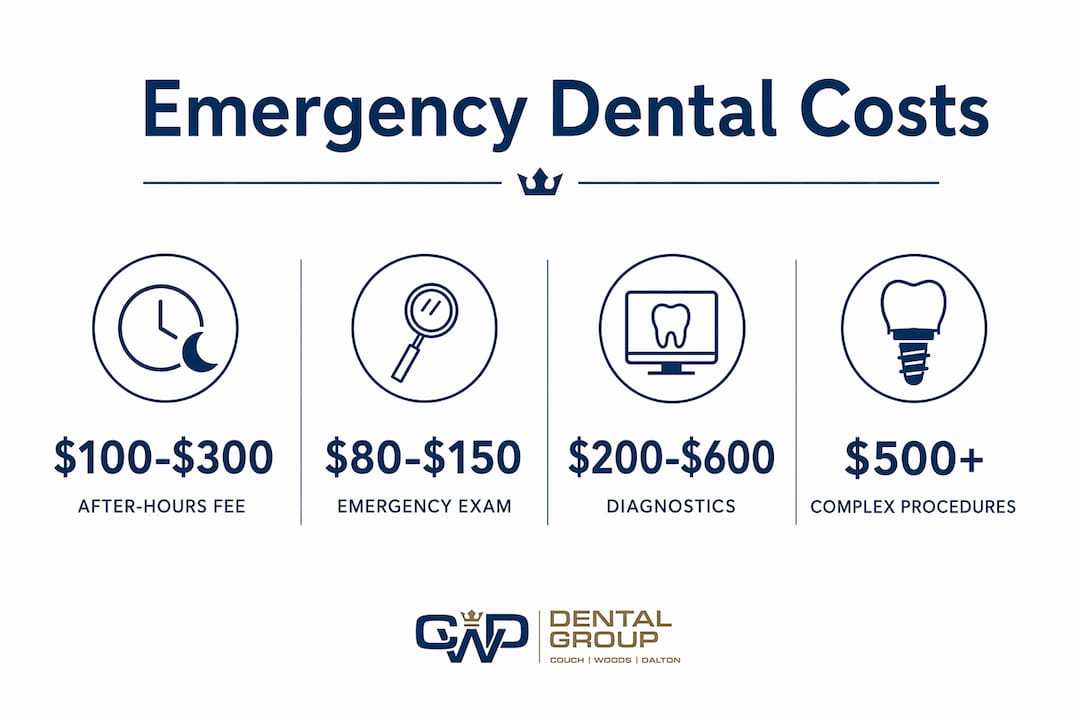
- After-hours and urgency surcharges (ADA code D9440): typically $100–$300 on top of exam and treatment fees
- Clinical complexity: infected, fractured, or traumatized teeth often need root canals, surgical extractions, or drainage rather than a simple filling
- Same-day diagnostics: fresh X-rays or CT imaging required when no recent records exist
- On-call staffing and overhead: overtime pay, sterilization readiness, and rapid room turnover
- Severity on arrival: delayed treatment escalates what could have been a $200 filling into a $1,800+ root canal and crown
The American Dental Association reports that emergency department visits for dental problems average $749 per non-hospitalized patient, while typical emergency dental office visits (exam, X-ray, and basic treatment for self-pay patients) cost about $300–$600 including after-hours surcharges. The CDC tracks dental emergency visits as a significant public health cost, particularly for uninsured and Medicaid patients. Cwddentalgroup, based in Tallahassee, Florida, offers same-day emergency appointments specifically to keep patients out of the ER and reduce that cost gap.
Table of Contents
- Why emergency dental care costs more: a breakdown of every charge
- What you will likely be billed for: common procedures and price ranges
- How insurance and payment options change what you actually pay
- ER or dentist? How to triage a dental emergency and what it costs you
- How to lower the chance of facing emergency-level dental bills
- What to expect when you come to Cwddentalgroup for a dental emergency
- Key Takeaways
- The real reason emergency dental costs feel so high
- Same-day emergency dental care in Tallahassee, without the ER bill
- Useful sources and further reading
Why emergency dental care costs more: a breakdown of every charge
Understanding each line item on an emergency dental bill removes the shock. Here is where the money actually goes.
After-hours and urgency premiums
Most practices bill a separate access fee under ADA code D9440 when you call outside normal hours. This after-hours surcharge commonly runs $100–$300 and covers the cost of recalling staff, keeping the operatory ready, and running utilities for a single unscheduled visit. It is billed in addition to the exam, imaging, and any treatment performed. Many patients are surprised to see four separate line items on a bill for what felt like one visit.
Solo practices tend to charge higher after-hours premiums than group practices because a single provider must physically return to the office and absorb the full labor cost alone. Group practices can rotate on-call duty across multiple clinicians, spreading the burden.
Pro Tip: If you are an established patient, call the office during triage and ask whether the after-hours surcharge can be reduced or waived when definitive treatment is scheduled immediately. Many practices will negotiate this — but only if you ask before the appointment, not after.
Clinical complexity and risk
A routine filling takes 30–45 minutes and carries minimal risk. A same-day root canal on an acutely infected molar requires local anesthesia management in an inflamed field (which resists numbing), sterile endodontic instrumentation, and often a temporary crown placement. The procedure is longer, the materials cost more, and the clinical risk is higher. That complexity is priced accordingly.
Severity on arrival is the biggest multiplier. Patients who delay treatment face escalating procedure costs — what starts as a small cavity that needed a $200 filling can become a root canal plus crown running $1,800–$5,000 if infection sets in. Waiting rarely saves money.
Diagnostics and equipment
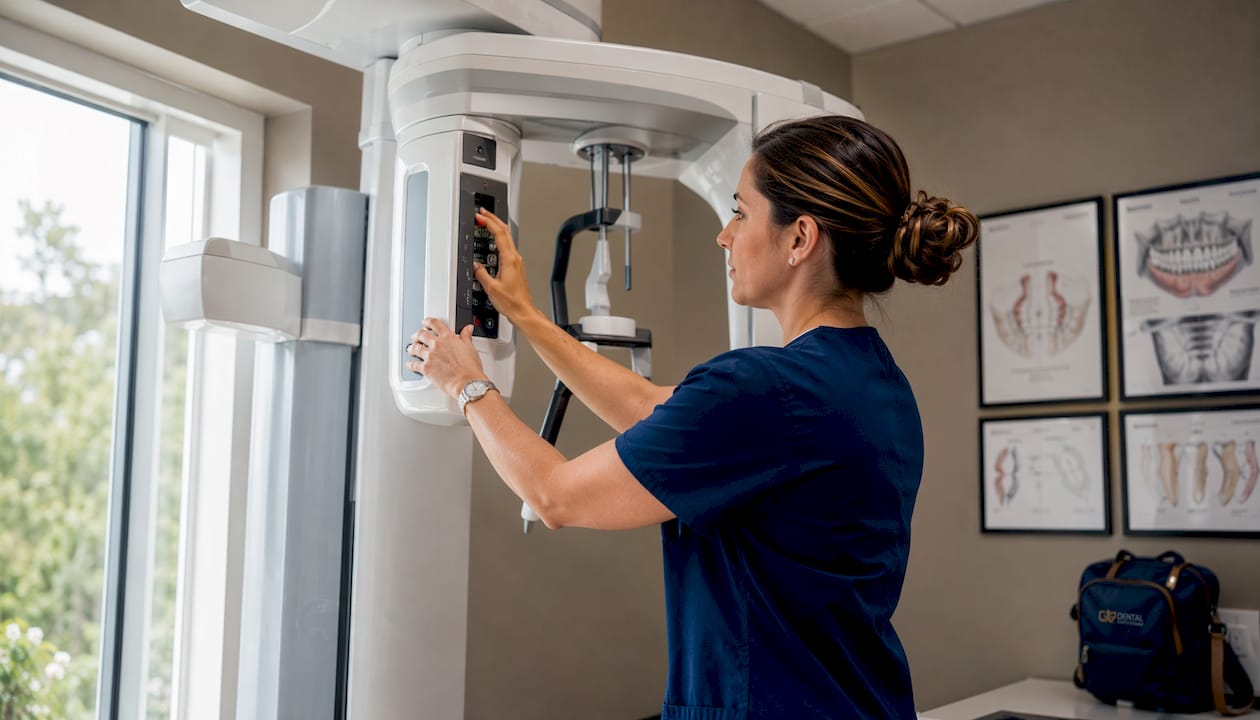
Emergency visits almost always require same-day imaging because the practice either has no recent records for a new patient or the condition has changed enough that old images are clinically useless. A single periapical X-ray (D0220) incurs an additional diagnostic fee. A full-mouth series or cone-beam CT, needed for complex fractures or implant planning, costs considerably more. The equipment itself — a digital X-ray unit runs tens of thousands of dollars — is part of the overhead built into every visit fee.
Staffing, overhead, and liability
Running an emergency-ready practice means paying for readiness even on quiet nights. That includes on-call compensation, sterilization cycles kept current, single-use surgical supplies stocked and rotated, and malpractice insurance premiums that reflect the higher-risk nature of urgent procedures. None of that overhead disappears when the phone does not ring. It is distributed across every emergency visit that does happen.

What you will likely be billed for: common procedures and price ranges
The table below shows typical U.S. no-insurance price ranges for the most common emergency dental services. Actual costs vary by region, provider type, and whether the visit falls outside normal hours.
| Procedure | ADA Code | Typical U.S. Range (no insurance) |
|---|---|---|
| Limited emergency exam | D0140 | $80–$150 |
| Single periapical X-ray | D0220 | $30–$60 |
| After-hours access fee | D9440 | $100–$300 |
| Palliative/temporary filling | — | $75–$150 |
| Simple extraction | — | $100–$300 |
| Surgical extraction | — | $200–$600 |
| Root canal — anterior tooth | — | $700–$1,200 |
| Root canal — molar | — | $900–$1,500 |
| Porcelain crown (post-root canal) | — | $1,000–$2,000 |
| Incision and drainage (abscess) | — | $100–$300 |
A self-pay patient who needs an exam, one X-ray, and basic treatment can expect a total emergency visit in the range of $300–$600 during normal hours. Add the after-hours surcharge and that floor rises to $400–$900 for a weekend or late-night call.
The most severe emergencies push costs considerably higher, such as procedures like surgical extraction with implant or molar root canal combined with a porcelain crown.
Ranges vary significantly by geography, provider type, and insurance status. Always ask for an itemized written estimate before treatment begins.
How insurance and payment options change what you actually pay
Dental insurance helps, but it rarely covers everything — and the billing structure of emergency visits creates specific gaps worth knowing about.
What dental insurance typically covers:
- Limited emergency exams (D0140) are usually covered at 80–100% after the deductible
- Diagnostic X-rays (D0220) are generally covered as a diagnostic benefit
- After-hours surcharges (D9440) are frequently not covered or are covered at a lower percentage — call your insurer before the visit
- Definitive treatment (root canals, extractions, crowns) is subject to your annual maximum, deductible, and the plan's coverage tier (basic vs. major)
- Annual maximums of $1,000–$2,000 are common; a single molar root canal and crown can exhaust that limit entirely
Medical insurance and the ER trap:
Going to a hospital ER for tooth pain triggers a facility fee, a physician fee, and possibly specialist charges — all billed under medical insurance, not dental. The ADA reports that dental ER visits average $749 per non-hospitalized patient compared to $300–$600 for an emergency dental office visit, and total $1.6 billion annually. Your medical deductible may be $1,500 or higher, meaning you pay most of that out of pocket before insurance contributes anything.
Practical payment options:
- FSA/HSA funds: dental emergency costs qualify; use them to pay before year-end deadlines
- CareCredit-style financing: deferred-interest plans allow you to spread costs over 6–24 months; ask the office before treatment
- Dental savings plans: membership-based discount programs (not insurance) that reduce fees 10–60% at participating offices
- In-office payment plans: many practices offer these for established patients — ask during triage
- Dental school clinics: supervised student care at significantly reduced rates, though scheduling is less flexible for true emergencies
- Sliding-fee community health centers: HRSA-funded clinics charge on a sliding scale based on income
Six questions to ask before or during an emergency:
- Is the after-hours surcharge (D9440) covered under my plan?
- What ADA billing codes will you submit for this visit?
- Does my plan require pre-authorization for crowns or surgical extractions?
- Is this provider in-network for my dental insurance?
- Do you offer a payment plan or financing for same-day treatment?
- Can you provide an itemized estimate before we start?
Being an established patient matters here. Some practices waive or reduce the after-hours surcharge for existing patients, and your insurer may process claims faster when records are already on file.
ER or dentist? How to triage a dental emergency and what it costs you
Choosing the wrong venue for a dental emergency can double your bill and still leave the problem unsolved.
Go to the ER immediately if you have:
- Difficulty breathing or swallowing due to spreading swelling
- Facial swelling that has crossed the jaw line or is closing your airway
- Uncontrolled bleeding that does not slow after 20 minutes of pressure
- Suspected jaw fracture after trauma
- High fever (above 101°F) combined with facial swelling and tooth pain
Call a dentist first for:
- Severe toothache or throbbing pain without systemic symptoms
- Cracked, chipped, or broken tooth
- Knocked-out tooth (a dentist can attempt reimplantation within 30–60 minutes of the injury)
- Lost filling or crown
- Dental abscess without spreading swelling or fever
The cost difference is stark. An ER visit for a dental complaint typically generates facility fees of $1,100–$3,200 — and the ER will almost always send you home with antibiotics and a referral, not a filling or extraction. In contrast, most emergency dental office visits with basic treatment cost about $300–$600. ERs lack the drills, endodontic instruments, and dental-specific setup to perform definitive treatment. You pay ER prices and then still need a dentist. That is two bills for one problem.
An urgent care clinic is a cheaper bridge at $100–$300 for antibiotic and pain prescriptions, but the same limitation applies: no definitive dental work. You will need a dentist regardless.
Practical steps when a dental emergency hits:
- Call your dentist's emergency line first, even after hours — most practices have a recorded message with on-call instructions
- Describe your symptoms clearly: location of pain, swelling, fever, bleeding, and when it started
- If a tooth is knocked out, store it in milk or saliva (not tap water) and get to a dentist within an hour
- Apply a cold compress to reduce swelling while you wait; learn more about managing swelling at home
- If you cannot reach a dentist and symptoms suggest spreading infection, go to the ER for stabilization — then follow up with a dentist the next day
For help finding after-hours dental care quickly, the guide on how to find an after-hours emergency dentist walks through the fastest options by time of day.
How to lower the chance of facing emergency-level dental bills
Prevention is not a cliché here. The math is straightforward: a $200 filling now versus a $2,500 root canal and crown later.
Routine prevention:
- See a dentist every six months for a cleaning and exam; early decay caught at this stage costs a fraction of what it costs once it reaches the nerve
- Ask your dentist to take bitewing X-rays annually — small cavities between teeth are invisible without them
- Wear a night guard if you grind your teeth; cracked molars from bruxism are a leading cause of emergency visits
- Regular family dental visits catch problems before they escalate for every member of the household
Immediate steps after dental trauma:
- Save a knocked-out tooth by placing it in milk or between your cheek and gum — do not scrub the root
- Apply a cold compress for 10–15 minutes to reduce swelling; avoid heat
- Avoid hard foods on a cracked or sensitive tooth until you see a dentist
- Call the office the same day, even for a chip that does not hurt — cracks propagate
Financial planning:
- Use your annual dental maximum before it resets; most plans run on a calendar year
- Fund an FSA or HSA at the start of the year so emergency costs are covered with pre-tax dollars
- Pre-authorize crowns and surgical procedures when your dentist recommends them proactively — waiting until it becomes an emergency removes that option
What to expect when you come to Cwddentalgroup for a dental emergency
Cwddentalgroup offers same-day emergency appointments in Tallahassee for patients who need immediate attention. The practice is built around reducing wait time and getting patients out of pain efficiently, without the cost and limitations of an ER visit.
What the process looks like:
- Phone triage: call the office and describe your symptoms; the team will assess urgency and get you scheduled same-day
- Exam and diagnostics: a limited exam (D0140) and same-day X-rays identify the source of the problem quickly
- Immediate palliative care: pain control and stabilization happen first — the goal is to stop the emergency, then plan definitive treatment
- Same-day or staged treatment: depending on complexity, the dentist may complete the procedure in one visit or schedule a follow-up for more involved work (root canal, crown)
- Payment and financing: the team discusses costs and financing options before treatment begins, so there are no surprises
The practice follows ADA-recommended infection-control and sterilization standards for all emergency procedures. Services available for dental emergencies include extractions (simple and surgical), root canal therapy, drainage of abscesses, temporary restorations, and trauma management. Cwddentalgroup also serves veterans and families with children, so the same-day emergency capability extends across all patient groups.
For patients who want to know more about the clinical team, Dr. Chance Dalton's profile outlines his training and approach to emergency care. If you are unsure whether your situation qualifies as a dental emergency, the guide on what is a dental emergency covers the most common signs and next steps.
Key Takeaways
Emergency dental care costs more because of after-hours staffing, same-day diagnostics, and the clinical complexity that delayed treatment creates — but choosing a dental office over the ER and acting early are the two most effective ways to control that cost.
| Point | Details |
|---|---|
| After-hours surcharges add up fast | The D9440 access fee ($100–$300) is billed separately from exam, imaging, and treatment fees. |
| ER visits cost far more for less | ADA data puts average dental ER visits at $749 vs. $300–$600 at a dental office, with no definitive treatment provided in the ER. |
| Delayed treatment escalates cost | A filling left untreated can become a root canal and crown, adding more than $1,600 to the total bill. |
| Ask six key questions before treatment | Confirm surcharge coverage, billing codes, in-network status, and financing before the procedure starts. |
| Cwddentalgroup offers same-day care | Same-day emergency appointments in Tallahassee provide exam, diagnostics, and stabilization without ER-level fees. |
The real reason emergency dental costs feel so high
Most patients assume the price spike is about profit. Having seen how emergency dental care actually works, the more accurate explanation is structural: a practice that can see you at 9 PM on a Saturday has been paying for that capability every day of the year, whether the phone rings or not. The on-call dentist, the stocked operatory, the sterilized instruments sitting ready — none of that is free, and none of it appears on a routine appointment bill because routine appointments are scheduled around normal operating costs.
What actually frustrates me about how this topic gets discussed is the focus on the after-hours surcharge as the villain. That $100–$300 fee is visible and easy to resent. The real cost driver is almost always the procedure itself, and the procedure is almost always more expensive than it needed to be because the patient waited. A cracked tooth that hurt for three weeks before the patient called is not an emergency because of bad luck. It is an emergency because early treatment was deferred. That is where the money goes.
The practical takeaway is not "avoid emergency dentists." It is: use preventive care to stay out of emergency situations, and when an emergency does happen, call a dental office before the ER. The cost difference is significant, and the treatment you receive at a dental office is actually definitive — not a prescription and a referral.
Same-day emergency dental care in Tallahassee, without the ER bill
When a tooth breaks or an abscess flares, the fastest path to real treatment — not just pain medication — is a dental office that can see you the same day. Cwddentalgroup provides same-day emergency appointments in Tallahassee, with on-site exam, imaging, and immediate stabilization for the most common dental emergencies.
Getting started is straightforward. Call the office, describe your symptoms, and the team will triage your situation and get you in. Bring your insurance card and a photo ID; the front desk will review payment and financing options with you before treatment begins, so you know the cost upfront. For patients without insurance, in-office financing is available.
Cwddentalgroup handles extractions, root canals, abscess drainage, trauma management, and temporary restorations — including advanced urgent implant and rapid replacement workflows detailed in Emergency Dental Implants Jacksonville FL — Fast, Comfortable Tooth Replacement Near You — all in one location, without the facility fees that come with an ER visit. Book your same-day emergency appointment or call the office directly to speak with the team.
Useful sources and further reading
The following sources informed this article. Each covers a distinct aspect of emergency dental costs in the United States.
- American Dental Association — Emergency Department Referrals: ADA data on ER visit costs for dental complaints, Medicaid utilization, and the cost comparison between ER and dental office care.
- RealDentalCosts.com — Emergency Dentist Cost, No-Insurance Prices: Detailed breakdown of no-insurance emergency visit costs, ADA billing codes (D0140, D0220, D9440), and itemized fee structures.
- ToothCostGuide — After-Hours Dentist Cost: Explains after-hours surcharge ranges, how solo vs. group practices price on-call availability, and when surcharges may be waived.
- ToothCostGuide — Urgent Care for Tooth Pain Cost: Covers urgent care clinic costs ($100–$300) and their limitations for definitive dental treatment.
- DrSirin.com — Are Emergency Dentist Appointments More Expensive?: Explains clinical escalation from delayed treatment and the role of same-day imaging in emergency visits.
- DentCost.cc — Emergency Dental Care Costs: ER facility fee ranges ($1,100–$3,200) for dental complaints and the cost implications of receiving only palliative ER care.
- CareCredit — 12 Dental Emergencies and What You May Expect to Pay: National average cost data for common emergency procedures including root canals, crowns, extractions, and implants.
Prices vary by geography, provider, and insurance status. Ask your dentist for an itemized estimate before treatment begins, and verify coverage details directly with your insurer.