
The VA will pay for dental implants, but only if you fall into a specific eligibility class and a VA dentist determines implants are the clinically appropriate treatment. If neither condition applies, your realistic path is VADIP private coverage through Delta Dental or MetLife, where only the higher plan tiers typically include implants, and waiting periods plus annual caps will shape what you actually pay out of pocket.
Three things to check right now:
- Your VA dental eligibility class. Log into VA.gov or call your local VA dental clinic and ask which class you're enrolled under. Classes I, IIA, IIC, and IV open the door to comprehensive care, including implants. Most other classes do not.
- Whether you have a service-connected dental condition or a 100% disability rating. Either one can qualify you for comprehensive VA dental care regardless of other factors.
- Whether you're enrolled in VA health care or CHAMPVA. Both make you eligible to enroll in VADIP, the VA's discounted private dental insurance program, if free VA dental care doesn't apply to you.
Pro Tip: Before your first VA dental appointment, pull your VA rating decision letters and any prior dental records. Showing a documented history of dental problems related to your service or to a service-connected condition strengthens the case for clinical necessity, which is the key phrase that unlocks implant approval.
Table of Contents
- Which veterans qualify for free VA dental care?
- When will the VA actually pay for implants?
- How do VADIP plans from Delta Dental and MetLife cover implants?
- How to pursue implants step by step
- What are your options if implants aren't covered?
- Key Takeaways
- A local clinic's perspective on veterans and implants
- Cwddentalgroup serves veterans who need implants in Tallahassee
- Useful sources to check next
Which veterans qualify for free VA dental care?
The VA's dental eligibility system divides veterans into classes based on service history, disability ratings, and other qualifying conditions. The class you're in determines whether you get comprehensive care, limited care, or nothing at all through VA dental.
The classes that realistically lead to implant coverage are the ones that authorize "any needed dental care." That phrase matters because implants are a major restorative procedure, and a VA dentist can only approve them if the treatment is within the scope of what your class allows.
| Eligibility Class | Who Qualifies | Implant Outlook |
|---|---|---|
| Class I | 100% service-connected disability rating | Full coverage, including implants if clinically indicated |
| Class IIA | Service-connected dental condition rated compensable | Full coverage for the service-connected condition and related care |
| Class IIC | Dental condition aggravating a service-connected disability | Full coverage for conditions directly linked to the service-connected issue |
| Class IV | Prisoner of war (POW) veteran | Any needed dental care, including implants |
| Class II (one-time) | Dental condition present at discharge, treated promptly | One-time care only; implants are almost never approved under this class |
| Class III | Receiving VA care for a medical condition where dental care is medically necessary | Dental care tied to the medical condition only |
| Class V | Enrolled in VA health care but not otherwise eligible | No VA dental benefit; VADIP enrollment is the primary option |
Certain eligibility classes provide a stronger basis for implant approval, including classes that allow comprehensive dental care. Class II one-time care is limited to a narrow window after discharge and rarely covers something as involved as implant therapy. Class V veterans, which is a large portion of those enrolled in VA health care, have no free VA dental benefit at all and must rely on VADIP or private insurance.
Checking your class takes one phone call to your local VA dental clinic or a few minutes on VA.gov. Do it before you assume anything about what you're owed.
When will the VA actually pay for implants?
Being in a comprehensive-care eligibility class is necessary, but it's not sufficient. A VA clinician must also determine that implants are the most appropriate evidence-based treatment for your specific situation. That second condition is where many requests stall or get denied.
Why requests get denied
Legal analyses of VA dental policy show that the most common denial reasons are:
- The VA dentist judged a less invasive option, such as a removable denture or fixed bridge, to be equally effective
- Active periodontal disease or bone loss was unresolved at the time of the request
- The veteran's eligibility class doesn't authorize comprehensive care
- Insufficient documentation connecting the dental need to a service-connected condition
Typical implant timeline through VA care
Evaluation and records review → Treatment of gum disease, extractions, or infections → Bone grafting if needed (healing: 3–6 months) → Implant placement → Osseointegration (3–6 months) → Final prosthetic restoration
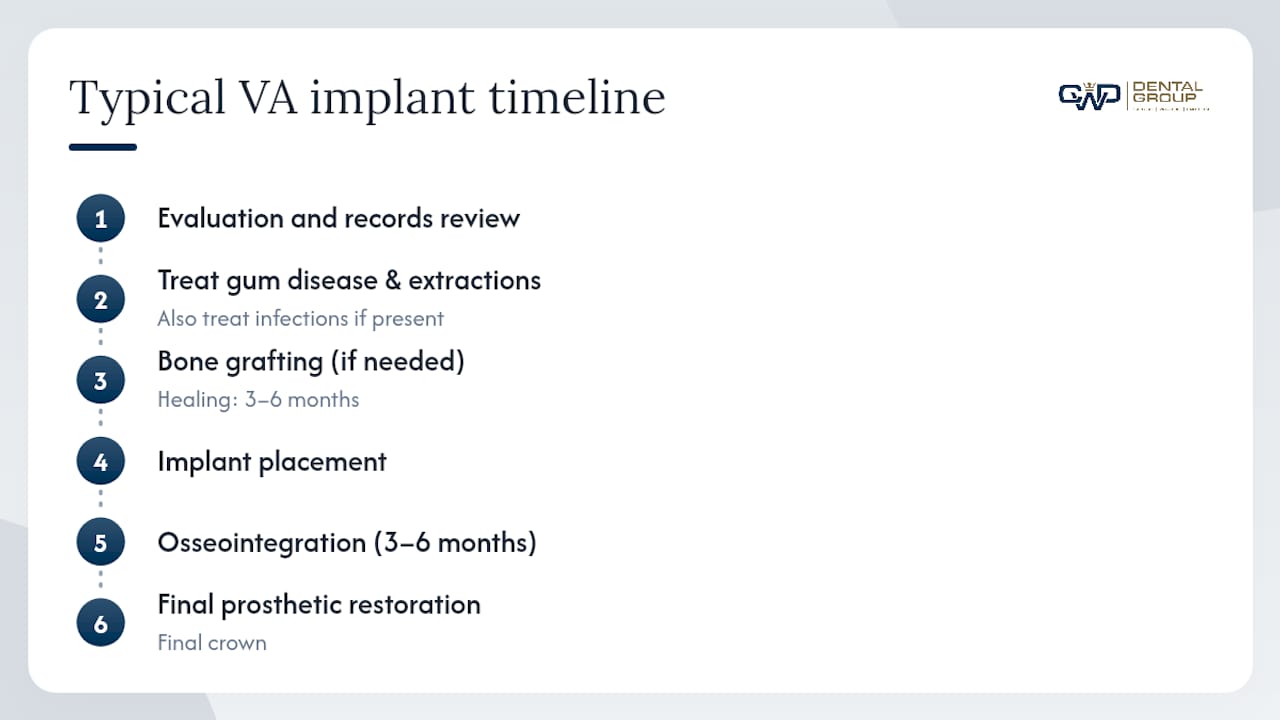
The full process from evaluation to final crown can take several months to over a year, especially if bone grafting is needed.
Pro Tip: If your implant request is denied, ask for a written explanation of the clinical reasoning. You have the right to request a second opinion from another VA dentist, and documenting that less invasive alternatives have already failed, or are contraindicated, significantly strengthens an appeal.
Some VA facilities are now using digitally designed custom subperiosteal implants for veterans with severe bone loss who couldn't qualify for traditional implants. If you've been told your bone volume is too low, ask whether your VA facility offers this option or can refer you to one that does.
How do VADIP plans from Delta Dental and MetLife cover implants?
VADIP is discounted private dental insurance, not a free VA benefit. Veterans enrolled in VA health care and CHAMPVA beneficiaries can enroll in VADIP plans offered by Delta Dental and MetLife. You pay a monthly premium, and the plan covers a portion of dental costs, including potentially implants, depending on the tier you choose.
VADIP is the primary fallback for veterans in Class V or any class that doesn't include free VA dental care.
VADIP plan comparison: Delta Dental vs MetLife
| Dimension | Delta Dental Enhanced | Delta Dental Comprehensive | Delta Dental Prime | MetLife Standard | MetLife High Option |
|---|---|---|---|---|---|
| Implants/Prosthodontics | Not included | Limited | Included | Limited | Included |
| Waiting period (major procedures) | Up to 9 months | Up to 9 months | Varies by plan | Up to 9 months | Reduced or waived |
| Annual maximum benefit | Lower | Mid-range | Higher | — | Up to $3,500 |
| In-network coverage | Higher % | Higher % | Higher % | Higher % | Higher % |
| Out-of-network coverage | Lower % | Lower % | Lower % | Lower % | Lower % |
Delta Dental's VADIP Prime plan is the tier most likely to include prosthodontic procedures like implants. MetLife's higher-option plan offers up to $3,500 in annual maximum benefits and no in-network deductible on certain tiers, which can meaningfully reduce out-of-pocket costs on a multi-stage implant case.
That said, even the top-tier VADIP plans have limits. According to the MetLife VADIP Plan Summary, waiting periods for major procedures and annual maximums mean a full implant case, which can cost $3,000–$6,000 or more per tooth in private practice, will likely exceed what any single plan year covers. Many veterans spread treatment across two plan years to maximize benefits.
What to look for when choosing a VADIP tier
- In-network dentists who place implants — Not every dentist in a VADIP network performs implant surgery. Confirm before you enroll.
How to pursue implants step by step
Path B: Through VADIP or private care
- Confirm VADIP enrollment eligibility — You must be enrolled in VA health care or be a CHAMPVA beneficiary.
Documents to have ready
- DD-214 (Certificate of Release or Discharge from Active Duty)
- VA rating decision letters
- Prior dental records and X-rays
- Medical history, including current medications and chronic conditions
What are your options if implants aren't covered?
Not every veteran will qualify for VA-paid implants, and VADIP annual caps often leave a significant balance. That doesn't mean implants are out of reach, but it does mean planning ahead.
Alternatives to full implant therapy:
- Removable dentures. The most affordable option, though function and comfort are lower than implants. For veterans weighing the role of dentures vs implants, the quality-of-life difference is real and worth understanding.
- Fixed bridges. A non-removable option that doesn't require surgery, though it involves preparing adjacent teeth.
- Implant-supported overdentures. Two or four implants anchor a removable denture, offering better stability than a conventional denture at a lower cost than full implant replacement.
- Staged treatment. Spreading implant work across multiple plan years to maximize annual VADIP benefits each cycle.
Funding strategies:
- Enroll in the highest VADIP tier you can afford before treatment begins, and plan treatment to span two benefit years.
- Dental school programs at accredited institutions offer implant placement at reduced fees under faculty supervision.
- Veteran-oriented nonprofits and local grants occasionally cover dental costs; the VA social work team can point you toward regional resources.
- Payment plans through private dental practices allow you to spread costs over time without delaying treatment.
For local cost context in Tallahassee, the dental implant cost guide breaks down what to expect at a private practice and how insurance interacts with those numbers.
Key Takeaways
VA dental implant coverage depends on your eligibility class and a VA clinician's determination of clinical necessity, with VADIP higher-tier plans as the primary alternative for veterans who don't qualify for free VA care.
| Point | Details |
|---|---|
| Check your eligibility class first | Classes I, IIA, IIC, and IV authorize comprehensive VA dental care, including implants when clinically indicated. |
| Clinical necessity drives approval | A VA dentist must document that implants are the appropriate evidence-based treatment; unresolved disease or bone loss will delay or block approval. |
| VADIP higher tiers cover implants | Delta Dental Prime and MetLife's high-option plan include prosthodontics, but annual maximums of up to $3,500 and waiting periods of up to 9 months affect out-of-pocket costs. |
| Prepare your documents | DD-214, VA rating decision letters, and prior dental records are needed for both VA approval and VADIP pre-authorization. |
| Cwddentalgroup offers local support | Veterans in Tallahassee can schedule an implant evaluation at Cwddentalgroup, which coordinates with VA records and VADIP benefits to plan treatment. |
A local clinic's perspective on veterans and implants
The gap between what veterans are theoretically entitled to and what actually gets approved is wider than most people expect. A veteran can have a 100% disability rating, be in Class I, and still spend months navigating prerequisite treatments before a VA dentist signs off on implants. That's not a flaw in the system so much as a reflection of how complex implant therapy actually is. The clinical prerequisites exist for good reasons. An implant placed into a jaw with uncontrolled periodontal disease will fail.
What often gets overlooked is the documentation piece. Veterans who come in with organized records, prior treatment histories, and a clear narrative connecting their dental condition to their service or service-connected health issues move through the approval process faster. The VA dental team isn't looking for reasons to deny. They're looking for clinical justification to approve. Give them that justification in writing.
The other thing worth saying plainly: VADIP is useful, but it's not a substitute for free VA care when you qualify. The annual caps are real. A full implant case at a private practice will almost certainly exceed what a single VADIP plan year covers, even at the highest tier. Veterans who use VADIP strategically, choosing the right tier before treatment starts and spreading work across two benefit years, get far better outcomes than those who enroll in the lowest-premium plan and then discover it doesn't cover prosthodontics.
For veterans in Tallahassee who want to pursue implants outside the VA system or alongside it, the practical path starts with a thorough evaluation, honest cost planning, and a provider who understands how VA and VADIP benefits interact with private treatment.
Cwddentalgroup serves veterans who need implants in Tallahassee
Veterans navigating VA approvals or VADIP coverage often need a local practice that can move quickly, handle the surgical side, and work with their existing benefits documentation. Cwddentalgroup does exactly that.
The clinic offers implant surgery, bone grafts, and prosthetic restoration under one roof, with same-day emergency appointments available for urgent dental issues that can't wait for a VA scheduling slot; veterans can also consult Dentist Tukwila, WA | Lance Timmerman, DMD for additional expert implant treatment options. The team coordinates with VA records and helps veterans understand their VADIP benefits before treatment begins, including pre-authorization support and phased treatment planning designed to work within annual benefit caps.
Veterans in Tallahassee can schedule an implant evaluation online or call the clinic directly. If you're dealing with a dental emergency while waiting for VA approval, the emergency dental service is available for same-day care. Bring your DD-214 and VA rating letters to your first visit, and the team will help map out a realistic treatment plan from there.
Useful sources to check next
Before calling your VA dental clinic or enrolling in VADIP, bookmark these pages and documents. Each one covers a specific piece of the coverage puzzle.
| Resource | What to look for |
|---|---|
| VA Dental Care — Eligibility | Your eligibility class, what each class covers, and how to apply |
| VA Dental Insurance Program (VADIP) | VADIP overview, enrollment eligibility, and links to carrier pages |
| Delta Dental VADIP Plans | Plan tier comparison (Enhanced, Comprehensive, Prime) and prosthodontic coverage details |
| MetLife VADIP | Plan options, annual maximums, and in-network deductible information |
| MetLife VADIP Plan Summary PDF | Waiting periods, benefit limits, and covered procedure lists |
| VA News — Advanced Implant Techniques | Custom subperiosteal implants and expanded options for low-bone patients |
| VA Dental Implant Clinical Guidance | Clinical prerequisites, prosthesis types, and patient instructions |
| LegalClarity — VA Implant Eligibility Rules | Denial patterns, eligibility limits, and appeal considerations |
Start with the VA eligibility page to confirm your class, then pull the VADIP plan summaries from whichever carrier you're considering. Having both documents in hand before your first dental appointment puts you in a much stronger position to ask the right questions and push for the coverage you've earned.
This article provides general information about VA dental benefits and VADIP coverage. It is not legal or medical advice. Confirm current eligibility rules and plan details with the VA or a qualified benefits counselor before making coverage decisions.