

Having a service-connected disability does not automatically give you VA dental care. Eligibility depends on your assigned VA benefits class, not on whether you receive monthly disability compensation. Two situations grant the broadest access right away: a service-connected dental disability rated as compensable (Class I under 38 CFR § 17.161), and a total disability rating that is schedular or permanent and total (P&T). Veterans in those two categories can receive any needed dental care through the Veterans Health Administration (VHA).
The role of dental care in veteran disability is bigger than most veterans realize. Nearly 888,000 veterans received VA dental care in FY2025, yet millions more are enrolled in VA health care without qualifying for free dental treatment. The governing authority is 38 U.S.C. § 1712, which lists every qualifying condition and the rules that apply to each. The Veterans Benefits Administration (VBA) handles compensation decisions; the VHA handles clinical care. Those are separate tracks, and confusing them is the most common mistake veterans make.
The fastest path to VA dental care: Identify your benefits class first. If you are rated at 100% schedular or P&T, or if your dental condition is service-connected and compensable, contact your local VA dental clinic directly. If you separated within the last 180 days and had a dental condition at discharge, apply immediately — that window closes fast.
The clearest qualifiers for "any needed dental care" are:
- Service-connected compensable dental disability (Class I)
- 100% schedular or permanent and total (P&T) disability rating (Class IV)
- Individual Unemployability (IU) rated at 100% (Class IV)
- Former prisoner of war (POW)
- Veteran Readiness and Employment (Chapter 31) participants when dental treatment is part of the rehabilitation plan
- Inpatient veterans when dental care is medically necessary to complete treatment
Check your specific class using the VA eligibility tool before calling your VA dental clinic.
Table of Contents
- Which veterans qualify for VA dental care?
- What the VA will and won't pay for
- How compensation and clinical dental care are actually different
- How to apply for VA dental care, step by step
- What to do if VA dental care is denied
- Key Takeaways
- The part of VA dental benefits most veterans find out too late
- Tallahassee veterans who need care now have a local option
- Useful sources and official VA resources
Which veterans qualify for VA dental care?
VA dental benefits are not universal for all enrolled veterans. The VA assigns each eligible veteran a benefits class, and that class determines what dental services are available and under what conditions. Think of it as a tiered system where your class is the key, not your enrollment status alone.

| Benefits Class | Who Qualifies | What's Covered |
|---|---|---|
| Class I | Service-connected compensable dental disability | Any needed dental care, no time limit |
| Class II | Service-connected noncompensable dental condition present at discharge | One-time course of care; must apply within 180 days of discharge |
| Class III | Dental condition aggravating another service-connected disability | Dental care authorized to treat the aggravating condition |
| Class IV | 100% schedular or P&T rating, or IU at 100% | Any needed dental care |
| Class V | Former POW | Any needed dental care |
| Class VI | Inpatient care or medically necessary pre-admission dental treatment | Care necessary to complete or prepare for hospital treatment |
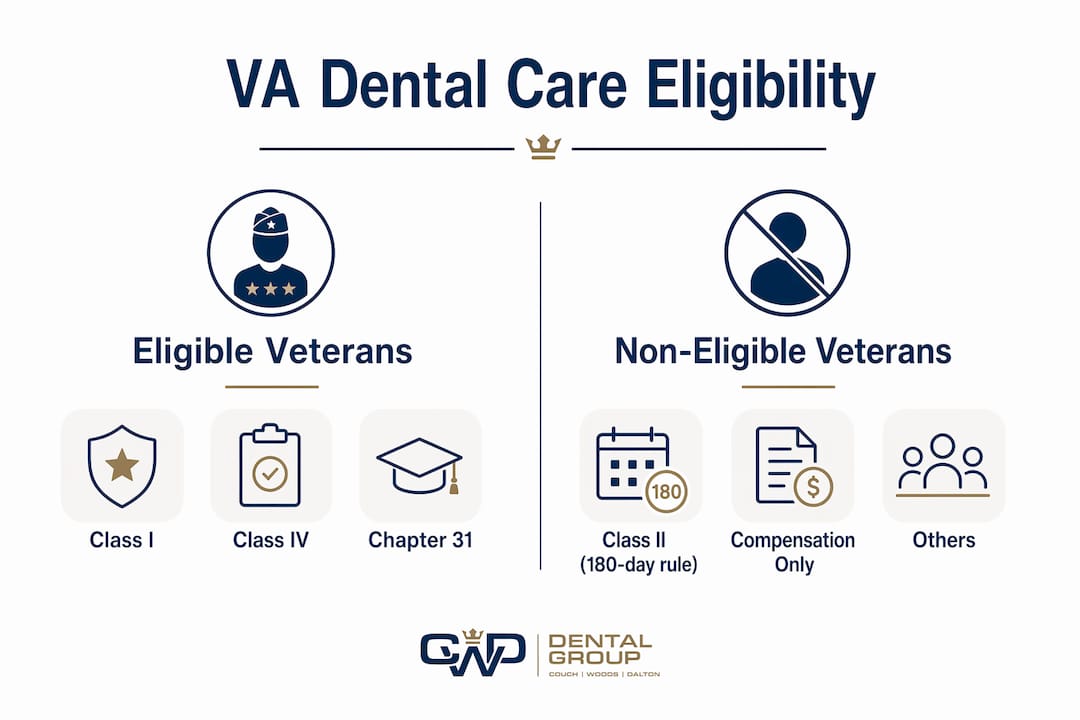
Class I and Class IV are the two most expansive categories. Both authorize "any needed dental care" with no procedural ceiling, which is why knowing your rating matters so much before you call the VA dental clinic.
The 180-day rule under 38 U.S.C. § 1712 applies specifically to Class II: if you had a dental condition at discharge that was not compensable, you had 180 days from separation to apply for a one-time correction. Miss that window and Class II eligibility is gone. Veterans who reenlisted within 90 days of a prior discharge get a reset — the 180 days runs from the subsequent discharge date.
Chapter 31 (Veteran Readiness and Employment) is a separate pathway. When dental treatment is identified as necessary for a veteran to participate in a vocational rehabilitation plan, the VA can authorize care through that program regardless of the veteran's dental benefits class.
Pro Tip: If you are rated at 100% P&T or IU, you are in Class IV and qualify for any needed dental care. Confirm this in writing with your VA dental clinic before your first appointment — some clinics require documentation of the rating before scheduling.
A few scenarios veterans commonly recognize:
- Combat-trauma dental injury (broken jaw, lost teeth from blast): Class I or Class V (if POW)
- Dental condition documented at discharge but rated noncompensable: Class II, 180-day window
- Severe PTSD rated at 100% P&T: Class IV
- Dental condition that worsens a service-connected TMJ disorder: Class III authorization possible
Having monthly compensation for a dental condition is relevant evidence, but it does not automatically place you in a dental benefits class for clinical care. That distinction is covered in detail below.
What the VA will and won't pay for
VA dental coverage for eligible veterans is broader than most people expect, but it is not unlimited. The governing standard is whether care is "reasonably necessary to maintain oral health and masticatory function." For Class I and Class IV veterans, that standard is applied generously. For other classes, the VA applies it more narrowly.
Commonly covered services for eligible veterans:
- Diagnostic services (exams, X-rays, oral cancer screening)
- Preventive care (cleanings, fluoride treatment, sealants)
- Restorative treatment (fillings, crowns when functionally necessary)
- Endodontic treatment (root canals when indicated)
- Periodontal care (scaling, root planing, surgical treatment of gum disease)
- Extractions (including surgical extractions)
- Prosthetics (dentures, bridges when needed for function, not appearance)
- Emergency dental care for pain or infection
What the VA generally does not cover:
- Purely cosmetic procedures (whitening, veneers for appearance only)
- Elective orthodontics in most cases
- Implants, unless medical necessity is established
Implants deserve a specific note. The VA does cover implants, but only when a VA dentist determines they are medically necessary and a conventional prosthetic is not a clinically appropriate alternative. This is not a rubber stamp. The VA dentist must document why a standard denture or bridge would fail or cause harm before implants are authorized.
On contracted private dental care: Under 38 U.S.C. § 1712(c), the VA may not spend more than a limited amount on contracted private dental care in a 12-month period unless a VA dentist has examined the veteran and determined that additional care is reasonably necessary. This cap matters most when the VA refers you to a private provider for complex work.
Pro Tip: If a proposed implant or surgical procedure is denied, request a written clinical justification from the VA dentist explaining the denial. That document becomes your strongest asset in an appeal and gives any private provider the context needed to write a supporting letter.
A practical example: a veteran with Class I eligibility who lost a molar to a combat-related fracture and cannot tolerate a partial denture due to a service-connected jaw injury would likely qualify for an implant under the medical-necessity standard. A Class IV veteran who simply prefers implants to dentures for cosmetic reasons would not. The difference is clinical documentation, not desire.
The health consequences of untreated dental issues sustained during service can compound over time, which is exactly why the medical-necessity standard exists — to prevent a small problem from becoming a systemic one.
How compensation and clinical dental care are actually different
Disability compensation and clinical dental care run on separate tracks. The VBA decides whether a condition is service-connected and what rating it receives. The VHA decides whether a veteran receives clinical treatment. Being on one track does not automatically put you on the other.
This distinction is the single largest source of confusion in veteran dental benefits, and legal analysis confirms that misapplied expectations cause veterans to pursue the wrong channel and miss deadlines on the right one.
VBA vs. VHA at a glance:
- VBA (Veterans Benefits Administration): Processes disability claims, assigns ratings, pays monthly compensation. Contact: your regional VA benefits office or VA.gov/disability.
- VHA (Veterans Health Administration): Provides clinical care, schedules appointments, authorizes dental treatment. Contact: your local VA medical center or VA dental clinic.
A veteran can receive monthly compensation for a service-connected dental condition (VBA decision) and still not qualify for ongoing VA dental care (VHA eligibility) if the condition is rated noncompensable and the 180-day window has passed. The compensation check and the dental appointment are two different outcomes from two different offices.
Pro Tip: When you contact the VA about dental care, specify whether you are calling about a disability claim (VBA) or a dental appointment (VHA). Routing your call correctly saves weeks.
The 180-day rule has two distinct applications that veterans often conflate. The first governs Class II eligibility: a noncompensable dental condition present at discharge must be applied for within 180 days of separation. The second is a general service-connection standard: dental conditions treated after 180 days of active service are generally presumed to be service-connected for compensation purposes. These are different rules with different consequences. Getting them mixed up can cost a veteran their one-time correction window.
A dental condition that aggravates another service-connected disability opens a third path. If your service-connected TMJ disorder is worsened by a separate dental problem, the VA can authorize treatment for that dental problem under Class III, even if it would not otherwise qualify. The key is documentation showing the aggravation relationship, which is where combat-related dental injury records become critical evidence.
How to apply for VA dental care, step by step
Start here: check your VA benefits class using the VA eligibility tool or call your local VA dental clinic. Everything else follows from knowing your class.
Step-by-step path:
- Confirm VA health care enrollment. You must be enrolled in VA health care before you can access VA dental benefits. Apply at VA.gov/health-care/apply or call 1-877-222-8387.
- Determine your benefits class. Use the VA eligibility tool or ask your VA primary care team. Your class determines what dental services are available to you.
- Gather your documentation. Collect your DD-214, service treatment records, discharge dental exam (if one was performed), and any post-discharge dental records showing conditions present at separation.
- Contact your local VA dental clinic. Use the VA Locations Finder to find the nearest VA dental clinic. Call to confirm your class and schedule an appointment.
- Request authorization in writing. For complex procedures (implants, oral surgery), ask for written authorization before treatment begins. This protects you if a billing dispute arises later.
- Attend your initial exam. The VA dentist will assess your needs and create a treatment plan. For Class I and IV veterans, this plan can include any needed care. For other classes, the plan is scoped to the authorized category.
Documentation checklist for your first appointment:
- DD-214 (Certificate of Release or Discharge from Active Duty)
- Service treatment records showing dental conditions during service
- Discharge dental exam documentation (if performed within 90 days of separation)
- Any VA rating decision letters referencing dental conditions
- Post-discharge dental records showing conditions present at or near separation
Pro Tip: If you have an urgent dental problem (severe pain, swelling, infection), tell the VA dental clinic explicitly when you call. VA clinics have emergency pathways for urgent cases, and framing your call as an emergency often accelerates scheduling significantly.
For veterans who need care between VA appointments or while waiting on authorization, the post-service dental access guide covers practical interim options including VADIP enrollment.
What to do if VA dental care is denied
A denial is not the end. Veterans have multiple appeal options, and several practical alternatives exist while an appeal is pending.
Appeals pathway:
- Request an informal review. Ask the VA dental clinic chief to reconsider the denial in writing. Provide any additional clinical documentation supporting medical necessity.
- File a Supplemental Claim or Request for Higher-Level Review. Submit new evidence (treatment records, private dentist letters, X-rays) through the VBA decision review process at VA.gov/decision-reviews.
- Board of Veterans' Appeals (BVA). If lower-level reviews fail, you can appeal to the BVA. This takes longer but allows for a full evidentiary review.
Preserve your evidence immediately:
- Keep all invoices, treatment notes, and X-rays from any private dental care received while appealing
- Request a written explanation of the denial from the VA dental clinic
- Document dates, names of VA staff contacted, and the substance of any conversations
Practical alternatives while you wait:
- VADIP (VA Dental Insurance Program): Available to all veterans enrolled in VA health care. VADIP offers discounted private dental insurance through participating carriers. Enrolling in VADIP does not affect your eligibility for future VA clinical dental care under 38 CFR § 17.169.
- Federally Qualified Health Centers (FQHCs): Community health centers offer sliding-scale dental care regardless of insurance status. Find one at findahealthcenter.hrsa.gov.
- Dental school clinics: Accredited dental schools provide supervised care at significantly reduced rates. Quality is generally high; wait times can be longer.
- Homeless Veterans Dental Program: For veterans experiencing homelessness, VA operates dedicated dental programs through its Homeless Veterans programs. Contact your local VA social worker.
- Local private practices: Fee-for-service care at a local practice can be documented and submitted as supporting evidence in appeals. Keep every record.
Pro Tip: Enrolling in VADIP while your appeal is pending is one of the smartest moves available. You get discounted coverage now, and it does not close the door on VA clinical care later. Many veterans skip VADIP because they assume it replaces VA benefits. It does not.
For veterans managing care between VA appointments, interim private care guidance explains how to document treatment so it supports rather than complicates your VA claim.
Key Takeaways
Your VA dental benefits class matters more than your compensation rating alone. Veterans who know their class, gather the right documents, and use available alternatives while appealing often get better outcomes than those who wait.
| Point | Details |
|---|---|
| Benefits class determines care | Class I and Class IV veterans receive any needed dental care; other classes have narrower, condition-specific coverage. |
| 180-day rule is strict | Class II eligibility requires application within 180 days of discharge; missing this window eliminates the one-time correction option. |
| Implants require medical necessity | Advanced procedures like implants are covered only when a VA dentist documents that conventional alternatives are clinically inappropriate. |
| VADIP fills the gap | Enrolling in VADIP provides discounted private coverage and does not affect future VA clinical dental care eligibility. |
| Cwddentalgroup serves Tallahassee veterans | Same-day emergency appointments and full documentation support make Cwddentalgroup a practical option for veterans needing immediate care or appeal records. |
The part of VA dental benefits most veterans find out too late
Veterans navigate the VA dental system expecting it to work like their disability rating: get the rating, get the care. The reality is more layered, and the gap between expectation and outcome is where most frustration lives.
The compensation-versus-care distinction is not a bureaucratic technicality. It reflects a genuine structural separation between two agencies with different mandates, different evidence standards, and different timelines. A veteran who spends months building a VBA compensation claim for a dental condition, wins the rating, and then calls the VHA expecting an appointment is going to be confused when the VHA asks about their benefits class. Those two outcomes are related but not the same thing, and the VA does not always explain that clearly upfront.
What I find underappreciated is how much the 180-day window matters for recently separated veterans. It is one of the most time-sensitive rules in the entire VA benefits system, and it applies to a population that is often dealing with a dozen other transition priorities simultaneously. Missing it is not a moral failure; it is a systems problem. But the consequence is real: a dental condition that would have been corrected for free becomes a permanent out-of-pocket expense.
The other thing worth saying plainly: VADIP is genuinely useful and genuinely underused. Veterans who do not qualify for free VA dental care often assume their only options are full private-pay or nothing. VADIP sits in between, costs relatively little, and preserves every future VA entitlement. This combination is rare in any benefits system.
Tallahassee veterans who need care now have a local option
If you need urgent dental care while your VA claim or appeal is pending, Cwddentalgroup offers same-day emergency dental appointments in Tallahassee for pain, infection, broken teeth, and other urgent needs. The practice handles the full range of restorative and surgical services relevant to veterans: implants, extractions, bone grafts, endodontic treatment, dentures, and TMJ therapy.
Cwddentalgroup can also provide detailed treatment records, written clinical justifications, and X-rays that support VA appeals or benefits-class applications. If you received private care before your VA authorization came through, those records matter. The practice is a fee-for-service local dental office, which means private care here complements your VA entitlements rather than replacing them. Your VA eligibility stays intact.
Schedule an appointment online or call the office directly for same-day assistance. Veterans who need immediate care do not have to wait on the VA timeline to get it.
Useful sources and official VA resources
The sources below are the authoritative starting points for verifying eligibility rules, finding VA dental clinics, and understanding your appeal options.
| Resource | What It Covers |
|---|---|
| VA Dental Care Benefits | Benefits classes, eligibility tool, enrollment guidance |
| VA Dentistry Home | Clinic locations finder, program overview, service statistics |
| 38 U.S.C. § 1712 | Federal statute governing when dental care must be furnished |
| 38 CFR § 17.161 | Implementing regulation for benefits classes I–VI |
| VADIP Program Page | Discounted private dental insurance for VA enrollees |
| 38 CFR § 17.169 | VADIP regulatory authority and enrollment rules |
| VA Disability Dental Benefits | Special claims for dental disability and compensation |
Additional community resources:
- HRSA Health Center Finder (findahealthcenter.hrsa.gov): Locate federally qualified health centers offering sliding-scale dental care near you.
- Dental school clinics: Most accredited dental schools accept patients at reduced rates. Search by state through the American Dental Association's school directory.
- VA Homeless Veterans Dental Program: Contact your local VA social worker or the National Call Center for Homeless Veterans at 1-877-4AID-VET for program access.
For a broader look at how VA benefits processes work across different veteran programs, the VA burial benefits guide illustrates how eligibility frameworks and documentation requirements apply across VA benefit categories.
This article is general information, not legal or medical advice. Eligibility rules can change, and individual circumstances vary. Confirm your specific benefits class and current rules with the VA or a qualified veterans service organization (VSO) before making decisions about your care.