

To establish a service-related dental injury for a VA claim, assemble dated clinical notes, labeled radiographs, intraoral or facial photos, a signed dental narrative describing the mechanism of injury, and any Line-of-Duty or unit incident reports. That five-part package is what VA raters actually look for when they decide whether a broken tooth, jaw fracture, or TMJ condition traces back to your time in service.
Before you request a single record, work from this priority list:
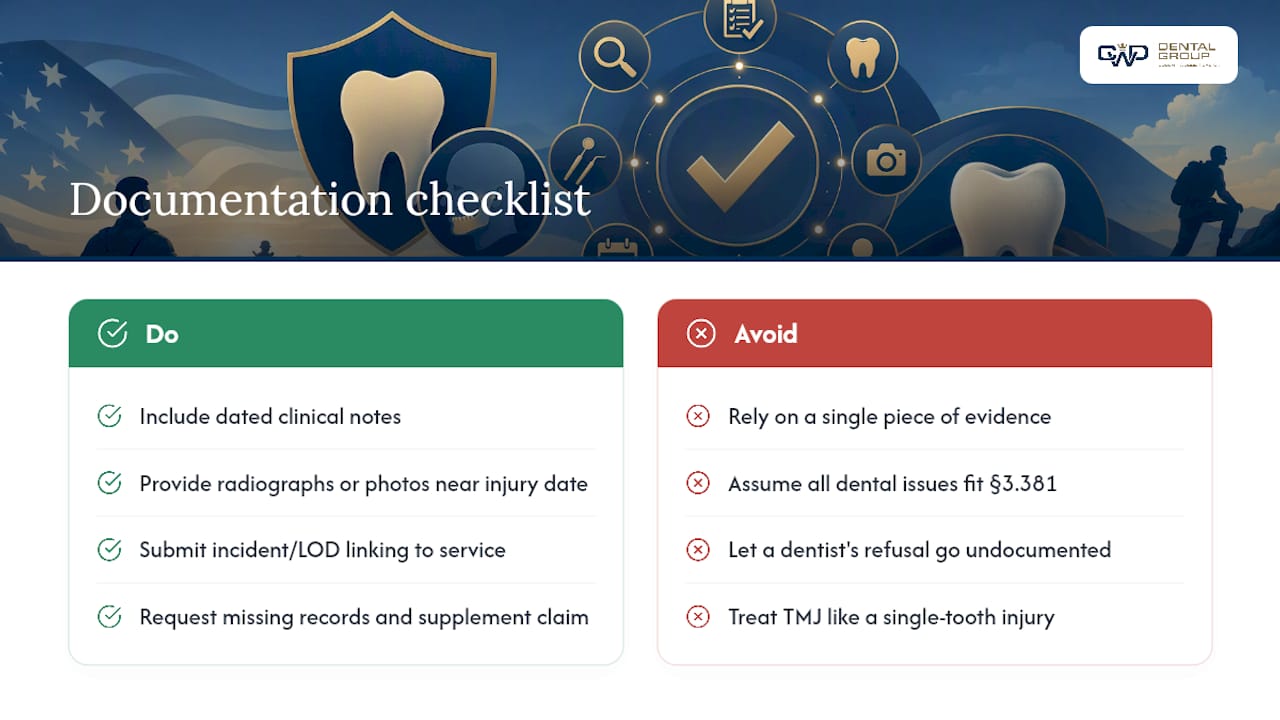
- Clinical notes from the treating dentist, dated and specific to the injury event
- Radiographs (periapical, bitewing, or panoramic) taken close to the time of injury
- Photographs of the injury with a visible date and patient identifier
- Incident or Line-of-Duty (LOD) report connecting the injury to a specific duty event
- Dental chart entries showing procedure codes and treatment dates
- A signed narrative from your dentist describing how the injury happened and what was treated
VA's own guidance on filing a disability claim confirms that additional medical evidence strengthens a claim after submission, and the governing standard sits in 38 CFR §3.381, which addresses when teeth noted as normal at entry can still be service-connected.
Key Takeaways
A service-connected dental claim succeeds or fails on whether dated records, imaging, and a clear injury narrative tell one consistent story from the event to today.
| Point | Details |
|---|---|
| Prioritize dated records | Clinical notes and radiographs taken near the injury date carry more weight than later summaries. |
| Write a specific narrative | Describe the mechanism of injury with date, location, and activity, not a vague general statement. |
| Chase LOD documentation | Line-of-Duty or unit incident reports directly link an injury to a specific service event. |
| Request VA-usable formats | Ask for PDFs with visible dates, CDT/ICD-10 codes, and labeled radiographs, not screenshots. |
| Address gaps explicitly | Explain delayed care or missing records with a short statement rather than leaving silence. |
Table of Contents
- What Records Belong in Your Dental Injury Documentation Checklist?
- How Do You Connect the Injury to a Specific Service Event?
- What Imaging and Diagnostic Records Should You Request?
- What Does a Strong vs. Weak Documentation Packet Look Like?
- What Should You Ask Your Dentist to Provide?
- How Do You Submit This Evidence and What Does the Regulation Require?
- Who's Behind This Guidance on Veteran Dental Claims?
- Where to Verify These Standards Yourself
- The Documentation Gap Nobody Talks About
- Frequently Asked Questions
- Sources
What Records Belong in Your Dental Injury Documentation Checklist?
Every item on your evidence checklist earns its place because it answers a specific question a rater will ask: did this happen, when did it happen, and does it match your service record?
Clinical notes carry the most weight when they include a chief complaint written in the dentist's own words, not a generic template. A note that says "patient reports tooth fractured during field exercise, presents with visible enamel loss on tooth #8" does far more work than "patient c/o tooth pain." Adjudicators read notes for internal consistency between what the dentist observed and what you say happened.
Here's the order in which to chase down documentation, starting with what most often decides a claim:
- Treatment records from the date of injury or shortly after — these anchor the timeline and are hardest to challenge.
- Radiographs dated at or near the injury — a fracture line or missing tooth on film beats a written description every time.
- Photographs with visible dates — useful for soft tissue injuries, swelling, or lacerations that x-rays won't capture.
- Dental charts with CDT procedure codes — these prove what treatment actually happened, not just what was diagnosed.
- Any LOD or incident report referencing the dental injury, even in passing.
If your service dental records are incomplete, submit a records request through the National Personnel Records Center or ask your last military dental clinic directly. Civilian dentists you've seen since separation can also pull historical charts if you were referred there for follow-up care, and many offices keep records far longer than veterans expect.
Pro Tip: Ask for records in writing and request a "complete dental treatment history," not just "records related to my claim." Front desk staff sometimes pull only recent visits unless you specify the full history.
How Do You Connect the Injury to a Specific Service Event?
VA wants a mechanism of injury, meaning a specific, physical description of how the trauma occurred. "Injured my tooth in the Army" tells a rater nothing. "Struck in the mouth by rifle stock during weapons qualification, March 2019, treated same day at Fort Campbell dental clinic" gives them something to verify against unit records and dated treatment notes.
A strong veteran statement should include:
- The date, location, and activity during which the injury occurred
- What body part or teeth were affected and how
- Who treated you immediately afterward, and where
- Any follow-up care and how symptoms changed over time
Line-of-Duty documentation, when it exists, is some of the strongest evidence available. The ADDP LOD process routes unit-generated incident paperwork through DSPOC review before authorizing civilian treatment, which means an approved LOD form already ties your injury to a specific duty event in an official record. If your unit never filed one, buddy statements from fellow service members who witnessed the injury are a reasonable substitute.
Gaps in care are common and don't sink a claim by themselves, but you need to explain them. A short statement noting you were in a remote deployment location without dental access, or that symptoms worsened gradually before you sought treatment, keeps your timeline credible rather than leaving a raw gap.
Pro Tip: Write your statement the same week you request records, while details are fresh, then cross-check it against the clinical notes once they arrive.
What Imaging and Diagnostic Records Should You Request?
Ask your dentist for periapical films to show root and bone detail around a specific injured tooth, bitewings if adjacent teeth were affected, and a panoramic (OPG) image if the jaw or multiple quadrants were involved. Each serves a different diagnostic purpose, and raters know the difference, so submitting the wrong type of film for your injury can weaken an otherwise solid claim.
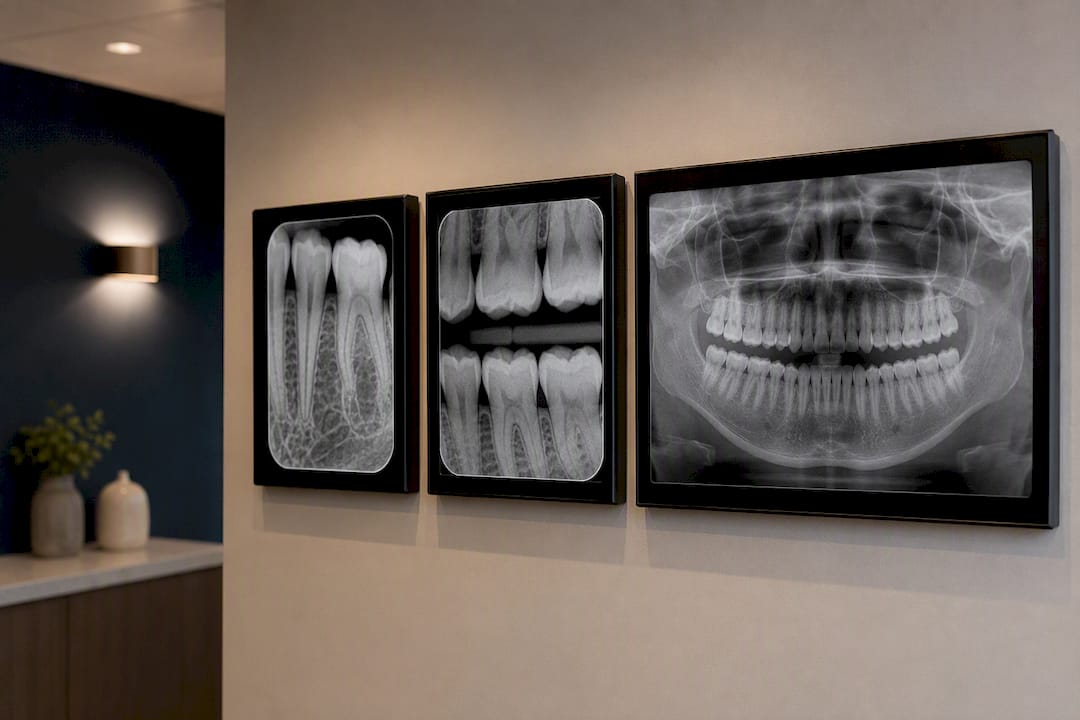
For photographs, request close-up intraoral shots and a wider facial photo if there's visible swelling or asymmetry, both with a visible date stamp and patient identifier in frame. Clinical guidance on dental trauma from the Royal Children's Hospital recommends this kind of photo documentation specifically because trauma injuries can change in appearance within days, and a single undated photo loses most of its evidentiary value.
Also request:
- CDT procedure codes for every treatment performed
- ICD-10 diagnostic codes tied to the specific injury
- A signed treatment plan or letter, not just chart notes
Ask that files be sent as PDFs or high-resolution images with metadata intact. A screenshot of an x-ray taken on a phone strips the embedded date and loses resolution, which is exactly what you don't want when a C&P examiner is trying to read a fracture line.
What Does a Strong vs. Weak Documentation Packet Look Like?
A strong packet reads like a story with no gaps. One example: a veteran submits a same-day treatment note describing a fall during physical training, a periapical x-ray dated the same day showing a horizontal root fracture, a follow-up note two weeks later documenting a root canal, and a signed narrative from the dentist connecting all three. Nothing here requires the rater to guess.
A weak packet usually has one of these problems:
- Undated photos with no way to confirm when the injury occurred relative to service.
- A vague incident description ("hurt my mouth overseas") with no date, location, or mechanism.
- Missing follow-up records, leaving a gap between initial injury and current condition with no bridge.
If your packet has gaps like these, don't just submit it and hope. Get a supplemental statement from the dentist explaining any missing links, request an affidavit from a witness if the incident wasn't documented at the time, and consider asking for a current dental exam that explicitly ties present findings back to the original event.
Pro Tip: If your dentist's note only says "trauma history reported by patient," ask them to add one sentence stating whether the clinical findings are consistent with the reported mechanism. That single line moves your file from weak to strong.
What Should You Ask Your Dentist to Provide?
Be specific when you request records. Vague requests get vague responses.
Ask for:
- A signed narrative connecting your current condition to the reported trauma, in the dentist's own clinical language
- A typed chronology of visits, treatments, and outcomes
- Labeled radiographs with dates and tooth numbers
- CDT and ICD-10 codes for every procedure and diagnosis
Request electronic copies in PDF format, since some VA claim uploads have file size and type restrictions that scanned paper copies can violate. If a provider is unresponsive or unwilling to write a narrative statement, document the refusal in writing and pursue a sworn statement from another treating professional instead, including staff at an emergency department if that's where you were first seen.
How Do You Submit This Evidence and What Does the Regulation Require?
Upload records directly through your VA.gov claim as supplemental evidence, or mail them if your regional office requests hard copies. VA's own filing guidance allows evidence submission after your initial claim, so incomplete records at filing don't disqualify you, though earlier is always stronger.
The regulatory standard matters more than most veterans realize:
Under 38 CFR §3.381, a tooth noted as normal on entrance examination can still be service-connected for treatment purposes if it was filled or extracted after more than six months of active service. This means a dental condition doesn't need to be documented as abnormal at enlistment to qualify.
Practical filing steps:
- Request a Compensation and Pension (C&P) exam if one hasn't been scheduled, and ask your representative whether the examiner has your full dental file beforehand.
- If denied, review the decision letter for which evidence element was found insufficient, then file a supplemental claim with the missing piece rather than starting over.
- Consider working with a Veterans Service Organization representative for appeals, since they often catch documentation gaps a first-time filer misses.
Who's Behind This Guidance on Veteran Dental Claims?
Cwddentalgroup has built same-day emergency dental appointments into its Tallahassee practice specifically because urgent injuries, including the kind that later become VA claims, need same-week documentation, not a six-week wait for an opening.
The practice's range of services matters here too. Because Cwddentalgroup handles everything from routine exams to surgical extractions and TMJ therapy under one roof, veterans don't have to coordinate records across three separate offices when a single injury touches multiple areas of treatment.
- Same-day emergency appointments for urgent dental trauma in Tallahassee
- Full-service care spanning general, cosmetic, surgical, and emergency dentistry
- A patient base that includes veterans navigating VA claims alongside routine care
- Ongoing coverage of veteran-specific dental topics, including combat-related dental injuries, on the practice's blog
If you're still assembling records for an open claim and need imaging or a same-day exam to fill a gap, scheduling a visit with a practice experienced in emergency documentation beats waiting weeks for an opening elsewhere. For urgent trauma specifically, Cwddentalgroup's emergency dentistry service is built around same-day imaging and same-day notes, the two things a VA claim needs most.
Where to Verify These Standards Yourself
- 38 CFR §3.381: the legal standard for dental service connection
- Va: official claim and evidence submission steps
- Law.Cornell's copy of §3.381: a readable cross-reference for the same regulation
The Documentation Gap Nobody Talks About
Most guidance on this topic treats regulation citation as the hard part. It isn't. The regulation is short and plain enough to read in five minutes. The hard part is that veterans wait years after separation to start pulling records, by which point the dentist who treated the original injury has retired, the clinic has closed, or the chart was purged under a standard retention schedule.
The single highest-leverage thing you can do is request your complete dental treatment history now, whether or not you're ready to file, because record retrieval takes weeks and sometimes months. Conventional advice focuses heavily on writing the perfect narrative statement, but a beautifully written statement means nothing if it isn't backed by a dated x-ray or chart entry showing the same event. Get the paper trail first. Write the narrative second, once you know exactly what the records already say, so your statement reinforces the file instead of contradicting it.
Frequently Asked Questions
What counts as sufficient documentation for a service-related dental injury? VA typically wants dated clinical notes, radiographs or photos from near the injury date, and some form of incident or LOD documentation connecting the event to your service. A single piece of evidence rarely carries a claim on its own.
Can I still file if my military dental records are incomplete? Yes. Submit what you have through VA.gov, then request missing records from the National Personnel Records Center or your last treating dental clinic. Supplemental evidence can be added after the initial claim.
Does 38 CFR §3.381 cover all dental conditions? It specifically addresses service connection for treatment purposes, including the rule that teeth noted normal at entry can still qualify if filled or extracted after more than six months of active service. Compensation-related dental ratings involve separate criteria your representative can walk through.
What if my dentist won't write a narrative statement? Document the refusal in writing, then seek a sworn statement from another treating provider or a buddy statement from someone who witnessed the injury.
How does TMJ or facial injury documentation differ from a single tooth injury? TMJ and facial trauma often need broader imaging, like a panoramic film, plus notes tracking symptom progression over time, since these conditions frequently develop or worsen well after the original event.
This article is general information, not a substitute for advice from a qualified doctor. Consult a qualified healthcare professional about your own circumstances before acting on anything here.
Sources
- eCFR :: 38 CFR 3.381 -- Service connection of dental conditions for treatment purposes.
- Va
- ADDP LOD Fast Facts (Active Duty Dental Program)