
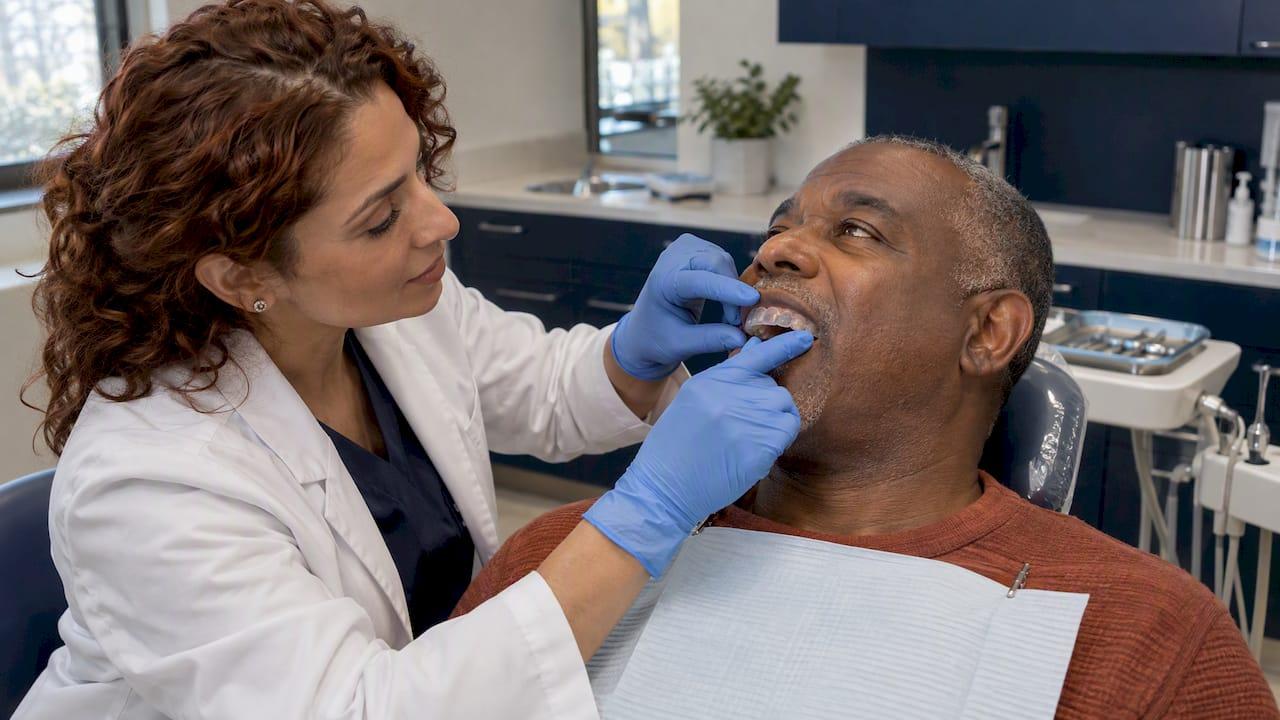
Bruxism, the clenching or grinding of teeth, is treated in layers. Most people start with a custom night guard to protect their teeth and with changes to daily habits. Others add stress management, physical therapy for the jaw, or Botox injections into the chewing muscles. A dentist also checks for sleep problems such as sleep apnea, because grinding is sometimes a symptom of something larger.
No single option works for everyone. The right plan depends on what is driving your grinding, how much damage you already have, and whether your jaw hurts. This guide walks through each option, what it does and does not do, and how a dentist decides where to begin.
TL;DR
- A custom night guard is the usual first step. It protects enamel but does not stop the clenching itself, so your jaw may still feel sore.
- Lifestyle changes matter: less caffeine and alcohol, no smoking, and a calmer evening routine can all lower the intensity of the habit.
- Botox injected into the masseter muscles can reduce grinding activity and jaw pain, but results are temporary and only a trained provider should give it.
- Because grinding can be linked to obstructive sleep apnea, a good plan includes screening and, if needed, coordination with a physician.
- Same-day emergency visits are available at CWD Dental Group in Tallahassee if you have a cracked tooth or sudden jaw pain.
Table of Contents
- How to know your grinding needs treatment
- Start with habits you can change at home
- Night guards: the first line of defense
- Stress, behavioral and physical therapies
- Botox for bruxism
- When grinding signals a sleep problem
- Treating the damage grinding has done
- Comparing the options side by side
- Our perspective on treating bruxism
- Care at CWD Dental Group in Tallahassee
- What to bring to your appointment
- FAQ
- Sources
How to know your grinding needs treatment
Many people grind without knowing it. A partner hears it, or you notice the effects after waking. JADA patient guidance from 2025 lists the signs that call for a professional evaluation:
- Chronic jaw pain or stiffness
- Unexplained wear on your teeth
- Recurring morning headaches
- Tooth sensitivity to temperature
- Indentations along the sides of your tongue
The same guidance notes that symptoms often show up after waking, which fits nighttime activity. If you recognize two or three of these, book an exam. Our post on clear signs you need a dental check-up covers other warning signs worth knowing.
A dentist will look at flattened or chipped edges, worn enamel, cracked fillings, tender chewing muscles, and the way your jaw opens. They will also ask about snoring, daytime sleepiness, stress, medications, and caffeine. That conversation matters as much as the mouth exam, because treatment follows the cause.
Start with habits you can change at home
The ADA's patient resource frames bruxism as a habit that needs lifestyle management alongside clinical care. According to that JADA guidance, practical changes include:
- Limiting caffeine, alcohol and sugar
- Cutting screen time in the two hours before bed
- Quitting smoking
These steps are free and low risk, and they support every other option below. Add a few more habits that dental educators commonly suggest for sore jaw muscles. Dentalcare's continuing education course on bruxism lists home care such as applying ice or heat to the jaw, avoiding hard foods and chewing gum, drinking plenty of water, doing gentle facial stretches and massaging the muscles of the face and neck.
Two practical tips from our own chairside experience: notice daytime clenching, because many people clench while driving or at a computer, and keep your teeth apart with lips closed and the tongue resting gently on the roof of the mouth. Daytime awareness can carry over to the night.
Night guards: the first line of defense
A night guard, also called an occlusal splint or bite guard, is a custom-fitted appliance that sits between your upper and lower teeth. Dentalcare's course describes night guards as among the most popular options for sleep bruxism, and it distinguishes custom-made guards from generic ones. For heavy grinders, a harder material is typically recommended.
What a guard does and does not do
A guard acts as a sacrificial barrier. Your guard wears down instead of your enamel, crowns, veneers or fillings. That is valuable, since worn enamel does not grow back.
What it does not do is cure the habit. The muscles can still clench hard against the guard, which is why some patients are surprised to wake up with a sore jaw even though their teeth are protected. If that sounds like you, a guard is a foundation, not the whole plan.
Custom versus store-bought
Drugstore boil-and-bite guards are cheap and can be a stopgap. They are often bulky, may not fit evenly, and can be hard to tolerate. A custom guard is made from an impression or digital scan of your teeth, so the bite is balanced and the thickness is right for how hard you grind. Ask your dentist to check the fit after a few weeks, because a guard that feels uneven can aggravate jaw pain.
If you have veneers, bonding or crowns, protecting them is a strong reason to choose custom. Our article on how cosmetic dentistry improves your bite and smile explains how restorations and bite health connect.
Stress, behavioral and physical therapies
Because stress is a common contributor, behavioral options are a recognized part of treatment. The Cleveland Clinic-style overviews that rank for this topic are not the source here, so we rely on the peer-reviewed literature: reviews of bruxism treatment describe behavioral techniques, intraoral devices, medications and electrical stimulation as the main categories studied.
In practice, behavioral care can include:
- Relaxation training and meditation, to lower baseline muscle tension
- Biofeedback, which teaches you to notice and release jaw tension
- Cognitive behavioral therapy or counseling, when anxiety or life stress is a major driver
- Exercise, which helps many people manage stress overall
- Jaw stretching and physical therapy, when the muscles or the joint are painful
These approaches do not replace a guard if your teeth are being worn down. They work on the cause, while the guard works on the consequence.
Botox for bruxism
Botulinum toxin type A, widely known as Botox, relaxes the muscle it is injected into. For bruxism, the target is usually the masseter, the large muscle at the angle of the jaw, and sometimes the temporalis.

The evidence is encouraging. A 2024 systematic review of botulinum toxin for temporomandibular symptoms associated with sleep bruxism found that injections into the masseter can significantly reduce bruxism-related pain and jaw muscle hyperactivity. In some studies the treated groups dropped from about 4.97 bruxism events per hour to 1.70. Another systematic review of randomized controlled trials describes BTX-A as a promising alternative for managing bruxism.
What to expect
- It is temporary. Effects typically last 12 to 16 weeks, so maintaining results means repeat treatments, per the 2024 review above.
- It treats muscle overactivity, not tooth wear. A guard is still sensible if your enamel is thinning.
- It may help most with pain. People with sore masseters and tension headaches are often the best candidates.
- Dose and placement matter. Our deeper articles cover masseter Botox for grinding and how clinicians use Botox for TMJ.
Safety and who should inject
Botox is a prescription drug with real risks. FDA labeling for botulinum toxin products warns that the toxin's effect can spread beyond the injection site, and in rare cases this can affect swallowing or breathing. Local weakness is also possible. For that reason, choose a licensed clinician who understands the anatomy of the head and neck and locates the muscle carefully. Tell the provider if you are pregnant or nursing, have a neuromuscular condition or take medications that affect muscles. Call your provider right away, or seek emergency care, if you have trouble swallowing or breathing after an injection.
If you are comparing quotes in Tallahassee, see our guide to TMJ Botox cost and the three quote details to compare.
When grinding signals a sleep problem
Sometimes grinding is not just a habit. The ADA notes that dentists are well positioned to identify patients at greater risk of sleep related breathing disorders and play a role in multidisciplinary care. Obstructive sleep apnea is the one that matters most here. If it is present and you treat only the grinding with a guard, the airway problem, which carries the larger health risk, can be missed. The ADA's overview of obstructive sleep apnea explains the condition and the dentist's part in it.
Red flags that deserve a conversation with your physician include loud snoring, gasping or pauses in breathing at night, and heavy daytime fatigue. The diagnosis comes from a physician, usually through a sleep study. Where an oral appliance is appropriate, for example mild to moderate sleep apnea in a patient who cannot tolerate CPAP, the ADA policy says a trained dentist should fabricate it and review it annually.

Treating the damage grinding has done
Protecting teeth going forward is one job. Repairing existing damage is another. Depending on what the exam shows, a dentist may recommend:
- Bonding or fillings for chips and worn edges
- Crowns for cracked or heavily worn teeth
- Veneers to rebuild the look of worn front teeth, usually after the grinding is under control
- Root canal therapy when a cracked tooth has damaged the nerve
- TMJ treatment when the joint itself is painful, clicking or locking
A cracked tooth can turn urgent quickly. Read why a cracked tooth is a dental emergency, and if tooth pain wakes you at night, see when to seek emergency care for tooth pain at night. For persistent jaw pain, TMJ jaw pain: causes, relief and when to see a dentist is a good next read.
Comparing the options side by side
| Option | What it addresses | Main limit | Good fit for |
|---|---|---|---|
| Habit and lifestyle changes | Triggers such as caffeine, alcohol, smoking, late screens | Slow, depends on consistency | Everyone, as a base layer |
| Custom night guard | Tooth and restoration wear | Does not stop clenching | Anyone with visible wear or a restored mouth |
| Stress and behavioral therapy | Stress-driven clenching, awareness | Takes time and practice | Patients with anxiety or daytime clenching |
| Botox in the masseters | Muscle overactivity and pain | Temporary, repeat visits, needs trained provider | Sore, strong jaw muscles; guard alone not enough |
| Sleep apnea evaluation | Airway problems behind grinding | Requires a physician for diagnosis | Snorers, tired patients, suspected OSA |
| Restorative dentistry | Existing damage | Does not treat the cause | Chipped, cracked or worn teeth |
Most patients combine two or three of these. A typical plan might be a custom guard, a few habit changes and a re-check in a few months, adding Botox only if the muscles stay painful.
Our perspective on treating bruxism
We see grinding most often as a pattern across a whole mouth, not a single bad tooth. A patient may come in for a chipped front tooth or a morning headache, and the exam tells a longer story: flattened molars, sensitive necks of teeth, a tender masseter. Our approach is to protect first, then ask why.
Protecting means a well-fitting guard. Asking why means listening: stress at work, new medications, snoring, a bite that has changed. When sleep apnea seems possible, we think the right move is a conversation with your physician, not treating it as a purely dental issue.
We also offer Botox for both cosmetic and therapeutic purposes, so we can speak plainly about it. It can be a real help for sore, overworked jaw muscles, and it is not a substitute for protecting your enamel. We would rather you leave with a realistic expectation of 12 to 16 weeks of effect than an overpromise.
Because we care for children and adults, we also watch for grinding in kids. If you notice it in your child, mention it at the next visit so we can look at the bite and the pattern.
— Kayle
Care at CWD Dental Group in Tallahassee
We offer general and family dentistry, restorative care such as fillings, crowns, bonding and veneers, TMJ treatment, Botox and same-day emergency appointments for urgent problems, all in one practice. That means one team can evaluate your grinding, repair damage and coordinate next steps. Pricing is not published for these services, so ask our office for details before you book. See our full list of services, or call us for a same-day emergency dentist visit if you have a cracked tooth or sudden jaw pain.
What to bring to your appointment
A little preparation makes the visit more useful:
- Note when symptoms occur: on waking, midday, after stressful days.
- List your medications and supplements, plus daily caffeine and alcohol.
- Ask a partner whether you grind or snore.
- Bring any old night guard, even a damaged one. Its wear pattern shows how you grind.
- Write down questions about costs and insurance coverage.
FAQ
Can bruxism go away on its own?
Sometimes it eases when a stressful period ends, but you cannot count on it. Because teeth wear down silently, it is safer to have a dentist look at the damage and decide whether a guard is needed.
Is a night guard enough?
A guard protects teeth and restorations, but it does not stop the clenching itself, so muscle soreness can continue. Many patients pair it with habit changes, stress management or, in persistent cases, Botox.
How long does Botox for teeth grinding last?
The 2024 research reports effects typically lasting 12 to 16 weeks, so repeat treatments are needed to maintain results. Only a trained provider should perform the injections because of rare risks such as spread of the toxin.
Can grinding be a sign of sleep apnea?
It can be linked. Dentists often screen for sleep related breathing disorders, but diagnosis comes from a physician, so mention snoring, gasping at night or heavy daytime tiredness during your visit.
Sources
- Efficacy and Safety of Botulinum Toxin in the Management of Temporomandibular Symptoms Associated with Sleep Bruxism: A Systematic Review (PMC)
- Efficacy of botulinum toxin type A in bruxism management: A systematic review (PubMed)
- Bruxism, The Journal of the American Dental Association
- Policy Statement on the Role of Dentistry in the Treatment of Sleep Related Breathing Disorders (ADA)
- Obstructive sleep apnea (ADA)
- FDA approval label for botulinum toxin
- Treatment Modalities, Bruxism: The Grind of the Matter (Dentalcare)