
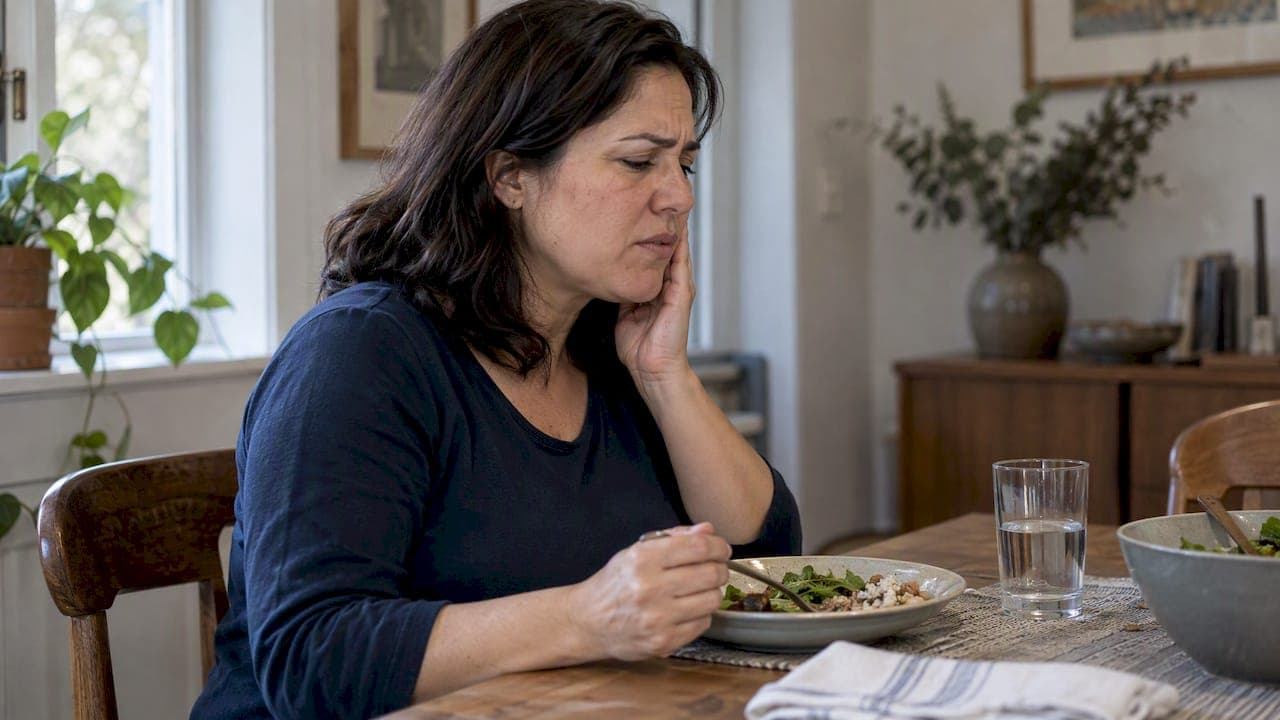
TMJ jaw pain is usually a problem with the jaw joint or the muscles that move it, and for most people it settles with simple, reversible care: soft foods, heat or cold, gentle stretching and less clenching. See a dentist if the pain lasts more than a few days, your jaw locks, or chewing keeps getting harder. Call 911 if jaw pain comes with chest or shoulder pain.
Below, we explain what the pain feels like, what drives it, what to try at home, what to be wary of, and how a dental visit works.
TL;DR
- "TMJ" is the joint; the painful conditions are called temporomandibular disorders (TMDs). Over 10 million Americans are affected, and for most people symptoms are temporary.
- Start with the simplest care: soft foods, heat or cold, gentle jaw exercises and short-term over-the-counter anti-inflammatories.
- Clicking or popping with no pain is normal and needs no treatment. Pain, stiffness or locking is the signal to get checked.
- Be cautious with anything permanent: bite changes, crowns to "fix" the bite, or permanent splints. Less is often best.
- Jaw pain with chest or shoulder pain is an emergency. Call 911.
Table of Contents
- What TMJ jaw pain actually feels like
- Why your jaw hurts
- When jaw pain is an emergency
- What to try at home first
- What a dental visit involves
- The treatment ladder
- Botox and TMJ: what we tell patients
- Our perspective
- See us in Tallahassee
- FAQ
- Sources
What TMJ jaw pain actually feels like
Your temporomandibular joints sit just in front of each ear and connect the lower jaw to the skull. You use them to chew, talk and yawn. The NIDCR describes TMDs as a group of more than 30 conditions that cause pain and dysfunction in the joint and the muscles that control jaw movement.
The symptoms people report most often:
- Pain in the chewing muscles or the jaw joint, often on one side
- Jaw stiffness, limited opening, or a jaw that catches or locks
- Painful clicking or popping when you open or close
- Pain that spreads to the face, neck or ears
- Headaches or migraines, and sometimes ringing in the ears
- A feeling that your teeth no longer fit together the way they used to
The ear symptoms confuse many people, because the joint sits so close to the ear canal. If you are wondering whether your earache is the jaw or an infection, our guide to TMJ ear pain versus infection walks through the differences.
Clicking alone is not a disorder
A joint that clicks or pops without pain is considered normal, and the NIDCR says it does not need treatment. Attention is warranted when the sounds come with pain, stiffness or a locking sensation that limits movement. Many patients seek treatment for noise alone, and that is usually unnecessary.
Why your jaw hurts
TMJ pain rarely has one clean cause. The Mayo Clinic-style lists you see online mix several factors, and the NIDCR describes the same pattern: habits such as clenching, gum chewing or nail biting, stress, injury to the jaw, and other painful conditions can all play a part. Women are affected more often than men.
Three contributors come up again and again in dental exams:
- Overworked muscles. Clenching or grinding, often during sleep or while concentrating, keeps the chewing muscles tense for hours. They get sore and tight, much like any overused muscle.
- Joint problems. The disc inside the joint can shift, or the joint surfaces can wear or be injured.
- Stress and mood. The diagnostic standard used by clinicians, the Diagnostic Criteria for Temporomandibular Disorders, assesses both the physical side (Axis I) and the psychosocial and behavioral side (Axis II). Anxiety, depression and stress are strongly associated with TMDs, so good care often addresses them too.
When the jaw is not the problem
Jaw pain has other sources. The Cleveland Clinic lists grinding, gum disease and toothache among the common causes. A cracked tooth, an abscess or an inflamed nerve can all refer pain to the jaw. Pain that is constant, throbbing, worse with hot or cold, or paired with swelling points toward a tooth. If that sounds like you, read our guide on dental emergency versus routine pain.
A quick comparison:
| Clue | More likely TMJ or jaw muscles | More likely a tooth or gum problem |
|---|---|---|
| Where it hurts | In front of the ear, cheek, temple | One specific tooth or area of gum |
| What triggers it | Chewing hard food, yawning, stress, waking up | Hot, cold, sweets, biting on one tooth |
| Sounds and movement | Clicking, limited opening, locking | Usually none |
| Swelling or bad taste | Uncommon | Possible |
| Time pattern | Comes and goes, worse in the morning | Often steady or worsening |
This table is a rough guide, not a diagnosis. Both can exist at the same time.
When jaw pain is an emergency
Some jaw pain is not about the jaw. The NIDCR warns to call 911 if jaw pain comes with chest or shoulder pain, because it can signal a heart attack. Do not drive to a dental office in that situation.
Call a dentist the same day if you have:
- Swelling in the face or jaw, especially with fever
- A jaw that is locked and will not open or close
- Jaw pain after a blow to the face or a fall
- Severe tooth pain along with jaw pain
For dental causes, we keep same-day emergency appointments available so you do not have to wait out the pain. See our emergency dentist page for how that works.
What to try at home first
The NIDCR lays out treatment as a ladder, and the simplest rung is the one to try first:
- Eat soft foods for a while: eggs, yogurt, soup, pasta, smoothies
- Apply heat or cold to the sore side of your face
- Do gentle jaw stretching and strengthening exercises
- Use over-the-counter anti-inflammatories such as ibuprofen or naproxen for a short time, if they are safe for you
If you take blood thinners, have stomach, kidney or heart conditions, or are pregnant, ask your doctor or pharmacist before using NSAIDs.
Habits that make a real difference
A jaw at rest should have teeth slightly apart, lips closed and tongue relaxed. Many people clench without noticing. Try these:
- Check yourself during the day. If your teeth touch, let them part.
- Skip gum, and stop biting nails, pens or ice.
- Cut big bites. Avoid very chewy or hard foods such as bagels, jerky and raw carrots while it is sore.
- Do not open wide for long. Support your jaw when you yawn.
- Keep your head over your shoulders when working at a screen. Forward posture strains the neck and jaw.
- Wind down before bed. Stress-related clenching often peaks at night.
For most people these steps are enough. The NIDCR notes that TMD symptoms are temporary and go away without intervention for most people.
What a dental visit involves
A good TMJ exam is mostly hands-on and conversational. Expect questions about when the pain started, whether it is worse in the morning, whether you clench or grind, and how stress and sleep look. Your dentist will usually feel the muscles and joint, measure how far you open, listen for joint sounds, and check your teeth for wear patterns and cracks. X-rays may be taken to rule out a tooth or bone problem.

A dentist can also separate TMJ pain from a failing tooth, gum disease or a needed root canal, which is why an exam is worth it even when you suspect the jaw. Our services page lists TMJ treatment alongside general, emergency and restorative care, so one team can look at the whole picture.
Finding the right provider
There is no officially recognized specialty for TMJ disorders. The NIDCR suggests looking for providers trained in musculoskeletal pain conditions, including hospital or university pain clinics, instead of assuming every dentist or physician is an expert here. Ask any provider how many TMJ patients they see, what conservative options they offer first, and whether they will coordinate with a physical therapist or your physician when needed.
The treatment ladder
| Level | What it includes | Notes |
|---|---|---|
| Simple | Soft foods, heat or cold, stretching, short-term OTC NSAIDs, self-management | Try first |
| Intermediate | Physical therapy, behavioral health such as cognitive behavioral therapy or biofeedback, prescription muscle relaxants | If simple care is not enough |
| Moderately complex | Needle-based treatments and injections | Discuss evidence and goals |
| Most complex | Surgery | Last resort |
The levels above come from the NIDCR's summary of TMD treatment.
Night guards and splints
A removable oral appliance worn at night is a common reversible step for clenchers. The key word is reversible. The NIDCR's Less Is Often Best guidance cautions against permanent repositioning splints and other changes to the bite.
What to be careful with
Experts and the NIDCR caution against crown and bridge work to adjust the bite, orthodontics, or permanent changes to the joint as first-line treatment for TMJ pain. There is little evidence they work, and they can permanently worsen the bite. If someone recommends a permanent procedure, the NIDCR advises getting a second opinion from another qualified provider first.
That does not mean crowns, bridges or Invisalign are wrong in general. They are valid for their own purposes, such as a broken tooth or crowded teeth. They are just not a first answer to jaw pain.
Botox and TMJ: what we tell patients
Botox is on our services list, and patients ask about it for jaw pain and grinding. Here is the honest picture. The NIDCR treatment summary says there is currently no conclusive evidence that botulinum toxin is effective for managing TMDs, and that it is not a standard, validated treatment for the underlying disorder. Some clinicians still use it for muscle-related pain and grinding, and we have written about how clinicians approach Botox for TMJ and masseter Botox for grinding.
Our view: it is a conversation to have after conservative steps, not a starting point. If you are weighing it, our article on TMJ Botox cost in Tallahassee explains what to compare in a quote.

Our perspective
Most patients who come to us about jaw pain are worried they need something big. Usually they need a careful exam, a clear explanation and a plan that begins with the gentlest options. We would rather have you try a night guard, some stretching and a few weeks of habit changes than talk you into anything you cannot undo.
We also look beyond the joint. A sore jaw can come from a cracked tooth, gum disease or an infected nerve, and because we offer general, emergency, endodontic and TMJ care under one roof, we can tell you which one it is and treat it or refer you appropriately. If your pain does not fit TMJ, you will hear that from us, and if you need a physical therapist or a second opinion, we will say so.
We care for families and for veterans, and we know many people put off a sore jaw until it gets in the way of eating. Do not wait for that point.
— Kayle
See us in Tallahassee
If jaw pain is interfering with eating, sleeping or work, or you cannot tell whether it is your joint or a tooth, book an exam with CWD Dental Group. We offer TMJ treatment, same-day emergency appointments, and general and restorative care for all ages. Browse everything we offer or visit our home page to find a location and request an appointment. If you have insurance, ask the office what your plan covers before the visit, since we do not publish prices for treatment.
FAQ
How do you relieve TMJ pain fast?
Heat or cold on the sore side, soft foods, gentle stretching and a short course of an over-the-counter anti-inflammatory help many people within days. Stop chewing gum and avoid wide yawns. If pain is severe, or lasts more than a few days, see a dentist.
What does TMJ pain feel like?
It is typically a dull ache in the jaw muscles or in front of the ear, sometimes with stiffness, clicking, locking or headaches. It can spread to the face, neck or ear. Pain that is sharp and tied to one tooth is more often a dental problem.
Can I live with TMJ?
For most people, yes, because symptoms are often temporary and improve with simple care. Persistent pain, locking or trouble eating deserves a professional evaluation. Early conservative care is easier than waiting until the muscles and habits are entrenched.
Does TMJ go away on its own?
Often it does. The NIDCR says symptoms are temporary and resolve without intervention for most people. If they return or worsen, get checked rather than just waiting.
Should I get a bite adjustment or crowns for TMJ?
Not as a first step. The NIDCR cautions that irreversible treatments have little evidence behind them and can worsen the bite. Try reversible options first and get a second opinion before agreeing to anything permanent.
Sources
- TMD, NIDCR
- Summary of Treatment for Temporomandibular Disorders, NIDCR
- Diagnostic Criteria for Temporomandibular Disorders, JADA
- Jaw Pain: Common Causes and How To Treat It, Cleveland Clinic