

Dental trauma is any injury to a tooth, its root, or the surrounding gum and bone, usually from a sudden impact like a fall, sports collision, or car accident. Some cases are minor. Others are true emergencies where minutes matter.
Certain signs mean you should stop reading and get to a dentist now, not tomorrow:
- A tooth has been knocked out completely
- You see bleeding coming from inside the tooth, not just the gum
- A tooth feels severely loose or is visibly pushed out of position
- Your bite suddenly feels wrong, or the jaw won't close normally
- There's swelling affecting breathing or swallowing
If any of these apply, seek same-day dental or emergency care immediately. Waiting even an hour can change the outcome for a knocked-out tooth, and hidden damage doesn't always announce itself with pain.
Key Takeaways
Dental trauma ranges from minor enamel chips to full tooth avulsion, and treatment success depends more on speed of care than on the injury looking dramatic.
| Point | Details |
|---|---|
| Definition and urgency | Dental trauma is injury to a tooth, root, or surrounding bone; bleeding, severe mobility, or a knocked-out tooth mean go now. |
| Three main injury types | Fractures, luxations, and avulsions each need different handling, especially for knocked-out teeth. |
| Avulsion timing is critical | Reimplant within 30 to 60 minutes, storing in milk or saliva if reinsertion isn't possible. |
| Pain isn't a reliable guide | Painless-looking chips can hide pulp or root damage only visible on an X-ray. |
| Prevention is achievable | Custom mouthguards and treating a large overjet meaningfully lower the odds of serious injury. |
Table of Contents
- What Are the Main Types of Dental Injuries?
- What Causes Dental Trauma, and What Are the Symptoms?
- How Do Dentists Diagnose Dental Trauma?
- How Is Dental Trauma Treated?
- What Should You Do Right After a Dental Injury?
- What's the Long-Term Outlook, and How Do You Prevent Dental Trauma?
- What People Get Wrong About Dental Trauma
- Frequently Asked Questions
- Sources
What Are the Main Types of Dental Injuries?
Dental trauma falls into three broad categories, and knowing which one you're dealing with shapes what happens next.
- Fractures. These range from enamel-only chips (often just a cosmetic fix) to dentin exposure (sensitive to temperature, needs a filling or crown) to pulp exposure, where you'll see pinkish or bleeding tissue at the break. That last category is urgent and usually needs endodontic treatment.
- Luxations. This is displacement without the tooth leaving the socket entirely. Subluxation means the tooth is loose but hasn't moved. Lateral luxation pushes it sideways. Intrusive luxation drives it up into the bone, making it look shorter. Extrusive luxation pulls it partway out, making it look longer and very loose.
- Avulsion. The tooth is completely out of the socket. This is the one true race-against-the-clock injury, and handling differs for baby teeth versus permanent teeth. Primary (baby) teeth are generally not reimplanted, since forcing one back in can damage the permanent tooth developing underneath.
A playground fall onto a curb typically causes a chipped front tooth or intrusive luxation in a young child. A sports impact tends to knock a tooth out clean. A car crash can produce multiple fractures plus jaw involvement at once.
Pro Tip: If you're not sure whether a tooth is fractured or just loosened, don't press on it to test. Gentle visual inspection and a same-day dental exam will tell you more than poking at it will, and poking risks pushing a partially attached tooth further out.
What Causes Dental Trauma, and What Are the Symptoms?
Falls cause most dental trauma, followed by sports injuries and motor vehicle collisions. Children between roughly 7 and 11 show up in these statistics more than any other age group, and oral injuries account for around 17% of all injuries reported in children, with falls behind about two thirds of dental trauma cases in some reviews.
A few risk factors make injury more likely even from a modest impact:
- Kids with a large overjet (protruding front teeth) take more force directly on those teeth during a fall
- Teeth with existing cavities or old fillings are structurally weaker and fracture more easily
- Biting down on ice, pens, or fingernails causes trauma without any fall at all
- Assault and unsupervised play are less common but real contributors
Watch for pain, bleeding, swelling, a tooth that feels loose or sits differently than before, a bite that doesn't line up right, and discoloration that can appear gray or dark within days. Malocclusion, meaning your teeth suddenly don't meet the way they used to, is a particularly important sign because it often points to a jaw fracture or a tooth pushed out of alignment.
Here's the part people miss: a tooth that doesn't hurt can still be seriously injured. Pulp and root damage sometimes only shows up on an X-ray, days or weeks after the pain has faded.
How Do Dentists Diagnose Dental Trauma?
A trauma exam moves fast but covers specific ground. Expect the dentist to check several things in sequence:
- Mobility testing, gently checking how much a tooth moves compared to its neighbors
- Percussion and sensibility testing, tapping the tooth and testing its response too cold to gauge nerve health
- Occlusion check, having you bite down to see if the teeth meet normally
- Soft-tissue exam, looking for cuts, embedded tooth fragments, or lip lacerations
Imaging typically includes a periapical X-ray focused on the injured tooth and root, sometimes an occlusal film for a wider view of the jaw, and a CBCT scan for complex fractures involving bone. Some injuries get watched over weeks or months rather than treated immediately, because pulp necrosis or root resorption can develop gradually and won't show up on day one.
How Is Dental Trauma Treated?
Treatment scales directly with how bad the injury is, and the goal at every level is the same: save the tooth if possible, protect the nerve, and prevent infection.
- Minor chips. Enamel-only fractures often just need smoothing or a small composite bonding to restore the shape.
- Deeper fractures. Once dentin is exposed, a filling or crown is the usual fix, restoring both function and sensitivity protection.
- Pulp exposure or necrosis. This is where root canal therapy comes in, removing damaged nerve tissue before it becomes an infection.
- Luxations and alveolar fractures. These usually need splinting, a flexible wire or bonding technique that holds the tooth stable while the ligament heals.
- Avulsion. A reimplanted tooth is typically splinted, and it's worth knowing the numbers: splinting usually runs 7 to 10 days, but that stretches to 6 to 10 weeks if the surrounding bone is fractured. Most reimplanted teeth eventually need root canal therapy as a follow-up step.
- Supporting care. Antibiotics if the wound is contaminated, a tetanus check for dirty injuries, over-the-counter pain relief, and a follow-up visit to monitor healing.
Getting evaluated early genuinely changes the treatment path. A tooth assessed quickly sometimes only needs bonding, while the same injury left unchecked for weeks can progress to something that requires a root canal.
What Should You Do Right After a Dental Injury?
The first few minutes decide a lot, especially with a knocked-out tooth. Work through this order:
- Check for safety first. Make sure there's no head injury or other emergency taking priority.
- Control bleeding with gentle pressure from clean gauze or a cloth.
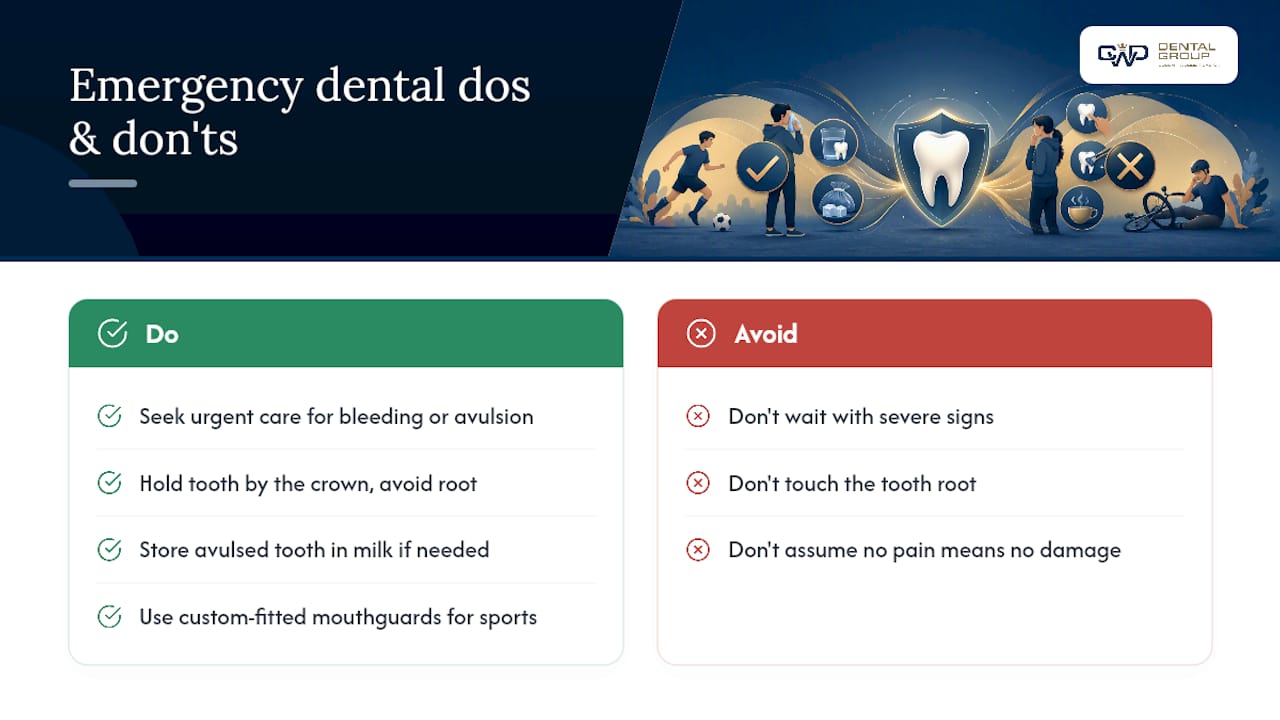
- If a permanent tooth is knocked out entirely, pick it up by the crown (the white part), never the root. If it's dirty, rinse it briefly with water, don't scrub it. Try to reinsert it into the socket right away if you can do it gently.
- Can't reinsert it? Drop it in a cup of milk, or have the person hold it in their cheek against the gum, and avoid swallowing it. Milk preserves the root surface cells better than water or a dry tissue, and reaching a dentist within 30 to 60 minutes gives the tooth its best shot at survival.
- For a loose or shifted tooth that's still in place, don't try to force it back into position yourself. Control any bleeding and get to a dentist.
- For pain and swelling, use a cold compress and an over-the-counter pain reliever per the label. Skip aspirin if there's active bleeding, since it thins the blood.
Pro Tip: Keep a small container of milk or saline in mind as your go-to storage option. If neither is available, tucking the tooth inside the cheek works in a pinch, but never let a child do this if there's any risk of swallowing it.
What's the Long-Term Outlook, and How Do You Prevent Dental Trauma?
Outcomes hinge on how fast treatment happened, how severe the injury was, the patient's age, and how healthy the tooth was beforehand. A tooth reimplanted within the first hour has a real shot at long-term retention. One left out longer faces a higher risk of root resorption and eventual loss.

Even with good care, some teeth darken permanently, some need a root canal months later, and some ultimately require an implant or bridge if they can't be saved. None of that means treatment failed. It means trauma has a wide range of possible endings, and prevention matters more than most people assume.
A few habits cut risk substantially:
- Custom-fitted mouthguards for any contact sport, not the boil-and-bite kind
- Addressing a large overjet with orthodontics before it becomes a liability
- Never using teeth to open packaging, bottles, or bite off tags
- Following up as scheduled, even after the immediate pain is gone, since resorption and necrosis can develop silently
Why Fast, Comfortable Emergency Care Matters
Cwddentalgroup offers same-day emergency dental appointments in Tallahassee specifically because trauma cases can't wait for next week's opening. A few things worth knowing about how that works in practice:
- Rapid assessment on arrival, including mobility and bite checks, means treatment decisions happen the same visit
- The practice covers the full range trauma can require, from bonding and crowns to root canal therapy and reimplantation follow-up
- Comfort-focused care matters here more than almost anywhere else in dentistry, since trauma patients are often in pain and understandably anxious
- Practical guidance on handling walk-in emergencies is available for readers who want to know what a visit actually looks like
What People Get Wrong About Dental Trauma
Most advice on dental trauma focuses so heavily on the avulsed-tooth scenario that it leaves people unprepared for the injuries that are actually more common: chips, luxations, and fractures that don't look dramatic but still carry real risk. That's a mistake. A tooth that looks fine but took a hard hit deserves the same urgency as one that's visibly displaced, because the damage that matters most, to the pulp and the root, is often invisible without an X-ray.
The other place conventional advice falls short is timing language. Telling someone to "see a dentist soon" after any trauma undersells how fast the window closes for an avulsed tooth and overstates the rush for a minor enamel chip. Both extremes lead to bad decisions: people panic over cosmetic damage and delay on injuries where every minute actually counts.
If you take one thing from this, prioritize getting eyes on the injury fast, even when it doesn't hurt much. A five-minute exam beats weeks of wondering whether that quiet ache is nothing or the start of a root canal.
Frequently Asked Questions
What is a dental trauma explained in simple terms? Dental trauma is any injury to a tooth, its supporting ligament, or the surrounding bone caused by an impact such as a fall, sports collision, or car accident. It ranges from a small enamel chip to a tooth being completely knocked out.
How do I know if a dental injury is an emergency? Bleeding from inside the tooth, a knocked-out tooth, severe looseness, or a bite that suddenly feels wrong are all reasons to seek urgent care rather than wait for a routine appointment.
Can a knocked-out tooth be saved? Often, yes, if it's handled correctly and reimplanted within about an hour. Hold it by the crown, avoid touching the root, and store it in milk if you can't reinsert it right away.
Does a tooth need treatment if it doesn't hurt after an impact? Yes. Absence of pain doesn't rule out pulp or root damage, and an X-ray can reveal injury that isn't obvious yet, especially in adjacent teeth.
How long does splinting last after a tooth is reimplanted? Typically 7 to 10 days, though it can extend to 6 to 10 weeks if the surrounding bone was also fractured, and a root canal often follows once healing is confirmed.
Are mouthguards actually effective at preventing dental trauma? Custom-fitted mouthguards reduce the force transmitted to teeth during contact sports far more reliably than generic store-bought versions, making them one of the most practical preventive steps available.
This article is general information, not a substitute for advice from a qualified doctor. Consult a qualified healthcare professional about your own circumstances before acting on anything here.
Sources
- Dental trauma — MedlinePlus
- Traumatic Dental Injuries — American Association of Endodontists (AAE)
- Fractured and avulsed teeth — Merck Manual Professional