
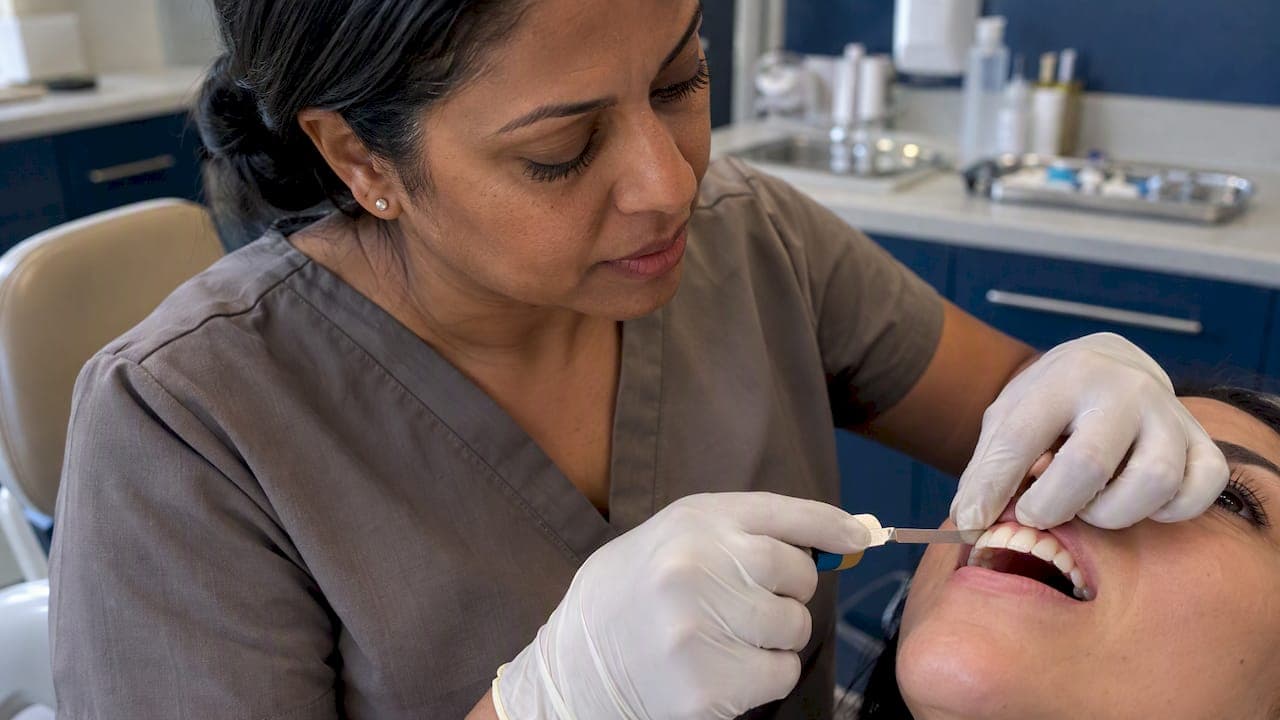
IPR stands for interproximal reduction. Your dentist or orthodontist polishes away a very thin layer of enamel from the sides of certain teeth so aligners have room to move them. It is quick, usually needs no numbing, and is a routine part of many Invisalign plans. It is also permanent, which is why how much is removed, and by whom, matters.
This guide covers what IPR is, why your plan might include it, how much enamel is typically taken, what it feels like, and what to ask before you agree.
TL;DR
- IPR removes a small amount of enamel between teeth to fix crowding or reshape contacts. Cleveland Clinic describes it as typically no more than 0.5 mm per tooth.
- It is generally not painful, because the outer enamel layer has no nerves. You may feel pressure or vibration, and some temporary sensitivity afterward.
- It cannot be undone, so the plan should be conservative, and it should be done once your teeth have started to align and the contacts are accessible.
- The amount planned on screen is not always the amount achieved in the mouth, so expect your plan to be checked and adjusted.
- IPR is normally part of the overall Invisalign fee, not a separate add-on. Ask for that in writing.
Table of Contents
- What IPR actually is
- Why your Invisalign plan might include it
- How much enamel is removed
- When in your treatment it happens
- What the appointment is like
- Does IPR hurt?
- The real risk is not pain
- Planned IPR versus real IPR
- Can you say no to IPR?
- Cost: is IPR extra?
- What we think about IPR
- Plan your Invisalign visit with CWD Dental Group
- Alternatives if you want to avoid IPR
- Aftercare checklist
- FAQ
- Sources
What IPR actually is
Every tooth is wrapped in enamel, the hard outer shell. Where two neighboring teeth touch, each has a small flat surface called a proximal surface. IPR, also called reproximation or stripping, thins those surfaces slightly. According to Cleveland Clinic's overview of the procedure, it is a common, minimally invasive way to create space for tooth movement and serves as an alternative to pulling teeth for some crowding cases.
In clear aligner treatment the amount and location of IPR is built into your digital treatment plan. A 2024 review of IPR in clear aligner therapy notes that it has become an integral part of the digital plan when using clear aligners. You will often see it on the plan as small marks between specific teeth, with a number of millimeters and the stage of treatment when it should happen.
Why your Invisalign plan might include it
Aligners can only move teeth into space that exists. If your jaw is short on room, the software looks for it in one of four places: expanding the arch, tipping teeth forward, extracting teeth, or trimming a little from the sides of teeth. IPR is the last of those, and it is the least invasive. The New York State Dental Journal guidelines list among its benefits that it is less invasive than extraction for gaining space.
Common reasons it shows up in a plan:
- Mild to moderate crowding. Overlapping front teeth need a fraction of a millimeter each to line up.
- Tooth shape. Triangular-shaped teeth touch only near the tips, which can leave gaps near the gums once straightened. Reshaping contacts can help.
- Small bite corrections. Slight differences in tooth size between the upper and lower arches can stop the bite from fitting together evenly.
- Avoiding extra expansion. Pushing teeth outward to find space can make a smile look too full or push teeth beyond healthy bone. IPR can reduce how far they must move.
If your case needs a lot of space, IPR alone will not be enough, and your dentist should say so.
How much enamel is removed
Tiny amounts. The Cleveland Clinic page puts the typical ceiling at about 0.5 mm per tooth. It also cites 2024 guidance with a rule of thumb of roughly 0.25 mm on front teeth and up to 0.8 mm on each back tooth surface, depending on how thick your enamel is.

To picture it, 0.25 mm is about the thickness of a few sheets of paper. Spread across several contacts, those fractions add up to the one or two millimeters of room a crowded arch might need.
Two things keep this safe:
- Conservative planning. The New York State Dental Journal guidelines stress that because IPR is irreversible, only the minimum necessary should be removed, after confirming good oral hygiene and no active dental disease.
- Clinician judgment. Software proposes numbers. A person who has seen your X-rays and measured your teeth decides whether they fit your enamel.
When in your treatment it happens
IPR is rarely done on day one. The same guidelines explain that when teeth are tightly crowded, the contact points are hard to reach, and forcing instruments in raises the risk of gum trauma and imprecise removal. Many clinicians wait until the first aligners have opened up the contacts, then do IPR in one or more short visits.
This is why you may hear "we'll do IPR at aligner 4" or "at your next check." The timing is deliberate, not a delay.
If you also need attachments (the small tooth-colored bumps that help aligners grip), those are placed separately. You can read how that visit works in our guide to Invisalign attachments.
What the appointment is like
The visit is short, and you stay awake and comfortable. The general sequence:
- Your teeth are cleaned and checked, and the planned contacts are confirmed against your treatment plan.
- Cheek and lip retractors move soft tissue out of the way, and often a small wedge or separator opens the contact slightly.
- A fine abrasive strip, a narrow disc, or a thin motorized tool removes the planned amount from the side of the tooth. Clinicians usually check with a thin gauge to measure the space as they go.
- The surfaces are polished smooth so plaque does not catch on them. Fluoride may be applied afterward.
- You try in your next aligners to confirm they seat properly.
Different tools give different experiences. A study comparing three IPR methods in clear aligner treatment found that modern motor-driven methods such as oscillating discs offer more precision, speed and comfort than older hand-operated strips, while the result still depends on the clinician's skill and protective measures like soft-tissue retractors.
Does IPR hurt?
For most people, no. That same study assessed patient discomfort and anxiety and found IPR generally well tolerated. The reason is simple: the layer being polished is superficial enamel, which does not contain nerves. You might feel vibration, pressure, or the sensation of a tight space being opened. Anesthesia is typically not needed.
Afterward, some people notice mild temperature sensitivity for a short time. If sensitivity is strong or lingers, tell your dental team. They can check the polished surfaces and suggest desensitizing toothpaste or a fluoride treatment.
The fear is often bigger than the procedure. If dental visits make you tense, say so at the start. Some patients find that breathing techniques or hypnosis for dental anxiety help them settle in the chair, and your dentist can pause whenever you raise a hand.
The real risk is not pain
The thing worth taking seriously is quality. According to the New York State Dental Journal guidelines, if IPR is done poorly it can leave ledges or furrows, small permanent imperfections that trap plaque and food. Without proper polishing, that can raise the long-term chance of cavities. So the question for your dentist is not "will it hurt?" but "how will you make sure the surfaces end up smooth and the amounts stay conservative?"
Cleveland Clinic also notes IPR is not right for everyone. People with naturally small teeth, enamel defects, poor oral hygiene or active gum disease may not be good candidates. Because removing enamel shifts the contact point toward the gums, planning also has to avoid black triangles, the dark gaps that can appear between teeth. If that is a concern, see our explainer on fixing black triangle teeth.

Planned IPR versus real IPR
Here is something many patients are not told. Research on clear aligners keeps finding a gap between what the software prescribes and what is achieved clinically. An abstract from the International Association for Dental Research compared planned IPR in ClinCheck with actual IPR measured on final 3D models of treated patients. A quantitative study in 10 orthodontic practices looked at the same question, and the study of accuracy across three methods reported that the achieved amount is often well below what was prescribed, sometimes by more than half.
What that means for you:
- If aligners stop fitting snugly later in treatment, missing space is one possible cause.
- Your dentist may add or redo IPR, or change the plan. A study of IPR in the refinement phase looked at 330 patients and found that about 40% of the contact sites prescribed IPR were recorded in the refinement plans, not the initial one.
- Refinement aligners are common and not a sign anything went wrong. We explain more in Invisalign refinements.
Can you say no to IPR?
Yes. You always have the right to decline a procedure. But it helps to understand the trade-off, because IPR is there for a reason. If you decline, your dentist may need another way to find space: moving teeth outward more, taking a longer or more complex route, or in some cases extracting teeth. For some mild cases, the plan can be rewritten with little or no IPR, and the result is almost the same. For others, skipping it can compromise the final alignment.
Useful questions to ask:
- How many contacts will be treated, and how many millimeters in total?
- Is there a version of the plan with less IPR, and what would change in the result?
- Which tool will be used, and how are the surfaces polished afterward?
- At which aligner stage will it happen?
- What is the backup if the space does not materialize?
A good dentist is glad to answer all of these.
Cost: is IPR extra?
In general, no. IPR is a clinical step performed by your dentist within the treatment, and it is normally folded into the overall Invisalign fee. Invisalign states that the cost is usually comparable to braces and that your doctor sets it based on case complexity and how many aligners you need. Ask your provider whether IPR, attachments, refinements and retainers are all included before you start.
If you want to dig into the numbers, our Tallahassee price breakdown is in Invisalign cost in Tallahassee, and coverage rules are in does insurance cover Invisalign.
What we think about IPR
We see IPR as a precision tool, not a shortcut. The patients who are happiest at the end of Invisalign treatment are the ones who understood their plan from the start: why a certain contact was being polished, how much, and when.
Our view comes down to a few principles:
- Less is more. Enamel does not grow back. If a case can reach a good result with a little less IPR and a little more patience, we would rather explain that choice than reach for the bur.
- Healthy teeth first. Cavities and gum problems should be treated before aligners and IPR, not after. Teeth that are clean and healthy tolerate the procedure best.
- Timing matters. Doing IPR once the teeth have started to line up makes it easier to reach the contacts and to measure accurately.
- No surprises. You should know the total planned amount, what happens if it falls short, and what is included in the fee.
- Comfort is part of the care. Our approach is built on comfort and accessibility, and IPR is a good example of a step that should feel calm and explained.
If something in your plan looks unclear, ask. That is what the consultation is for.
— Kayle
Plan your Invisalign visit with CWD Dental Group
If you are in Tallahassee and weighing clear aligners, we offer Invisalign alongside general, preventative and cosmetic dentistry, so your cleaning, exam and aligner plan can be coordinated in one practice. You can see everything we do on our services page. If your teen is the one who needs straightening, start with our guide to Invisalign for kids. Bring your questions from this article to the consultation.
Alternatives if you want to avoid IPR
If the idea of reshaping enamel bothers you, ask about these options for gaining space. Each has trade-offs, and which fits depends on your bite and your jaw.
| Option | How it creates space | Trade-off |
|---|---|---|
| IPR | Thins contact surfaces by fractions of a millimeter | Permanent, but minimal; needs careful polishing |
| Arch expansion | Widens the dental arch | Works only within limits; can affect smile fullness |
| Extraction | Removes one or more teeth | Most invasive; used for significant crowding |
| Longer, slower tooth movement | Uses small tipping and rotation steps | May lengthen treatment and may not fix all crowding |
Some patients with jaw tension or clenching also explore related care. If that is you, our TMJ treatment is worth discussing, since bite changes during aligner treatment can affect how your jaw feels.
Aftercare checklist
After IPR you do not need to change much, but a few habits help:
- Brush twice a day with fluoride toothpaste and clean between teeth daily. Newly polished surfaces are smooth, but you want to keep them that way.
- Keep wearing your aligners as instructed, usually 20 to 22 hours a day.
- If cold drinks bother you, use a desensitizing toothpaste and tell your dentist if it persists.
- Keep your regular cleanings. They let your team check the contacts and catch any problem early.
- Mention it if a new aligner feels tight at a spot where IPR was planned, since that can mean the space is not quite there yet.
FAQ
Is IPR included with Invisalign?
Usually, yes. IPR is a clinical step done by your dentist and is generally part of the overall treatment fee. Because pricing varies by provider, ask for a written list of what the fee covers before you begin.
Is dental IPR painful?
Generally not. The enamel being removed is a thin outer layer with no nerves, so most people feel only pressure or vibration and need no anesthesia. Some have mild, temporary sensitivity afterward.
Is IPR worth it for Invisalign?
Often, yes, when your teeth truly need a little space. It can avoid extractions and extra expansion, and it is among the least invasive ways to gain room. If your case needs only minimal space, ask whether the plan can use less of it.
Can you refuse IPR for Invisalign?
Yes, it is your decision. Your dentist can then look at alternatives such as more expansion, a different movement plan, or extractions in complex cases, and explain how each affects the result. Make that choice before treatment starts, if you can, so the plan is built around it.
Does IPR damage your teeth?
Done conservatively and polished well, it removes only a small part of the enamel. The risk comes from removing too much or leaving rough surfaces, which can trap plaque. That is why a careful pre-check and a conservative plan matter.
Sources
- Interproximal Reduction (IPR): Purpose & Benefits, Cleveland Clinic
- Guidelines for Interproximal Enamel Reduction (IPR), New York State Dental Journal
- Comparison of the accuracy of three interproximal reduction methods used in clear aligner treatment
- The Role of Interproximal Reduction (IPR) in Clear Aligner Therapy, PMC
- Planned IPR vs Actual IPR during Invisalign Treatment, IADR
- Quantitative assessment of interproximal tooth reduction in 10 orthodontic practices
- Interproximal reduction in the refinement phase of Invisalign treatment, PubMed
- Average Cost of Invisalign Aligners, Invisalign.com