

Invisalign cost in Tallahassee typically runs $2,790 to $7,905, with most cases landing near $4,500 to $5,600 once you factor in the extras a headline price often skips. Your final number depends on how complex your bite correction is and what the quote actually includes. Skip the guesswork: book a records scan, get a written itemized estimate, and confirm your insurance benefits before you commit to a start date.
TL;DR:
- Invisalign in Tallahassee typically costs between $2,790 and $7,905, with most cases falling around $4,500 to $5,600 after extras.
- The final price depends on treatment complexity, the number of trays required, whether refinements and retainers are bundled or billed separately, and the treatment tier selected.
- Insurance coverage usually caps benefits at $1,000 to $3,500, and HSA or FSA funds can help offset the costs if documented properly.
- A detailed, written estimate must include fees for scans, aligners, visits, refinements, retainers, and potential extras to prevent surprises.
- Refinements, extra retainers, and treatment length are the main factors that can increase the total cost beyond initial quotes.
Table of Contents
- How Much Does Invisalign Cost in Tallahassee?
- What Actually Changes Your Invisalign Price?
- Does Dental Insurance Cover Invisalign, and What About HSA/FSA?
- What Should a Written Invisalign Estimate Include?
- Three Realistic Tallahassee Budget Scenarios
- How CWD Dental Group Helps You Get a Real Number
- Ready to Get Your Tallahassee Invisalign Quote?
- Sources
- FAQ
How Much Does Invisalign Cost in Tallahassee?
Local pricing models put the Tallahassee range at $2,790 to $7,905, and individual clinic pages tend to echo that spread. Some Tallahassee providers quote $3,000 to $8,000, which sits close enough to confirm the market isn't wildly inconsistent, just imprecise on the margins.
Where you land in that range comes down to two things: how much your teeth need to move, and how much the quoted price bundles in.
- Low end ($2,790 to $4,000): Minor crowding or spacing, shorter treatment, fewer aligner trays.
- Mid range ($4,500 to $5,600): The typical Tallahassee case, moderate bite issues, standard monitoring schedule.
- High end ($6,000 to $7,905): Comprehensive bite correction, longer treatment timelines, more refinement trays built into the plan.
Two practices can quote different numbers for what looks like the same case because one bundles retainers and refinements into the sticker price and the other bills them separately. That's exactly why a written quote matters more than any published range, including this one.
What Actually Changes Your Invisalign Price?
A price quote is really a stack of five separate decisions, and each one moves the total up or down. Understanding them lets you compare two Tallahassee estimates apples to apples instead of guessing why one number is $1,500 higher than the other.
- Case complexity and aligner count. More movement means more trays, and tray count drives the base fee more than almost anything else.
- Treatment tier. Invisalign Comprehensive (sometimes called Full) covers complex bite correction and unlimited aligners over a longer window. Invisalign Lite or Express targets minor crowding with fewer trays, usually shaving $1,000 to $2,000 off the Comprehensive price.
- What's bundled in. Scans, monitoring visits, refinements, and retainers can be included or billed as add-ons, and this single choice explains a lot of the gap between advertised numbers.
- Provider type and technology. An orthodontist with an in-office 3D scanner often charges differently than a general dentist offering Invisalign as one service among many.
- Optional extras. Teeth whitening add-ons, extra retainer sets, or expedited scanning fees sometimes show up as separate line items.
Pro Tip: Ask every provider whether their quoted price is "all-in" through your final retainer, or whether refinements and retainers get billed once treatment wraps up. That one question prevents most sticker shock.
Read up on why refinements happen if your treatment plan mentions them, because they're one of the most common reasons a final bill exceeds the initial estimate.
Does Dental Insurance Cover Invisalign, and What About HSA/FSA?
Most dental plans that cover braces treat Invisalign the same way, but coverage math is trickier than a simple coinsurance percentage. What actually caps your benefit is your plan's lifetime orthodontic maximum, not the percentage printed on your benefits card.
Cigna Dental 1500 plans commonly cap lifetime orthodontic benefits at $1,000, while BCBS FEP Standard and High Option plans typically cap between $2,500 and $3,500. If your Invisalign plan costs $5,000 and your lifetime max is $1,500, insurance pays $1,500 total, period, regardless of your coinsurance rate.
Invisalign's own guidance confirms coverage sometimes reaches up to around $3,000 in favorable cases, but that figure varies enormously by carrier and employer plan. Check your specific coverage details before assuming a number.
HSA and FSA dollars can close much of that gap. IRS Publication 502 lists orthodontic treatment as an eligible medical expense, so HSA or FSA funds can cover Invisalign when the provider documents it as corrective treatment. One timing detail trips people up: eligible expenses count in the tax year you actually pay them, so a lump-sum payment in December counts differently than the same amount split across monthly installments spanning two tax years, per HSA orthodontic eligibility rules.
- Ask your provider for a written down payment amount, typically 10% to 25% of the total.
- Confirm whether monthly plans are interest-free or carry financing charges.
- Get the payment schedule in writing before your first tray is fitted.
What Should a Written Invisalign Estimate Include?
A real estimate is a receipt, not a headline number. Bring this checklist to your consultation and don't sign anything missing these items.
- Records and scans fee (often included, sometimes billed separately)
- Base aligner fee tied to your specific treatment tier
- Monitoring visit schedule and whether any are virtual check-ins instead of in-person appointments
- Refinement policy stated in writing: how many refinement rounds are included at no extra cost
- Retainer cost after treatment ends, since retainers are frequently excluded from the headline price
- Replacement aligner fees if you lose or damage a tray
- Lab fees, if the practice bills them as a separate line
Ask for an itemized insurance coordination statement too. That document is what your HSA or FSA administrator wants to see for reimbursement, and it's also your proof of what insurance actually paid versus what you owe. Comparing quotes without these details is comparing two different products that happen to share a name. The three items that most often cause a $500 to $1,500 swing between otherwise similar quotes are refinements, retainers, and replacement aligner pricing.
Three Realistic Tallahassee Budget Scenarios
These numbers assume a hypothetical plan structure, so swap in your own insurance figures once you have them.
- Minor case: $3,200 provider fee, $1,000 lifetime insurance max, $500 paid via FSA, $1,700 out of pocket.
- Moderate case: $5,000 provider fee, $2,000 lifetime insurance max, $1,000 paid via HSA, $2,000 out of pocket.
- Complex case: $7,500 provider fee, $2,500 lifetime insurance max, one refinement round adding $600, $4,400 out of pocket before HSA/FSA offset.
Refinements and extra retainers are the two variables most likely to push any of these totals higher.
How CWD Dental Group Helps You Get a Real Number
CWD Dental Group walks Tallahassee patients through a straightforward sequence: consultation, digital scan, written estimate, insurance verification, then a payment plan built around what you actually owe. That order matters, because it puts the insurance check before you commit to anything.
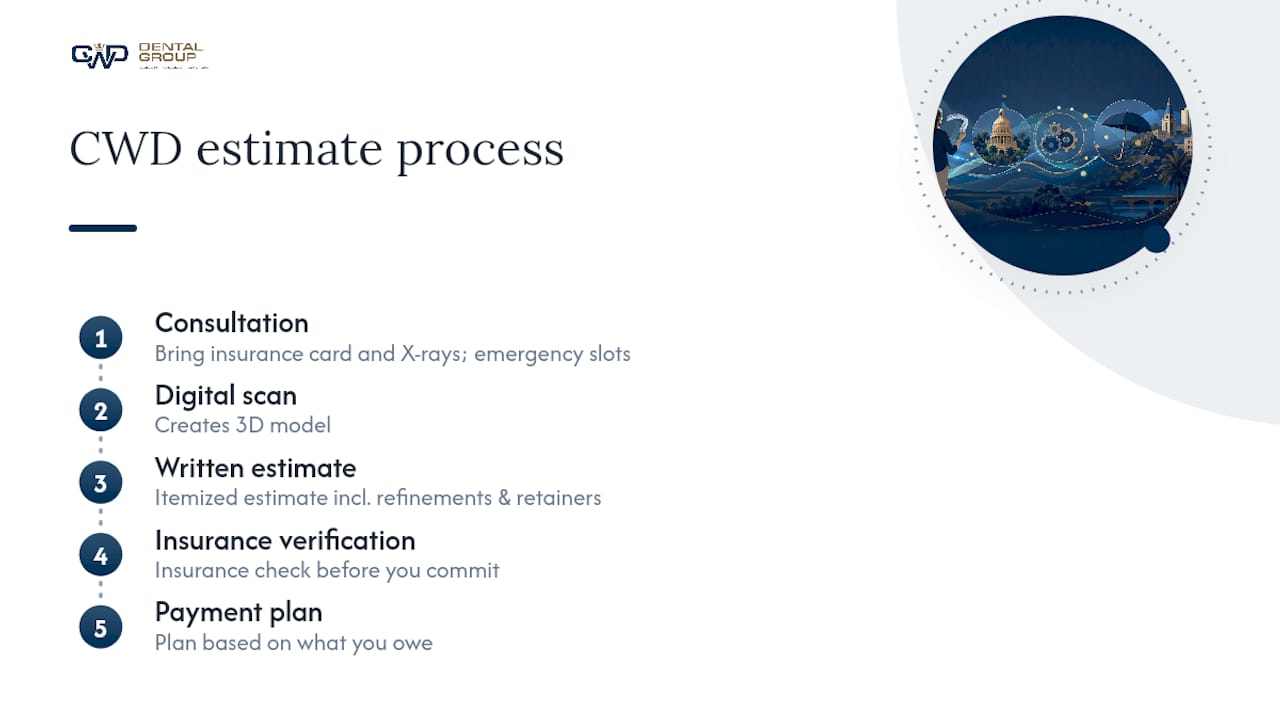
Emergency appointments can help if a dental issue needs attention before aligners can start, so you don't have to wait weeks for a slot. Bring your insurance card and any recent X-rays to your visit, and ask directly for an itemized estimate covering refinements and retainers.
Ready to Get Your Tallahassee Invisalign Quote?
Every option above (market averages, insurance carrier caps, HSA timing rules) gets you closer to an estimate, but none of it replaces a scan of your actual teeth. CWD Dental Group turns that research into a real number: bring your insurance card, note any past orthodontic work, and leave with a written estimate instead of another range to guess from.
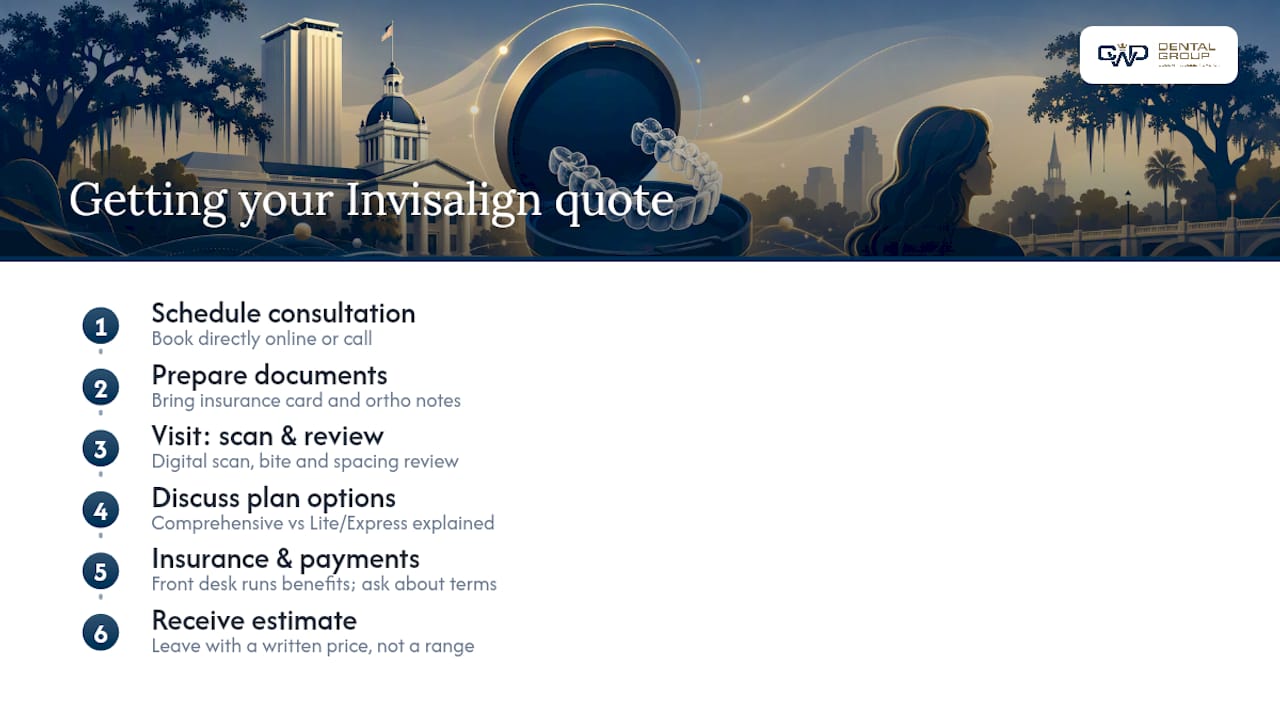
At your first visit, expect a digital scan, a review of your bite and spacing, and a conversation about whether Invisalign Comprehensive or a Lite/Express plan fits your case. If you also have an urgent dental issue that needs attention first, CWD Dental Group's same-day emergency dental care means that doesn't have to delay your aligner consultation by weeks. Bring your questions about monthly payment terms, and ask the front desk to run your insurance benefits on the spot.
Schedule your consultation directly online, or call the office to book a time that works around your schedule.
This article is general information, not a substitute for advice from a qualified doctor. Consult a qualified healthcare professional about your own circumstances before acting on anything here.
Sources
- Invisalign Cost in Tallahassee: $2,790-$7,905
- Does dental insurance cover Invisalign? Carrier guide
- Invisalign
FAQ
How much does Invisalign treatment cost in Tallahassee, Florida?
Tallahassee Invisalign pricing typically runs $2,790 to $7,905, with most patients landing near $4,500 to $5,600 depending on case complexity and what's bundled into the quote.
Is $3,000 a good price for Invisalign?
$3,000 is a reasonable price for a minor to moderate case using an Invisalign Lite or Express plan, and it aligns with the coverage ceiling Invisalign's own guidance cites for insurance-assisted cases. A comprehensive case needing more aligner trays will usually cost more than that.
What is the 30 minute rule with Invisalign?
Dentists commonly advise wearing aligners most hours of the day and removing them only briefly for meals, and some providers suggest a short break for eating before reinserting trays to protect your treatment timeline. This isn't a formal Invisalign policy, more a practical habit many providers recommend to keep treatment on schedule.
Why don't dentists recommend Invisalign for every patient?
Some cases involve bite issues, tooth rotations, or spacing that respond better to traditional braces or a combination approach, so a provider may recommend an alternative when the physics of the movement calls for it rather than because of the treatment's cost or convenience.
Can I use HSA or FSA funds to pay for Invisalign in Tallahassee?
Yes. Invisalign qualifies as an eligible medical or dental expense under IRS Publication 502, and CWD Dental Group can provide the itemized documentation your HSA or FSA administrator needs for reimbursement.