
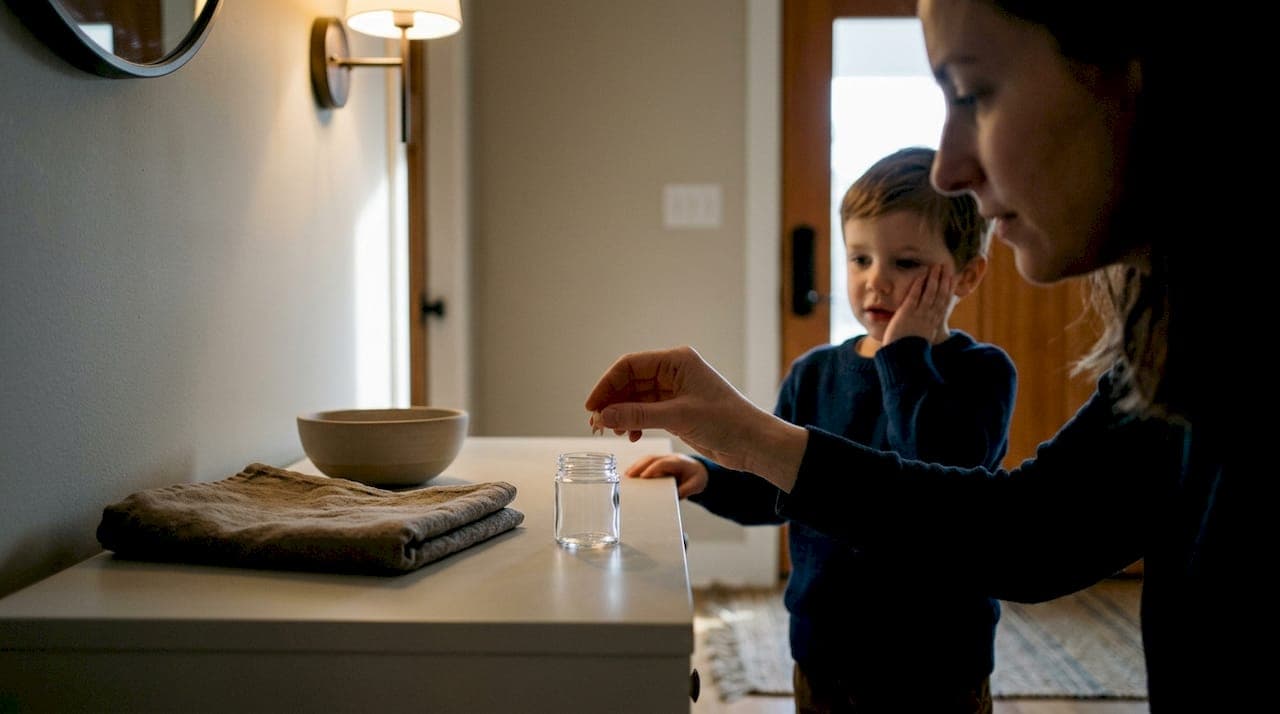
If your child knocks out a tooth, act now: control the bleeding, figure out whether it's a baby tooth or a permanent one, and get the right kind of care. Do not replant a baby tooth under any circumstance. A permanent tooth has the best shot at survival when it's replanted or properly stored within minutes, so speed matters more than almost anything else you do next.
TL;DR:
- Replanting is only recommended for permanent teeth, ideally within the first hour after injury, while baby teeth should never be replanted.
- Proper storage of a knocked-out permanent tooth in milk, saliva, or a salt solution is crucial if replantation is delayed beyond a few minutes.
- Children under age 6 nearly always have baby teeth, which are smaller, whiter, and have shorter roots compared to permanent teeth, aiding identification.
- Emergency room visits are necessary only if there are signs of head injury, uncontrolled bleeding, or airway issues, not for isolated dental trauma with no other symptoms.
- Dentists schedule multiple follow-ups over months to monitor long-term effects on the developing permanent tooth, as damage may only become evident later.
Table of Contents
- First aid steps to take in the first 60 minutes
- How to tell a baby tooth from a permanent tooth
- When to call an emergency dentist versus head to the ER
- What happens at the dental visit and what follow-up looks like
- Caring for your child at home in the days after
- Long-term risks to the permanent tooth and why monitoring matters
- A dentist's-eye view on parent panic versus preparation
- Same-day emergency care when your child needs it now
- Trusted resources for dental trauma guidance
- Sources
- FAQ
First aid steps to take in the first 60 minutes
Stay calm and work through these steps in order:
- Sit your child down and have them bite gently on clean, folded gauze or a clean cloth to control bleeding.
- Apply a cold compress to the lips or cheek near the injury to limit swelling and ease pain.
- Find the tooth if it's a permanent tooth, and pick it up only by the crown, never the root.
- Rinse the tooth briefly with milk or saline if it's dirty, never scrub it or dry it off.
- Try to reinsert a permanent tooth into its socket if your child is old enough to cooperate and hold it in place by biting on gauze.
- If reinsertion isn't possible, store the tooth in milk, your child's saliva, or a tooth-preservation product rather than letting it sit dry.
A few things matter just as much as the steps above:
- Never attempt to replant a baby tooth, even if it looks intact and clean.
- Give an age-appropriate dose of acetaminophen or ibuprofen for pain, following the package label or your pediatrician's guidance.
- Keep the child upright and avoid letting them chew on the injured side.
Permanent teeth have the best chance of survival when they're replanted promptly, ideally within the first hour after the injury, and storing them properly in milk, saliva, or a balanced salt solution buys time when instant replantation isn't possible. Keeping a small tooth-preservation kit in a diaper bag or sports bag, something we cover in our back-to-school dental checklist, can make that window easier to use well.
How to tell a baby tooth from a permanent tooth

Age is your first clue. Kids typically start losing baby teeth around age 6, and primary tooth trauma peaks between ages 2 and 5, before any permanent teeth have erupted. Between roughly ages 6 and 12, children are in mixed dentition, meaning both tooth types are present in the mouth at once, which makes visual identification more important.
Look for these differences:
- Baby teeth are noticeably smaller, whiter, and smoother than permanent teeth.
- Permanent teeth often look slightly yellower or more textured along the edges.
- A baby tooth knocked out close to its natural exfoliation time may show a shorter, resorbed root, while a permanent tooth has a long, intact root.
- If your child is younger than 6, the tooth is almost certainly a baby tooth.
Our guide to pediatric dental treatments walks through typical eruption timing if you want more detail. When you genuinely can't tell, treat the tooth as permanent, preserve it, and get urgent dental advice rather than guessing wrong.
When to call an emergency dentist versus head to the ER
Some situations need a hospital before they need a dentist. Go to the emergency room if your child shows:
- Loss of consciousness, confusion, or repeated vomiting after the injury.
- Severe facial trauma, a suspected broken jaw, or heavy, uncontrolled bleeding that gauze pressure doesn't stop.
- Any sign of airway trouble, including a missing tooth that may have been swallowed or inhaled.
Head injury signs take priority over dental treatment, so stabilize those concerns first. Once medical issues are ruled out, call an emergency dentist right away if a permanent tooth is missing, since replantation success drops sharply after 15 to 60 minutes. A knocked-out baby tooth, with no other injuries present, can typically wait for a same-day or next-day dental visit rather than an ER trip. Our page on recognizing a dental emergency breaks down these triggers in more detail.
What happens at the dental visit and what follow-up looks like
The dentist starts with a history of how the injury happened, followed by an exam of the head, neck, and inside the mouth. Radiographs are common, both to check the socket and to get a baseline look at any permanent teeth developing underneath a lost baby tooth.
From there, treatment depends on what the exam shows:
- A displaced but still-rooted primary tooth may be gently repositioned or splinted rather than pulled.
- A loose or badly displaced primary tooth is sometimes extracted if it threatens the developing permanent tooth underneath.
- A replanted permanent tooth is typically splinted for about two weeks, with antibiotics and a tetanus status check when appropriate.
- Soft tissue injuries like cut lips or gums get cleaned and, if needed, stitched.
Follow-up isn't a formality. Dentists typically want to see pediatric trauma patients again at intervals over the following weeks and months to check healing and watch for effects on the permanent tooth germ. A pediatric endodontist or orthodontist sometimes joins the picture later if root development or eruption looks off.
Pro Tip: Bring photos of the injury taken right after it happened. They help the dentist compare swelling and positioning changes at follow-up visits.
Caring for your child at home in the days after

Pain and swelling usually peak in the first day or two, then ease off. Stick to soft foods, offer age-appropriate acetaminophen or ibuprofen per the label or your pediatrician's instructions, and keep using cold compresses as needed.
For hygiene, have your child rinse gently with water after meals, but skip brushing directly over the injured socket for the first few days. Supervise their brushing elsewhere in the mouth so plaque doesn't build up while that one area heals.
- Watch for fever, spreading swelling, or bleeding that won't stop with gentle pressure.
- Call the dentist if a replanted tooth darkens noticeably or pain gets worse instead of better.
- A little tenderness for a few days is normal; anything escalating is not.
Pro Tip: Offer food from a cup or spoon rather than a straw for the first day or two. Suction can irritate a healing socket.
Long-term risks to the permanent tooth and why monitoring matters
Trauma to a baby tooth doesn't always stay contained to that tooth. Because primary tooth roots sit close to the developing permanent tooth underneath, injury to that root can disturb the permanent tooth's formation or delay its eruption. That's the main reason dentists still want to examine and document an injury even when the baby tooth itself is a lost cause.
Possible long-term issues include:
- Enamel defects or discoloration on the permanent tooth once it erupts.
- Delayed or altered eruption timing compared to the corresponding tooth on the other side.
- Infection or abscess at the injury site weeks after the initial trauma.
Our dental trauma explainer covers typical healing timelines in more depth. Most complications, when they occur, show up over the following months to a couple of years, which is why dentists schedule periodic checks rather than a single follow-up visit.
A dentist's-eye view on parent panic versus preparation
Parents almost always overestimate how much they need to fix in the moment and underestimate how much the follow-up matters. The scary part, a missing tooth and a bleeding mouth, resolves faster than most people expect. The part that actually determines long-term outcomes, whether the permanent tooth germ was affected, only shows up on x-rays and repeat visits over the following months.
That gap between what feels urgent and what's actually consequential is where kids get underserved. A single ER visit with no dental follow-up misses the slow-developing problems entirely.
— Kayle
Same-day emergency care when your child needs it now
A knocked-out tooth doesn't wait for a convenient appointment slot, and neither should your dentist. Some dental practices offer same-day emergency appointments for exactly these situations, so a scary five minutes at the playground doesn't turn into days of uncertainty.

- Call to describe the injury and get same-day guidance on whether the tooth is likely primary or permanent.
- Book through our emergency dentist page for urgent evaluation, x-rays, and treatment.
- Ask about pediatric dentistry on our services page if ongoing monitoring is needed.
If your child shows any signs of head injury, difficulty breathing, or uncontrolled bleeding, go to the emergency room first. Dental care can follow once they're medically stable.
Trusted resources for dental trauma guidance
For deeper reading beyond this guide, a few sources stand out:
- The IADT and AAPD trauma guidelines set the clinical standard dentists follow for avulsed teeth.
- MedlinePlus offers a clear, government-backed overview of what to do for a knocked-out tooth.
- KidsHealth provides parent-friendly first-aid steps and timing benchmarks.
- The University of Michigan's dental trauma handout explains age-related patterns in primary tooth injuries.
This article is general information, not a substitute for advice from a qualified doctor. Consult a qualified healthcare professional about your own circumstances before acting on anything here.
Sources
- IADT / AAPD guidance on dental trauma
- MedlinePlus — Knocked-out tooth
- KidsHealth / Norton Children’s — What to do about tooth injuries
- University of Michigan — Dental trauma: primary teeth handout
FAQ
Can a knocked out tooth be put back in?
A permanent tooth can often be replanted, ideally within minutes of the injury, by gently reinserting it into the socket and biting on gauze to hold it in place. A baby tooth should never be replanted, since IADT and AAPD guidance explicitly advises against it due to the risk to the permanent tooth developing underneath.
Should you go to the ER for a knocked out tooth?
Go to the ER if there are signs of head injury, loss of consciousness, repeated vomiting, uncontrolled bleeding, or any concern the tooth was swallowed or inhaled. For a knocked-out baby tooth with no other injuries, a same-day or next-day dental visit is usually appropriate instead.
Will a knocked loose baby tooth tighten back up?
A baby tooth that's loosened but still in place can sometimes reattach and stabilize on its own, and a dentist may reposition or splint it depending on how displaced it is. If it's fully knocked out, it will not be put back in, since primary teeth are not replanted.
Is it possible for a baby's tooth to never fall out?
Baby teeth can occasionally fail to fall out on schedule if the permanent tooth beneath it isn't positioned to push it out, sometimes requiring a dentist to extract it. This is different from a knocked-out tooth situation, but either way, ongoing dental checkups are the way to catch it early.