

A veteran's dental history shapes two things at once: the clinical choices a dentist makes at the chair and whether that dentist's work qualifies for VA payment. Service dates, documented dental trauma, and medical conditions like diabetes or PTSD all change treatment planning, and gaps in that history are the single biggest reason VA dental claims get denied.
Here's what to act on right away:
- Pull your DD214 and request service dental records before your next appointment or claim.
- Bring a current medication list and recent X-rays so your dentist can flag interactions or risks fast.
- Ask directly which VA dental benefit class you might fit rather than assuming you don't qualify.
- Request your service treatment records (including dental) through the National Personnel Records Center.
- Schedule a VA dental eligibility check or a civilian consultation that reviews your full history in one visit.
Key Takeaways
A veteran's documented dental and medical history determines both the safest treatment plan a dentist can offer and which VA benefit class, if any, applies to that care.
| Point | Details |
|---|---|
| History drives eligibility | VA benefit classes (Class I–VI) depend on documented service connection, timing, and one-time completion rules under 38 C.F.R. § 17.161. |
| Routine care isn't trauma | In-service fillings or extractions generally don't count as service trauma for Class IIa claims, per VA Office of General Counsel guidance. |
| Medical flags change treatment | Diabetes, tobacco use, and PTSD history all shift how dentists plan procedures, sedation, and pain management. |
| Complete records speed everything | Combining DD214, service dental records, civilian X-rays, and medication lists cuts delays in both claims and appointments. |
| Local urgent access matters | Cwddentalgroup offers same-day emergency appointments and record-friendly intake for veterans in Tallahassee needing care now. |
Table of Contents
- How VA Dental Eligibility Classes Depend on Your History
- How Your Medical and Dental History Changes Treatment Choices
- What Records You Need to Build a Complete Dental History
- Using Dental History to Support VA Claims and Appeals
- Where to Get Dental Care Outside the VA System
- What the Research Says About Veteran Oral Health Risk
- How Documented Conditions Shape Your Treatment Plan
- Combining Civilian and Military Dental Records Into One History
- How PTSD and Service-Related Trauma Affect Dental Visits
- How Long VA Dental Benefit Applications Typically Take
- Why Keeping Your Dental History Current Matters Going Forward
- A Veteran-Friendly First Visit: What to Expect
- How CWD Dental Group Supports Veterans in Tallahassee
- Frequently Asked Questions
- Sources
How VA Dental Eligibility Classes Depend on Your History
VA doesn't run one dental program. It runs six, and which one applies to you depends almost entirely on what your records show. The legal foundation sits in 38 U.S.C. § 1712, which authorizes outpatient dental care for specific veteran categories, and 38 C.F.R. § 17.161, which spells out Classes I through VI.
Class I covers veterans with a compensable, service-connected dental disability and gets unlimited authorization. Classes II and IIa cover one-time treatment for a dental condition tied to service. They often come with strict timing rules. Class V covers veterans in a VA vocational rehabilitation program. Class VI covers veterans needing dental care to treat a condition complicating another medical problem VA is already treating.
A common misunderstanding trips up a lot of claims: routine fillings or extractions performed during service are not automatically "service trauma." The VA Office of General Counsel clarified this directly, stating that therapeutic dental treatment received in service does not by itself establish the kind of trauma Class IIa requires.
Timing matters just as much as category. Many one-time treatment classes require applying within 180 days of discharge, and once VA completes that one-time treatment, the case is generally closed unless a new service-connected issue arises.
Quick self-check before you apply:
- Do your discharge papers show a compensable, service-connected dental disability? → Likely Class I.
- Did a specific injury (not routine care) happen in service? → Possibly Class II or IIa, if within the time window.
- Are you rated 100% service-connected disabled? → Likely Class IV.
How Your Medical and Dental History Changes Treatment Choices
Dentists don't treat a tooth in isolation. They treat the whole record, and for veterans that record often includes flags that change the entire plan. NHANES data shows veterans have measurably more missing and filled teeth and greater unmet periodontal need than non-veterans, driven largely by higher rates of tobacco use and diabetes rather than service itself.
Flags a dentist watches for in your history include:
- Diabetes or prediabetes, which slows healing and raises infection risk after extractions or implants.
- Tobacco or vaping history, which affects everything from gum healing to implant success rates.
- Prior maxillofacial trauma or reconstructive surgery, which can limit anesthesia options or require imaging before any new procedure.
- Missing teeth or advanced periodontal disease, which shifts priority from cosmetic work to structural stabilization.
- PTSD or documented service-related trauma, which changes how a provider approaches sedation and pacing.
These flags change real decisions. A veteran with poorly controlled diabetes may need antibiotic prophylaxis before an extraction. A veteran with prior jaw trauma may need a cone-beam scan before implant planning even starts.
Pro Tip: Write your medical history down before the appointment, in plain language, with rough dates. Handing a dentist a clear timeline gets you a better plan than trying to recall it out loud under the light.
What Records You Need to Build a Complete Dental History
The strongest dental history combines four things: your DD214, in-service dental records, civilian dental records with X-rays, and a current medication list. VA reviewers and civilian dentists both work faster and more accurately when all four show up together.
To request records:
- Order your service treatment records (dental included) through the National Personnel Records Center or eBenefits.
- Contact your last civilian dental office directly for copies of X-rays and treatment notes.
- Ask your VA primary care team for any prior VA dental exam reports on file.
Organize everything into a single, date-stamped timeline. A one-page summary, even handwritten, saves real time in both claims review and a first dental appointment.
Using Dental History to Support VA Claims and Appeals
A dental claim lives or dies on documentation, not on how the condition feels. VA examiners want a clear line from entry status to exit status to current diagnosis.
- Gather your entry and discharge dental exams, showing exactly what condition each tooth was in at both points.
- Confirm timing against the 180-day rule where it applies. Regulatory guidance under 38 C.F.R. § 3.381 notes that a tooth listed as normal at entry and treated after that window can support service connection for treatment purposes, while a tooth already marked missing at entry generally cannot.
- Get a dentist's written opinion linking the current condition to service, not just a diagnosis.
- Request a VA dental examination using the VA's oral and dental exam form, which captures onset and cause details examiners rely on.
Common pitfalls that sink otherwise solid claims:
- Assuming routine in-service fillings count as trauma (they usually don't).
- Missing exact dates connecting when a condition appeared to your service window.
- Submitting a diagnosis with no dentist opinion connecting it to service.
If your claim gets denied or feels stuck, a Veterans Service Organization like DAV can help build the appeal file and push it forward.
Where to Get Dental Care Outside the VA System
Not every veteran qualifies for VA dental benefits, and VA's own numbers show the scale of the gap: nearly 888,000 veterans received VA dental care in FY2025, a fraction of the total veteran population needing it.
If you're not eligible, or you need care faster than VA can schedule it, you have real options:
- VADIP offers reduced-cost private dental insurance plans for veterans already enrolled in VA health care, even without dental eligibility.
- Federally Qualified Health Centers (FQHCs) provide sliding-scale dental services regardless of VA status.
- Private practices with financing options cover cosmetic and restorative work VA doesn't authorize.
- Emergency outpatient dental care at a VA facility is available under limited circumstances, but coverage caps and eligibility rules still apply even in urgent situations.
For general dental services when you're weighing private options, resources like Complete Dental Care's general dentistry page outline what routine private coverage typically includes.
What the Research Says About Veteran Oral Health Risk
The oral health gap between veterans and civilians isn't really about combat exposure. It's about lifestyle risk factors that accumulate during and after service.
The NHANES 2011-2014 analysis found veterans have significantly higher DMFT (decayed, missing, filled teeth) scores and greater unmet periodontal treatment need, with tobacco use and diabetes prevalence identified as the primary explanatory factors rather than service itself.
That distinction changes what you should ask for at your next visit: request tobacco cessation support, ask for a diabetes screening referral if you haven't had one recently, and push for earlier periodontal evaluation rather than waiting until a problem becomes painful. CareQuest Institute's policy research recommends integrating dental and primary care for exactly this reason, since the risk factors driving poor oral health rarely show up in isolation.
How Documented Conditions Shape Your Treatment Plan
Missing teeth change more than your smile. They shift bite force onto remaining teeth, which accelerates wear and can trigger jaw joint problems over years. A dentist reviewing a veteran's history who sees multiple missing teeth documented from service will often prioritize stabilizing the bite before tackling anything cosmetic, sometimes recommending a full dental reconstruction rather than isolated fixes.
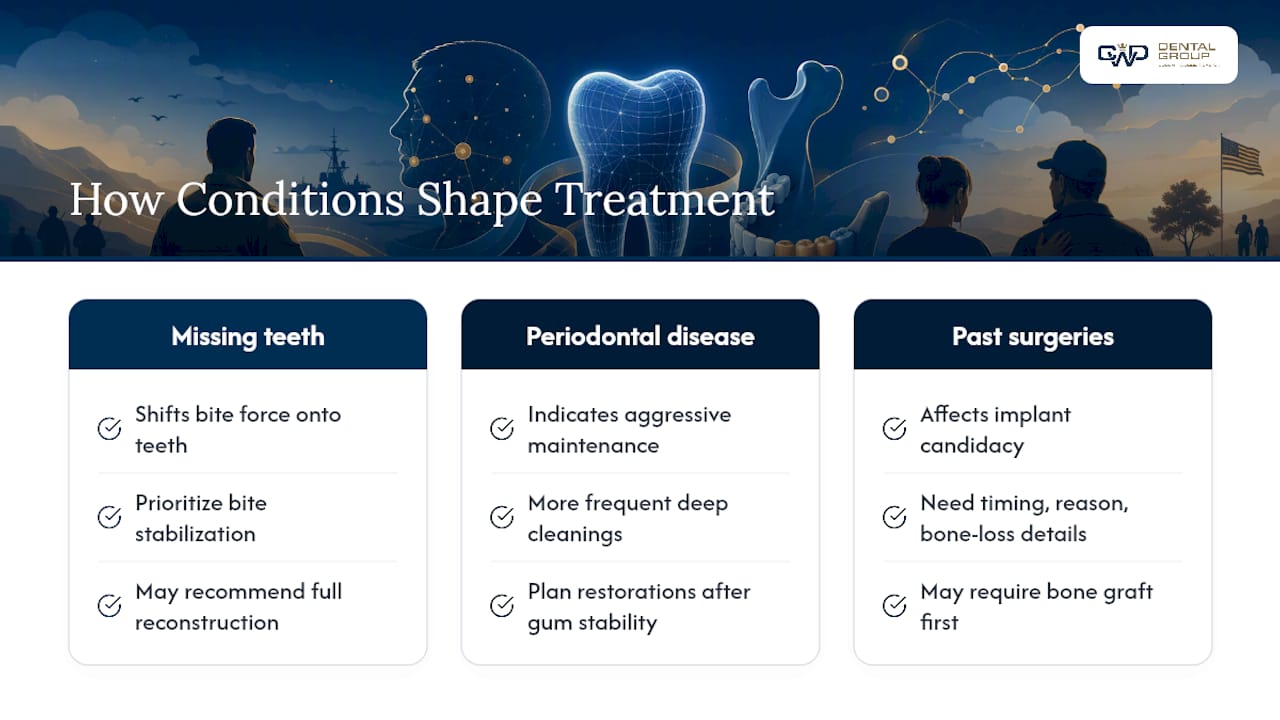
Periodontal disease documented in your history tells a dentist how aggressive a cleaning and maintenance schedule needs to be. A veteran with a history of moderate to severe periodontitis usually needs more frequent deep cleanings than the standard twice-a-year visit, and any restorative work (crowns, bridges, implants) gets planned around gum stability first. Skipping that step is why some restorative work fails early.
Past dental surgeries, especially extractions or bone grafts tied to service-connected trauma, directly affect implant candidacy. A dentist needs to know not just that a tooth was removed, but when, why, and whether bone loss followed. That history determines whether you're a straightforward implant candidate or need a bone graft first.
None of this is guesswork when the history is complete. It becomes guesswork the moment records are missing, which is exactly why a documented, chronological history matters more for veterans than for the average patient walking in for a checkup.
Combining Civilian and Military Dental Records Into One History
Most veterans have two disconnected dental files: one from service, one from every civilian dentist they've seen since. Neither file alone tells the full story, and VA reviewers plus civilian dentists both need the combined picture to make good decisions.
Start by requesting your service dental records through the National Personnel Records Center, then contact every civilian dental office you've used since discharge for copies of exam notes and X-rays. If you've moved or changed providers multiple times, this can mean four or five separate requests. It's tedious, but incomplete records are one of the most common reasons treatment plans get delayed or claims get questioned.
Once you have both sets, build a single chronological timeline: entry dental status, any in-service treatment or trauma, discharge dental status, and every civilian visit since. Note dates on X-rays specifically, since timing evidence often determines whether a condition qualifies under the 180-day rule.
Bring this combined file, even in rough form, to any new dentist or VA appointment. A dental office equipped to handle veteran records can help you organize a scattered history into something usable, and having it ready before your first visit typically means a faster, more accurate treatment plan instead of guesswork based on a fresh exam alone.
How PTSD and Service-Related Trauma Affect Dental Visits
PTSD changes what happens in the dental chair more than most veterans expect. Sounds, restricted positioning, and the loss of control that comes with dental work can trigger genuine distress responses, not just mild nervousness. A dentist who doesn't know a patient's PTSD history may misread hesitation as noncompliance rather than a trauma response.

That's why disclosing service-related mental health history changes the treatment approach. A trauma-informed dentist adjusts pacing, explains each step before doing it, and offers breaks on request rather than pushing through a set appointment length. Sedation options also shift. Some veterans do better with mild oral sedation to manage anxiety during longer procedures, while others prefer staying fully alert with more frequent check-ins instead.
Pain management planning changes too. Veterans on medications for PTSD or related conditions may have interactions with certain sedatives or pain relievers, which is exactly why a current medication list matters as much as the PTSD diagnosis itself. Cooperation during longer procedures, like extractions or implant placement, tends to improve significantly when the provider has this context upfront rather than discovering it mid-appointment.
None of this requires oversharing details of service. A simple note, "I have PTSD and prefer to know each step before it happens," gives a provider enough to adjust the whole visit.
How Long VA Dental Benefit Applications Typically Take
VA dental applications move on a different timeline depending on which class you're applying under, and knowing the general shape of that process helps set realistic expectations.
Initial eligibility review, once VA has your service records and dental exam findings, generally takes a few weeks for straightforward Class I or IV determinations where service connection is already established. Claims requiring new evidence, like linking a condition to service under Class II or IIa, take longer because they need dentist opinions and sometimes a scheduled VA dental exam before a decision gets made.
The 180-day application window for certain one-time treatment classes is separate from processing time. It's the deadline for filing, not the wait for treatment. Miss that window and you may lose eligibility for that specific class entirely, regardless of how strong your dental history looks.
Once approved, scheduling the actual treatment depends on VA facility capacity in your area, which varies significantly by region. Veterans in areas with fewer VA dental clinics sometimes wait longer for appointment slots even after approval, which is one reason VADIP or community care options are worth exploring in parallel rather than after the fact.
Why Keeping Your Dental History Current Matters Going Forward
A dental history isn't a document you file once. It's a living record, and letting it go stale creates real problems down the line, both clinically and for benefits.
New medications, a new diabetes diagnosis, or a recent dental procedure at a civilian office all need to make it into whatever record VA or your dentist is working from. A dentist working off a five-year-old history might miss a medication interaction or misjudge healing risk entirely. VA reviewers face a similar problem: a claim built on outdated records can miss the exact evidence needed to establish or maintain eligibility for ongoing care.
Update your history every time something changes, not just before an appointment. That means requesting new X-rays after any major dental work, updating your medication list after any prescription change, and keeping copies of exam notes from every provider you see. Veterans who maintain this habit tend to move through both VA claims and civilian treatment planning noticeably faster than those who reconstruct everything from memory at each visit.
A Veteran-Friendly First Visit: What to Expect
A first visit at a practice that regularly treats veterans usually starts with a records review, not a drill. Expect the team to ask for your DD214 or service dental records, take updated X-rays, and walk through your medical history, including PTSD-sensitive considerations, before any treatment plan gets built. When VA coordination makes sense, a good practice will help track down outstanding records rather than leaving that entirely on you.

How CWD Dental Group Supports Veterans in Tallahassee
If you're a veteran in Tallahassee dealing with a dental problem right now, waiting weeks for a VA appointment isn't always realistic, and that's the gap Cwddentalgroup fills. Same-day emergency appointments mean a cracked tooth or infection gets seen the day it happens, not the day it's scheduled weeks out.
The team handles record-friendly intake, meaning you can bring whatever service dental records, civilian X-rays, or medication lists you have, even if they're incomplete, and the clinic will help fill in the gaps. Care is trauma-informed for veterans managing PTSD, and the practice offers implant and reconstructive options for veterans dealing with missing teeth or past service-related dental work. If you need urgent care or want help organizing your dental history before a VA claim or appointment, visit the emergency dentist page to see same-day availability and book a visit.
Frequently Asked Questions
Does having dental work done during service automatically qualify me for VA dental benefits?
No. Eligibility depends on the specific class and documented circumstances, not simply having had dental work done while enlisted.
What's the most important document to gather before applying for VA dental care?
Your DD214 and in-service dental records matter most, since they establish your entry and discharge dental status. Pair those with any civilian dental records and X-rays to build a complete history for reviewers.
Can I still get affordable dental care if I don't qualify for VA dental benefits?
Yes. VADIP offers reduced-cost private dental plans for enrolled veterans, and federally qualified health centers provide sliding-scale care regardless of VA eligibility status.
How does PTSD affect a dental appointment?
PTSD can affect anxiety levels, cooperation, and sedation choices during dental procedures. Disclosing it lets your dentist adjust pacing, explain steps in advance, and choose safer sedation options if medication interactions are a concern.
Why does my dental history need updates even if I already have VA dental benefits?
New diagnoses, medications, or civilian dental work can all affect treatment safety and ongoing eligibility. An outdated history increases the risk of missed interactions or claims decisions based on incomplete information.
This article is general information, not a substitute for advice from a qualified doctor. Consult a qualified healthcare professional about your own circumstances before acting on anything here.
Sources
- Oral Health Status Among Adults With and Without Prior Active Duty Service in the U.S. Armed Forces, NHANES 2011-2014
- 38 CFR § 17.161 - Authorization of outpatient dental treatment. | Legal Information Institute