
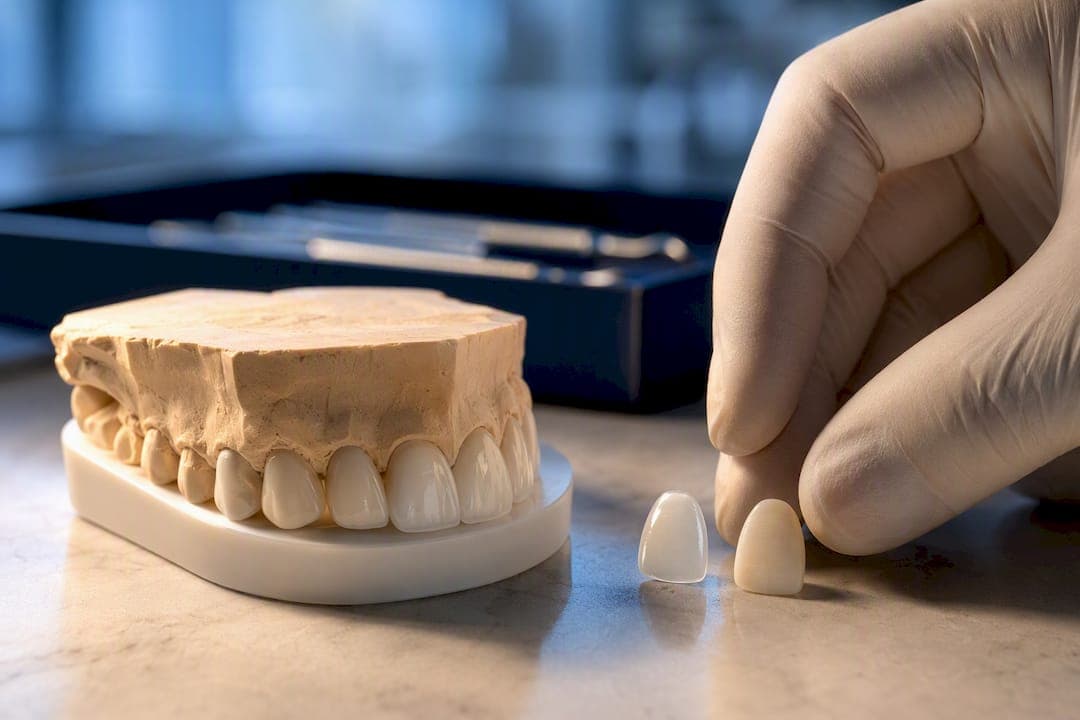
Porcelain veneers typically hold up for 10 to 15 years, with well-bonded cases lasting well beyond that. Composite veneers run shorter, usually 4 to 8 years. The real deciding factors aren't the calendar. They're whether your dentist bonded to enamel or dentin, how your bite handles pressure at night, and whether you keep up with routine care.
TL;DR:
- Porcelain veneers bonded to enamel have a proven survival rate of around 96% at 10 years and up to 20 years with some materials, while composite veneers typically last 4 to 8 years.
- Bonding to enamel significantly reduces failure odds compared to bonding to dentin, making preservation of enamel a critical factor for long-term success.
- Bruxism and habits like biting hard objects or smoking can drastically reduce veneer lifespan, with fracture being the most common failure mode.
- Proper aftercare, including gentle brushing, flossing, and regular checkups, along with using night guards for grinders, extends veneer longevity.
- Conservative preparation and routine monitoring outweigh brand choice in predicting long-term outcomes, emphasizing minimal enamel removal and careful occlusion management.
Table of Contents
- Porcelain vs. composite: what the survival data actually shows
- What clinical technique has to do with veneer durability
- Do lifestyle habits really change how long veneers last?
- When does a veneer actually need replacing?
- Your everyday aftercare checklist for veneers
- What the clinical evidence means for your consultation
- Balancing the aesthetics you want with the upkeep you'll owe
- Considering veneers? Here's what a consultation at CWD Dental Group covers
- Where the lifespan data in this guide comes from
- Sources
Porcelain vs. composite: what the survival data actually shows
The gap between porcelain and composite isn't marketing talk. It's measured in cohort studies that tracked real patients for decades. A long-term review found 96% survival at 10 years and 91–96% survival at 20 years for porcelain veneers bonded to healthy enamel. That's a remarkably durable outcome for a material that's essentially a thin ceramic shell glued to a tooth.
Composite tells a different story. It typically lasts 4 to 8 years because the resin is softer than porcelain, picks up surface roughness faster, and stains at a rate porcelain simply doesn't match. It's still a legitimate option, especially for smaller cosmetic fixes, but it's not built for the same timeline.
Not all porcelain is identical either. The subtypes matter:
- Feldspathic porcelain: the classic, hand-layered ceramic; excellent esthetics, moderate strength, decades of clinical track record.
- Leucite-reinforced ceramic: a step-up in strength over feldspathic, still prized for translucency.
- Lithium disilicate (E.max): often performs strongly in real-world use, with some practices reporting 15 to 20 years of service in the right cases.
- Zirconia: strong short-term data and high fracture resistance, but it lacks the multi-decade track record the other materials have.
| Material | Typical lifespan | Standout trait |
|---|---|---|
| Feldspathic porcelain | 10–15 years | Best natural translucency |
| Leucite-reinforced | 10–15 years | Stronger than feldspathic |
| Lithium disilicate | 15–20 years (reported) | High fracture resistance |
| Composite resin | 4–8 years | Repairable, lower cost |
What clinical technique has to do with veneer durability
The single biggest lever your dentist controls is what the veneer bonds to. Bonding to enamel is dramatically more reliable than bonding to dentin. One review found the odds of failure jump roughly 3.47 times higher when the bonding surface includes exposed dentin instead of intact enamel. That single variable often matters more than the ceramic brand stamped on the lab slip.
This is why minimal-prep and no-prep veneer techniques have gained ground. Preserving enamel isn't a cosmetic preference. It's a structural one. When dentin exposure can't be avoided, many clinicians use immediate dentin sealing right after preparation to protect the surface before the final cementation appointment.
A few other technical details shape outcomes:
- Resin cement selection and surface treatment (etching, silane application) directly affect margin integrity.
- Incomplete polymerization at the margins is a known contributor to early debonding.
- Occlusion checked in centric bite and in excursive movements immediately after cementation reduces fracture risk from unnoticed high points.
Pro Tip: Ask your dentist how much enamel your specific prep plan will remove. A "yes, minimal" answer is a better predictor of longevity than the brand name of the ceramic.
Do lifestyle habits really change how long veneers last?
Yes, and bruxism is the biggest one. Grinding concentrates enormous force on thin ceramic edges, and clinical reviews consistently name fracture as the most common failure mode for veneers, with bruxism as a major amplifier. A night guard isn't optional for grinders. It's the difference between a veneer that lasts 15 years and one that chips at year three.
Beyond grinding, a few everyday factors move the needle:
- Diet and habits: biting into hard candy, chewing ice, or using teeth to open packaging puts sudden load on the porcelain edge where it's most vulnerable.
- Tobacco and staining: composite veneers especially pick up discoloration faster with smoking, and margins can darken over time even on porcelain.
- Existing enamel condition: teeth with prior erosion, old fillings, or thin enamel give the bond less to hold onto from day one.
- Follow-through on checkups: routine visits let your dentist catch tiny marginal gaps before bacteria get underneath and cause decay nobody can see from the outside.
When does a veneer actually need replacing?
Veneers don't fail on a schedule. They fail when specific things go wrong, and recognizing those signs early keeps a small fix from becoming a bigger one.
Watch for:
- A visible chip or fracture line, even a small one.
- A gap or ledge at the margin where the veneer meets your natural tooth.
- Staining or discoloration concentrated right at that margin line.
- Sensitivity or discoloration that suggests decay developing underneath.
- A shade mismatch after your other teeth have changed color from whitening or aging.
Replacement typically starts with an assessment and imaging, followed by removal of the old veneer, evaluation of the underlying tooth structure, and a decision on whether a new veneer is sufficient or a crown makes more sense. If enamel loss is significant, a crown often provides better long-term support than another thin veneer. Most replacements run one to two appointments, similar to the original placement, and one clinical resource notes that teeth can often be re-veneered multiple times as long as enough healthy enamel remains.
Your everyday aftercare checklist for veneers
Longevity is mostly a habit problem, not a luck problem. A short daily routine covers most of it.
- Brush with a soft-bristle brush and nonabrasive toothpaste. Skip charcoal or heavy-grit whitening pastes.
- Floss carefully around the margins where plaque likes to hide.
- Never use your teeth as scissors, bottle openers, or nutcrackers.
- Wear a night guard if you grind, and a mouthguard for contact sports.
- Keep six-month exams and cleanings on the calendar. Report any chip or new sensitivity right away instead of waiting for the next visit.
Pro Tip: If a veneer edge ever feels rough or "catches" your tongue, that's often the first sign of a micro-fracture. Call your dentist before it turns into a full chip.
What the clinical evidence means for your consultation
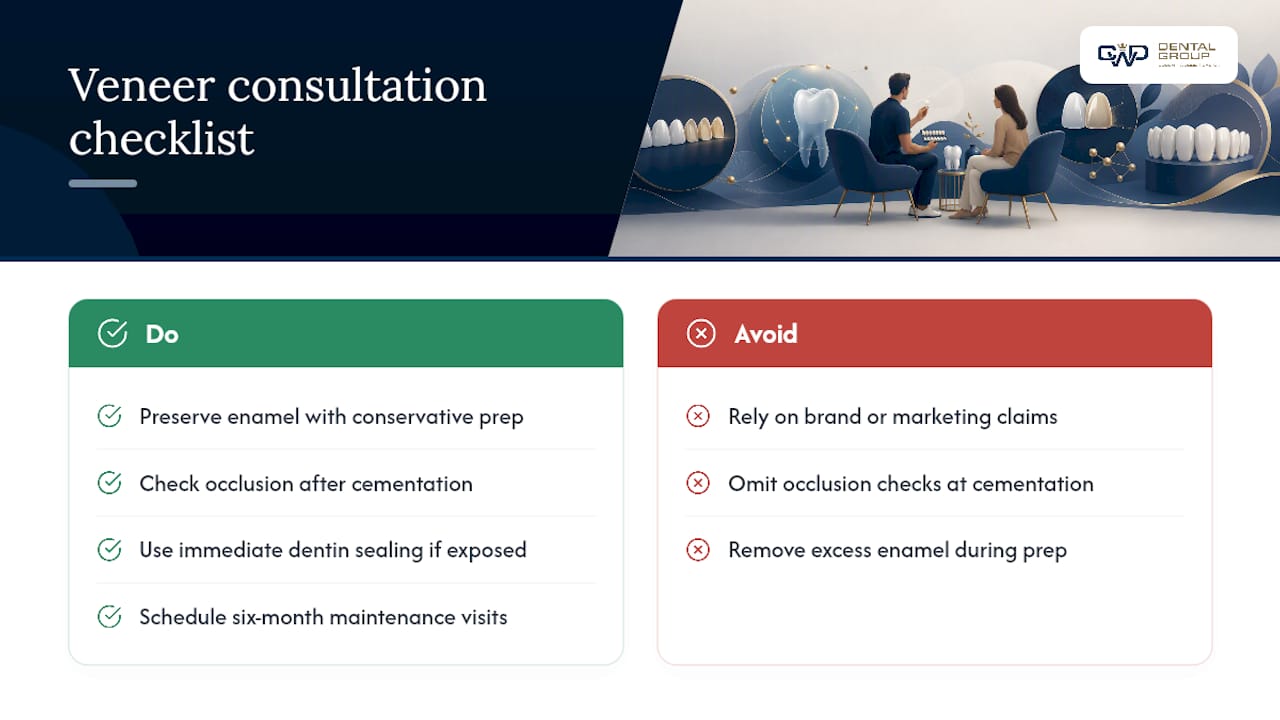
The research is fairly consistent: enamel preservation and conservative preparation are the strongest predictors of how long a veneer survives, ahead of brand or ceramic type. Dentists who lean toward minimal-prep techniques, check occlusion carefully after cementation, and use immediate dentin sealing when dentin gets exposed are making decisions that show up in survival data, not just in marketing language.
Some practices translate clinical evidence into conservative preparation planning, occlusion evaluation at cementation visits, and maintenance schedules built around catching small problems early.
Ask specifically: how much enamel will be removed, is a night guard part of the standard follow-up plan, and what does the six-month maintenance schedule look like for veneer patients?
Those three questions tell you more about long-term outcomes than any brochure will.
Balancing the aesthetics you want with the upkeep you'll owe
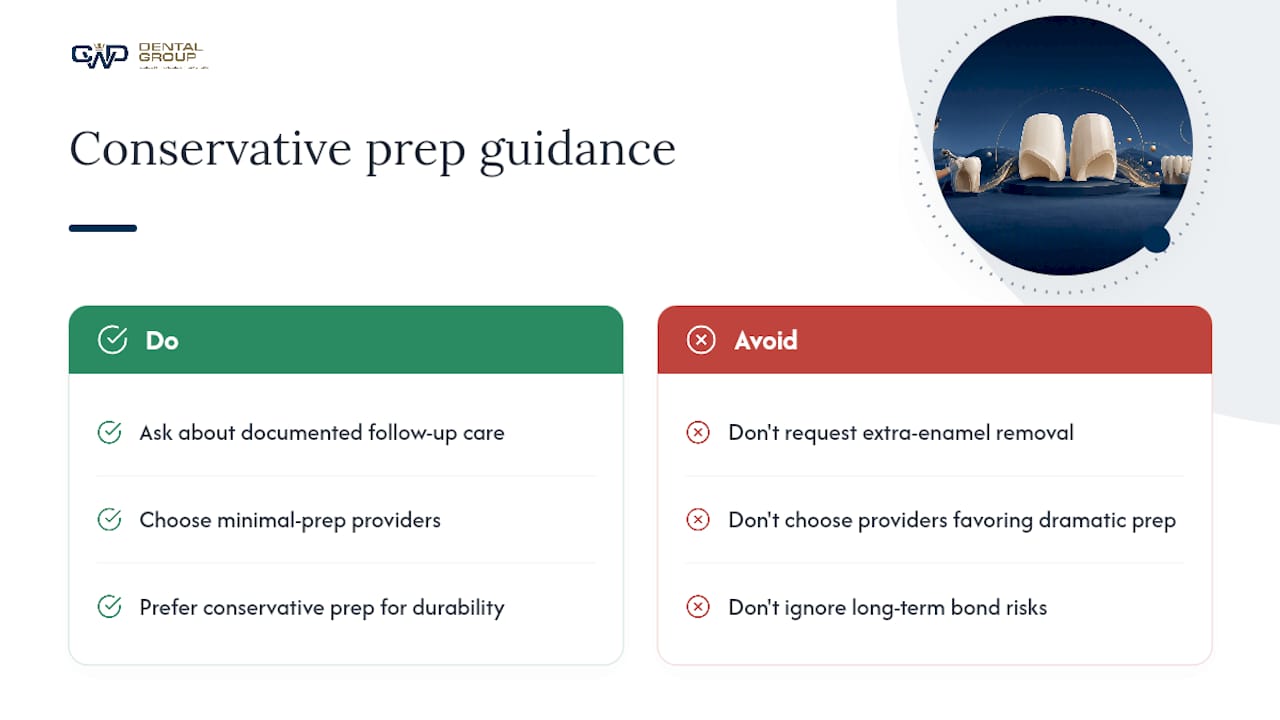
Veneers deliver a transformation few other cosmetic treatments can match, and that's exactly why people underestimate the trade-off. Every bit of enamel removed to make room for a dramatic shape or shade change is enamel you don't get back, and it's the same enamel that determines whether your bond holds for 15 years or fails in five.
The smarter path usually isn't the most dramatic one. It's the most conservative prep that still gets you the smile you want. When you're choosing a provider, ask how they document follow-up care and whether they lean toward minimal-prep techniques by default, not just when a patient requests it. That single habit says more about long-term results than any before-and-after photo.
— Kayle
Considering veneers? Here's what a consultation at CWD Dental Group covers
Enamel preservation is often treated as the starting point for veneer cases, which may include conservative preparation planning, occlusion checks during cementation visits, and discussions about night guards for patients showing signs of grinding, all aimed at improving long-term outcomes.

A veneer consultation here walks through your bite, your existing enamel condition, and your cosmetic goals before any prep work happens, so you know upfront what the plan preserves and what it changes. You can review what to expect and bring your questions using this veneer consultation preparation guide, and see the practice's approach to conservative technique on the porcelain veneers in Tallahassee page. If you're dealing with a chipped or failing veneer right now and need faster attention, CWD Dental Group also offers same-day emergency dental appointments so a small problem doesn't sit untreated. Ready to talk through your options? Booking a consultation is the next step.
Where the lifespan data in this guide comes from
The survival figures cited here draw from a comprehensive review of porcelain veneer longevity covering 10 and 20 year outcomes, a narrative literature review on clinical survival and failure modes, and supporting data on composite veneer durability. Each source breaks down survival rates, bonding outcomes, or failure patterns behind the numbers above.
This article is general information, not a substitute for advice from a qualified doctor. Consult a qualified healthcare professional about your own circumstances before acting on anything here.