

Tooth symmetry in cosmetic dentistry is defined as the balanced alignment and proportional matching of teeth on both sides of the dental midline. It is one of the most studied factors in smile design, directly shaping how attractive and harmonious a smile appears to others. Patients seeking cosmetic treatment often describe wanting a "straight" or "even" smile. What they are describing is dental symmetry. Understanding what it is, how dentists assess it, and which techniques correct it gives you a clear path toward the smile you want.
What is tooth symmetry in cosmetic dentistry?
Tooth symmetry refers to how closely the teeth on the left side of your smile mirror those on the right, in size, shape, position, and spacing. The reference point is the dental midline, an imaginary vertical line running between the two upper central incisors. When that line aligns with the center of your face, and when teeth on both sides match proportionally, the result is a smile that reads as balanced and attractive.
Smile harmony results from coordinating teeth, gums, lips, and facial features, not from tooth perfection alone. That distinction matters. Symmetry is one input in a larger system of smile design, not the only goal.
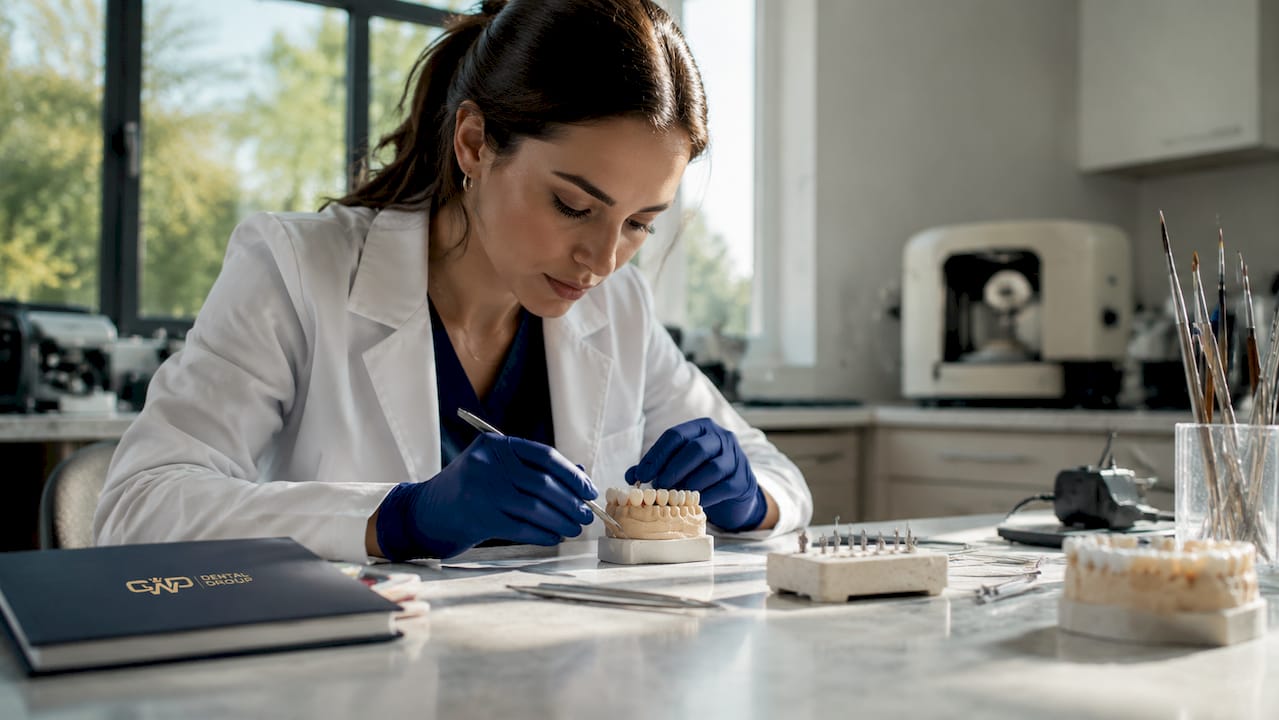
The industry term for the broader discipline is smile design, which encompasses symmetry, proportion, color, and gingival contour. Tooth symmetry is the foundational element within that system. Cosmetic dentists evaluate it first because central incisors are critical for symmetry perception. Patients notice misalignment there far more than in lateral teeth or gums.
How is tooth symmetry evaluated in cosmetic dentistry?
Evaluation happens at two levels: the individual tooth and the full arch. At the tooth level, dentists compare the width, height, and shape of corresponding teeth on each side. At the arch level, they assess spacing, arch form, and how the dental midline relates to the facial midline.
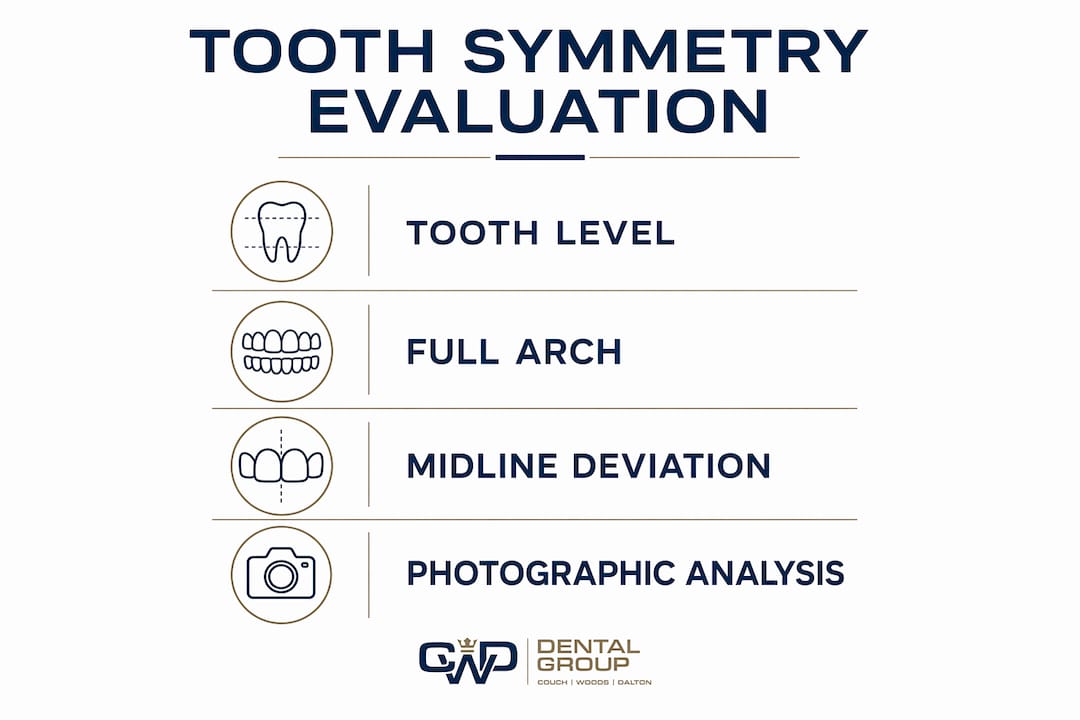
The most clinically significant measurement is midline deviation. Midline shifts over 2 mm are perceived as unattractive by laypeople, with a meaningful likelihood of a lower attractiveness rating. That threshold tells dentists exactly where treatment becomes necessary from an aesthetic standpoint.
Modern practices use digital imaging and smile design software to map these measurements with accuracy. Tools like digital photography, intraoral scanners, and software such as Digital Smile Design (DSD) allow dentists to overlay measurements on a patient's actual face. This removes guesswork and gives patients a preview of proposed outcomes before any procedure begins.
Key factors assessed during a symmetry evaluation include:
- Dental midline alignment relative to the facial midline and the philtrum of the upper lip
- Central incisor symmetry in width and height, the most visible and sensitive zone
- Lateral incisor and canine proportions on both sides of the arch
- Gingival margin levels, since uneven gum lines create the appearance of asymmetry even when teeth match
- Arch form and spacing, which affects how teeth sit relative to each other
Pro Tip: Ask your dentist to photograph your smile from the front and show you the midline overlay before any treatment begins. Seeing the deviation on screen makes the treatment plan far easier to understand and accept.
What natural asymmetries exist in smiles, and how do dentists address them?
Perfect bilateral symmetry does not exist in nature. Every human face carries some degree of asymmetry, and the smile is no exception. Facial asymmetries within the 3–4 mm range are generally not detectable by average observers. That finding reframes the goal of cosmetic treatment. The target is not mathematical perfection. It is harmony that reads as natural.
Strict adherence to the golden ratio is not essential for aesthetic appeal. Many natural smiles do not conform to it, and forcing mathematical ratios onto a patient's unique facial structure can produce results that look artificial. Contemporary cosmetic dentistry has moved away from rigid formulas toward individualized smile design.
Natural asymmetries that dentists commonly encounter include:
- Minor differences in the width or length of lateral incisors on each side
- Slight variation in gingival margin height between corresponding teeth
- Mild rotation of a single tooth that breaks the arch line
- A dental midline that sits slightly off center from the facial midline
The clinical approach depends on the degree of asymmetry. Minor variations are often left untreated or addressed with minimal reshaping. Larger deviations that cross the patient's perception threshold get corrected through the techniques described below. Absolute symmetry is neither natural nor desirable. Clinicians aim for harmonious balance tailored to individual facial features, not a mirror image.
What cosmetic dentistry techniques improve tooth symmetry?
Several well-established procedures address symmetry concerns, ranging from conservative to more involved. The right choice depends on the cause of the asymmetry, whether it is a size issue, a position issue, or a gingival issue.
Dental bonding
Dental bonding reshapes teeth to create more balanced and symmetrical smiles. A tooth-colored composite resin is applied directly to the tooth surface, sculpted, and hardened with a curing light. Bonding works well for minor size discrepancies, small chips, and gaps that break visual symmetry. It is the most conservative option and requires no removal of natural tooth structure.
Porcelain veneers
Veneers are thin shells of porcelain bonded to the front surface of teeth. They correct size, shape, and color simultaneously, making them the preferred choice when multiple teeth need to be brought into proportion. A full veneer set across the upper front six to eight teeth can create dramatic symmetry improvements. The tradeoff is that a small amount of enamel must be removed to accommodate the veneer thickness.
Orthodontic treatment
Braces and clear aligners like Invisalign reposition teeth within the arch. Orthodontic treatment improves both tooth alignment and gingival morphology symmetry, though gingival asymmetry sometimes persists after tooth movement and requires additional treatment. Orthodontics is the best solution when the root cause of asymmetry is tooth position rather than tooth size or shape.
Gingival contouring
Uneven gum lines are a common but overlooked source of perceived asymmetry. Laser gingival contouring reshapes the soft tissue to create even margins across the smile. It is often combined with veneers or bonding for a complete result. The procedure is minimally invasive and heals quickly.
| Technique | Best for | Typical outcome |
|---|---|---|
| Dental bonding | Minor size or shape differences | Immediate, conservative correction |
| Porcelain veneers | Multiple teeth needing size and shape change | Dramatic, long-lasting symmetry |
| Orthodontics (braces or aligners) | Positional asymmetry and midline shifts | Full arch correction over time |
| Gingival contouring | Uneven gum margins | Even gum line, enhanced proportion |
| Composite contouring | Slight reshaping of tooth edges | Subtle refinement with no lab work |
Pro Tip: Strategically repositioning restorative elements can create the visual perception of symmetry even when underlying skeletal asymmetry exists. A skilled cosmetic dentist uses this principle to produce natural results without requiring jaw surgery.
How does achieving tooth symmetry benefit your smile and confidence?
Symmetric smiles are consistently rated as more attractive and more youthful across perception studies. The reason is rooted in how the human brain processes faces. Symmetry signals health and genetic fitness, a deeply wired response that operates before conscious judgment kicks in. Laypeople's sensitivity to midline discrepancies means small asymmetries can influence perceived attractiveness and confidence in ways patients may not fully articulate but clearly feel.
The psychological impact is real and well-documented. Patients who correct significant dental asymmetry report higher self-esteem and greater willingness to smile in social and professional settings. A smile is one of the first things people notice in a face-to-face interaction. When patients feel confident about their smile, that confidence shows in their posture, eye contact, and overall presence.
"The goal of cosmetic dentistry is not to manufacture a perfect smile. It is to give patients a smile they are proud to share." This principle guides every symmetry-focused treatment plan, from a single bonding appointment to a full smile redesign.
Practical examples of transformation are common. A patient with a 3 mm midline shift and mismatched central incisors may feel self-conscious in photos and avoid smiling with their mouth open. After orthodontic correction and gingival contouring, the same patient often describes the change as life-altering. The teeth did not become perfect. They became harmonious, and that shift in perception is what drives the confidence gain. For patients exploring these options, cosmetic dentistry improves both function and aesthetics in ways that compound over time.
Key Takeaways
Tooth symmetry in cosmetic dentistry is the single most visible factor in smile aesthetics, and correcting meaningful asymmetry requires matching the right technique to the right cause.
| Point | Details |
|---|---|
| Midline threshold matters | Deviations over 2 mm are perceived as unattractive; this is the clinical trigger for treatment. |
| Central incisors drive perception | Patients notice asymmetry in central incisors far more than in lateral teeth or gums. |
| Harmony beats perfection | Absolute symmetry is unnatural; the goal is balance tailored to individual facial features. |
| Technique must match cause | Bonding fixes size issues, orthodontics fixes position, and gingival contouring fixes gum lines. |
| Symmetry boosts confidence | Correcting visible asymmetry has a direct, documented impact on self-esteem and social confidence. |
Why harmony matters more than perfection in smile design
I have seen patients come in with printed photos of celebrity smiles, asking for an exact replica. The request is understandable. What they are responding to in those photos is not mathematical symmetry. It is harmony. Those celebrity smiles work because they fit the face they belong to, not because they scored perfectly on a proportion chart.
The most satisfying outcomes I have observed come from dentists who treat symmetry as a starting point, not an endpoint. They use digital tools to measure deviations, identify the ones that cross the patient's personal perception threshold, and then design corrections that respect the patient's natural facial structure. The result looks effortless because it is built around the individual, not imposed on them.
Technology has made this process far more accurate. Digital Smile Design software, intraoral scanners, and high-resolution photography allow dentists to show patients exactly what a proposed correction will look like before a single tooth is touched. That transparency builds trust and produces better outcomes because patients can give informed feedback during the planning stage. For anyone curious about where this field is heading, smile design dentistry in 2026 reflects just how far the tools and philosophy have advanced.
My honest advice: do not wait for a "perfect" time to consult a cosmetic dentist. A consultation is not a commitment to treatment. It is a conversation about what is possible for your specific smile. The assessment alone often changes how patients see their own teeth, and that shift in awareness is the first step toward a smile they are genuinely proud of.
— Kayle
Smile symmetry treatments at Cwddentalgroup
Cwddentalgroup offers a full range of cosmetic services designed to address tooth symmetry concerns, from dental bonding and veneers to orthodontic treatment and laser gingival contouring. The team in Tallahassee takes a patient-centered approach, starting with a thorough symmetry assessment before recommending any procedure.

For patients with urgent cosmetic concerns, such as a chipped or broken tooth that disrupts smile balance, Cwddentalgroup provides same-day emergency care so you are never left waiting when your smile needs immediate attention. Schedule a consultation and find out exactly what achieving your best smile looks like.
FAQ
What is the dental midline and why does it matter?
The dental midline is the vertical line between the two upper central incisors. When it aligns with the center of the face, the smile reads as balanced and symmetrical.
How much midline deviation is considered a cosmetic problem?
Midline shifts over 2 mm are consistently perceived as unattractive by laypeople. Deviations below that threshold are often unnoticed and may not require treatment.
Can braces alone fix tooth symmetry issues?
Braces and clear aligners correct positional asymmetry effectively, but gingival asymmetry sometimes persists after orthodontic treatment and may require laser contouring for a complete result.
Is the golden ratio used in cosmetic smile design?
Strict adherence to the golden ratio is not essential for an attractive smile. Modern cosmetic dentistry prioritizes harmony and individual facial fit over rigid mathematical formulas.
How do veneers improve smile symmetry?
Porcelain veneers correct size, shape, and proportion across multiple teeth simultaneously, making them the most effective option when several front teeth need to be brought into visual balance.