
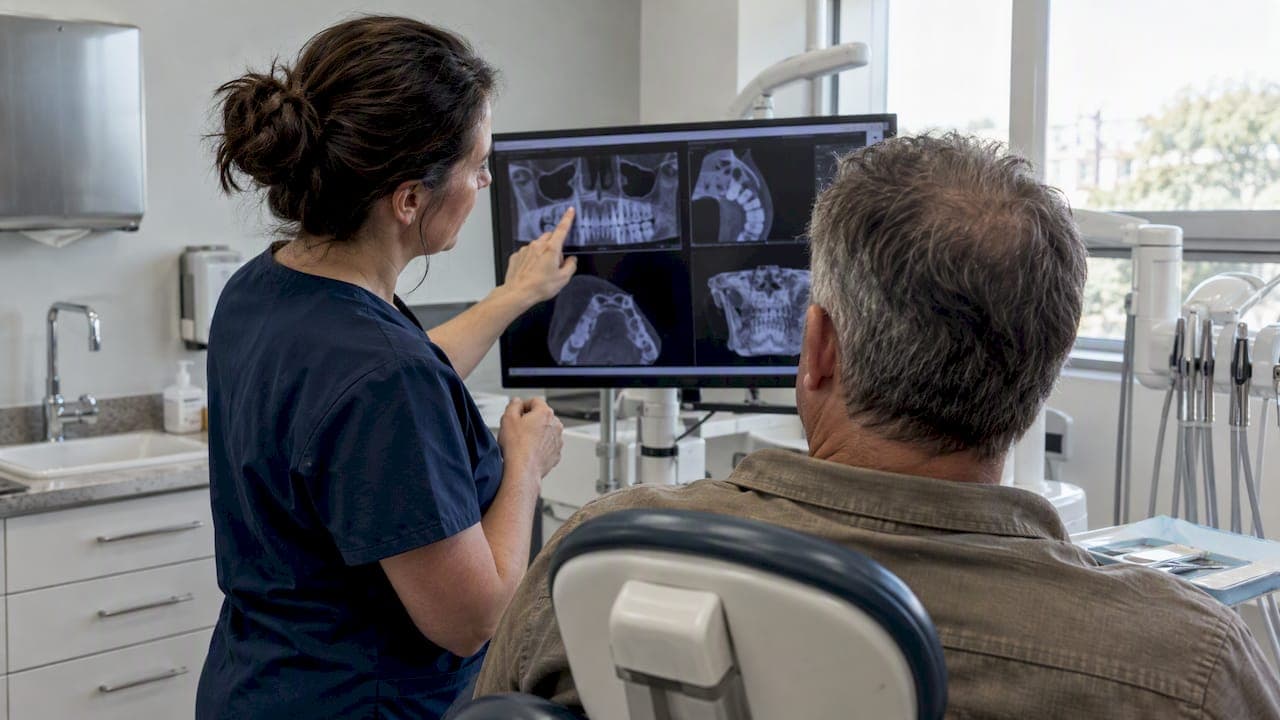
A sinus lift, also called sinus augmentation, is a surgery that adds bone beneath the maxillary sinus so an upper back-tooth implant has enough solid ground to anchor into, as explained by Washington DC's oral surgeons. Many people lose height in this area of the jaw after tooth loss, and without enough vertical bone, an implant cannot sit securely. The usual path is a bone graft, a healing period, then implant placement, either at the same time as the graft or afterward.
TL;DR:
- Sinus lifts are necessary when residual bone height is below 4 to 6 millimeters, especially in cases of long-term tooth loss and ridge resorption.
- The lateral window approach can typically achieve 6 to 12 millimeters of bone gain for severe cases, while the crestal approach offers up to 5 millimeters for modest lifts.
- Healing takes around 4 to 9 months, during which membrane tears are the most common complication and are usually repairable without affecting long-term implant success.
- Graft material choice impacts healing speed and cost, with autografts healing faster but requiring a second surgical site, while xenografts and allografts are widely used.
- Patients should avoid nose blowing, strong sneezing, and straw use during initial healing to prevent graft disruption and should expect several months before final implant restoration.
Table of Contents
- What a sinus lift is and the relevant anatomy
- When a sinus lift is necessary and how clinicians decide
- How the main sinus lift techniques work
- Graft materials, healing timeline, and when implants can be placed
- Risks and complication management
- Alternatives and adjuncts worth knowing about
- Recovery, sinus precautions, and your timeline to restoration
- How we evaluate and treat sinus lift candidates at CWD Dental Group
- A few things worth asking before you book surgery
- Schedule a consult with CWD Dental Group
- FAQ
- Sources
What a sinus lift is and the relevant anatomy
The maxillary sinuses are air-filled spaces sitting just above the upper back teeth. When a molar or premolar is lost, the bone that used to support its root can shrink, and the sinus floor often drops lower into that space, a process called pneumatization. That leaves too little bone height for a standard implant.
Inside the sinus, a thin tissue layer called the Schneiderian membrane lines the cavity. "Lifting" the sinus means gently raising this membrane and packing bone graft material into the space created underneath it, giving an implant something solid to sit in.
Surgeons reach that space two main ways:
- Lateral window approach: access through the side wall of the jawbone, used for larger bone gains.
- Crestal (transcrestal) approach: access through the top of the ridge where the implant will go, used for smaller gains.
When a sinus lift is necessary and how clinicians decide
Clinicians rely on residual bone height (RBH), measured with CBCT imaging, to decide whether a sinus lift is needed and which technique to use. Digital planning and three-dimensional scans have become standard for mapping the sinus floor accurately before any incision is made.
Common reasons a patient needs one include:
- Long-term tooth loss: years without a tooth lets the bone resorb and the sinus expand downward.
- Ridge resorption or sinus septa: irregular anatomy that reduces usable bone or complicates access.
- Low RBH on imaging: a thin strip of bone between the ridge and sinus floor that can't support an implant alone.
Candidacy also depends on health factors. Active smoking, an unresolved sinus infection, or poorly controlled systemic disease can delay or rule out surgery until those issues are addressed.
How the main sinus lift techniques work
The two techniques differ in invasiveness, the amount of bone gained, and the scenarios where each makes sense, according to a review of contemporary sinus lift techniques.
- Lateral window: the surgeon opens a small window in the side of the jawbone, lifts the membrane from below, and packs graft material into the space. This approach typically produces 6 to 12 millimeters of vertical bone gain and suits cases with more severe bone loss.
- Crestal (osteotome) approach: the surgeon works through the implant site itself, using instruments to push the sinus floor upward in small increments before placing graft and, often, the implant in the same visit. Gains are smaller, generally up to about 5 millimeters, and the technique suits patients who need a modest lift.
Modern tools have changed the risk picture for both approaches. Piezoelectric instruments, which cut bone but spare soft tissue, can reduce the chance of tearing the sinus membrane during window preparation, and CBCT-guided surgical planning helps surgeons map anatomy before cutting anything.
Pro Tip: Ask your surgeon whether they use piezosurgery for window preparation, especially if your CBCT scan shows a thin or irregular sinus floor.
Graft materials, healing timeline, and when implants can be placed
Surgeons choose from several graft types: a patient's own bone (autograft), processed animal bone (xenograft), donor human bone (allograft), or synthetic material (alloplast). Each carries trade-offs in healing speed, cost, and how much the body remodels it over time, and some surgeons add platelet-rich fibrin (PRF) to support soft tissue healing.
- Autograft: heals quickly and integrates well but requires a second surgical site.
- Xenograft and allograft: avoid a second surgery site and are widely used for sinus augmentation.
- Alloplast: synthetic and consistent in supply, though it may remodel more slowly.
Healing typically takes 4 to 9 months, averaging around 6 months, before the graft is solid enough to support an implant, according to research on staged sinus augmentation approaches. Surgeons often confirm readiness with a follow-up CBCT scan. When RBH is adequate and the implant can achieve good primary stability at placement, the surgeon may place the graft and implant simultaneously; when bone is too thin for that, the graft heals first and the implant goes in during a second procedure.
Risks and complication management
The most common surgical complication during a sinus lift is a tear in the Schneiderian membrane, with reported rates varying by technique and surgeon experience. When a perforation happens, surgeons typically repair it with a collagen membrane, sutures, or fibrin glue before continuing the graft placement.
Repaired perforations do not meaningfully reduce implant survival. A systematic review and meta-analysis of membrane perforation outcomes found implant survival was very high in both sinuses without perforation and those where a perforation was repaired, with no significant difference, a difference the researchers considered not statistically meaningful.
Other risks include:
- Infection: managed with sterile technique and antibiotics when indicated for the case.
- Sinusitis: usually mild and temporary, monitored during follow-up visits.
- Graft failure: uncommon, but a reason surgeons recheck healing with imaging before placing an implant.
Alternatives and adjuncts worth knowing about
A sinus lift isn't the only route to a stable implant. Ridge preservation, a graft placed into the socket right after a tooth extraction, can slow bone loss and sometimes avoids the need for a lateral window procedure later.
- No-graft osteotome elevation: can work well in select patients with adequate starting bone and good primary stability, though evidence on long-term bone gain varies by study design.
- Zygomatic implants: anchor into the cheekbone instead of the sinus floor, an option for severe bone loss that skips grafting entirely but involves a more complex surgery.
Recovery, sinus precautions, and your timeline to restoration
Most patients experience mild to moderate swelling, bruising, and soreness for about a week, with symptoms tapering steadily after the first few days.
- Follow sinus precautions early: avoid blowing your nose, sneezing forcefully, and using straws, since pressure changes can disturb the healing graft.
- Watch for warning signs: persistent bleeding, fever, or graft material in your nose should prompt a call to your dental office right away.
- Keep follow-up visits: stitches typically come out within one to two weeks, and imaging checks confirm graft integration before implant placement or loading.
- Expect several months before restoration: depending on grafting and healing speed, the path from graft to final implant restoration usually spans multiple months rather than weeks.
How we evaluate and treat sinus lift candidates at CWD Dental Group
We offer consults for patients who need answers quickly, including those facing bone loss that may require grafting before implant placement. Our services cover the full path from bone grafting and dental implants through routine and cosmetic care, so your treatment plan stays under one roof.
When you come in, we review your dental and medical history and use CBCT imaging to measure residual bone height and map your sinus anatomy before recommending a technique or timeline. Bring a list of current medications, any prior imaging, and your dental insurance information so we can give you a clear plan at your first visit.
- We assess RBH and sinus anatomy with CBCT before any procedure.
- We explain whether simultaneous or staged implant placement fits your case.
- We outline a realistic timeline and cost estimate before you commit to treatment.
A few things worth asking before you book surgery
If I were sitting across from a surgeon, I'd want to see my CBCT scan and hear the exact residual bone height in millimeters, not just a general impression. I'd also ask what happens if the membrane tears during surgery and whether repair protocols are standard practice there. Finally, I'd ask for a written estimate covering both the graft and the eventual implant, since staged treatment often spans two separate procedures months apart. Properly planned and repaired cases carry high survival rates, so a thorough consult matters more than rushing to surgery.
— Kayle
Schedule a consult with CWD Dental Group
If you suspect you need a sinus lift, the fastest way to find out is a consult that includes an exam, a CBCT review, and a treatment plan built around your anatomy and goals. We offer same-day appointments for patients who want answers without a long wait, and our team walks you through graft options, timing, and cost before any procedure begins.
Ready to find out where you stand? Visit our services page to book your evaluation and get a personalized plan for your implant.
This article is general information, not a substitute for advice from a qualified doctor. Consult a qualified healthcare professional about your own circumstances before acting on anything here.

FAQ
What is the downside of a sinus lift?
The main downsides are added healing time, since integration typically takes 4 to 9 months before an implant can be placed, and a modest risk of membrane perforation during surgery. When a perforation happens, it is usually repairable and does not meaningfully change long-term implant survival.
Is a sinus lift very painful?
Most patients report mild to moderate discomfort, swelling, and bruising for about a week rather than severe pain. Over-the-counter or prescribed pain management typically keeps symptoms manageable during that first week.
What can you not do after a sinus lift?
Avoid blowing your nose, sneezing forcefully with your mouth closed, and using straws, since pressure changes can disrupt the healing graft. Smoking and strenuous exercise are also typically restricted for the first week or two during initial healing.
What's the average cost of a sinus lift?
Sinus lift pricing depends on the technique, graft material, and whether the implant is placed at the same time or later, so an exact figure requires an individual consult and imaging review. Our team provides a cost estimate after assessing your specific case during a consultation.
Sources
- External sinus lift with simultaneous implant placement for severely atrophic maxilla: optimization of staged surgical approaches
- Evolving techniques and trends in maxillary sinus lift procedures in implant dentistry: a review of contemporary advances