
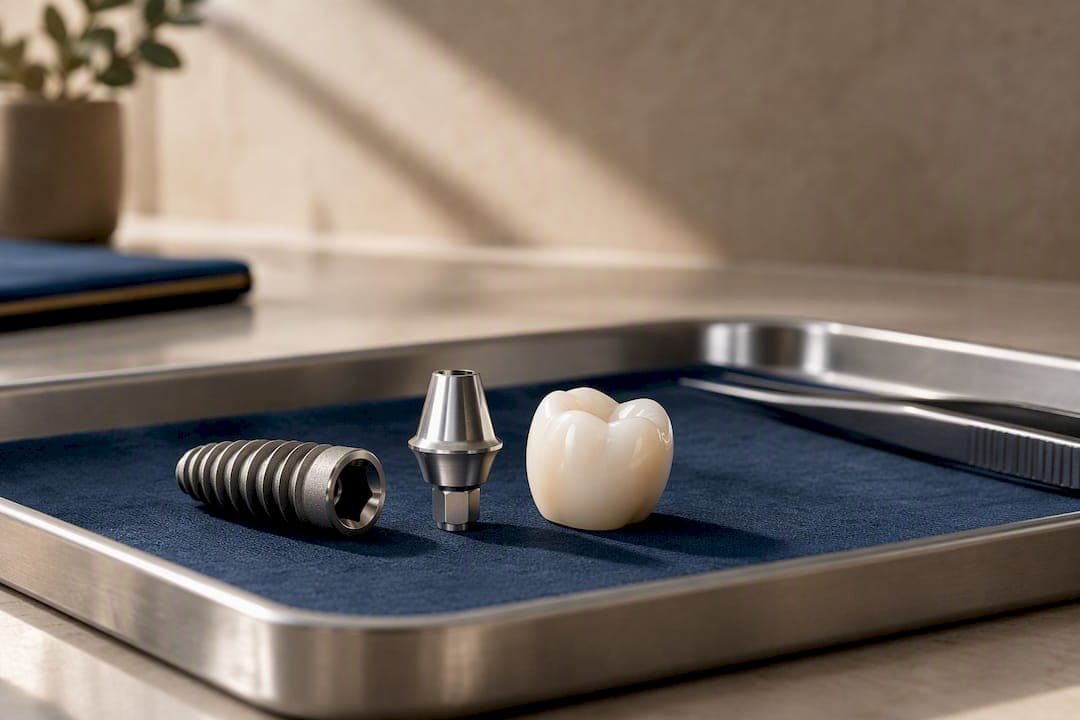
A single tooth implant replaces one missing tooth with a titanium or zirconia post, an abutment, and a crown, and it does this without touching the healthy teeth next to the gap. Most adults with enough jawbone and no major uncontrolled health conditions are good candidates. The main catch is biological, not surgical: the post needs bone to fuse into, and if that bone is thin or soft, you may need a graft first before the implant will hold.
TL;DR:
- Proper bone density and overall health are essential; insufficient jawbone may require grafting before implant placement.
- Implants preserve jawbone and maintain long-term stability, outperforming bridges and dentures in bone retention and force transmission.
- The full implant process typically takes three to six months, especially if grafting or additional procedures are necessary, extending recovery time.
- Costs vary widely depending on materials, imaging, grafting, and other factors, with the total expense often exceeding initial estimates.
- Smoking, uncontrolled diabetes, recent radiation therapy, and certain medications significantly increase failure risks and may disqualify candidates.
Table of Contents
- What a Single Tooth Implant Actually Replaces
- Implant vs. Bridge vs. Partial Denture: Which Holds Up Longer?
- Who Actually Qualifies for a Single Tooth Implant
- The Full Procedure and Timeline, Step by Step
- What a Single Tooth Implant Costs and How to Get an Honest Quote
- Recovery Week One Through Long-Term Maintenance
- How CWD Dental Group Approaches Single Tooth Implant Cases
- How One Missing Tooth Affects Everything Around It
- Getting the Esthetics Right: Why Placement Affects Your Whole Smile
- Clinic Viewpoint: Why We Won't Rush Your Healing Timeline
- Ready to Talk Through Your Options? Here's How to Start
- Sources
- FAQ
What a Single Tooth Implant Actually Replaces
A missing tooth is really two problems: a missing crown you can see, and a missing root you can't. Dental implant surgery addresses both by placing a screwlike post into the jawbone to act as an artificial root, then topping it with a connector piece (the abutment) and a visible crown. That root replacement is what separates an implant from a bridge or a removable partial, neither of which does anything for the bone underneath.
Material choice affects how the tooth looks, feels, and holds up. Titanium fixtures dominate the market because decades of use back their strength and integration record. Zirconia is the newer option, chosen more often in the esthetic zone or for patients with metal sensitivities, since it's a tooth-colored ceramic rather than a metal.
Crown materials break down into a few practical tradeoffs:
- Porcelain fused to metal: strong, less expensive, but can show a faint gray line at the gum over time.
- All-ceramic or zirconia crowns: better light transmission and a more natural look, ideal for front teeth.
- Gold or metal alloy: rarely chosen up front anymore, but still the toughest option for back-tooth chewing forces.
Implant vs. Bridge vs. Partial Denture: Which Holds Up Longer?
An implant wins on one point competitors can't match: it doesn't require cutting into the teeth on either side of the gap. A fixed bridge does exactly that, shaving down two healthy teeth to anchor a false one, which permanently weakens them even if the bridge itself performs well. Cleveland Clinic notes that because an implant replaces the root itself, it also preserves the jawbone that a bridge or denture leaves to shrink.
That bone preservation shows up in the numbers. Long-term follow-up on single-tooth implant crowns points to low annual marginal bone loss around a properly placed and maintained implant, a stability bridges and dentures simply can't offer since neither transmits chewing force into the jaw the way a natural root does.
Where implants lose ground:
- Upfront cost is higher than a bridge in most cases.
- Timeline stretches over months, not weeks, because of the healing phase.
- Medical limits (poor bone, certain health conditions) can rule an implant out entirely, making a bridge or partial the only workable option.
A removable partial still has a place for patients who need something fast, temporary, or budget-driven, and it requires no surgery at all.
Who Actually Qualifies for a Single Tooth Implant
Candidacy comes down to bone, gum health, and overall medical stability. You need finished jaw growth (which rules out most candidates under 18), enough bone volume to anchor the post (or a willingness to graft first), and gums free of active periodontal disease.
Certain conditions complicate or rule out treatment:
- Uncontrolled diabetes, since blood sugar swings interfere with healing.
- Recent head or neck radiation therapy, which affects bone quality and blood supply.
- Current use of certain IV bisphosphonates, tied to a rare but serious risk of jaw bone complications.
- Heavy smoking, which measurably lowers integration success and raises failure risk.
Age itself isn't a barrier for adults. What matters more is whether the jaw has stopped growing and whether the patient can manage a multi-month healing process without rushing it.
Pro Tip: If you smoke, ask your dentist whether pausing for even a few weeks around surgery could improve your odds. Many implant failures trace back to compromised healing, and smoking is one of the few risk factors you can actually control.
The Full Procedure and Timeline, Step by Step
The process is slower than most people expect, mostly because biology sets the pace, not the dentist. Here's how it typically unfolds:
- Surgical placement. The dentist creates a small osteotomy (a precise channel in the bone) and seats the implant post. Chair time for this step is often just 30 to 60 minutes.
- Osseointegration. This is the waiting game, the biological fusion of bone to the implant surface. It commonly takes three to six months, and Delta Dental's patient guidance frames that window as typical for straightforward single-tooth cases without grafting.
- Abutment connection and crown delivery. Once integration is confirmed, the abutment attaches and the final crown is fitted and adjusted for bite.
Some cases skip steps or add them. Immediate placement, putting the implant in right after extraction, works well in select cases and has shown survival rates as high as 94.9% to 98.4% when the site is properly qualified. On the other end, bone grafting or a sinus lift adds a separate healing window of its own before the implant can even go in, which is often the single biggest reason a "simple" case turns into a year-long process.
What a Single Tooth Implant Costs and How to Get an Honest Quote
Prices vary widely because a single tooth implant is really several separate line items bundled together: the implant fixture, the abutment, the crown, the imaging, and sometimes surgical add-ons. Clinician fees and lab costs for the crown material chosen also swing the total.
Extra costs that catch people off guard include:
- CBCT imaging, often billed separately from the surgical fee.
- Tooth extraction, if the damaged tooth is still in place.
- Bone grafting or sinus lift, when bone volume falls short.
- A temporary crown to wear during the healing months.
Dental insurance frequently treats implants as a partial or excluded benefit, so check your plan's specific implant clause before assuming coverage. Financing tends to fill the gap through in-house payment plans or third-party medical lenders. Before committing anywhere, ask for a fully itemized written estimate covering every phase, from imaging through the final crown, and compare that total against other quotes rather than comparing a single line item like the surgical fee alone. A local cost breakdown can help set realistic expectations for what a comparable case runs.
Recovery Week One Through Long-Term Maintenance
Expect soreness and mild swelling for a few days after placement, manageable with standard pain control and a soft-food diet. Most patients return to normal routines within a week.
Watch for these warning signs and call your dentist promptly if any appear:
- Pus or drainage at the surgical site.
- Pain that worsens instead of easing after the first few days.
- Numbness or tingling that persists beyond the expected local anesthetic window.
- Any looseness or movement in the implant post itself.
Long-term, daily brushing and flossing around the crown, regular professional cleanings, and periodic bite checks keep the restoration stable for years. If you grind your teeth at night, a nightguard protects the crown and the implant's connection point from excess force. Implants placed and maintained well show low annual bone loss over years of follow-up, a track record that favors patients who stay consistent with hygiene and checkups over patients who treat the implant like a natural tooth that needs no attention at all.
Pro Tip: Treat the first professional cleaning after your crown goes on as a baseline exam. It gives your dentist a reference point for spotting early bone or gum changes around the implant before they become real problems.
How CWD Dental Group Approaches Single Tooth Implant Cases
Predictable implant outcomes come down to planning before the drill ever touches bone, and that's where Cwddentalgroup's process starts. A consult typically includes digital imaging, a candidacy review, and a straightforward conversation about what your specific case will require.
What that looks like in practice:
- Comprehensive in-house services mean surgical placement, restoration, and follow-up care happen without shuffling you between separate specialists.
- Emergency access matters if you're dealing with a cracked or lost tooth right now, not in three weeks.
- A patient-centered approach means the timeline gets explained honestly, including when grafting or extended healing is the right call rather than the fast one.
For readers who want the mechanics in more depth, the step-by-step implant process guide walks through each clinical phase in detail.
How One Missing Tooth Affects Everything Around It
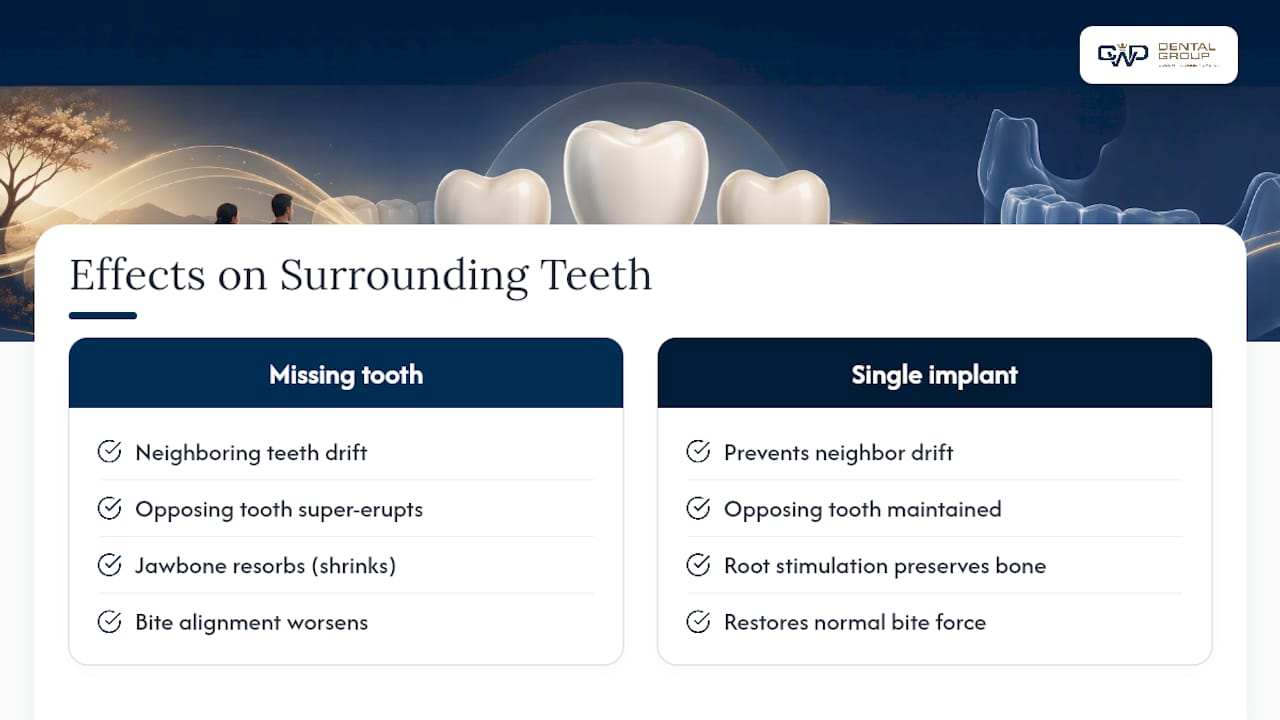
A gap left unfilled doesn't stay contained to one spot. Neighboring teeth tend to drift toward the empty space over months and years, throwing off your bite alignment in ways that are hard to reverse once they've settled. The opposing tooth in the other jaw, with nothing to bite against, can also super-erupt, growing slightly out of its socket, which creates its own bite problems down the line.
There's a structural issue too: without a root stimulating the bone in that spot, the jawbone begins to resorb, shrinking in width and height over time. That's part of why an implant's ability to replace the root itself matters so much. It's not just restoring a tooth, it's maintaining the bone architecture and load pattern the entire nearby dentition relies on. Bridges and dentures don't offer that same benefit, since neither transmits chewing force down into the bone.
An implant, once integrated, functions close enough to a natural tooth that it distributes bite force normally, which takes pressure off neighboring teeth that would otherwise compensate for the gap. Gum health benefits too, since a properly placed implant crown is contoured and cleaned like a natural tooth rather than creating hard-to-reach spaces the way a bridge's connector or a partial's clasps often do. Over years, that translates into fewer plaque traps and a lower risk of the kind of localized gum inflammation that clusters around unreplaced gaps or poorly fitted restorations. The net effect reaches beyond the one tooth: a single implant, done right, tends to protect the health of everything around it rather than just filling a visible hole.
Getting the Esthetics Right: Why Placement Affects Your Whole Smile
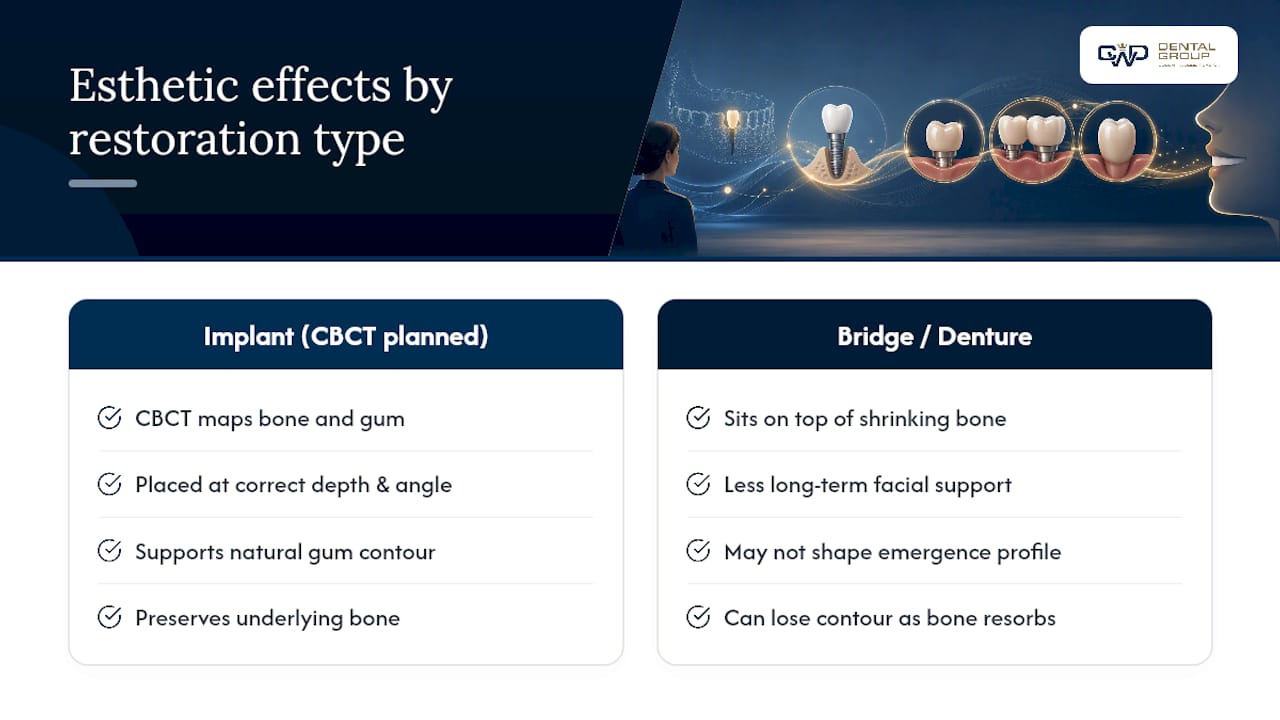
The crown itself is only part of what makes an implant look natural. Gum contour around the restoration matters just as much, since a poorly shaped emergence profile (the angle where the crown meets the gum) can leave a tooth looking slightly off even when the crown color is perfect. This is where CBCT-based planning earns its keep: mapping bone and gum position beforehand lets the surgical team place the implant at a depth and angle that supports a natural-looking gum line once the crown goes on.
Front teeth carry the highest esthetic stakes, which is exactly why zirconia implants and all-ceramic crowns show up more often in that zone. Metal margins that might go unnoticed on a molar become a visible gray shadow on an incisor, especially as gum tissue can recede slightly with age. Shade matching against neighboring teeth is its own skill, and a well-matched crown blends closely enough that most people won't spot which tooth is the implant at conversational distance.
There's a quieter esthetic factor too: facial support. Losing a tooth, especially in the front, can subtly change how the lip and cheek are supported in that area over years of bone loss. Because an implant preserves the underlying bone rather than letting it resorb, it also helps preserve that facial contour in a way a bridge or denture, sitting on top of shrinking bone, generally can't match. For readers weighing how much a restored tooth might change their smile day to day, this closer look at appearance and confidence covers the patient-experience side of that question.
Clinic Viewpoint: Why We Won't Rush Your Healing Timeline
Osseointegration is biology, not a schedule you can negotiate. The surgery itself takes under an hour, but the fusion that makes an implant permanent takes months, and pushing that window shortens the odds of long-term success. Every patient's bone quality and health history set their own pace. If you're weighing a single tooth implant, a consult gives you a realistic, personalized timeline instead of a generic one.
— Kayle
Ready to Talk Through Your Options? Here's How to Start
If a missing tooth has you weighing implants against a bridge or a partial, the fastest way to get real answers is a consult, not another guide. Cwddentalgroup handles the entire process in-house, from the initial exam through surgical placement and final crown, so you're not bounced between separate offices for imaging, surgery, and restoration.
Your first visit typically covers a full exam, CBCT imaging if your case calls for it, a candidacy review based on your bone and health history, and a conversation about financing options if cost is a concern. Bring your medical history, a list of current medications, and any recent dental X-rays you have on hand, since they can save a repeat scan. Same-day emergency appointments are available if you're dealing with a cracked or recently lost tooth and don't want to wait weeks just to get evaluated.
Browse the full range of general and surgical dental services Cwddentalgroup offers, or head straight to scheduling a consult to find out whether a single tooth implant is the right call for your specific case.
This article is general information, not a substitute for advice from a qualified doctor. Consult a qualified healthcare professional about your own circumstances before acting on anything here.
Sources
- Dental implant surgery - Mayo Clinic
- Clinical overview of dental implants (NCBI Bookshelf)
- Dental implant procedure: step-by-step process | Delta Dental
FAQ
Are Single Tooth Implants Worth It?
For most people with adequate bone and stable health, yes. An implant preserves the bone and the healthy teeth around the gap in a way bridges and dentures can't, and long-term data shows low annual bone loss around properly placed and maintained implants.
How Painful Is a Single Tooth Implant?
Most patients describe surgical placement as less painful than an extraction, with manageable soreness and swelling for a few days afterward. Standard pain control handles it for the vast majority of cases, and severe or worsening pain after the first few days is a reason to call your dentist.
How Much Does a Single Tooth Dental Implant Cost?
Total cost depends on the implant fixture, abutment, crown material, and whether grafting or extraction is needed, which is why estimates vary so widely between cases. Cwddentalgroup's current pricing details are available directly through its services page, since costs depend on your specific treatment plan.
Can You Get Just One Tooth Replaced With an Implant?
Yes, a single tooth implant is designed for exactly that: replacing one missing tooth without altering the teeth next to it. It's one of the few replacement options that restores both the visible crown and the root structure underneath.