
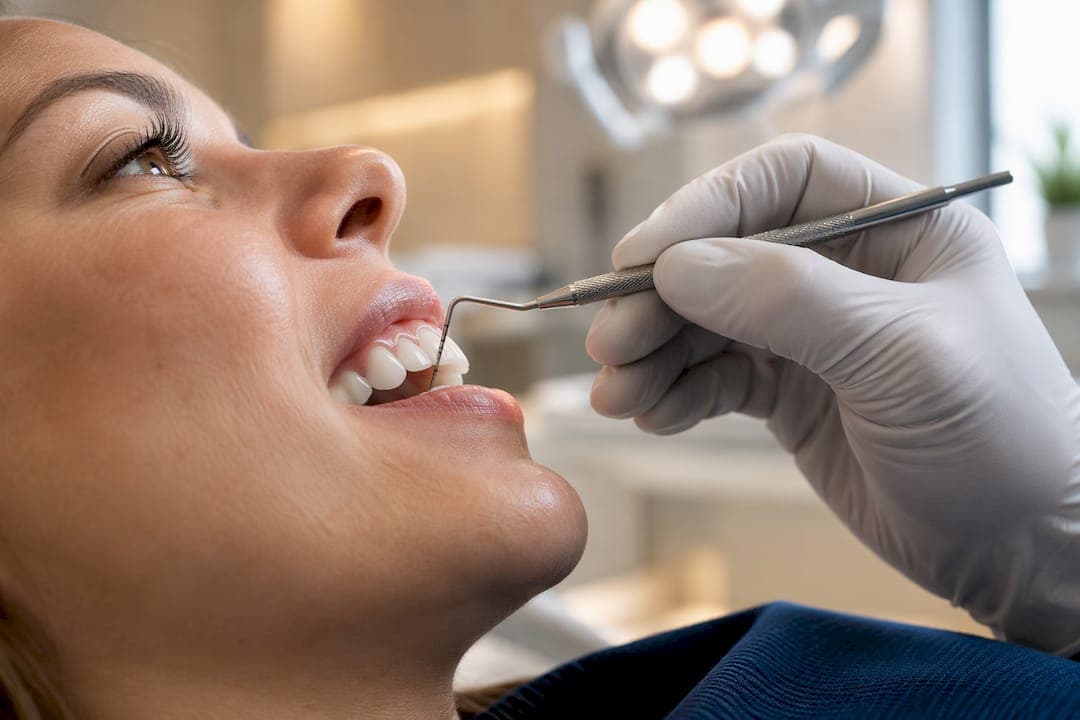
Gum disease begins as gingivitis, a reversible inflammation caused by plaque buildup along the gumline, and can advance into periodontitis, where the supporting bone and tissue break down in ways a dentist cannot fully undo. Catching it at the gingivitis stage means the damage reverses with cleaning and better home care. Once bone loss starts, treatment shifts to controlling the disease rather than reversing it, so bleeding gums or persistent bad breath are worth a dental visit now, not later.
TL;DR:
- Most gum disease patients are actually dealing with gingivitis, which completely reverses with professional cleaning and improved home care.
- Progression speed varies widely and is influenced most significantly by smoking and uncontrolled diabetes, which accelerate tissue destruction.
- Accurate staging depends on pocket depth, bone loss measured on X-rays, and attachment loss, not just appearance or symptoms.
- Deep periodontal pockets above 3 millimeters and bone loss seen on X-rays indicate more advanced and less reversible disease stages.
- Regular monitoring of pocket depth measurements over time is crucial to evaluate treatment effectiveness and ongoing health.
Table of Contents
- What are the stages of gum disease?
- What symptoms show up at each stage?
- How do dentists diagnose which stage you're in?
- What treatment looks like at each stage
- How fast does gum disease progress, and what speeds it up?
- What you can do daily to protect your gums
- How CWD Dental Group supports patients through gum disease care
- The gap between what people fear and what actually matters
- Sources
- FAQ
What are the stages of gum disease?
Gum disease falls into two broad categories. Gingivitis is the mild, reversible stage: plaque irritates the gum tissue, causing redness and bleeding, but the bone and ligaments holding your teeth in place remain untouched. Periodontitis is what happens when that inflammation is left unchecked long enough that the infection works its way below the gumline and starts destroying the structures that anchor your teeth.
Dentists describe periodontitis using a staging system built around how much damage has already occurred, rather than vague labels like "moderate" or "severe." The 2017 World Workshop framework from the American Academy of Periodontology set the current standard, pairing a stage (I through IV) with a grade (A through C) that estimates how fast the disease is likely to progress.
In plain terms, the stages break down as:
- Stage I: early bone loss, generally under 15% of root length, with minimal symptoms.
- Stage II: moderate bone loss with deeper pockets and clearer signs on X-rays.
- Stage III: significant bone loss with possible tooth mobility or loss of back teeth.
- Stage IV: advanced bone loss threatening most or all of the natural teeth, often with bite collapse.
This staging and grading approach is now the clinical standard because it ties treatment decisions to measurable damage instead of guesswork.
What symptoms show up at each stage?
Symptoms tend to track fairly closely with how far the disease has progressed, which is why dentists ask specific questions about bleeding, sensitivity, and mobility during an exam.
- Gingivitis: gums look red or puffy, bleed during brushing or flossing, and may feel tender, but there is no bone loss yet.
- Early periodontitis (Stage I): shallow pockets form between the tooth and gum, slight attachment loss appears, and some gum recession may begin.
- Moderate to advancing periodontitis (Stage II-III): pockets deepen further, bone loss becomes visible on X-rays, and teeth may start to feel loose.
- Advanced periodontitis (Stage IV): severe bone loss, noticeable tooth mobility, teeth drifting out of position, and pain while chewing.
A large proportion of U.S. adults aged 30 and older have some form of periodontitis, with a smaller segment experiencing the severe form, according to the CDC. That gap between the two figures matters: most people with periodontitis catch it before it reaches the advanced stage, which is exactly why symptom awareness and routine exams carry so much weight.
How do dentists diagnose which stage you're in?
A dentist cannot tell how far gum disease has progressed just by looking. The exam relies on a few specific measurements that translate directly into a stage.
- Pocket depth is measured with a periodontal probe. Readings of 1 to 3 millimeters are considered healthy, while anything consistently deeper signals active disease, according to the NIDCR.
- Clinical attachment loss tracks how far the gum tissue has detached from the tooth, which is a more precise gauge of long-term damage than pocket depth alone.
- Radiographic bone loss, visible on dental X-rays, confirms how much of the supporting bone has already been affected and helps assign a stage.
- Grading factors in things like smoking and uncontrolled diabetes, since both accelerate how quickly the disease moves from one stage to the next.
Because early periodontitis often causes no pain, these measurements are usually the only way to catch it before real damage sets in. If you've noticed signs that warrant a check-up, a probing exam and a set of X-rays are the fastest way to find out where you actually stand.
What treatment looks like at each stage
Treatment goals shift depending on how much damage has already occurred, which is the main reason self-diagnosing from symptoms alone is risky.
- Gingivitis: a professional cleaning combined with consistent brushing and flossing typically resolves the inflammation completely within a few weeks.
- Early periodontitis: scaling and root planing, a deeper cleaning that removes bacteria and tartar below the gumline, paired with a shorter recall schedule to monitor healing.
- Moderate to advanced periodontitis: may involve localized antibiotics, periodontal surgery, or regenerative procedures aimed at rebuilding lost bone and tissue where possible.
- Ongoing care: once periodontitis has been treated, most patients move to a periodontal maintenance schedule with more frequent cleanings than a standard six-month recall.
Scaling and root planing remains the standard first-line treatment for early periodontitis, and surgery becomes relevant mainly when deep pockets persist or bone loss is extensive, per the NIDCR. For patients with significant tissue loss, options like grafting are worth understanding in more detail, covered in this breakdown of gum recession treatment.
Pro Tip: Ask your dentist for your exact pocket depth numbers at each visit. Tracking them over time tells you whether treatment is working better than any symptom you can feel.
How fast does gum disease progress, and what speeds it up?
Progression speed varies a lot from person to person, which is part of why grading exists alongside staging. Two people with identical plaque levels can end up at very different stages years later because the immune response to bacterial buildup differs from one person to the next, a concept sometimes called host-mediated inflammation.
Smoking and uncontrolled diabetes are the two biggest modifiable accelerants, both cited by the NIDCR as reasons behavioral changes matter as much as professional cleanings for long-term control. Genetics and age are nonmodifiable factors that still shape individual risk. Severe periodontitis affects roughly 8% of U.S. adults aged 30 and older, according to CDC data, which suggests that while periodontitis itself is common, its most destructive form is not the typical outcome when the disease is caught and managed early.
What you can do daily to protect your gums
Preventing progression, or supporting treatment once it has started, comes down to a short list of habits done consistently rather than any single product.
- Brush twice daily and clean between teeth once a day with floss or an interdental brush, since plaque left between teeth is where gingivitis usually starts.
- See a dentist or hygienist on the recall schedule they recommend, which may be more frequent than six months if you have a history of periodontitis.
- If you smoke, quitting is one of the most effective changes you can make for gum health, and keeping blood sugar controlled matters just as much if you have diabetes.
- Treat bleeding gums, persistent bad breath, or any looseness in a tooth as a reason to call a dentist promptly rather than waiting for the next scheduled visit.
A guide to interdental cleaning walks through technique and tool choice in more depth if you're unsure which method fits your mouth.
Pro Tip: Bleeding gums are never normal, even if it's minor and only happens once in a while. Treat it as your body's earliest warning sign, not something to brush past.
How CWD Dental Group supports patients through gum disease care
CWD Dental Group offers periodontal disease treatment alongside routine cleanings, exams, and same-day emergency appointments for urgent symptoms like sudden swelling or a loose tooth. A periodontal exam typically includes pocket-depth measurements, a review of your dental history, and X-rays when bone loss is suspected. Bringing a list of current medications and any prior periodontal treatment history helps the exam move faster and gives a clearer picture of where you stand.
The gap between what people fear and what actually matters

Most patients searching for gum disease stages want to know if they're already past the point of no return. The honest answer is that the anxiety is often misplaced: gingivitis, the stage most people are actually dealing with, resolves completely with a cleaning and better habits. The real failure point isn't the disease itself, it's the gap between the first bleeding gum and the first dental visit, since periodontitis usually has months or years to progress silently in between.
Conventional advice leans hard on brushing and flossing technique, which matters, but it underplays how much a single measurement, pocket depth, tells you that no amount of self-inspection in a mirror can. If you take one thing from this, make it that number rather than how your gums look or feel. A mouth with zero pain can already have Stage II bone loss, and a mouth that bleeds a little can still be fully reversible. Ask for your numbers at every visit and treat consistency in professional cleanings as more protective than any single home routine.
— Kayle
This article is general information, not a substitute for advice from a qualified doctor. Consult a qualified healthcare professional about your own circumstances before acting on anything here.
Sources
- Periodontal (Gum) Disease — Centers for Disease Control and Prevention (CDC)
- Periodontal (Gum) Disease — NIDCR
- American Academy of Periodontology — 2017 World Workshop
FAQ
Can you live a long life with gum disease?
Yes, gum disease on its own is not life-threatening, and many people manage periodontitis for decades with proper treatment and maintenance. The bigger concern is tooth loss and the discomfort that comes with advanced stages, both of which are preventable with early treatment and consistent care.
How do I know what stage of gum disease I have?
The only reliable way is a dental exam that includes pocket-depth probing and, often, X-rays to check for bone loss. Normal pocket depths measure 1 to 3 millimeters, according to the NIDCR, and anything deeper points toward periodontitis rather than simple gingivitis.
Can gum disease be reversed?
Gingivitis is fully reversible with professional cleaning and consistent home care, since no bone or tissue has been lost yet. Once periodontitis sets in and bone loss occurs, treatment can stop the disease and stabilize your gums, but the lost bone and attachment generally do not grow back on their own.
How do I get healthy gums again?
Start with a professional cleaning to remove plaque and tartar buildup, then keep up daily brushing and interdental cleaning to prevent it from returning. If pockets deeper than 3 millimeters or bleeding persist after that, a deeper cleaning like scaling and root planing is usually the next step.
What causes gum disease to get worse faster?
Smoking and poorly controlled diabetes are the two biggest factors known to speed up periodontitis, alongside inconsistent oral hygiene. Genetics and age also play a role, which is part of why two people with similar habits can progress at very different rates.