
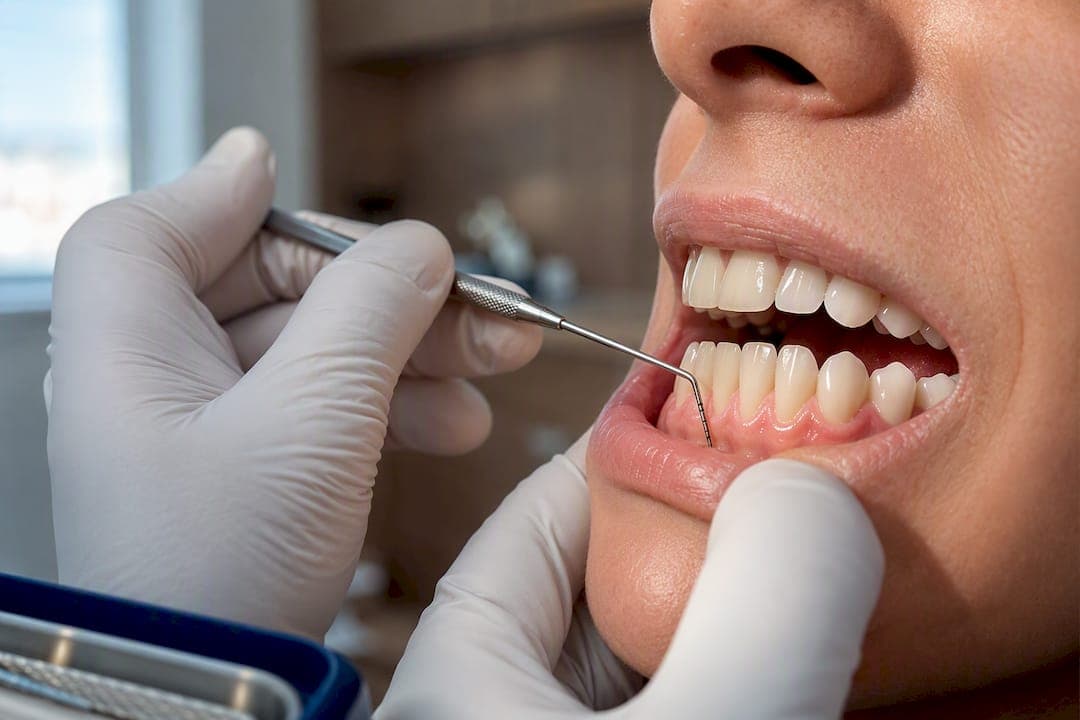
Mild recession usually responds to a professional cleaning and desensitizing care; moderate cases often need dental bonding or a small localized graft; severe cases typically require a coronally advanced flap with a connective tissue graft for the most predictable root coverage. Every option shares the same goals: calm sensitivity, stop the recession from getting worse, and stabilize the gum line. Full regrowth isn't realistic in most cases. Coverage and protection are.
TL;DR:
- Mild recession often only requires monitoring and improved oral hygiene, while moderate cases with sensitivity can benefit from desensitizing treatments and scaling.
- Surgical options like coronally advanced flap with connective tissue graft show the highest success rate for severe or progressing recession, especially Miller Class I and II defects.
- Non-surgical treatments such as scaling, desensitizing agents, and bonding work best when recession is caused by plaque, abrasion, or behavioral factors like brushing and bruxism.
- The prognosis decreases significantly with thin tissue biotypes, smoking, or adjacent bone loss, which warrants early referral to a periodontist for advanced procedures.
- Proper root coverage over combined hard and soft tissue defects often requires restoring non-carious cervical lesions before surgical grafting for optimal long-term results.
Table of Contents
- How Gum Recession Treatment Progresses From Monitoring to Surgery
- How Do Dentists Measure and Stage Gum Recession?
- What Non-Surgical Treatments Actually Stop Gum Recession?
- Surgical Root Coverage: Which Technique Works Best?
- When Gum Recession Comes With Worn Tooth Structure
- What to Expect During Recovery From Gum Recession Treatment
- Preventing Gum Recession From Getting Worse
- How to Choose the Right Provider for Gum Recession Treatment
- Balancing the Evidence With What Patients Actually Want
- Get a Personalized Gum Recession Evaluation in Tallahassee
- Sources
How Gum Recession Treatment Progresses From Monitoring to Surgery
Treatment for gingival recession isn't one path. It's a decision tree that branches based on how deep the recession is, what caused it, and whether the tooth structure underneath is intact.
Four things drive which direction a dentist or periodontist takes: the underlying cause (aggressive brushing, periodontitis, orthodontic movement, or bruxism), how many millimeters of root are exposed, the patient's gingival biotype (thin tissue behaves very differently than thick tissue under stress), and whether a non-carious cervical lesion, a notch-shaped groove at the gumline, is also present.
Here's roughly how cases sort themselves out in practice:
- Mild recession (1 to 2mm, stable, no sensitivity complaints): Often just monitored, with better brushing technique and a hygiene visit.
- Mild to moderate recession with sensitivity: Desensitizing treatment plus scaling and root planing, sometimes dental bonding if the root surface is exposed and unsightly.
- Moderate recession with esthetic concerns or continued progression: Localized surgical grafting, frequently combined with restorative bonding if a cervical lesion has formed.
- Severe recession, multiple adjacent teeth, or thin biotype with high risk of further loss: Referral to a periodontist for coronally advanced flap with connective tissue graft or a tunnel technique.
A general dentist or dental hygienist usually manages the first two tiers. Once the case involves surgical grafting, root coverage across multiple teeth, or a biotype so thin that regular treatment risks making things worse, a periodontist takes over. That handoff point matters more than most patients realize. Waiting too long to get referred is one of the most common reasons recession that could have been treated conservatively ends up needing a bigger surgical fix later.
How Do Dentists Measure and Stage Gum Recession?
A periodontal exam for recession isn't just "how far back did the gum go." Dentists measure recession depth in millimeters from the cementoenamel junction (where enamel meets root) down to the current gumline, using a periodontal probe. That number alone doesn't tell the full story.
Two other measurements matter just as much:
- Keratinized tissue width — the band of tougher, attached gum tissue that protects the root; thin bands predict worse outcomes and lower graft success.
- Interdental papilla height — whether the little triangle of gum between teeth is intact; its loss (sometimes called a "black triangle") affects both prognosis and appearance.
- Attachment loss between teeth — interproximal bone and tissue loss changes the whole treatment calculus, because it's the factor most associated with lower root coverage predictability.
Classification systems (built on the older Miller classes, now largely folded into the 2018 Cairo recession type system) sort defects by whether bone loss extends between teeth. Miller Class I and II defects, meaning no interdental bone or tissue loss, respond best to grafting and are exactly the cases where research on coronally advanced flap with connective tissue graft shows the most consistent, stable long-term coverage. Class III and IV defects, where interdental attachment is already gone, carry a much less predictable outlook no matter which surgical technique gets used.
A few findings should prompt a referral to a periodontist rather than continued monitoring by a general dentist: recession on multiple adjacent teeth, any suspicion of a Class III or IV defect, visible interproximal bone loss on X-ray, or a biotype so thin the tissue looks almost translucent. Gingival phenotype (thin versus thick tissue) is one of the strongest predictors of how a case will behave. Thin biotypes recede faster, respond less predictably to surgery, and need closer monitoring even after successful treatment.
What Non-Surgical Treatments Actually Stop Gum Recession?
Not every case of gum recession needs a scalpel. A good chunk of mild-to-moderate recession is manageable through non-surgical routes that address the underlying irritation and protect the exposed root surface.
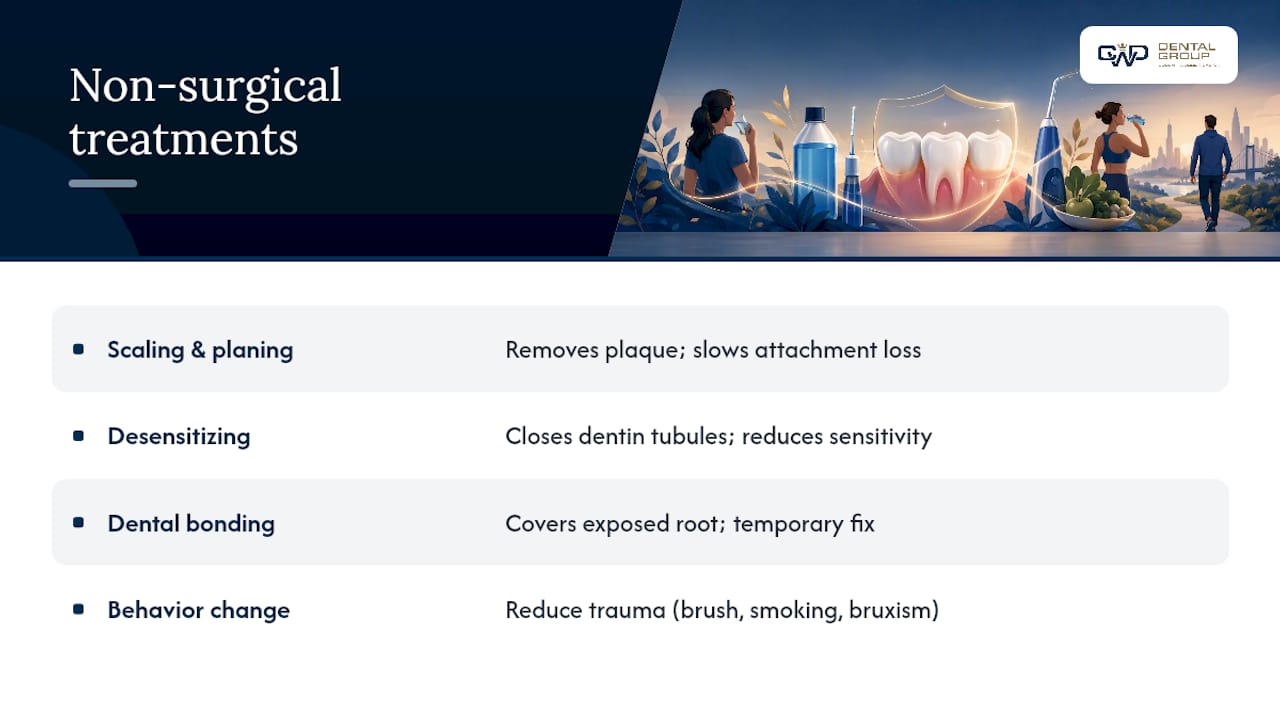
1. Scaling and root planing. When recession is driven by plaque buildup or periodontitis, a deep dental cleaning removes the bacterial deposits and smooths the root surface, which slows further attachment loss. This is standard first-line care and is explicitly recommended for mild recession before anything more invasive gets considered.
2. Desensitizing treatments. Exposed dentin (the layer under enamel) is riddled with microscopic tubules that transmit temperature and pressure straight to the nerve, which is why cold drinks or a toothbrush bristle can feel like an electric jolt. In-office fluoride varnish, potassium nitrate applications, or resin-based sealants can close those tubules within one or two visits. At home, desensitizing toothpaste with potassium nitrate or stannous fluoride typically needs several weeks of consistent use before sensitivity noticeably drops. It won't help overnight, and patients who quit after three days usually conclude, wrongly, that it doesn't work.
3. Dental bonding. When a root surface is exposed but there isn't active disease driving further recession, tooth-colored bonding material can be applied directly over the exposed root to reduce sensitivity and improve appearance without surgery. It's fast, relatively inexpensive, and reversible if a patient later wants a surgical graft instead. The tradeoff: bonding material wears faster than natural tooth structure and typically needs replacement or touch-up every several years, so it's a management tool, not a permanent structural fix.
4. Behavior change. This is the unglamorous part that determines whether any of the above actually holds. A soft-bristle toothbrush, the modified Bass technique (angling bristles at 45 degrees toward the gumline with light pressure, not scrubbing side to side), and quitting smoking all directly reduce mechanical and chemical trauma to the gum tissue. Bruxism (nighttime grinding or clenching) also drives recession by putting abnormal lateral force on teeth at the gumline, and a night guard is often part of the non-surgical plan when grinding is present.
Pro Tip: If a toothbrush wears out in under six weeks with bristles splayed sideways, that's a sign of overly aggressive brushing, not a sign you're doing a thorough job. Replace the habit before you replace the brush.
Non-surgical care works best as a package rather than a single fix. Reviews of gingival recession management consistently point to plaque control, behavior modification, and desensitizing agents together, with supportive maintenance keeping results stable over time.
Surgical Root Coverage: Which Technique Works Best?
For recession that's progressing, esthetically significant, or affecting multiple teeth with thin biotype, surgical root coverage is where the evidence gets the strongest. And the evidence points in one clear direction.
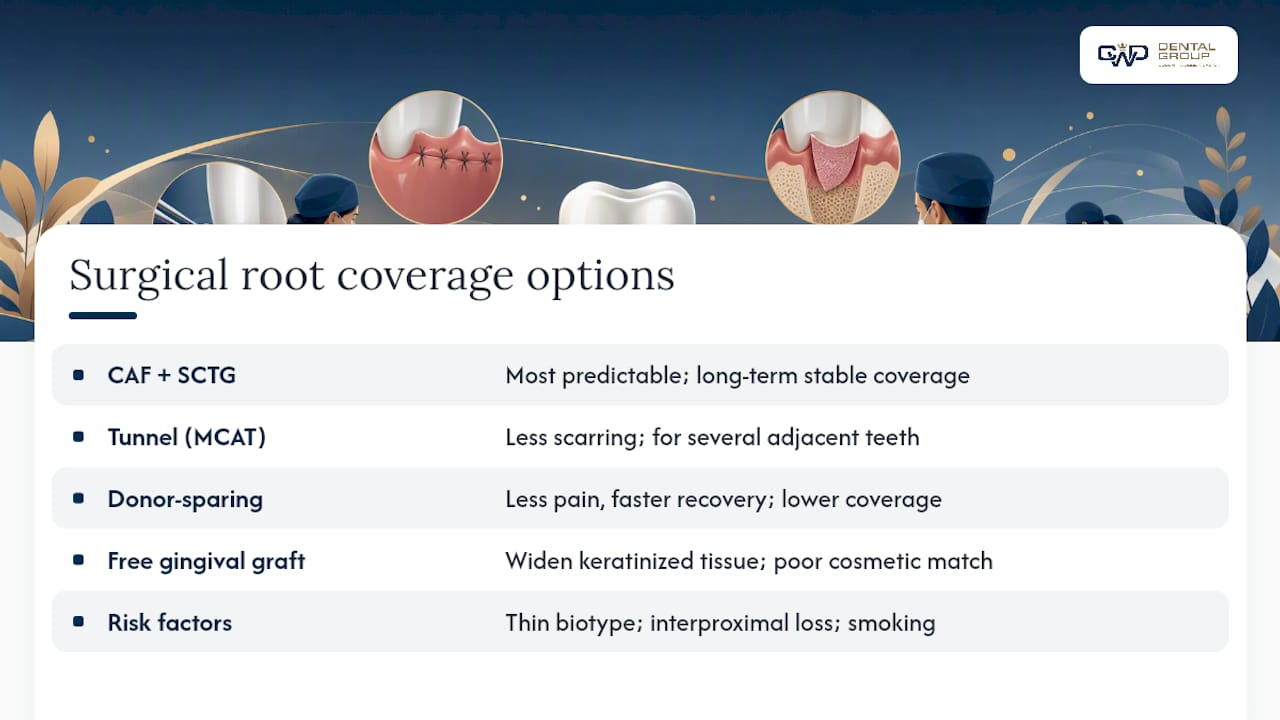
Coronally advanced flap with subepithelial connective tissue graft (CAF + SCTG) is the technique with the most consistent long-term data behind it. The surgeon takes a thin piece of connective tissue, usually from the roof of the patient's mouth, and places it under a flap of gum tissue that's then pulled up ("coronally advanced") to cover the exposed root. The graft adds bulk and a blood supply that helps the tissue reattach and stay stable for years rather than months.
A consensus report from the American Academy of Periodontology identifies SCTG-based procedures as delivering the best root coverage outcomes for Miller Class I and II defects, the category that covers the majority of isolated recession cases dentists see.
Tunnel technique (also called MCAT, modified coronally advanced tunnel). Instead of cutting and lifting a flap, the surgeon creates a tunnel under the gum tissue across several teeth and slides a connective tissue graft through it without any visible incision lines. It's chosen when several adjacent teeth need coverage at once, or when a patient and surgeon are prioritizing minimal scarring and faster-looking healing over the very slight edge in predictability that traditional flap surgery offers.
Donor-site-sparing alternatives. Not everyone wants a second surgical site in their palate, and some patients don't have enough donor tissue to harvest. Acellular dermal matrix (processed donor tissue), collagen matrix, and enamel matrix derivative (a gel that encourages the body's own tissue regeneration) all substitute for the patient's own connective tissue. Clinical evidence shows these materials meaningfully cut down on post-surgical pain and shorten recovery, but they generally deliver somewhat lower complete-coverage rates over the long run than a graft taken from the patient's own tissue. It's a real tradeoff, not a free upgrade.
Free gingival grafts still have a role, but a narrow one. They're better suited to widening a band of tough, keratinized tissue than to covering an exposed root cosmetically, since the graft tends to look paler and thicker than the surrounding gum.
A few factors reliably knock down the odds of full coverage no matter which technique is chosen: a thin gingival biotype going in, existing interproximal attachment loss, and smoking, which impairs blood flow to healing tissue and is one of the most consistent predictors of surgical failure across periodontal literature. Patients who smoke and won't quit before surgery should hear that plainly from whoever is doing the procedure. It's not a scare tactic. It's the single biggest lever a patient controls.
When Gum Recession Comes With Worn Tooth Structure
Recession doesn't always show up alone. A fair number of patients have both an exposed root and a wedge-shaped notch carved into the tooth at the gumline, a non-carious cervical lesion (NCCL), usually caused by a mix of abrasive brushing and mechanical flexing of the tooth under bite force.
That combination changes the treatment plan. Surgery alone can pull gum tissue up over the root, but if there's a deep notch in the tooth structure underneath, the graft has an irregular surface to adapt to and coverage tends to fall short. Research on combined treatment protocols shows that neither a restoration nor a surgical graft alone reliably solves both problems when a deep NCCL is present.
The usual sequence: the dentist places a conservative restoration, often a tooth-colored composite, to fill and smooth the notch, then the periodontist performs the graft over the restored surface once it's properly contoured. Getting the order and the margin design right matters. A restoration with a rough or overhanging edge gives bacteria somewhere to hide and undermines the graft's chance of attaching cleanly. Feathered, smooth margins that blend into the root surface give the graft the best shot at full coverage.
- Deep NCCLs generally need restoration before or alongside surgical coverage, not instead of it.
- Margin placement and material choice directly affect how well the graft adapts to the tooth surface.
- Combined restorative and surgical care shows better esthetic and functional outcomes than treating either problem in isolation.
This is also where a lot of self-treatment attempts go wrong. Bonding alone might mask the notch cosmetically, but it doesn't address the gum recession, and gum surgery alone might cover the root while leaving a rough restoration edge that invites the recession right back.
What to Expect During Recovery From Gum Recession Treatment
Recovery timelines depend heavily on which treatment path you're on, but a few patterns hold across most cases.
For non-surgical care, sensitivity relief from desensitizing agents usually shows up within two to four weeks of consistent use, and scaling and root planing sites typically feel tender for just a few days.
For surgical grafting, initial healing takes 10 to 14 days, but the tissue continues maturing and tightening for several months afterward. One detail that surprises a lot of patients: gum coverage can keep improving for up to a year after surgery through a slow process called creeping attachment, where the gum tissue continues migrating slightly coronally on its own. Judging the final result at the two-week checkup is premature.
"Complete root coverage" has a specific clinical meaning: the gumline sits exactly at the cementoenamel junction with no residual probing depth. CAF + SCTG achieves this outcome more consistently than most alternative techniques in Miller Class I and II defects, which is why it holds its position as the reference standard for predictable, stable coverage.
- Smoking, poor plaque control, and thin biotype are the three factors most associated with recession creeping back after successful treatment.
- Supportive periodontal maintenance, typically every three to four months for treated patients rather than the standard six, catches early relapse before it becomes a repeat surgical case.
- Even biomaterial-based grafts, while easier to recover from, need the same maintenance discipline to hold their result long term.
Preventing Gum Recession From Getting Worse
Stopping gum recession before it needs a graft comes down to a short list of habits, executed consistently rather than perfectly.
- Switch to a soft-bristle toothbrush and the modified Bass technique. Angle the bristles toward the gumline at roughly 45 degrees and use small vibrating motions instead of horizontal scrubbing. Scrubbing is the single most common mechanical cause of recession in patients who otherwise have healthy gums.
- Pick the right toothpaste for your situation. Desensitizing toothpaste with potassium nitrate or stannous fluoride helps once sensitivity has already started; an abrasive whitening toothpaste used daily on already-thin gum tissue can make things worse.
- Set a maintenance schedule that matches your risk. Patients with thin biotype, a history of periodontitis, or prior grafting generally benefit from cleanings every three to four months instead of the standard twice a year.
- Address bruxism and smoking directly. A night guard protects against the lateral forces of grinding, and quitting smoking removes one of the most consistently cited risk multipliers for recession progression, documented across recent reviews of contemporary treatment outcomes.
Pro Tip: If your gums bleed slightly when you switch to correct brushing technique, that's usually inflamed tissue adjusting, not a sign you're doing it wrong. Give it two weeks before judging.
Orthodontic treatment deserves a specific mention here. Moving teeth can increase recession risk in patients with a thin biotype, but careful monitoring during treatment meaningfully reduces that risk, so it's worth flagging a thin gum phenotype to an orthodontist before braces or aligners start, not after recession shows up.
How to Choose the Right Provider for Gum Recession Treatment
Not every case needs a periodontist, but knowing when to ask for one saves time and tissue. A preoperative assessment and treatment plan that clearly maps out diagnostic findings before any procedure is one sign you're dealing with a thorough clinician rather than someone rushing to a scalpel.
Bring these questions to a consult:
- If surgery is recommended, how many CAF + SCTG or tunnel procedures has this clinician performed, and what's the typical outcome they see?
- Are donor-site-sparing alternatives (ACDM, collagen matrix, EMD) appropriate for my case, and why or why not?
- What's the plan for pain control, and how is the donor site managed if a graft is being harvested?
- What does follow-up and maintenance look like after treatment, and how often?
- What does this cost, and does insurance typically apply to any part of it?
A provider who dismisses non-surgical options outright, or who can't describe a maintenance plan beyond "come back if it hurts," is a red flag worth taking seriously.
Balancing the Evidence With What Patients Actually Want
The research is fairly unambiguous: CAF + SCTG produces the most predictable, most stable root coverage available, and it holds that position across enough studies that dismissing it outright would be bad advice. But treating every recession case as a referral straight to graft surgery misreads what most patients actually need.
A lot of recession is mild, stable, and driven by a brushing habit that's fixable in a single hygiene visit. Pushing surgery there isn't evidence-based, it's overtreatment. On the other end, some patients with genuinely surgical-grade recession will still choose a donor-site-sparing biomaterial or decline surgery altogether because the recovery and second surgical site aren't worth it to them, even knowing the coverage odds are slightly lower. That's not ignoring the evidence. That's weighing it against a life that has to keep functioning during a two-week recovery.
Good care means naming the best option honestly, then building a plan around what the patient can actually live with.
— Kayle
Get a Personalized Gum Recession Evaluation in Tallahassee
If your gums have started pulling back and you're not sure whether you need a cleaning, a bonding appointment, or a referral for surgery, guessing is the expensive path. We evaluate recession cases across a full range of treatments from scaling and root planing to dental bonding and surgical grafting, and offer same-day appointments to provide timely answers for dental concerns.
A same-day evaluation gets you a probing depth measurement, a look at your biotype and any interproximal attachment loss, and a straight answer on which tier of treatment actually fits your case, instead of a generic "watch and wait." If sensitivity or an exposed root is bothering you enough to have read this far, schedule an evaluation and get a plan built around your teeth, not a worst-case assumption.
This article is general information, not a substitute for advice from a qualified doctor. Consult a qualified healthcare professional about your own circumstances before acting on anything here.
Sources
- Gum Recession: Causes, Prevention, Surgery & Treatment — Cleveland Clinic
- PubMed: Evidence on CAF + SCTG as predictable root coverage technique
- Treatment of Gingival Recession: When and How? — PMC
- PubMed: Combined treatment protocols for recession with NCCLs