
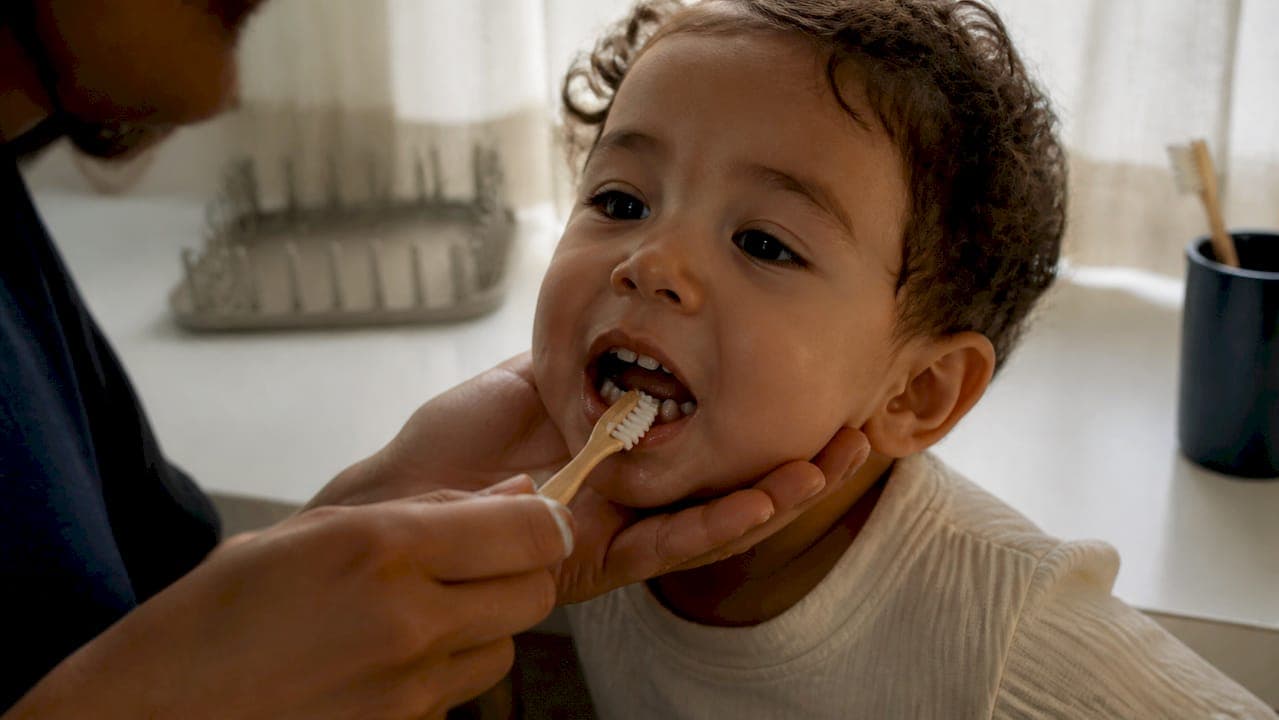
From the moment your baby's first tooth breaks through to the day your teenager's wisdom teeth appear on an X-ray, dental development follows a fairly predictable path. Here is the short version: clean gums from birth, start fluoride toothpaste at the first tooth, schedule that first dental visit by age 1, begin flossing when teeth touch, and keep up twice-yearly checkups through adolescence. Each stage has one non-negotiable action. For infants, it is booking that first visit. For toddlers, it is supervised brushing with the right toothpaste amount. For school-age kids, it is asking about sealants. For teens, it is orthodontic screening if you have not done it yet.
Quick-action guide by age:
- 0–12 months: Wipe gums with a clean cloth; start a smear of fluoride toothpaste at first tooth; schedule the first dental visit by the first birthday.
- 1–3 years: Supervise brushing twice daily with a rice-sized amount of fluoride toothpaste; no bottle at bedtime.
- 3–6 years: Switch to a pea-sized toothpaste amount; start daily flossing when teeth touch; build a positive dental routine.
- 6–12 years: Ask about pit-and-fissure sealants on first permanent molars; keep twice-yearly exams.
- 12–18 years: Confirm orthodontic screening has happened; discuss wisdom teeth monitoring.
Call or go to the dentist today if your child has: uncontrolled bleeding in the mouth, a knocked-out permanent tooth, severe facial swelling, or a tooth that has been painful for more than two days without explanation.
Pro Tip: Keep a simple notes app entry with your child's eruption dates. It takes ten seconds per tooth and gives your dentist genuinely useful information at every visit.
Key Takeaways
Every dental care milestone by age follows a predictable sequence, and pairing each stage with one specific action, from the first fluoride smear to the orthodontic screening at age 7, is what turns good intentions into a cavity-free childhood.
| Point | Details |
|---|---|
| First dental visit by age 1 | Schedule within 6 months of the first tooth or by the first birthday, per AAPD and ADA guidance. |
| Fluoride toothpaste from tooth one | Use a rice-grain smear under age 3, then a pea-sized amount from age 3 onward. |
| Floss when teeth touch | Start daily flossing as soon as two adjacent teeth are in contact, regardless of age. |
| Sealants at first permanent molars | Ask about pit-and-fissure sealants when first permanent molars erupt around age 6–7. |
| Cwddentalgroup for Tallahassee families | Same-day emergency appointments and full pediatric care available; book online at cwddentalgroup.com. |
Table of Contents
- What are the dental care milestones by age in infancy?
- How should toddler dental care work from ages 1 to 3?
- How do you build good dental habits in early childhood (ages 3–6)?
- What happens to teeth during the school-age years (ages 6–12)?
- What dental changes should you expect during adolescence (ages 12–18)?
- When should you see the dentist, and what counts as an emergency?
- What prevention basics should every parent know?
- When should your child see an orthodontist?
- Why do early dental milestones matter for lifelong health?
- What parents often overlook about dental routines
- Families in Tallahassee get same-day care at Cwddentalgroup
- Sources
What are the dental care milestones by age in infancy?
Most babies cut their first tooth somewhere between 6 and 12 months, though a few arrive earlier and some not until 14 or 15 months. The lower central incisors typically lead, followed by the upper central incisors. By around 33 months, most children have their full set of 20 primary teeth, according to eruption timing data from the AAPD.
Oral care starts before that first tooth. Wipe your newborn's gums with a clean, damp cloth after feedings to remove milk residue and start a hygiene habit early. The moment a tooth appears, switch to a soft-bristled infant toothbrush and a smear (rice-grain-sized) amount of fluoride toothpaste. The ADA recommends scheduling the first dental visit within six months of that first tooth or by the first birthday, whichever comes first. The AAPD's periodicity guideline reinforces this: the first oral exam should happen at eruption of the first tooth and no later than 12 months, with recall intervals set by individual caries risk.
Safe teething relief:
- A chilled (not frozen) teething ring or a clean, cold, wet washcloth.
- Gentle gum massage with a clean finger.
- Age-appropriate teething toys made from solid rubber.
What is NOT normal: According to the Merck Manual, teething may cause mild local discomfort and drooling, but it does not cause high fever or diarrhea. If your baby develops either, that is a sign of something else and needs a clinician's evaluation, not a teething remedy.
Statistic to know: The AAPD reports that tooth decay is the most common chronic childhood disease in the United States, yet it is largely preventable with early professional care and home hygiene.
Pro Tip: At the first dental visit, ask your dentist to apply a fluoride varnish. The AAPD recommends it starting at the first tooth, and it takes about two minutes.
How should toddler dental care work from ages 1 to 3?
By age 3, most children have all 20 primary teeth. The exact timing varies, and a gap of a few months in either direction is completely normal. What matters more than timing is the care routine you build now.
Keep the toothpaste amount at a rice-grain smear until age 3. You are the one holding the brush. Children this age lack the fine motor control to clean their own teeth effectively, so supervise every session and finish the job yourself. Twice daily, every day.
Diet and bottle habits:
- No bottle or sippy cup with milk, juice, or formula at bedtime. Pooled sugary liquid against teeth overnight is the primary driver of early childhood caries.
- Limit juice to 4 ounces per day maximum for toddlers, and serve it in an open cup rather than a sippy cup.
- Introduce water as the default between-meal drink.
Flossing: Start flossing as soon as two teeth are touching each other. You cannot clean the contact point between adjacent teeth with a brush alone. Floss picks designed for children make this easier.
Pacifier and thumb-sucking: Both are normal at this age and rarely cause lasting harm before age 3. If the habit continues past 3 and you notice the front teeth starting to flare or the bite looks off, bring it up at the next dental visit. Most children stop on their own between 2 and 4 years.
Pro Tip: Let your toddler "brush" first as play, then you do the real cleaning. It builds cooperation without a fight.
For a full breakdown of dental services for toddlers, including what to expect at early visits, that resource covers the specifics well.
How do you build good dental habits in early childhood (ages 3–6)?
At age 3, bump the toothpaste to a pea-sized amount. That is the only change in dosing until adulthood. Keep supervising brushing until at least age 6 or 7; most children cannot reliably clean all surfaces on their own until then.
A practical brushing supervision sequence:
- Let your child brush first for about 60 seconds.
- You follow up, focusing on the back molars and the gumline.
- Spit, but no rinsing with water right after. Leaving a trace of fluoride toothpaste on the teeth extends its protective effect.
- Floss between any teeth that are touching.
- Keep the whole routine under three minutes to hold attention.
Around age 4, you may notice gaps developing between your child's primary teeth. This is developmentally normal. Natural jaw growth creates spacing that actually reduces crowding risk when permanent teeth arrive.
Managing dental anxiety: Keep early visits low-stakes and positive. Read books about the dentist before appointments, use play-dentist games at home, and avoid framing the visit as something to "get through." Children who have positive early experiences are far more likely to maintain regular care as adults. For age-appropriate dental care strategies that match each developmental stage, that guide offers practical framing.
Persistent habits: If thumb-sucking or pacifier use is still active at age 4 and you can see it affecting tooth position, ask your dentist. A simple habit appliance or behavioral strategy can redirect the habit before it requires orthodontic correction.
Pro Tip: Use a two-minute sand timer or a brushing app with a song. The visual countdown removes the argument about whether brushing is "done."
What happens to teeth during the school-age years (ages 6–12)?
This is the mixed dentition phase, when primary teeth fall out and permanent teeth replace them. It can look chaotic, but the sequence is fairly predictable.

Eruption and exfoliation timeline
| Tooth | Primary tooth lost (approx.) | Permanent tooth erupts (approx.) |
|---|---|---|
| Lower central incisor | 6–7 years | 6–7 years |
| Upper central incisor | 7–8 years | 7–8 years |
| Lower lateral incisor | 7–8 years | 7–8 years |
| Upper lateral incisor | 8 years | 8 years |
| First permanent molar | No primary predecessor | 6–7 years |
| Lower canine | 10 years | 10 years |
| First premolar | 10–11 years | 10–11 years |
| Second premolar | 10–12 years | 10–12 years |
| Second permanent molar | No primary predecessor | 11–13 years |
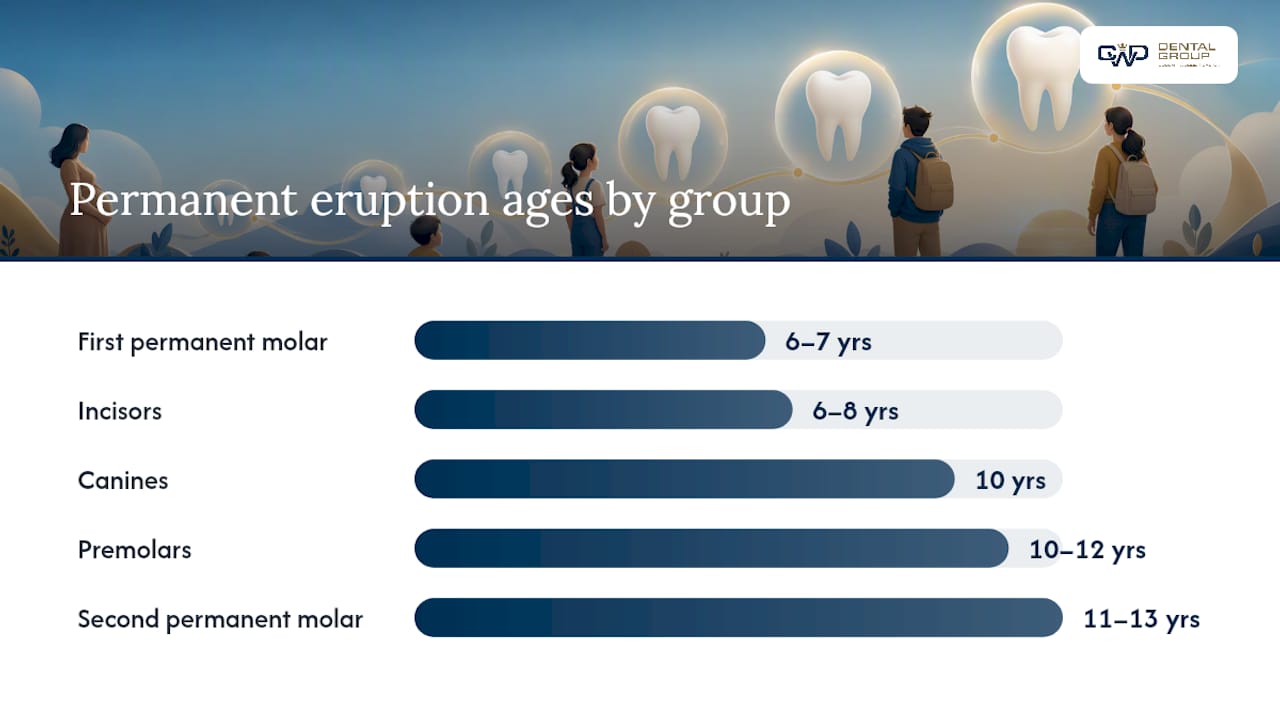
Sources: AAPD dental growth tables; Cleveland Clinic eruption chart
The first permanent molars arrive around age 6 without replacing any baby tooth. They sit behind the last primary molar and are often mistaken for baby teeth. They are not. They are permanent, and they are highly susceptible to cavities because their deep grooves trap food and bacteria.
Sealants vs. fluoride varnish: which does your child need?
The AAPD periodicity guideline recommends both topical fluoride treatments and pit-and-fissure sealants as part of individualized prevention.
| Prevention option | How it works | Best timing |
|---|---|---|
| Pit-and-fissure sealants | Plastic coating fills grooves on chewing surfaces | At eruption of first and second permanent molars |
| Fluoride varnish | Concentrated fluoride applied to all tooth surfaces | Every 3–6 months based on caries risk |
Sealants reduce decay risk on the chewing surfaces of back teeth significantly. They do not replace fluoride; the two work on different surfaces and complement each other.
Orthodontic screening: The American Association of Orthodontists recommends a screening by age 7. At this point, enough permanent teeth have erupted for an orthodontist to spot crowding, crossbite, or jaw discrepancies early. An early screening does not mean early treatment; it means early awareness.
Pro Tip: Ask your dentist whether your child's first permanent molars are fully erupted and cavity-free. If they are, that is the right moment to discuss sealants.
What dental changes should you expect during adolescence (ages 12–18)?
Most of the permanent dentition is in place by the mid-teens, with the exception of third molars. The second permanent molars typically finish erupting around 11–13 years. After that, the mouth is largely stable until wisdom teeth appear.
Third molars (wisdom teeth): These typically emerge between ages 17 and 25, though timing varies widely. Some people never develop them. Panoramic X-rays around age 16–17 give a clear picture of whether they are present, how they are positioned, and whether they are likely to cause problems. Impaction, crowding, or recurrent infection are the main reasons removal becomes a consideration.
Orthodontic timing: If a screening happened at age 7 and no early treatment was needed, comprehensive orthodontic treatment typically begins in early adolescence once most permanent teeth have erupted. Braces or clear aligner therapy at this stage takes advantage of remaining jaw growth.
Adolescent-specific risks:
- Vaping and tobacco use damage gum tissue and increase oral cancer risk. Adolescents who use these products need more frequent periodontal monitoring.
- Contact sports without a custom mouthguard are a leading cause of dental trauma in teenagers. An over-the-counter boil-and-bite guard offers some protection, but a custom-fitted guard from a dentist provides significantly better coverage.
- Oral piercings (tongue, lip) cause tooth fractures, gum recession, and infection. If your teenager has one or is considering one, that conversation belongs at the dental visit.
Pro Tip: Teenagers often skip dental visits once they age out of the pediatric "fun" environment. Scheduling their appointment alongside a parent's own checkup normalizes it as a family routine rather than a child's errand.
When should you see the dentist, and what counts as an emergency?
Routine visit schedule:
- First visit: by the first birthday or within 6 months of the first tooth.
- Ages 1–5: every 6 months, or more frequently if caries risk is elevated.
- Ages 6 and up: every 6 months as a baseline; your dentist may adjust based on risk.
For a detailed breakdown of dental check-ups at every age, including what happens at each type of visit, that resource covers the specifics.
Signs that need same-day care:
- A knocked-out permanent tooth (not a baby tooth).
- Uncontrolled bleeding from the mouth.
- Severe facial swelling, especially if it is spreading toward the eye or neck.
- Fever combined with visible oral infection or swelling.
- Dental trauma with possible jaw fracture.
Emergency action flow:
- Assess: Is there uncontrolled bleeding or a swollen airway? Go to the ER immediately.
- Knocked-out permanent tooth: Handle by the crown, rinse gently without scrubbing, and place it back in the socket if possible. If not, store it in milk or the child's saliva and get to a dentist within 30 minutes. Time is the critical factor.
- Severe swelling or infection: Call your dental office for a same-day appointment. If the office is closed and swelling is spreading, go to urgent care or the ER.
- Persistent pain or a broken tooth without bleeding: Call the dental office the same day for guidance.
Baby teeth that are knocked out are generally not replanted, as replantation can damage the developing permanent tooth underneath. A dentist should still evaluate the injury to check for bone damage.
What prevention basics should every parent know?
The single most powerful thing you can do for your child's dental future is combine fluoride exposure, a low-sugar diet, and your own healthy mouth.
Fluoride:
- Community water fluoridation is the most cost-effective public health measure for reducing caries. If your water is not fluoridated, ask your dentist whether a fluoride supplement is appropriate after assessing total intake.
- Use fluoride toothpaste from the first tooth: smear/rice-sized until age 3, pea-sized from 3 onward.
- Professional fluoride varnish at dental visits adds a layer of protection, especially for high-risk children.
Diet:
- Calcium and vitamin D are the structural building blocks of teeth and jaw bone. Dairy, fortified plant milks, leafy greens, and adequate sunlight exposure all contribute.
- Frequency of sugar exposure matters as much as total amount. Five sugary snacks spread through the day cause more acid exposure than one dessert after a meal.
- No bottle or sippy cup with anything other than water at bedtime.
Caregiver transmission: The bacteria that cause cavities, primarily Streptococcus mutans, are transmitted from caregiver to child through shared utensils, tasting food before offering it, and cleaning a pacifier in your own mouth. AAP anticipatory guidance specifically recommends assessing caregiver oral health as part of infant caries prevention. Treating your own untreated cavities reduces the bacterial load you pass to your child.
Family prevention checklist:
- Wipe infant gums from birth; brush with fluoride toothpaste at first tooth.
- No bedtime bottle with milk, juice, or formula.
- Floss when two teeth touch.
- Schedule dental visits every 6 months.
- Ask about sealants at first permanent molar eruption.
- Treat your own cavities. Avoid sharing utensils or cleaning pacifiers in your mouth.
- Check your water supply's fluoride level at CDC's My Water's Fluoride.
For a broader oral care checklist for families that covers additional daily habits, that resource offers a useful complement to these evidence-based steps.
Key figure: Life-course research shows childhood caries and low childhood socioeconomic status are independently associated with worse oral health outcomes in adulthood, making early prevention one of the highest-return investments a family can make.
When should your child see an orthodontist?
The American Association of Orthodontists recommends a first orthodontic screening by age 7. At this point, the first permanent molars and incisors have erupted, giving an orthodontist enough information to assess jaw relationships, spacing, and bite patterns.
Signs that warrant an earlier referral:
- Crossbite (upper teeth biting inside the lower teeth).
- Severe crowding or spacing.
- Jaw asymmetry or a noticeable shift when biting.
- Thumb-sucking or pacifier use that has visibly altered tooth position.
- Difficulty chewing or biting.
- Early or late loss of primary teeth (more than 12 months outside the typical range).
Two treatment windows: Early interceptive treatment (ages 7–10) addresses skeletal problems while jaw growth is still active. A palate expander, for example, can widen a narrow arch before the mid-palatal suture fuses. Comprehensive treatment (typically ages 11–14) corrects tooth alignment once most permanent teeth are in. Not every child needs the first phase; the screening tells you which category your child falls into.
Third molars: Monitor with panoramic X-rays from the mid-teens. Removal is considered when impaction is likely, when there is insufficient space, or when recurrent pericoronitis (infection around a partially erupted wisdom tooth) occurs. Routine prophylactic removal of asymptomatic, fully impacted wisdom teeth is no longer universally recommended; the decision should be individualized.
Pro Tip: An orthodontic screening at age 7 costs nothing if your child is already seeing a general or pediatric dentist. Ask for a referral at the next visit. Most problems caught early are far simpler to treat.
Why do early dental milestones matter for lifelong health?
The connection between childhood oral health and adult outcomes is well-documented. Cohort and life-course evidence shows that children who experience early caries are significantly more likely to have higher caries burden as adults. The social gradient in oral health, where children from lower-income households carry a disproportionate disease burden, compounds over decades without early intervention.
The AAPD periodicity guideline and AAP anticipatory guidance materials both emphasize integrating oral health into routine well-child care, precisely because the dental office visit alone is not enough. Pediatricians who ask about feeding practices, fluoride exposure, and caregiver oral health at every well-child visit catch risk factors before they become cavities.
The practical bottom line:
- A child who reaches age 5 cavity-free has a substantially lower lifetime treatment burden.
- Fluoride toothpaste, professional varnish, and sealants are the three most evidence-supported preventive tools available.
- Caregiver oral health is part of the child's oral health equation.
What parents often overlook about dental routines
Most parents know they should brush their child's teeth. The part that gets missed is how long supervision needs to continue. Children typically lack the dexterity to clean all tooth surfaces reliably until around age 7 or 8, and even then, a quick parental check of the back molars a few nights a week catches what they miss.
The other thing worth saying plainly: eruption timing varies, and the ranges in any chart are just that, ranges. A tooth that arrives three months later than average is almost never a problem. A tooth that has not appeared by 18 months past the expected window, or a primary tooth that has not fallen out by age 14, is worth a dental X-ray to check for impaction or other causes.
If you are reading this because something looks off, the right move is a quick call to your dentist, not a deep dive into online forums. Most concerns resolve with a single X-ray and a reassuring conversation.
Families in Tallahassee get same-day care at Cwddentalgroup
When a dental concern comes up, whether it is your toddler's first cavity, a knocked-out tooth on a Tuesday afternoon, or an overdue first visit for your infant, waiting weeks for an appointment should not be the answer.

Cwddentalgroup serves families across Tallahassee with a full range of pediatric and family dental services: infant first visits, routine checkups, fluoride varnish, pit-and-fissure sealants, orthodontic screening referrals, and same-day emergency appointments for urgent situations. The practice accepts most major dental insurance plans, and the team is known for making children and parents feel at ease from the first visit forward. If you have been putting off a visit or a concern has come up after reading this guide, schedule a visit online and get it handled by a team that knows your family.
Sources
These are the primary guidelines and resources used to prepare this article. Each one is worth bookmarking.
- Oral health and the life-course: evidence and implications — NCBI Bookshelf
- Age-appropriate anticipatory guidance — AAP EQIPP oral health materials
- Dental Growth and Development — AAPD
This article is general information, not a substitute for advice from a qualified doctor. Consult a qualified healthcare professional about your own circumstances before acting on anything here.