

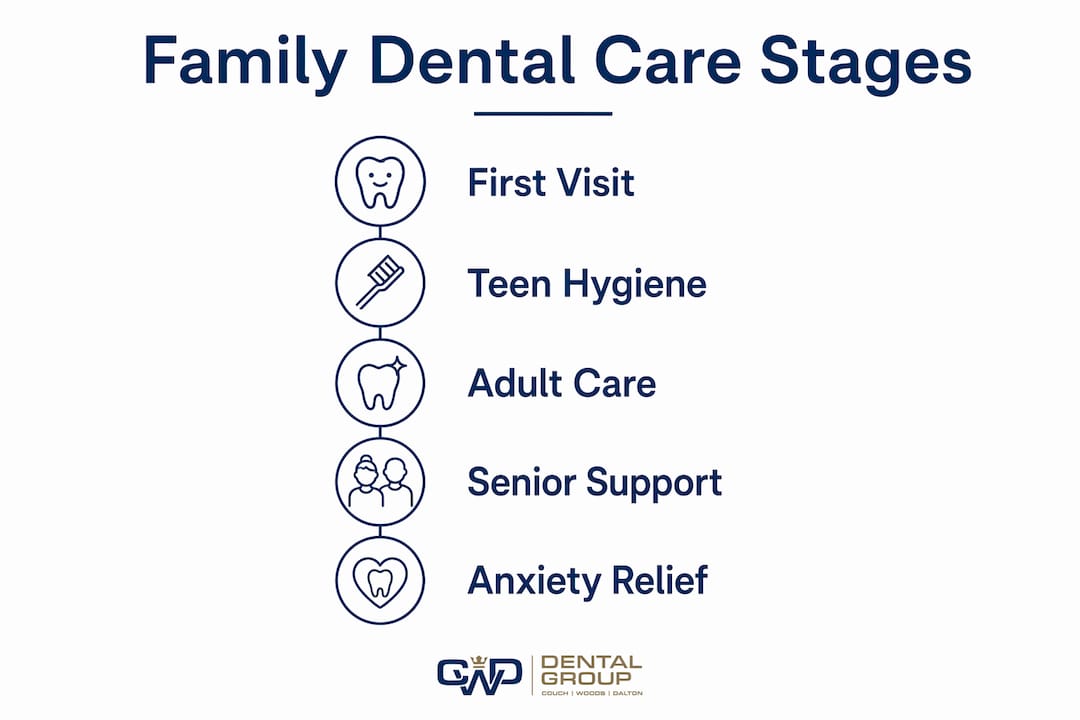
Dentists don't use a one-size-fits-all approach. How dentists treat all ages comes down to reading each patient's developmental stage, health history, and emotional needs, then building a care plan around those specifics. A toddler getting her first exam, a teenager managing braces, an adult dealing with gum disease, and a senior navigating dry mouth all sit in the same chair but need completely different things from the person holding the mirror.
Here's what that looks like across a lifetime of care:
- Infants and toddlers: First visits focus on comfort, early cavity detection, and teaching parents brushing basics
- Children (ages 3–12): Preventive treatments like fluoride varnish and sealants, plus gentle anxiety management
- Teenagers: Orthodontic monitoring, wisdom tooth tracking, and mouthguard fittings for athletes
- Adults: Biannual exams, restorative work, cosmetic options, and gum disease management
- Seniors: Denture care, dry mouth solutions, and more frequent screenings for oral cancer
- Special needs patients: Adapted communication, sedation options, and modified treatment environments
Table of Contents
- 1. How dentists care for young children from the very first visit
- 2. What teenagers need from their dentist beyond basic cleanings
- 3. Adult dental care goes well beyond the twice-a-year cleaning
- 4. How dentists help seniors manage the unique challenges of aging
- 5. Patient-centered care reduces dental anxiety across every age group
- Cwddentalgroup serves every age in your family, all in one place
- Key Takeaways
1. How dentists care for young children from the very first visit
The American Academy of Pediatric Dentistry recommends a child's first dental visit by their first birthday or when the first tooth appears. That timing isn't arbitrary. Early visits let dentists catch developmental issues before they compound, and they start building the kind of trust that determines whether a child grows up comfortable in a dental chair or avoids one for years.
The standard technique for pediatric visits is "tell-show-do": the dentist explains what's about to happen, demonstrates with an instrument, and then proceeds. It sounds simple, but it works because it removes the element of surprise, which is the main driver of fear in young children. A calm, present parent in the room reinforces that effect.
Preventive treatments at this stage carry real weight. Fluoride varnishes prevent a significant portion of cavities in both primary and permanent teeth, and sealants greatly reduce cavities in molars within two years of application. Those aren't minor gains for a child whose diet includes juice and crackers.
- Cavity risk assessment and dietary counseling for parents
- Fluoride varnish application at each checkup
- Sealants applied to permanent molars as they erupt
- Screening for early orthodontic issues like crowding or crossbite
- Modified techniques and extra time for children with sensory sensitivities or disabilities
Pro Tip: Ask your dentist about silver diamine fluoride (SDF) for young children who can't tolerate traditional drilling. It stops cavity progression without any drilling at all and is especially useful for kids with high anxiety or special needs.
2. What teenagers need from their dentist beyond basic cleanings
Adolescence brings a specific cluster of dental challenges that go well beyond keeping teeth clean. Restorative dental procedures increase notably during early adolescence, which means the early teen years are when dentists are busiest addressing the consequences of childhood diet and hygiene habits. That's also when orthodontic treatment typically begins in earnest.
Wisdom teeth are another defining issue of this decade. Most third molars start developing between ages 15 and 18, and dentists use panoramic X-rays to monitor their trajectory. Impacted wisdom teeth that press against neighboring molars can cause crowding, infection, and pain, so early monitoring allows for planned extraction rather than emergency intervention.
- Orthodontic screening and referral for braces, clear aligners, or retainers
- Panoramic X-rays to track wisdom tooth development
- Custom mouthguards for athletes playing contact sports
- Nutritional guidance around sugary sports drinks and acidic foods
- Braces-specific hygiene coaching to prevent white spot lesions around brackets
- Emotional sensitivity around appearance, since teens often care deeply about how their smile looks during treatment
Dentists also watch for early signs of gum disease during these years. Hormonal changes in adolescence make gum tissue more reactive to plaque, which means a teenager with decent hygiene can still develop gingivitis. Catching it early prevents the progression to more serious periodontal disease in adulthood.
3. Adult dental care goes well beyond the twice-a-year cleaning
Most adults operate on the standard six-month checkup schedule, but that's not universal. Patients with periodontal disease, active orthodontic treatment, or dry mouth benefit from evaluations every three months to stay ahead of faster-moving problems. Dentists calibrate visit frequency to individual risk, not a blanket calendar rule.
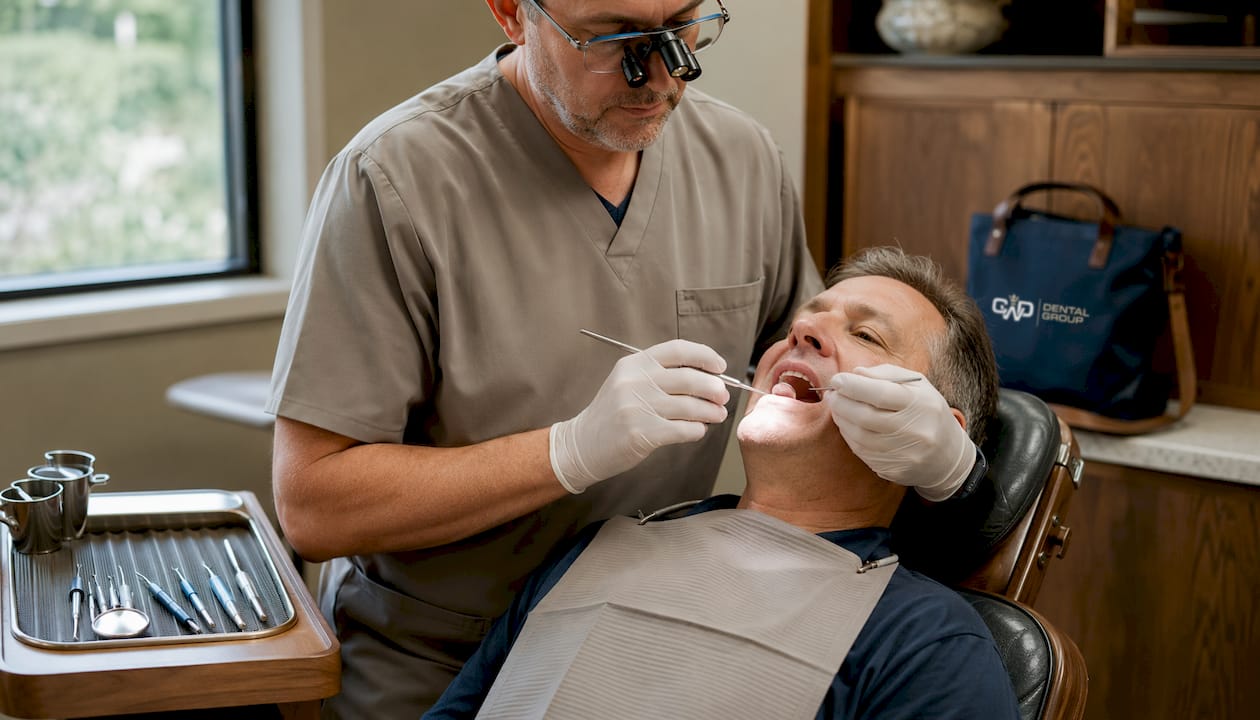
Restorative work dominates adult dental care. Fillings address new decay; crowns protect teeth weakened by large fillings or cracks; root canals save teeth with infected pulp; implants replace missing teeth with a permanent, bone-anchored solution. The shift in modern dentistry has been toward noninvasive techniques that stop disease progression and promote remineralization before a drill becomes necessary, which means adults who stay current on checkups often avoid the more involved procedures entirely.
Cosmetic dentistry is also a significant part of adult care. Whitening, porcelain veneers, and tooth bonding address discoloration and chips. For patients interested in cosmetic and general dental treatments, modern minimally invasive options mean better aesthetics with less removal of healthy tooth structure than older techniques required.
- Biannual exams with personalized frequency for higher-risk patients
- Periodontal maintenance including scaling and root planing for gum disease
- Restorative services: fillings, crowns, bridges, root canals, implants
- Cosmetic options: whitening, veneers, bonding, smile makeovers
- Oral cancer screenings at every routine exam
- Same-day emergency appointments for acute pain, broken teeth, or lost restorations
Gum disease management deserves particular attention. Untreated periodontitis doesn't just threaten teeth; research has linked it to cardiovascular disease and diabetes complications. Adult dental care increasingly treats the mouth as part of overall systemic health, not an isolated system.
4. How dentists help seniors manage the unique challenges of aging
Oral health changes significantly after 65. Medications for common conditions like hypertension, depression, and diabetes frequently cause dry mouth, which strips away saliva's natural cavity-fighting protection. Seniors on multiple medications can develop rampant decay in a matter of months if their dentist isn't monitoring for it. Prescription-strength fluoride toothpaste and saliva substitutes are standard tools in this situation.

Tooth loss and denture care are central to senior dental visits. Full or partial dentures require regular adjustments as the jaw bone remodels over time, and ill-fitting dentures cause sores, difficulty eating, and nutritional problems. Implant-supported dentures have become a preferred solution for patients who are candidates, offering stability that traditional dentures can't match.
Oral cancer screening becomes more urgent with age. The CDC data on dental utilization shows that older adults visit dentists less frequently than younger adults, which is precisely when consistent screening matters most. Dentists performing thorough soft tissue exams at every visit can catch suspicious lesions early, when treatment outcomes are significantly better.
Seniors also benefit from family dental services that allow a single practice to manage care across generations, reducing the coordination burden on adult children managing appointments for aging parents.
5. Patient-centered care reduces dental anxiety across every age group
73% of Americans report dental fear, with sensory management and sedation options making care accessible for all age groups. The triggers are rarely pain itself. Sounds, smells, and the loss of control in the chair outrank actual discomfort as anxiety drivers, which means the clinical environment matters as much as the clinical technique.
Modern practices address this directly. Creating a non-clinical atmosphere through softer lighting, quieter equipment, and scent management reduces sensory overload before treatment even begins. Computer-controlled anesthetic delivery systems like the Wand eliminate the anticipatory anxiety of a visible syringe. Quieter electric handpieces replace the high-pitched drill whine that many patients identify as their primary fear trigger.
Communication style is equally important. Dentists who explain each step, offer a stop signal, and adjust their pace to the patient's comfort level consistently see better cooperation and less avoidance behavior. This matters across ages but is especially critical for children and seniors, where fear-driven avoidance leads to delayed care and worse outcomes.
Sedation options extend the reach of dental care to patients who can't manage treatment otherwise. Nitrous oxide suits children and mildly anxious adults. Oral conscious sedation works for moderate anxiety. IV sedation and general anesthesia are available for patients with severe phobia, significant special needs, or complex procedures. A family dental practice that offers multiple sedation tiers can serve patients who would otherwise go without care entirely.
Pro Tip: If dental anxiety is a barrier for you or your child, ask specifically about nitrous oxide before the appointment. Many practices offer it routinely but don't mention it unless asked, and it can make a significant difference for moderate anxiety without the recovery time of deeper sedation.
Nutrition counseling rounds out the patient-centered picture. Dentists across all age groups now routinely address diet: limiting acidic beverages for teens, managing sugar intake for cavity-prone children, and advising seniors on soft-food diets that still protect remaining teeth. The mouth is the entry point for everything a person eats, and dentists who treat it that way catch problems that a purely clinical approach misses.
Cwddentalgroup serves every age in your family, all in one place
Families in Tallahassee dealing with a child's first cavity, a teenager's orthodontic questions, and a parent's crown all in the same week know how much it matters to have one practice that handles all of it without referrals and scheduling chaos.

Cwddentalgroup provides comprehensive dental care for every member of your family, from toddlers to seniors, with same-day emergency appointments that mean you're never left managing a dental crisis over a weekend. The team's patient-centered approach addresses anxiety directly, using clear communication and a warm environment that makes visits manageable for patients who've avoided the dentist for years. Whether you need a child's first exam, a senior's denture adjustment, or an adult's emergency extraction, one call gets your whole family seen by professionals who already know your history.
Book your family's appointments at Cwddentalgroup and get every age group covered under one roof.
Key Takeaways
Dentists who adapt their approach to each life stage deliver better outcomes than those who treat every patient the same way, and the difference shows up in both oral health and patient comfort over time.
| Point | Details |
|---|---|
| Start early with children | First dental visits by age one catch developmental issues and build lifelong comfort with care. |
| Preventive treatments work | Fluoride varnish prevents roughly one-third of cavities; sealants reduce molar cavities by 80% within two years. |
| Adult visit frequency varies | Patients with periodontal disease or dry mouth need checkups every three months, not the standard six. |
| Anxiety is nearly universal | 73% of Americans report dental fear; sensory management and sedation options make care accessible for all. |
| Cwddentalgroup covers every age | Same-day emergency care and age-specific treatment for the whole family, all in one Tallahassee practice. |