

Family dentistry is defined as a dental care model that serves patients of all ages, from infants to seniors, within a single practice that maintains continuous, unified records for every family member. Understanding how family dentistry works matters because it determines how well your household's oral health is coordinated, monitored, and protected over time. Unlike specialty practices that focus on one age group, family dentistry covers preventive cleanings, restorative fillings, cosmetic treatments, and developmental monitoring under one roof. The result is a care model built around your family's history, risk profile, and schedule rather than a one-size-fits-all protocol.
How family dentistry works across different age groups
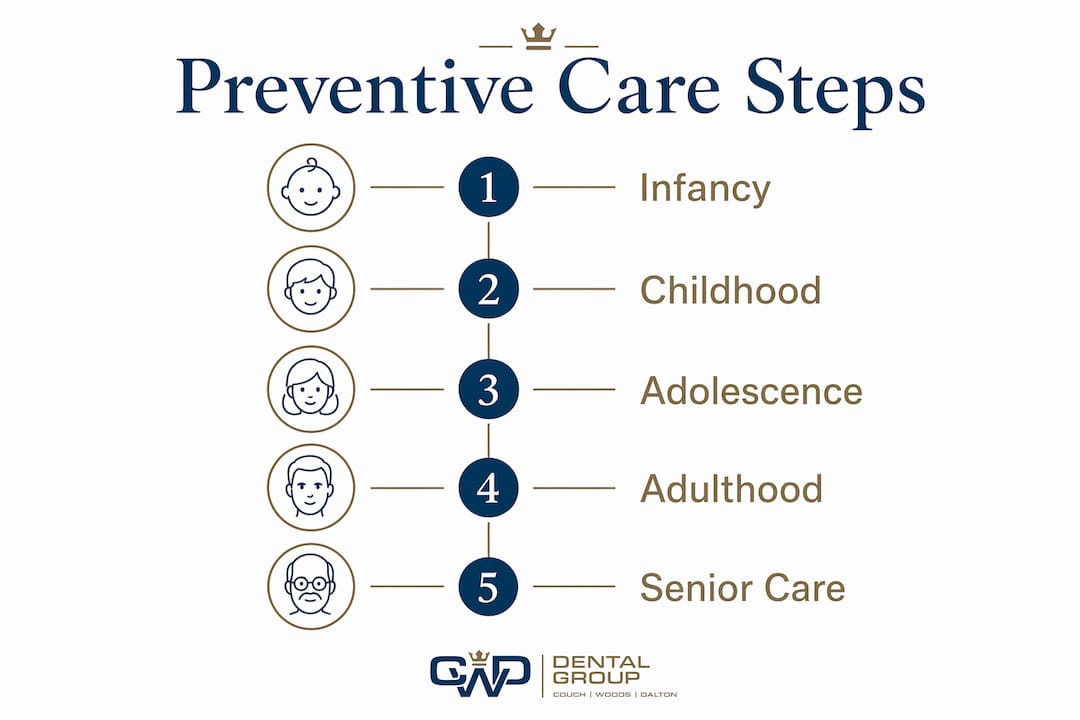
The family dental care process is structured around developmental stages, and each stage demands a different clinical approach. A toddler's first visit looks nothing like a teenager's orthodontic screening or a grandparent's denture check. What ties them together is the same dental team, the same records, and a continuous understanding of how oral health evolves across a lifetime.
Care starting in infancy
The American Academy of Pediatrics recommends a first dental visit by age one or within six months of the first tooth erupting. That early visit is not just symbolic. It establishes a dental home, a consistent clinical relationship where the dentist tracks eruption patterns, assesses cavity risk, and applies fluoride varnish on a schedule calibrated to the child's needs. For most children, fluoride varnish is applied every six months until age five, with high-risk children receiving it every three months. Starting this early reduces the likelihood of invasive treatment later by catching problems when conservative options still work.
Pro Tip: Book your child's first dental appointment before their first birthday, even if only a few teeth have come in. The dentist can spot early signs of nursing bottle decay and give you feeding and brushing guidance that prevents problems before they start.
Adolescent and adult care
For children between ages six and twelve, the IAPD advises regular assessments of developing dentition, including eruption sequences, bite relationships, and early signs of malocclusion. Catching a crossbite or crowding issue at age eight is far less costly to correct than addressing it at sixteen. Pit-and-fissure sealants are applied to permanent molars during this window to block the deep grooves where cavities most commonly form.

Teenagers receive orthodontic assessments, mouthguard fittings for sports, and education on habits like tobacco use or acidic drink consumption. Adults shift toward maintenance: routine cleanings, restorative work like crowns or fillings, and cosmetic options such as whitening or veneers. Seniors face a distinct set of challenges including gum recession, dry mouth from medications, wear-related sensitivity, and denture management. A family dentist who has treated a patient for thirty years understands that history without needing to reconstruct it from scratch.
Key age-specific services in family dentistry include:
- Infants and toddlers: Dental home establishment, fluoride varnish, eruption monitoring, parent education
- Children (6 to 12): Pit-and-fissure sealants, bite assessments, space maintainers if needed, cavity prevention
- Adolescents: Orthodontic screening, sports mouthguards, habit counseling, wisdom tooth monitoring
- Adults: Routine cleanings, restorations, cosmetic treatments, periodontal maintenance
- Seniors: Denture care, dry mouth management, gum disease treatment, implant consultations
How recall scheduling is personalized in family dentistry
One of the most misunderstood aspects of the family dental care process is the recall schedule. Most people assume every family member gets a cleaning every six months. That assumption is wrong, and it matters clinically.
Recall intervals range from 3 to 24 months depending on individual caries risk, periodontal status, and oral hygiene habits. A child with active cavities and poor brushing compliance needs to be seen every three months. A low-risk adult with excellent hygiene and no history of decay may only need an annual visit. The dentist reassesses risk at each appointment and adjusts the interval accordingly. This is not a billing tactic. It is evidence-based clinical management.
Risk stratification in family dentistry typically evaluates:
- Caries history: Number and frequency of past cavities
- Oral hygiene quality: Plaque levels, brushing and flossing consistency
- Diet: Sugar frequency and acidic beverage consumption
- Saliva flow: Reduced flow increases decay risk significantly
- Medical history: Conditions like diabetes or medications that affect oral health
- Fluoride exposure: Whether the patient uses fluoride toothpaste and receives professional applications
Pro Tip: Ask your family dentist to explain the recall interval they have assigned to each family member and why. Understanding the reasoning behind a three-month versus twelve-month schedule helps your family stay compliant and engaged with preventive care.
Family dental practices balance whole-family appointment logistics with clinical customization. Two siblings can attend the same appointment block, but one may receive a fluoride application while the other does not, because their risk profiles differ. The scheduling is coordinated for your convenience. The treatment is individualized for clinical accuracy.
Why family dentistry simplifies your household's oral health
The practical benefits of consolidating dental care for your entire family in one practice go well beyond convenience, though convenience alone is significant for busy households.
-
Unified records across generations. A family dentist who treated a parent for twenty years brings that context to the child's care. Genetic tendencies toward gum disease, enamel defects, or crowding are noted and monitored proactively rather than discovered reactively.
-
Coordinated scheduling. Booking appointments for four family members at the same practice on the same day saves hours compared to managing separate practices with separate portals, separate reminder systems, and separate billing departments.
-
Simplified insurance management. Consolidating under one practice simplifies dental insurance management for multi-member households. One practice knows your plan, your deductibles, and your coverage limits across every family member, reducing billing errors and out-of-pocket surprises.
-
Continuity of trust. Children who grow up seeing the same dental team develop comfort with dental visits that carries into adulthood. That comfort directly reduces dental anxiety, which is one of the primary reasons adults avoid care until problems become severe.
-
Early detection through family history. When a dentist knows that a parent had significant periodontal disease at age forty, they begin monitoring the teenage child's gum health earlier and more closely. That kind of longitudinal awareness is only possible within a continuous care model.
The family dentistry scope and benefits extend to seniors in the household as well. Grandparents who attend the same practice as their grandchildren receive care in an environment already familiar to the family, which reduces the isolation that sometimes accompanies senior dental visits.
What preventive treatments does family dentistry use?
Prevention is the clinical foundation of family dentistry, and the WHO guidelines emphasize prevention first, minimally invasive interventions, shared decision-making, and risk mitigation as the standard for modern dental care. That means preserving tooth structure wherever possible rather than drilling and filling as a default response to early decay.
The most common preventive treatments used across age groups are summarized below:
| Treatment | Age group | Frequency | Purpose |
|---|---|---|---|
| Fluoride varnish | Infants to adults | Every 3 to 6 months based on risk | Remineralizes enamel, slows cavity progression |
| Pit-and-fissure sealants | Children and teens | Once per molar, reapplied if worn | Blocks grooves where decay most commonly starts |
| Silver diamine fluoride | All ages, high risk | As needed | Arrests active cavities without drilling |
| Dental cleanings | All ages | Every 3 to 24 months by risk | Removes plaque and tartar, assesses gum health |
| Orthodontic screening | Children and teens | Annually from age 7 | Identifies bite and spacing issues early |
Silver diamine fluoride deserves specific attention because most families have never heard of it. It is a liquid applied directly to a cavity that stops decay progression without any drilling. The WHO recognizes it as a minimally invasive preventive treatment particularly valuable for young children, anxious patients, and seniors who cannot tolerate extensive procedures. It is not a permanent restoration, but it buys time and preserves tooth structure while a more definitive plan is developed.
Shared decision-making is built into the prevention-first dental care model. Your dentist explains the risk level, presents the options, and involves you in choosing the approach. That transparency builds the kind of trust that keeps families returning consistently rather than only when something hurts.
Pro Tip: When your child's permanent molars erupt, ask specifically about sealants at that appointment. The window for maximum effectiveness is narrow, and many parents miss it simply because no one raised the topic.
Key takeaways
Family dentistry works because it integrates continuous, risk-based, personalized care for every age group within a single practice, making prevention more effective and logistics far simpler for families.
| Point | Details |
|---|---|
| All-ages care under one roof | Family dentistry covers infants through seniors with services tailored to each developmental stage. |
| Recall intervals are individualized | Checkup frequency ranges from 3 to 24 months based on each person's caries and periodontal risk. |
| Prevention drives treatment decisions | Fluoride varnish, sealants, and silver diamine fluoride preserve tooth structure before drilling becomes necessary. |
| Unified records improve outcomes | Shared family history helps dentists detect genetic risk patterns and intervene earlier. |
| Scheduling and billing are consolidated | One practice manages insurance, appointments, and records for every family member, reducing administrative burden. |
Why I think most families underestimate what a good family dentist actually does
After years of writing about dental care and speaking with practitioners across the country, the gap between what families expect from a family dentist and what a skilled one actually delivers is striking. Most people think of a family dentist as a convenient generalist. The reality is closer to a longitudinal health partner.
The risk-based recall model is the clearest example. When a dentist moves a patient from a six-month to a three-month schedule, that decision is based on clinical data, not habit. Most patients push back because they assume the dentist is padding the schedule. They are not. A three-month recall for a high-risk patient is the difference between catching a lesion at the white-spot stage and treating a full cavity six months later.
What I find most compelling about the family dentistry model is the generational continuity. A dentist who treated a mother through her twenties and thirties brings genuine clinical context to her child's first appointment. That is not something you can replicate by switching practices every few years for a better deal on a new patient exam.
The families who get the most out of this model are the ones who treat their dental appointments the way they treat pediatrician visits: consistent, scheduled, and taken seriously even when nothing hurts. Oral health does not announce problems early. The dental check-ups at every age are how you find the problems before they find you.
If you are choosing a family dentist, prioritize the practice that explains your recall interval and the reasoning behind it. That transparency tells you everything about how they approach care.
— Kayle
Experience family dentistry built around your whole household

Cwddentalgroup provides family dentistry services in Tallahassee for patients of every age, from a toddler's first visit to a senior's ongoing periodontal care. The practice uses a patient-centered approach that combines personalized risk assessment, preventive treatments, and coordinated scheduling to make dental care genuinely manageable for busy families. Same-day emergency appointments are available for urgent situations, so your family is never left waiting when something goes wrong. Whether you need a routine cleaning, a sealant application for your child, or immediate attention for a dental emergency, Cwddentalgroup's team is ready to help. Contact Cwddentalgroup to schedule your family's appointments or visit the emergency dentist page for same-day urgent care in Tallahassee.
FAQ
What is family dentistry?
Family dentistry is a dental practice model that provides continuous care for all ages under one roof, covering preventive, restorative, and cosmetic services while maintaining unified records for every family member.
How does family dentistry work for young children?
The family dental care process for children starts with a dental home by age one, where the dentist applies fluoride varnish, monitors eruption patterns, and sets a recall schedule based on the child's individual cavity risk.
How often should family members visit the dentist?
Recall intervals in family dentistry range from 3 to 24 months based on individual risk factors including caries history, oral hygiene, diet, and medical conditions. The standard six-month schedule applies only to average-risk patients.
What preventive treatments does a family dentist provide?
Family dentists use fluoride varnish, pit-and-fissure sealants, and silver diamine fluoride as core minimally invasive preventive treatments, selected based on each patient's age and risk level to preserve tooth structure.
How do I choose a family dentist for my household?
Choose a practice that explains individualized recall intervals, offers care for all age groups including infants and seniors, accepts your insurance, and provides dental care for infants as a standard service rather than a referral.