

Family dental records are comprehensive documents that chronicle the oral health history of every member of your household across generations, giving dentists the clinical context they need to deliver better care. Understanding why family dental records matter is the first step toward protecting your children from preventable conditions. The American Dental Association recognizes family dental history as a core component of complete oral health assessment. When you walk into a dental office with a full picture of your family's oral health past, your dentist can spot patterns, predict risks, and act before problems become expensive or painful.
Why family dental records matter for detecting genetic risks
Genetics shapes oral health far more than most parents realize. Inherited traits affect tooth enamel strength, saliva production, and cavity risk, independent of how well a child brushes or flosses. That means a child who develops cavities despite excellent hygiene may simply be expressing a genetic predisposition passed down from a parent or grandparent.
Periodontal disease follows the same pattern. About 30% of the population carries significant genetic risk for gum disease, according to ADA 2026 data. That figure means roughly one in three families has a member who will develop serious gum problems regardless of brushing frequency.
Family dental records make these patterns visible. When a dentist can see that a parent lost teeth early or that a grandparent had repeated gum infections, they can place a child on a more aggressive preventive schedule before symptoms appear. Tracking family patterns across generations allows timely referrals and personalized treatment plans that generic care simply cannot provide.
- Enamel hypoplasia: Thin or underdeveloped enamel runs in families and raises cavity risk significantly.
- Gum disease susceptibility: A parent with chronic periodontitis signals elevated risk for every child in the household.
- Jaw structure and crowding: Inherited jaw size affects whether children will need orthodontic intervention.
- Dry mouth tendency: Low saliva production, which accelerates decay, has a strong hereditary component.
Pro Tip: Ask your dentist to note any hereditary conditions in your family record at every visit, not just at the initial intake. Conditions like gum disease often progress silently, and a documented family pattern gives your dentist a reason to screen more frequently.
How consistent records improve continuity of care
A unified family dental record prevents the gaps that lead to missed diagnoses and repeated procedures. Switching dental providers frequently forces a restart of family dental history, which risks misdiagnoses and unnecessary repeat X-rays. Every time a family changes dentists without transferring records, the new provider starts blind.

Consistent records also support coordination with specialists. When an orthodontist, periodontist, or oral surgeon can access a complete history, they avoid ordering duplicate imaging and can make faster, more accurate decisions. That efficiency protects both your family's health and your wallet.
The contrast between reactive and proactive care is stark. Families with complete records get ahead of problems. Families without them tend to show up only when something hurts.
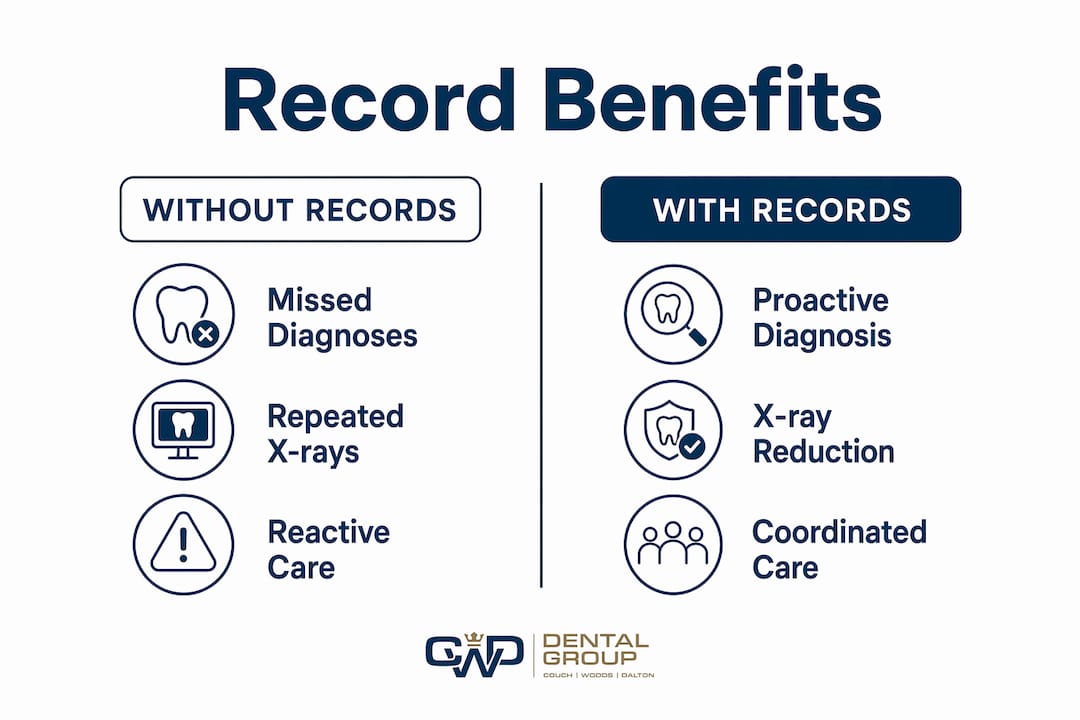
| Care factor | Without consistent records | With consistent records |
|---|---|---|
| X-ray duplication | Common, adds cost and radiation | Avoided through shared imaging history |
| Emergency response | Delayed by missing history | Faster, informed treatment |
| Specialist coordination | Fragmented, requires re-testing | Smooth, with full clinical context |
| Preventive scheduling | Reactive, based on symptoms | Proactive, based on documented risk |
| Treatment cost over time | Higher due to late intervention | Lower through early prevention |
Unified records enable proactive care and help families avoid the costly reactive treatments that follow missed early warnings. A dental home that holds complete records for every family member also makes appointment coordination simpler, since the office already understands each person's baseline. Learning about the benefits of a family dentist for every age group shows how one consistent provider builds a clinical picture that no single-visit office can replicate.
Pro Tip: When you move or change dentists, request a printed or digital summary of every family member's records before your last appointment. Do not wait until you need emergency care to discover the records were never transferred.
Practical ways to maintain family dental health records
Parents carry the most responsibility for keeping family dental histories organized and accessible. The good news is that the process does not require medical training. It requires consistency and a few simple habits.
- Collect a baseline family history. Ask older relatives about their dental experiences, including early tooth loss, gum disease, braces, implants, and dentures. Write it down. This one conversation can give your dentist years of clinical context.
- Keep a treatment summary for each family member. A one-page document listing major procedures, X-ray dates, and known conditions is enough. A one-page treatment summary reduces information gaps and improves care continuity when visiting a new provider.
- Ask your dental office about record retention policies. Most practices retain records for a minimum period set by state law, but policies vary. Confirm how long your records are kept and how you can request copies.
- Use digital storage for backups. Electronic health record systems improve security, accessibility, and sharing of dental records through password protection and regular backups. A secure cloud folder or encrypted USB drive works well for personal copies.
- Notify your dentist about life changes. Moving, adding a new family member, or taking on caregiving responsibilities for an elderly parent all affect dental care needs. Update your family record at each transition.
- Coordinate insurance and scheduling together. Coordinated family records enable strategic scheduling of costly treatments to make the most of insurance benefits across the family. Timing crowns, orthodontic work, and major procedures within the same plan year can save hundreds of dollars.
Thinking about family-centered care as a whole-household approach, rather than a series of individual appointments, changes how you manage every health record, not just dental ones. Your preventative dental visit checklist is a practical starting point for building this habit at home.
How dental records support emergency and forensic identification
Dental records serve a purpose that goes far beyond routine care. In emergencies, a complete record can determine whether a patient receives the right treatment in the first critical minutes. In forensic situations, dental records can confirm identity when no other method is fast enough.
- Emergency care speed: When a child arrives at an emergency dental office after an accident, a complete record tells the provider which teeth are natural, which have restorations, and whether any conditions like bleeding disorders or allergies affect treatment.
- Specialist handoffs: An oral surgeon receiving a patient mid-treatment needs the full restorative history to avoid damaging existing work.
- Forensic identification: Comprehensive ante-mortem dental records are the foundation of rapid forensic identification, relying on up-to-date radiographs and treatment history for accurate matching.
- Speed advantage over DNA: Up-to-date dental records are superior in speed and reliability to DNA testing for forensic identification. DNA analysis takes days; dental comparison can take hours.
"Forensic odontology depends entirely on the quality and completeness of ante-mortem dental records. A single missing X-ray or undocumented restoration can delay identification significantly. The families who maintain thorough records provide investigators with the clearest possible picture."
Keeping detailed radiographs and a complete list of restorations is not morbid preparation. It is the same practical thinking that drives parents to keep copies of birth certificates and medical records. The dental record is part of your family's complete identity documentation.
Key Takeaways
Family dental records protect every generation by making genetic risks visible, enabling proactive care, and providing critical information in emergencies.
| Point | Details |
|---|---|
| Genetics drives oral health risk | About 30% of people carry genetic risk for gum disease, making family history a clinical necessity. |
| Consistent records prevent gaps | Switching providers without transferring records leads to repeat X-rays and missed diagnoses. |
| One-page summaries work | A simple treatment summary for each family member improves care at every new or emergency visit. |
| Records support emergencies | Complete dental records speed up emergency treatment and enable forensic identification faster than DNA. |
| Coordination saves money | Scheduling major treatments together across family members maximizes insurance benefits each year. |
Records reveal what hygiene alone cannot
I have spent years watching families arrive at dental offices convinced that their children's recurring cavities are a hygiene failure. The parents feel guilty. The kids feel blamed. And the real cause, a genetic predisposition to weak enamel or low saliva production, goes unaddressed for years.
The most useful shift I have seen is when a parent brings in even a rough family dental history. Suddenly the dentist has a framework. The child's cavities are not a mystery or a moral failing. They are a predictable outcome of an inherited trait that can be managed with fluoride varnish, sealants, and more frequent cleanings.
Families consistently underestimate how much genetics shapes oral health and overestimate how much brushing alone can compensate. A child who brushes twice a day but carries a family history of early tooth loss needs a different care plan than a child with no such history. Records make that distinction possible.
My honest recommendation is to treat your family dental history the way you treat your family medical history. Bring it to every new provider. Update it after major events. Ask your dentist to document findings that future providers will need. The families who do this spend less time in the dental chair dealing with problems that could have been caught years earlier.
— Kayle
Cwddentalgroup keeps your family's full dental picture
Cwddentalgroup serves families across Tallahassee with a patient-centered approach built around complete, accessible records and same-day emergency appointments. Every visit builds on the last, so your dentist always has the full clinical context needed to catch problems early and plan care around your family's specific history.
Whether you need a comprehensive family checkup, want to establish a dental home with thorough record-keeping, or face an urgent situation, Cwddentalgroup is ready. The practice offers same-day emergency dental care for families who cannot afford to wait. Schedule your family's visit today and give your dentist the complete picture your family deserves.
FAQ
Why do family dental records matter for children?
Family dental records reveal inherited risks like weak enamel and gum disease susceptibility, allowing dentists to create preventive care plans before problems develop. Children with a documented family history receive more targeted care than those treated without that context.
How long should dental records be kept?
State laws vary, but most dental practices retain records for a minimum of seven to ten years for adults and until a minor reaches adulthood plus several years. Parents should request personal copies and store them securely as a backup.
Can dental records really help in an emergency?
Complete dental records speed up emergency treatment by giving providers immediate access to a patient's restorations, allergies, and conditions. In forensic situations, up-to-date radiographs enable identification faster than DNA testing.
What should a family dental history include?
A useful family dental history covers early tooth loss, gum disease, orthodontic treatment, implants, dentures, and any known conditions like enamel hypoplasia or dry mouth. Even a rough summary from older relatives gives your dentist meaningful clinical context.
How does a dental home improve record continuity?
A dental home is a single practice that holds complete records for every family member over time. Staying with one provider prevents the gaps and repeat procedures that occur when families switch offices without transferring their full history.