

A dental home is defined as an ongoing relationship between a dental provider and a patient that delivers comprehensive, coordinated care beginning no later than age one. The American Academy of Pediatric Dentistry (AAPD) recommends establishing this relationship by a child's first birthday or within six months of the first tooth appearing. This is not just a single checkup. It is a continuous care model built on prevention, education, and trust. Parents who set up a dental home early give their children a measurable head start on lifelong oral health.
What is a dental home and why does it matter for children?
A dental home is the recognized clinical term for a child's primary, ongoing source of oral health care. Think of it the way you think of a pediatrician. Your child sees the same provider consistently, that provider knows your child's history, and care is proactive rather than reactive.
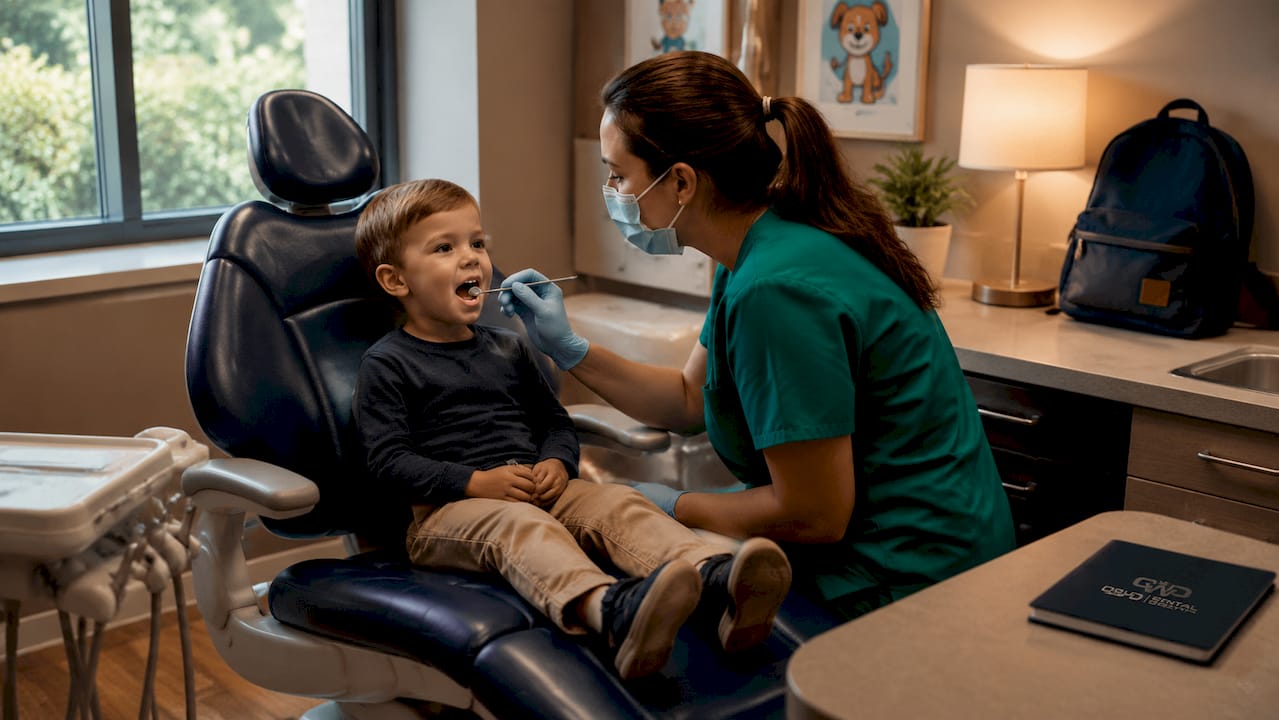
The AAPD dental home model defines this relationship as accessible, continuous, comprehensive, family-centered, coordinated, and compassionate. Each of those words carries weight. "Accessible" means appointments are available when your child needs them. "Continuous" means the same team tracks your child's oral development over years, not just at a single visit.
The dental home concept mirrors the medical home model used in pediatric medicine. Just as a primary care physician manages vaccinations, growth milestones, and referrals, a dental home provider manages eruption timelines, cavity prevention, and orthodontic referrals when needed. This parallel structure is not accidental. It reflects decades of evidence showing that consistent, relationship-based care produces better health outcomes than episodic visits to whoever is available.
What are the key benefits of having a dental home for your child?
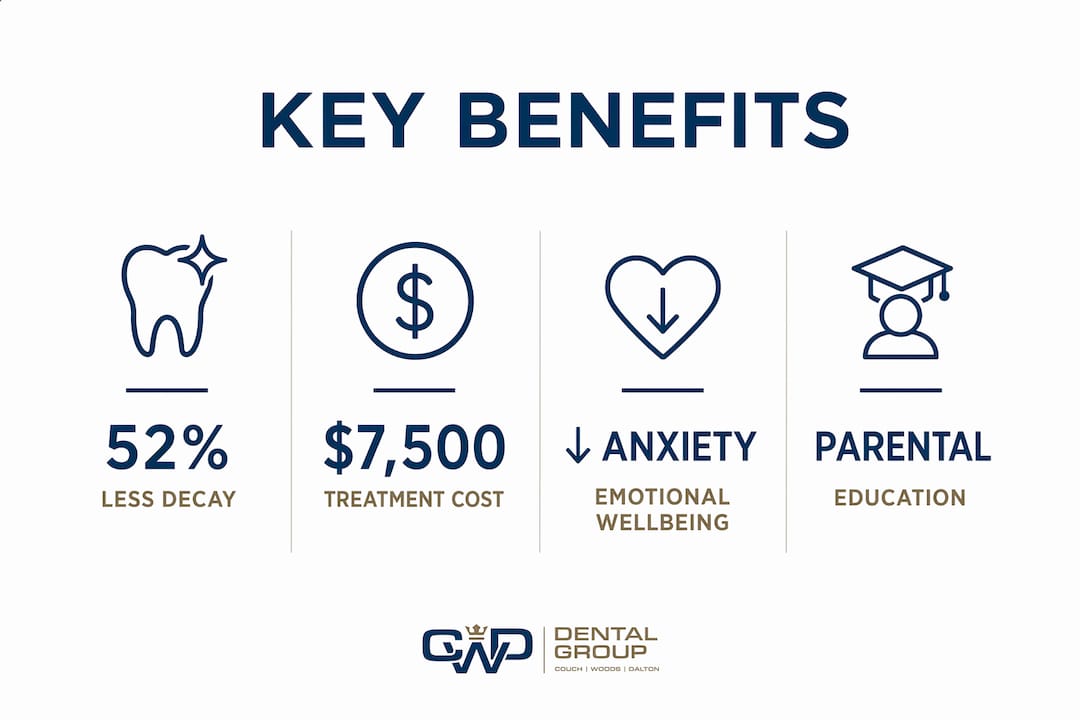
The benefits of a dental home fall into four clear categories: clinical outcomes, cost savings, emotional wellbeing, and parental education.
Clinical outcomes
Children with an established dental home show lower rates of tooth decay than those without one. Studies measure this using the DMF(T) index, which tracks decayed, missing, and filled teeth. Children with dental homes consistently score better. Early Childhood Caries (ECC) is the most common chronic childhood disease, affecting 42% of children ages 2–11. A dental home directly reduces that risk through regular fluoride treatments, sealants, and dietary counseling.
Cost savings
Untreated decay does not stay cheap. Advanced treatment for severe decay can cost between $7,500 and $15,000 per child. Preventive visits cost a fraction of that. Parents who establish a dental home early spend far less over their child's lifetime than those who wait until a problem forces a visit.
Emotional wellbeing
Early dental visits reduce anxiety by making the dental office a familiar, comfortable place. Children who visit the same provider from infancy learn that dental care is normal and safe. Children who only visit a dentist when something hurts associate the experience with pain. That association can last decades and lead to avoidance in adulthood.
Parental education
A dental home provides anticipatory guidance at every visit. This means your child's dentist tells you what to expect before it happens. Teething, thumb-sucking habits, first molars, and dietary changes all get addressed proactively. Parents leave each visit with specific, age-appropriate guidance rather than generic advice.
- Fluoride varnish applied at routine visits reduces cavity risk in toddlers
- Dental sealants protect back molars from decay starting around age 6
- Anticipatory guidance covers nutrition, pacifier use, and brushing technique
- Early detection of tongue-ties or bite issues prevents more complex treatment later
- Consistent records allow the provider to spot developmental patterns over time
Pro Tip: Ask your child's dentist to walk you through a dental care routine for kids at every annual visit. Guidance changes as your child grows, and what worked at age two may need updating at age six.
When and how should parents establish a dental home?
The AAPD is direct on timing: establish a dental home by age one or within six months of the first tooth. Most parents wait until their child has a full set of teeth or until a problem appears. Both approaches are too late. The first visit is not about cleaning a full mouth. It is about establishing a baseline, educating parents, and making the dental office feel safe.
Here is how to get started:
- Schedule the first visit early. Book an appointment as soon as your child's first tooth appears. Do not wait for a full set of teeth or a specific problem. Early visits are short, low-stress, and focused on education.
- Choose a pediatric specialist or a family dentist with pediatric experience. Pediatric dentists complete two to three years of additional training beyond dental school. They know how to work with young children and anxious patients. A pediatric dentistry overview can help you understand what to look for.
- Prepare your child before the visit. Read books about dental visits, play pretend dentist at home, and use positive language. Never use dental visits as a threat or punishment.
- Ask about the practice's approach to young children. A good dental home uses child-friendly language, explains each step before doing it, and lets children set the pace when possible.
- Confirm the practice accepts your insurance or offers payment options. Financial barriers are the most common reason families delay care. Confirm coverage before the first visit so cost does not become a reason to postpone.
Pro Tip: For infant dental care, start cleaning your baby's gums with a soft cloth before the first tooth even appears. This builds comfort with oral care from the very beginning.
How does the dental home model promote ongoing preventive care?
The dental home model is built on continuity. A single provider or practice team manages your child's complete oral health record over years. That continuity produces outcomes that episodic care simply cannot match.
Consistent providers manage longitudinal records that track eruption patterns, past treatments, and growth changes. When a new issue appears, the provider has context. A walk-in clinic seeing your child for the first time does not. This difference matters most for children with special needs, congenital conditions, or complex dental histories.
The dental home also coordinates referrals. When a child needs an orthodontist, oral surgeon, or speech therapist, the dental home provider manages that referral and stays involved. Care does not fragment across disconnected providers. The dental home remains the central point of contact.
| Care element | Dental home approach | Episodic care approach |
|---|---|---|
| Record keeping | Longitudinal, updated at every visit | Limited to single visit |
| Preventive services | Scheduled and tracked over time | Provided only when requested |
| Referral coordination | Managed by primary dental provider | Patient arranges independently |
| Emergency response | Provider knows patient history | No prior relationship |
| Parental education | Ongoing, age-specific guidance | Generic or absent |
- Dental homes reduce unplanned emergency visits by catching problems early
- Providers track orthodontic development and refer at the right time
- Sports mouthguards, night guards, and other appliances are fitted with full knowledge of the child's bite history
- Children with special health care needs benefit most from the continuity a dental home provides
What should parents consider when choosing a dental home?
Choosing the right dental home means evaluating several factors beyond location. The right fit for your child depends on clinical expertise, environment, and practical logistics.
Provider experience and specialization
A pediatric dentist holds a specialty license and has specific training in child behavior, development, and anxiety management. A general or family dentist with significant pediatric experience can also serve as a dental home provider. Ask directly how many pediatric patients the practice sees and what their approach is for anxious children. The benefits of a family dentist include the ability to treat your entire household under one roof, which simplifies scheduling and builds a long-term relationship.
Clinic environment
Children respond to their surroundings. A practice with a child-friendly waiting area, colorful decor, and staff trained to communicate with young patients creates a very different experience than a standard adult dental office. Visit the practice before your child's first appointment if possible. Trust your instincts about whether the environment feels welcoming.
Insurance and affordability
Access to a dental home varies significantly by insurance status. Adults with insurance are far more likely to have a dental home than those without coverage. The same pattern applies to families. Community health centers and Federally Qualified Health Centers (FQHCs) offer sliding-scale fees for families without insurance. Private practices, dental service organizations (DSOs), and community clinics each serve different needs and income levels. Confirm what your plan covers before committing to a practice.
Office hours and accessibility
A dental home only works if you can actually get there. Confirm that the practice offers hours that fit your schedule, including early morning or evening appointments. Ask about same-day availability for urgent issues. A dental home that cannot see your child when a problem arises forces you back to episodic, disconnected care.
Pro Tip: Review your child's dental care tips with your dental home provider at least once a year. Routines that work for a toddler need to evolve as your child grows.
Key takeaways
A dental home established by age one is the single most effective step parents can take to prevent costly, painful dental problems in childhood.
| Point | Details |
|---|---|
| Start by age one | The AAPD recommends a dental home no later than the first birthday or six months after the first tooth. |
| Prevention saves money | Advanced decay treatment can cost $7,500 to $15,000 per child. Preventive visits cost far less. |
| Continuity reduces anxiety | Children who visit the same provider consistently develop comfort and trust with dental care. |
| Anticipatory guidance matters | A dental home educates parents before problems arise, covering nutrition, hygiene, and development milestones. |
| Access varies by coverage | Families without insurance can access dental homes through community health centers and FQHCs. |
Why I think most parents wait too long
Parents consistently underestimate how early dental care shapes a child's relationship with their own health. I have seen it repeatedly. A child who visits the dentist at age one treats it as normal. A child who first visits at age five because of a toothache treats it as a threat. That emotional imprint is hard to undo.
The clinical argument for early establishment is airtight. The emotional argument is just as strong. Children who grow up with a dental home do not dread appointments. They ask questions, they cooperate, and they carry those habits into adulthood. Children who only see a dentist in crisis mode learn that dental care equals pain and fear.
The other thing parents miss is the education component. Your child's dental home provider is one of the best resources you have for age-specific oral health guidance. They will tell you when to stop the pacifier, how to handle thumb-sucking, when to expect the first molars, and what foods are quietly destroying enamel. That guidance is only available if you show up consistently.
Do not wait for a problem. The whole point of a dental home is that you never need to.
— Kayle
Cwddentalgroup: a dental home for Tallahassee families
Cwddentalgroup serves families across Tallahassee with patient-centered care built around the dental home model. Whether you are scheduling your child's first visit or need same-day emergency care, the team at Cwddentalgroup is equipped to handle it without long wait times.

Cwddentalgroup offers comprehensive dental services in Tallahassee including preventive cleanings, pediatric care, and urgent appointments. The practice is known for its warm staff and commitment to making every patient, especially young ones, feel comfortable from the very first visit. Contact Cwddentalgroup to establish your child's dental home and start building the foundation for a lifetime of healthy teeth.
FAQ
What is the dental home definition according to the AAPD?
The AAPD defines a dental home as an ongoing relationship providing comprehensive, accessible, and coordinated oral health care for children, established no later than age one or within six months of the first tooth.
What are the main benefits of a dental home for children?
A dental home prevents Early Childhood Caries, reduces dental anxiety, provides anticipatory guidance for parents, and catches developmental issues early before they require costly treatment.
How do I choose a dental home for my child?
Look for a provider with pediatric experience, a child-friendly environment, insurance compatibility, and accessible office hours. Pediatric dentists hold specialty training specifically for treating children.
When should I take my child to their first dental visit?
The AAPD recommends the first dental visit by age one or within six months of the first tooth appearing, whichever comes first.
What happens at a child's first dental home visit?
The first visit typically includes a gentle oral exam, a fluoride application, and a conversation with parents about hygiene routines, diet, and what to expect as the child's teeth develop.