
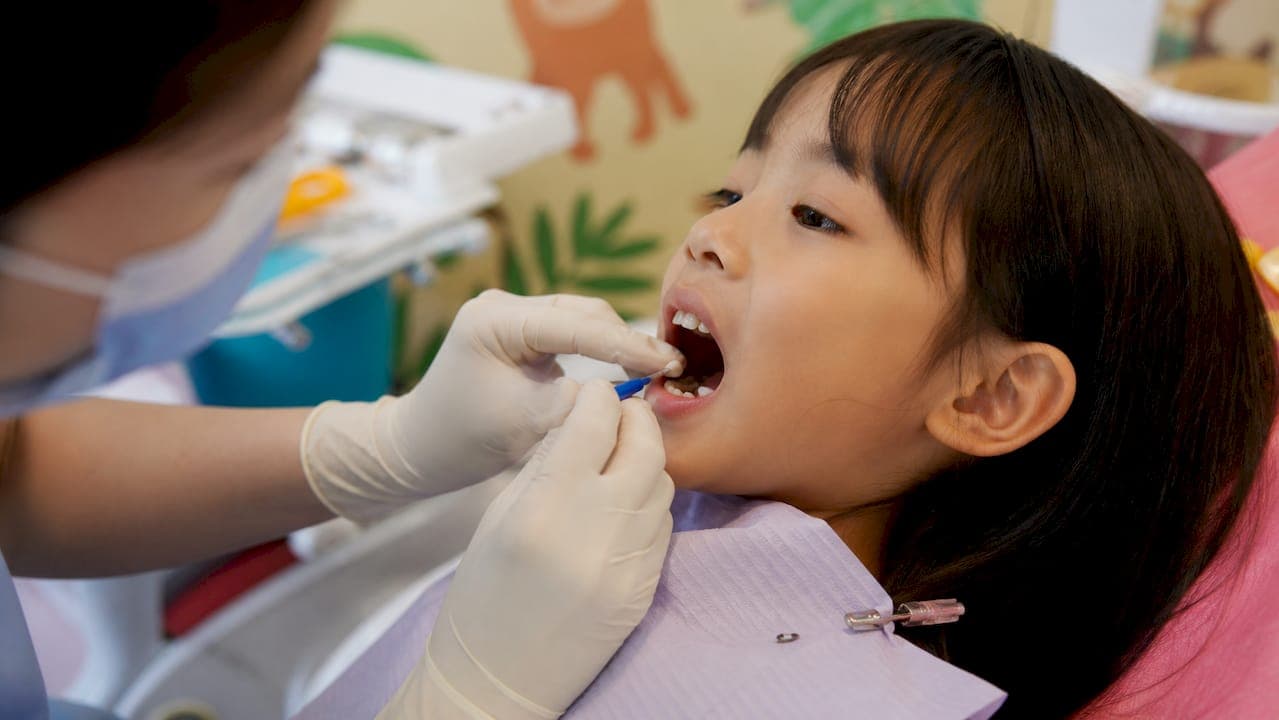
Silver diamine fluoride (SDF) is a quick, noninvasive office treatment that often stops cavities from progressing without drills, shots, or sedation. The trade-off is real: it permanently darkens the decay it treats, turning the spot black or dark brown. For many young children and special-needs patients who can't tolerate a traditional filling, that trade-off is worth it, but your dentist still needs to see the tooth again to decide whether it eventually needs a restoration.
TL;DR:
- SDF effectively halts decay in 65% to 81% of primary teeth cases, outperforming fluoride varnish for already cavitated lesions.
- The treatment permanently darkens the decay, creating a black stain that signals the decay has stopped, especially relevant for front teeth.
- Follow-up restorations, such as fillings or crowns, may still be necessary if the hardened tissue becomes brittle or the tooth's structural support is compromised.
- SDF is most beneficial for young children, special-needs patients, or those in limited-access settings, where traditional restorations are impractical or difficult.
Table of Contents
- What Is Silver Diamine Fluoride and How Does It Work?
- What Happens During an SDF Appointment?
- Does SDF Actually Work? What the Research Shows
- Is Silver Diamine Fluoride Safe? Understanding the Staining Trade-Off
- Who Benefits Most From SDF Treatment?
- When Does SDF Need to Be Followed by a Filling or Crown?
- What Should You Ask Before Agreeing to SDF Treatment?
- Publisher Perspective: How CWD Dental Group Uses SDF in Family Care
- Ready to Discuss SDF for Your Family? Here's How to Get Started
- Sources
What Is Silver Diamine Fluoride and How Does It Work?
Silver diamine fluoride is a liquid medicine, most commonly formulated at a 38% concentration, that dentists paint directly onto a cavity. It combines silver, ammonia, and fluoride into a clear or slightly tinted solution, and each ingredient does a different job once it touches the tooth.
Silver acts as an antimicrobial agent. It kills the bacteria driving the decay process and disrupts the enzymes those bacteria use to break down tooth structure. Fluoride, meanwhile, promotes remineralization, helping rebuild some of the mineral content the decay has stripped away. The solution's high alkalinity also plays a role, creating an environment that's inhospitable to the acid-producing bacteria responsible for cavities in the first place. Together, these mechanisms don't just slow decay. In many cases, they stop it cold, a process dentists call "caries arrest."
Here's what's happening at the tooth level when SDF goes to work:
- Silver ions bind to the softened, decayed dentin and to bacterial proteins, interrupting the microbial activity that keeps a cavity growing.
- Silver compounds precipitate within the tooth structure, physically hardening what was soft, porous decay.
- Fluoride ions integrate into the remaining tooth mineral, making it more resistant to future acid attack.
- The combined effect can halt the disease process without removing any tooth structure with a drill.
On the regulatory side, the picture is a little more nuanced than most parents expect. The FDA cleared SDF as a Class II medical device specifically for treating tooth sensitivity, not for arresting cavities. Using it to stop decay is technically an off-label application. That sounds concerning until you realize off-label doesn't mean unproven or unsupported. Major clinical guidelines from organizations like the American Dental Association explicitly recommend SDF for arresting cavitated lesions in specific situations, and the practice is backed by a substantial body of clinical trial evidence. Off-label, in this case, simply reflects how slowly FDA labeling catches up to accumulated clinical research, not a gap in the science itself.
One more detail worth knowing: SDF is not a do-it-yourself product. It is applied only by dental professionals in clinical settings using techniques designed to keep the solution off soft tissue and skin. That professional application is part of what makes it both effective and safe when used correctly.
What Happens During an SDF Appointment?
An SDF appointment is short, usually just a few minutes for the actual application, and it requires no anesthesia, no numbing shots, and no drilling. That alone makes it a realistic option for toddlers, kids with dental anxiety, and patients with special needs who struggle to sit through longer procedures.
Here's what a typical visit looks like, step by step:
- The dentist or hygienist isolates and dries the tooth. Cotton rolls or a similar barrier keep the area dry and protect nearby gum tissue and cheek from contact with the solution.
- SDF is applied with a microbrush. A small, disposable brush carries the liquid directly onto the decayed surface, and only the decayed surface, since accidental contact with healthy enamel or soft tissue can leave temporary marks.
- Excess solution is blotted away. The clinician removes any pooling liquid to limit contact with surrounding areas.
- The tooth is left to air-dry for roughly a minute. No rinsing is needed immediately, though the dentist may recommend a brief waiting period.
- Fluoride varnish may be applied afterward. Some clinicians combine SDF with a follow-up fluoride varnish and, in that case, advise waiting about 30 minutes before eating or drinking, according to guidance from Healthychildren.
Kids can typically eat and drink again almost right away if SDF is used alone, which is a real advantage over procedures that require hours of numbness before a child can safely chew.
A few sensations are common and completely normal. Many patients notice a metallic taste right after application, and it's harmless. If a drop of solution touches the gums, lips, or tongue, you might see a temporary gray or brown stain on that soft tissue. It fades within days, unlike the permanent staining that occurs on the treated tooth itself.

Pro Tip: Bring a change of clothes or a bib for younger kids if you're worried about drips. SDF can leave a dark stain on fabric, and it doesn't wash out. Most offices use a dental dam or cotton isolation specifically to prevent this, but a little extra caution never hurts with a wiggly toddler.
Clinicians are trained to minimize contact with anything other than the target tooth, using isolation techniques and careful brush control. If you're prepping a child for the visit, it helps to explain the process in simple, honest terms beforehand. Resources on explaining dental procedures to kids can make the appointment go more smoothly for everyone.
Does SDF Actually Work? What the Research Shows
Yes, and the numbers are more convincing than many parents assume going in. Systematic reviews and clinical trials examining 38% SDF on primary teeth consistently report high rates of caries arrest, with many trials showing more than 65% of treated cavities stopping their progression.
By the numbers: Meta-analyses and umbrella reviews of clinical trials report caries arrest rates often falling in the 65% to 81% range for primary teeth treated with 38% SDF, particularly when reapplied on a regular schedule.
That range matters because it tells you SDF isn't a coin flip. It's a treatment with a track record strong enough that professional guidelines have built specific protocols around it. Some trials have also found SDF outperforming fluoride varnish alone for arresting already-cavitated lesions in children, which is a meaningful distinction. Varnish works well for preventing decay before it starts or slowing very early lesions, but once a cavity has formed a hole, SDF has more evidence behind it for actually stopping that hole from growing.
Guideline bodies have translated this evidence into concrete reapplication schedules. The ADA's clinical guideline, along with guidance from CareQuest, recommends prioritizing minimally invasive options like 38% SDF for arresting cavitated lesions in specific clinical scenarios, and this guidance specifically notes biannual application, meaning twice a year, for some advanced or high-risk lesions in primary teeth.
Reapplication frequency isn't one-size-fits-all. It depends on risk:
- High-risk lesions or limited access to care often justify biannual reapplication to sustain the arrest and catch any regrowth of decay early.
- Lower-risk lesions, or cases where a child sees the dentist reliably, may be managed with annual reapplication as a baseline.
- Multiple applications generally outperform a single treatment. SDF isn't typically a one-and-done fix; think of it more like an ongoing management strategy until a restoration is placed or the tooth naturally exfoliates.
- Reassessment at each visit matters. A dentist checks whether the lesion remains hard and stable, or whether it has softened again, before deciding on the next step.
There's also a practical dimension to why SDF has become so widely adopted in pediatric and public health dentistry. It's non-aerosol-generating, requires minimal equipment, and costs far less than restorative procedures like fillings or crowns. That combination made it especially valuable for outreach programs and school-based dental care, and it's part of why the World Health Organization added SDF to its list of essential medicines in 2021.
For parents weighing this information, the honest takeaway is that SDF works well as a tool for arresting decay, backed by real trial data rather than anecdote. It isn't magic, and it doesn't guarantee every lesion stays stable forever, but the arrest rates reported across multiple studies are high enough that dental organizations have built it into mainstream treatment recommendations rather than treating it as a fringe option.
Is Silver Diamine Fluoride Safe? Understanding the Staining Trade-Off
SDF has a strong safety profile, but it comes with one visible and permanent cosmetic effect: it turns treated decay black or dark brown. This is the single biggest factor parents weigh before agreeing to treatment, so it deserves a clear explanation.
The staining happens because silver compounds form within the decayed tooth structure as part of the same chemical process that arrests the cavity. It isn't a side effect separate from the treatment working. It's evidence that the treatment worked. Clinicians actually use the dark color as a diagnostic sign, since it indicates the silver compound formation and lesion hardening that mean the decay has stopped progressing. Framing it that way tends to help parents mentally recalibrate: the black spot isn't a failure of the treatment, it's the treatment's signature.
Beyond staining, here's what else parents should know:
- A metallic taste is common immediately after application and disappears on its own within minutes.
- Temporary gray or brown marks on gums, lips, or skin can occur if the solution contacts soft tissue, but these fade within days, unlike the tooth staining, which is permanent.
- Silver allergy is the primary contraindication. It's rare, but a dentist should screen for it before treatment.
- Direct pulp contact can cause tissue damage, which is why accurate diagnosis of the cavity's depth and careful application technique matter before SDF is used.
Clinicians take specific steps to limit unwanted staining and contact. Isolation barriers, precise microbrush technique, and staff training in application protocol all reduce the risk of the solution reaching skin, clothing, or countertops, which is part of why SDF is applied only in a professional dental setting rather than as a take-home product.
Some parents ask about potassium iodide as a way to lighten the resulting stain. It's a legitimate question, and the honest answer is mixed. Potassium iodide can visibly reduce the darkness of a treated lesion in some cases, but the evidence for it is inconsistent, and it does not reliably prevent the permanent staining of already-carious tissue. If minimizing visible staining is a top priority, especially on a front tooth, that's worth discussing candidly with your dentist before treatment, not after.
Pro Tip: If esthetics are a major concern for a visible front tooth, ask your dentist whether a different approach, such as a filling under sedation or a different restorative material, might be more appropriate than SDF for that specific tooth. SDF is a fantastic tool, but it's not the right tool for every location in every mouth.
Who Benefits Most From SDF Treatment?
SDF earns its place in modern pediatric and family dentistry because it solves a specific, common problem: how do you treat a cavity in a patient who can't or won't sit through a traditional filling?
Several groups tend to benefit the most:
- Young, pre-cooperative children who aren't developmentally ready to tolerate the noise, sensation, and duration of a standard restorative procedure.
- Special-needs patients for whom sedation carries added risk, added cost, or added logistical complexity.
- Older adults with root caries, a form of decay that's common with gum recession and that SDF handles particularly well given its simple application.
- Patients in limited-access settings, including school-based dental programs and rural clinics, where SDF's low cost and minimal equipment needs make treatment possible where a full restorative setup isn't.
- Anyone needing a bridge to definitive care, meaning SDF buys time and halts damage until a more involved restoration can be scheduled, which matters when sedation availability, insurance timing, or a child's developmental stage make immediate restorative work impractical.
That last point deserves emphasis. SDF isn't always meant to be the final answer for a tooth. It's frequently the first, most urgent step: stop the disease process now, then plan the cosmetic or structural fix later, on a timeline that works for the family and the child's ability to cooperate.
Esthetics genuinely factor into the decision, particularly for front teeth. A back molar that darkens from SDF is invisible when a child smiles. A front incisor is a different conversation entirely, and this is exactly the kind of scenario where shared decision-making between parent and dentist matters most. Some families accept the staining on a front tooth as a reasonable trade-off for avoiding sedation. Others prefer to explore alternative treatments for visible teeth and reserve SDF for less visible ones. Both are legitimate choices, and a good dentist will walk you through the trade-offs rather than assuming which one you'll prefer.
When Does SDF Need to Be Followed by a Filling or Crown?
SDF arrests decay, but it does not rebuild the tooth structure that decay has already destroyed. That distinction is easy to overlook and important to understand before treatment starts.
Arrested dentin, the hardened, blackened tissue left behind after SDF does its job, is often more brittle than healthy tooth structure. It can also be harder to keep clean, since its rougher surface texture tends to accumulate plaque more readily than smooth enamel. Depending on where the lesion sits, how much structural support the tooth still has, and whether the area interferes with chewing or appearance, your dentist may recommend a filling or crown down the road to restore full function and a smoother, more cleanable surface. The American Dental Association's guidance frames this as an ongoing clinical judgment call rather than an automatic next step.
Here's how to think about the follow-up timeline:
- Some arrested lesions never need a restoration, especially in baby teeth that will naturally fall out before the arrested area becomes a functional problem.
- Others need restorative work eventually, particularly permanent teeth or lesions in high-stress chewing areas where brittle, arrested dentin risks fracturing.
- Regular monitoring visits let your dentist track whether the lesion stays hard and stable or shows signs of reactivation, meaning the decay has started progressing again.
- Watch for red flags between visits: new sensitivity, visible new softening around the treated area, or a fragment of the tooth breaking off all warrant a call to your dentist rather than waiting for the next scheduled checkup.
SDF also fits into a broader prevention plan rather than standing alone. Dentists often pair it with sealants on other at-risk teeth or with routine fluoride varnish, building a layered approach where each tool addresses a different stage or type of risk. Think of SDF as the emergency response for a cavity that's already active. Sealants and varnish are more like the ongoing maintenance plan for teeth that haven't gotten there yet.
What Should You Ask Before Agreeing to SDF Treatment?
Before you sign off on SDF for your child or family member, a short conversation with your dentist can save you from surprises later. Here's a practical checklist to work through together:
- What's the realistic success rate for this specific tooth? Ask how confident the dentist is that SDF will arrest this particular lesion, given its size and location.
- How often will reapplication be needed? Get a specific answer, annual or biannual, so you know what to expect for follow-up visits.
- Will the staining be visible when my child smiles? This is especially relevant for front teeth and helps set expectations before treatment, not after.
- What alternatives exist for this tooth? Ask specifically about fillings or other restorative options, and what sedation or cooperation they would require.
- Will this tooth eventually need a filling or crown anyway? Understanding whether SDF is a permanent solution or a bridge to later restorative work changes how you plan.
- Does my child or family member have a known silver allergy? This should be screened before any application.
Informed consent for SDF should explicitly cover the permanent staining, the plan for follow-up monitoring, and confirmation that allergy screening has taken place. If any of those three items isn't discussed before treatment, ask about it directly.
One more practical note: since SDF's use for caries arrest is technically off-label relative to its FDA clearance, insurance billing sometimes uses the dental procedure code CDT D1354 specifically for this application. Coverage varies by plan, so it's worth confirming with your insurer or the practice's billing staff before your appointment, rather than being surprised by the explanation of benefits afterward.
Publisher Perspective: How CWD Dental Group Uses SDF in Family Care
We treat SDF as one tool among several, not a default answer for every cavity that walks through the door. At CWD Dental Group, that means evaluating each tooth on its own terms: location, severity, the patient's ability to tolerate a traditional restoration, and whether the family has same-day access to follow-up if the lesion needs monitoring or eventual restorative work.
What we've found matters most in practice is the conversation before treatment, not just the treatment itself. Parents accept the staining trade-off far more comfortably when they understand it as a sign the decay has stopped, not a cosmetic accident. We walk through that distinction explicitly, along with a documented plan for what happens next, whether that's a scheduled recheck, a planned filling once the child is older and more cooperative, or simply watching a baby tooth until it naturally exfoliates.
Same-day access matters here in a way that's easy to underestimate. A parent who notices a new cavity or a stained tooth that seems to be changing shouldn't have to wait weeks for reassurance. Being able to get a same-day evaluation means small concerns get addressed before they become urgent ones, and it means the follow-up piece of SDF treatment, the part that's just as important as the application itself, actually happens on schedule rather than falling through the cracks.
If you're weighing SDF for a child, an aging parent, or anyone in the family who struggles with traditional dental visits, an honest, specific conversation with your dentist is worth more than any general guide, including this one.
— Kayle
Ready to Discuss SDF for Your Family? Here's How to Get Started
If your child has a cavity and traditional treatment feels like a fight you'd rather avoid, CWD Dental Group offers same-day evaluations to determine whether silver diamine fluoride is the right fit, without the weeks-long wait that many practices require for a simple assessment.

Our team evaluates each tooth individually, explains the staining trade-off in plain language before any treatment happens, and documents a clear follow-up plan so nothing gets lost between visits. That's the whole point of pairing a noninvasive option like SDF with a practice built around accessibility: your family gets an answer fast, without gambling on whether the necessary follow-up care will actually happen. We also handle the restorative side when a filling or crown becomes the right next step, so you're not bouncing between separate offices for arrest and repair.
If your child has a suspicious spot, a nagging cavity, or you've been putting off a checkup because past visits ended in tears, book an evaluation with our emergency dental team and bring your insurance information so our staff can walk you through coverage, including CDT code specifics, before treatment begins.
Sources
The American Dental Association's SDF resource lays out clinical guidance and FDA regulatory context directly from the profession's leading body. HealthyChildren.org, run by the American Academy of Pediatrics, offers a parent-friendly breakdown of what to expect during treatment. For the underlying trial data, the evidence-based dentistry review in PMC summarizes arrest-rate statistics across multiple studies. The ASTDD fact sheet covers reapplication protocols in detail, and the PMC review on staining addresses the potassium iodide question with appropriate nuance rather than overselling it.
This article is general information, not a substitute for advice from a qualified doctor. Consult a qualified healthcare professional about your own circumstances before acting on anything here.