
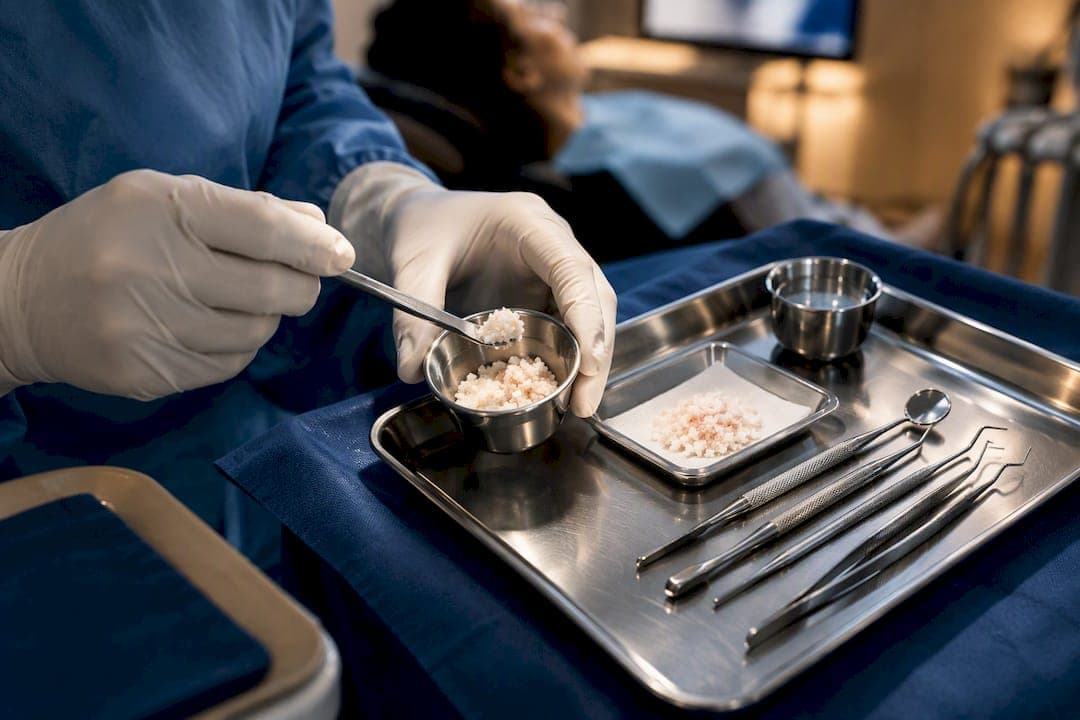
Most people don't need a bone graft for a dental implant, but a meaningful share do, especially after a tooth has been missing for months or years. Bone grafting fills in the jaw where the ridge has thinned, usually before implant placement but sometimes at the same appointment. The American Association of Oral and Maxillofacial Surgeons and Cleveland Clinic both frame it as case-by-case, not routine, and CWD Dental Group evaluates that exact question during your implant consultation.
TL;DR:
- Bone grafting is only necessary when imaging shows a significant bone shortfall or loss, especially in cases of long-term missing teeth, disease, trauma, or long-term denture use.
- Autografts provide predictable stability but require a second surgical site, while allografts, xenografts, and synthetic options perform reliably in routine cases without additional harvesting.
- Healing typically takes between 4 to 9 months, with complications like pain, swelling, or bleeding demanding prompt attention; smoking and poor health can slow recovery.
- Grafting procedures are usually performed under local anesthesia, with staged or immediate implant placement depending on graft size and site condition.
- Costs vary widely based on the graft type and complexity, and insurance coverage is inconsistent, making consultation essential for detailed estimates.
Table of Contents
- When Is a Bone Graft Needed for an Implant?
- What Are the Main Types of Bone Graft Materials?
- What Happens During the Bone Grafting Procedure?
- How Long Does Bone Graft Healing Take Before an Implant?
- What Are the Risks and Aftercare for a Bone Graft?
- How Much Does a Bone Graft for an Implant Cost?
- The CWD Dental Group Approach to Bone Grafting
- Ready to Find Out If You Need a Bone Graft?
- Sources
- FAQ
When Is a Bone Graft Needed for an Implant?
A dentist checks bone volume before recommending anything, and the decision usually comes down to whether the jaw has enough height and width to hold an implant securely for decades, not just months.
Bone loss around a missing tooth site typically comes from one of a few sources:
- A tooth that has been missing for a year or more, since the jawbone shrinks without a root to stimulate it
- Periodontal disease that has already eaten away supporting bone
- Trauma or a difficult extraction that damaged the socket walls
- Long-term denture wear, which accelerates ridge resorption underneath the appliance
To measure how much bone is actually there, dentists rely on a clinical exam plus CBCT imaging, which maps bone height and width in three dimensions rather than the flat picture a standard X-ray gives. AAOMS guidance is clear that grafting is not automatic for every patient. It's most beneficial when imaging shows a genuine shortfall, whether that's a small dehiscence around one implant site, a full ridge that needs augmentation, a sinus that has dropped too low for upper-jaw implants, or a fresh extraction socket that needs preservation before it collapses.
What Are the Main Types of Bone Graft Materials?
Four material categories cover almost every graft a dentist will discuss with you, and each one trades convenience against a slightly different set of risks.
- Autograft — bone taken from your own body, often the chin, jaw, or hip. It heals predictably because it carries living cells, but it means a second surgical site and more soreness.
- Allograft — processed donor bone from a tissue bank. No second surgical site, and modern processing makes disease transmission exceptionally rare.
- Xenograft — treated animal bone, usually bovine. It acts mainly as a scaffold your own bone grows into over time.
- Synthetic substitutes — lab-made calcium compounds. Fully synthetic, widely available, and free of donor-tissue concerns.
Many procedures also use a barrier membrane, a technique called guided bone regeneration (GBR), to keep soft tissue from crowding into the graft space while new bone forms.
Systematic reviews of graft materials find that autogenous bone tends to hold up well in complex augmentations, with strong long-term stability over 3 to 5 years. That said, allografts, xenografts, and synthetics are used constantly and perform reliably in the majority of routine cases.
Pro Tip: Ask which material your surgeon plans to use and why. A straightforward socket graft rarely needs your own bone, but a large ridge defect might.
What Happens During the Bone Grafting Procedure?
The visit itself is more predictable than most patients expect, and the exact sequence depends on which type of defect is being treated.
Before surgery, your dentist reviews your medical history, confirms the CBCT findings, and decides whether the graft material will come from a donor site in your own mouth or from processed tissue. That conversation also settles whether the implant can go in the same day or needs to wait.
- Anesthesia is administered. Most graft procedures use local anesthesia, sometimes paired with oral or IV sedation for anxious patients or longer surgeries.
- The site is accessed and cleaned. For a socket graft after extraction, this happens immediately; for a ridge or sinus procedure, the gum is opened separately.
- Graft material is placed. The surgeon packs the material into the defect, sometimes covering it with a membrane for GBR.
- The site is closed. Sutures hold everything in place while initial healing begins.
- Implant timing is decided. Small socket-preservation grafts sometimes allow an implant to be placed immediately after extraction, while larger ridge or sinus grafts almost always require staged healing before the implant goes in.
How Long Does Bone Graft Healing Take Before an Implant?
The first two weeks are the roughest part, and knowing what's normal versus what's worth a phone call makes that stretch much easier to manage.

Swelling, bruising, and tenderness are expected, with pain typically peaking in the first 1 to 3 days and most discomfort fading within 7 to 14 days.
Underneath that visible recovery, the graft itself moves through several biological stages:
- Clotting and early integration (roughly the first 2 to 6 weeks), when blood supply reestablishes and the graft begins to stabilize
- Regeneration (typically 2 to 6 months), as your own bone cells slowly replace or fuse with the graft material
- Final maturation, when the site becomes dense and strong enough to anchor an implant long-term
Academic centers including Johns Hopkins Medicine describe a typical implant-readiness window of 4 to 9 months, depending on graft size and material. Smoking, poorly controlled diabetes, and inconsistent oral hygiene can all push that timeline later. Your dentist confirms readiness with follow-up imaging rather than a calendar date alone, checking that the graft has hardened enough to support the forces an implant will experience during chewing.
What Are the Risks and Aftercare for a Bone Graft?
Most recoveries are uneventful, but knowing the difference between a normal symptom and a warning sign matters more than any other piece of aftercare advice.
Expect mild bleeding, swelling, and tenderness in the first few days. Some patients also notice small gritty particles near the site, which is usually just normal resorption of certain graft materials and not a cause for alarm on its own.
Call your dentist promptly if you notice:
- Pain that worsens after day 3 instead of improving
- Heavy or persistent bleeding
- Fever, foul taste, or visible discharge at the site
- Symptoms suggesting sinus involvement after an upper-jaw graft
Pro Tip: Stick to soft foods, skip straws for at least a week, and avoid smoking entirely during healing. Nicotine restricts blood flow to the graft site and is one of the most reliable ways to slow, or even stall, integration.
How Much Does a Bone Graft for an Implant Cost?
Cost swings widely depending on graft type, size, and whether sedation or a donor-site harvest is involved. A small socket-preservation graft costs far less than a sinus lift or block graft that requires more material and surgical time. Surgeon fees and restorative fees are often billed separately, and imaging adds its own line item.
Insurance coverage is inconsistent. Some plans cover a portion when grafting is tied to a covered implant or extraction, others treat it case-by-case. Bring these questions to your consultation:
- What specific material will be used, and why?
- What's the realistic timeline to implant placement?
- What are the alternatives, including veteran-specific coverage options if applicable?
- What financing or payment plans are available?
The CWD Dental Group Approach to Bone Grafting
Bone grafting works best when imaging, surgical planning, and restorative follow-up happen under one roof instead of being split across multiple offices and lost paperwork. CWD Dental Group handles the full sequence in-house, from CBCT evaluation through graft placement to the eventual implant, which cuts down on repeat consultations and scheduling gaps between providers.
Same-day emergency appointments matter here too. If a graft site flares up on a weekend or a patient shows up with an urgent extraction that needs immediate attention, that access shortens the wait between diagnosis and treatment. The practice emphasizes evidence-grounded answers to patients based on established AAOMS parameters of care and major medical-center guidance, ensuring consistency before treatment begins.
— Kayle
Ready to Find Out If You Need a Bone Graft?
CWD Dental Group gives you a same-day answer instead of weeks of waiting between an initial exam, a referral, and a follow-up consultation elsewhere. Surgical planning, imaging, and the eventual implant restoration happen with one team, which means fewer handoffs and fewer repeated X-rays.

If you're weighing whether your case needs grafting at all, bring your dental history, a list of current medications, and any prior X-rays or CBCT scans to your evaluation. That gives the team everything needed to map out whether you're a candidate for an immediate implant or a staged approach, and to walk through realistic costs and insurance questions on the spot. Second opinions are always welcome if you've already been told you need a graft elsewhere and want another set of eyes on the imaging.
Ready to get a clear answer? Visit the CWD Dental Group services page to see the full range of surgical and restorative options, or reach out directly to schedule your evaluation.

Sources
This article draws on AAOMS clinical parameters of care for grafting criteria, Cleveland Clinic for healing timelines and side effects, Johns Hopkins Medicine for staged healing windows, and a systematic review of graft materials comparing long-term outcomes.
This article is general information, not a substitute for advice from a qualified doctor. Consult a qualified healthcare professional about your own circumstances before acting on anything here.
- Dental Bone Graft: Process, Purpose & Healing — Cleveland Clinic
- Bone grafting — American Association of Oral and Maxillofacial Surgeons (AAOMS)
- Systematic analysis of bone graft materials for implants — PMC
- Bone grafting — Johns Hopkins Medicine
FAQ
How Painful Are Bone Grafts for Implants?
Discomfort is manageable for most patients, with pain typically peaking in the first 1 to 3 days after surgery. Swelling and tenderness generally fade within 7 to 14 days with standard over-the-counter pain management.
How Much Does Bone Grafting Cost for an Implant?
Cost varies based on graft type, size, and whether sedation or a donor-site harvest is involved, so there's no single fixed number. Current pricing details are available on the dental practice's website or by contacting them directly. Contact the practice directly through the services page for a personalized estimate after your imaging is reviewed.
How Long Do Bone Grafts Last for Dental Implants?
A well-integrated bone graft is meant to be permanent, fusing with your natural bone to support the implant for the long term. Reviews of graft materials show autogenous bone in particular holding stable results over 3 to 5 years and beyond in complex cases.
Is a Bone Graft Necessary for an Implant?
Not always. AAOMS guidance states that grafting is not indicated for every patient and depends on how much bone volume remains after clinical exam and CBCT imaging. Patients with adequate bone width and height can often move straight to implant placement.