

What is the teeth lengthening (crown lengthening) procedure?
Crown lengthening is a surgical procedure that exposes more of your tooth by removing excess gum tissue, and sometimes a small amount of bone, to reveal additional tooth structure. Dentists and periodontists perform it for two broad reasons: to make a tooth accessible for a filling or crown, or to improve the appearance of a smile that shows too much gum. Either way, the goal is the same — create enough exposed tooth surface to work with.
Here is what the procedure involves at a glance:
- Surgical exposure: Gum tissue (and sometimes underlying bone) is removed or repositioned to uncover more of the tooth structure
- Anesthesia: Local anesthesia is standard; sedation is available for patients who need it
- Specialist performed: Usually carried out by a periodontist or oral surgeon, not a general dentist
- Restorative purpose: Creates space for a crown or filling to sit properly without pressing into the gum
- Esthetic purpose: Reduces the appearance of a "gummy smile" by reshaping the gumline
- Biologic width: The procedure respects a critical zone of tissue around the tooth root, known as the biologic width, to protect long-term periodontal health
The informal term "teeth lengthening" describes the visual result — teeth look longer after the gumline is moved. The clinical term is crown lengthening, and that distinction matters when you are talking to your dental team.
Why would you need crown lengthening?
Crown lengthening serves two distinct purposes, and understanding which one applies to you shapes everything about how the procedure is planned.
Functional crown lengthening addresses restorative problems. When a cavity extends below the gumline, a dentist cannot place a filling or crown without first exposing that part of the tooth. The same applies to a tooth that has fractured near or below the gum. Beyond access, there is a structural concern: placing a restoration too close to the bone violates what clinicians call the biologic width, or supracrestal tissue attachment. Violating this zone triggers chronic inflammation and bone loss around the tooth, which undermines the restoration and the surrounding periodontium over time.
Esthetic crown lengthening targets the anterior teeth, typically the upper front six, where excessive gingival display makes teeth look short or the smile look "gummy." The procedure reshapes the gumline to reveal more of the natural tooth crown, creating more balanced proportions. It can also correct an uneven gumline where some teeth appear shorter than others due to irregular gum positioning.
Common indications include:
- Subgingival decay or fractures requiring restorative access
- Restoration margins that impinge on the biologic width
- Short clinical crowns needing more surface area for a secure restoration
- A ferrule effect: the band of tooth structure a crown needs to grip properly
- Excessive gingival display (gummy smile) caused by delayed passive eruption
- Uneven gingival contours affecting smile symmetry
One thing worth knowing: esthetic crown lengthening is not simply trimming gum for cosmetic reasons. It still requires careful planning around the biologic width to avoid creating the very periodontal problems it is meant to sidestep. You can read more about how gum contouring and biologic width interact in surgical planning.
How do you prepare for crown lengthening?
Preparation for crown lengthening is more involved than most patients expect, and that thoroughness is what separates a predictable outcome from a complicated one.
Your periodontist will start with a full periodontal examination, including probing depths at every tooth and a set of dental radiographs. These images reveal the bone level around the tooth and help the clinician measure the existing biologic width. Without that baseline, there is no way to know how much tissue or bone needs to be removed to create adequate space for a restoration while keeping the periodontium intact.
Key preparation steps include:
- Periodontal charting and radiographs: Establish bone levels and tissue dimensions before any surgical planning begins
- Anesthesia consultation: Discuss local anesthesia options and whether IV sedation or oral sedation is appropriate for your comfort level
- Temporary restoration management: If you already have a temporary crown on the tooth, your restorative dentist may need to adjust or remove it before surgery
- Neighboring teeth: The surgeon evaluates adjacent teeth to avoid inadvertently affecting their support structures during the procedure
- Activity restrictions: Plan to avoid strenuous physical activity for the first few days after surgery, so arrange your schedule accordingly
- Medication review: Inform your dental team of any blood thinners, anticoagulants, or supplements that could affect bleeding
Timing matters too. Crown lengthening is often coordinated between a periodontist and a restorative dentist or prosthodontist, because the final crown or filling cannot be placed until the gum tissue has fully healed and stabilized. That coordination needs to happen before the first incision, not after.
What happens during the crown lengthening procedure?
The procedure length varies depending on how many teeth are involved and whether bone removal is needed. Here is what to expect, step by step.

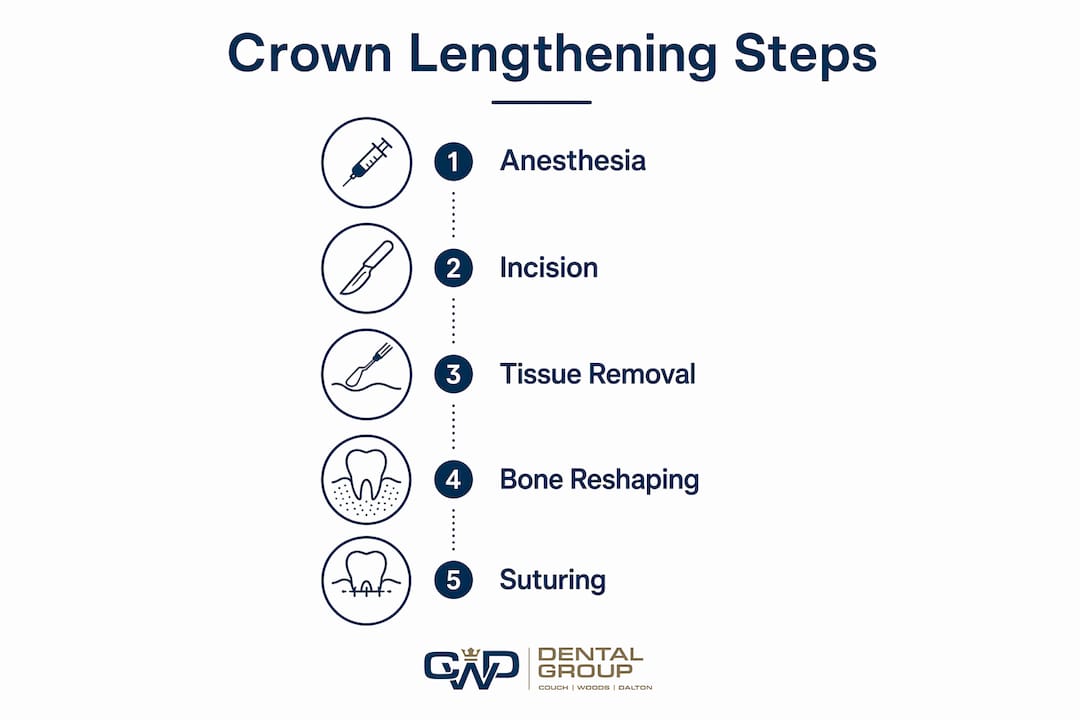
Step 1: Anesthesia. The surgeon injects local anesthetic around the treatment area. Most patients feel pressure during the procedure but no sharp pain. If you opted for sedation, that is administered first.
Step 2: Incisions and flap creation. The surgeon makes precise cuts in the gum tissue around the affected tooth or teeth, then gently peels the gum back to expose the underlying tooth root and bone. This is called raising a flap.
Step 3: Tissue and bone removal. Depending on the technique selected, the surgeon removes excess gum tissue, reshapes the bone, or both. The goal is to expose enough tooth structure while maintaining the correct distance between the new gumline and the bone crest — that distance is the biologic width.
Step 4: Flap repositioning and suturing. The gum flap is repositioned lower on the tooth and sutured closed. A periodontal dressing or protective bandage is sometimes placed over the site to protect it during initial healing.
Step 5: Temporary restoration adjustment. If a temporary crown was in place, it may be adjusted or replaced to fit the new gum position before you leave.
Crown lengthening is not a single technique — it is a family of procedures. The surgeon selects the approach based on your specific anatomy: how much keratinized gingiva you have, how deep the pockets are, and whether bone removal is necessary. Getting the technique right the first time is what determines whether the restoration placed months later actually holds.
Pro Tip: Ask your surgeon before the procedure whether osseous recontouring (bone reshaping) will be needed. Bone removal extends healing time and affects when your final crown can be placed, so knowing this upfront helps you plan your schedule realistically.
The three main surgical approaches are:
- Gingivectomy: Removes excess gum tissue only, used when probing depth is at least 4 mm and there is sufficient keratinized gingiva; no bone work needed
- Apically positioned flap: The gum flap is repositioned lower without removing bone, used when keratinized tissue is limited
- Apically positioned flap with osseous reduction: Combines flap repositioning with bone reshaping to establish proper biologic width; used when bone removal is necessary for adequate tooth exposure
What are the risks and possible complications?
Crown lengthening is a well-established surgical procedure, but like any surgery, it carries risks that patients should understand before consenting.
The most common side effects include pain and discomfort after anesthesia wears off, swelling around the treated area, bleeding at the surgical site, and temporary tooth sensitivity to temperature as the exposed root surface adjusts.
Less common but more serious complications include:
- Infection at the surgical site, particularly if post-operative hygiene instructions are not followed
- Delayed healing in patients who smoke, have uncontrolled diabetes, or take medications that affect tissue repair
- Damage to adjacent teeth or their supporting structures if the surgical approach is not carefully planned
- Gum recession beyond the intended amount, which can affect the appearance of neighboring teeth
The biologic width issue deserves special mention here. If the procedure does not create adequate space between the restoration margin and the bone, chronic low-grade inflammation can develop around the tooth, eventually leading to bone loss. This is not a failure of healing — it is a planning error, and it underscores why technique selection and pre-surgical measurement matter so much.
Pro Tip: Keep a written log of any symptoms after surgery, including pain level, swelling, and any unusual discharge. If something feels wrong at day three or four rather than improving, contact your periodontist the same day rather than waiting for your scheduled follow-up.
What does recovery from crown lengthening look like?
Crown lengthening is an outpatient procedure. You go home the same day, usually within an hour or two of the surgery finishing.

The first 48–72 hours are the most uncomfortable. Postoperative pain and swelling are normal and manageable with over-the-counter medications as directed by your surgeon. Icing the face can help reduce swelling in the first day.
Typical recovery involves resting and avoiding strenuous activity during initial days, followed by suture removal about a week after surgery. Gum tissue continues healing over the following weeks, with gradual stabilization of the tissue and bone remodeling over a longer period. Final crown or filling placement is delayed to allow tissues to settle fully.
Post-procedure care tips that genuinely affect outcomes:
- Rinse gently with warm salt water starting the day after surgery
- Avoid smoking entirely during healing — it restricts blood flow and significantly slows tissue repair
- Use a soft-bristled toothbrush and avoid brushing directly over the sutures until they are removed
- Attend every scheduled follow-up, even if you feel fine, because early detection of complications changes outcomes
The waiting period before final restoration placement frustrates some patients, but it exists for a good reason. Gum tissue that looks healed at six weeks may still be shifting. Placing a permanent crown too early risks a poor fit once the tissue fully stabilizes.
What can you expect after crown lengthening heals?
The long-term outlook after crown lengthening is generally very good, provided the procedure was well planned and the recovery instructions were followed.
On the restorative side, the primary benefit is a secure, properly fitting crown or filling. When the restoration margin sits in the right position relative to the bone and gum, the risk of chronic inflammation around that tooth drops considerably. Patients who had subgingival decay or a fractured tooth often find that crown lengthening was the step that made saving the tooth possible at all. For more on how dental crowns work and when they are needed, that context helps frame why adequate tooth exposure matters so much.
On the esthetic side, patients who had the procedure for a gummy smile typically see a meaningful improvement in smile proportions. The teeth look longer, the gumline looks more even, and the overall balance of the smile changes noticeably. Some patients combine crown lengthening with veneers or other cosmetic dental procedures to maximize the result.
Long-term considerations:
- Periodontal maintenance: Regular cleanings every three to four months for the first year help monitor tissue health around the treated teeth
- Follow-up radiographs: Bone levels should be checked at intervals to confirm stability
- Restoration longevity: A crown placed after proper crown lengthening, with adequate biologic width preserved, tends to perform better over time than one placed without it
- Sensitivity: Some patients experience lasting sensitivity at the treated teeth, though this typically diminishes over months as the exposed root surface adapts
How does surgical crown lengthening differ from nonsurgical options?
The term "nonsurgical crown lengthening" refers to orthodontic forced eruption, a technique that moves a tooth upward through the bone using braces or a similar appliance, effectively bringing more of the tooth above the gumline without cutting tissue. It is used primarily when a fracture or decay extends deep below the bone level and surgical access alone would require removing so much bone that neighboring teeth would be compromised.
Forced eruption takes considerably longer than surgery, often several months of active orthodontic movement followed by a stabilization period. It also requires coordination with an orthodontist in addition to the periodontist and restorative dentist. The payoff is that it avoids the bone removal that surgical crown lengthening requires in difficult cases, which can preserve the support structures of adjacent teeth.
Surgical crown lengthening, by contrast, produces results in a single appointment. The gumline is repositioned immediately, and while healing takes months, the structural change happens on the day of surgery. For most patients, especially those with functional needs or esthetic goals that do not involve deep subgingival fractures, surgery is the faster and more predictable path.
A few practical distinctions:
| Factor | Surgical crown lengthening | Orthodontic forced eruption |
|---|---|---|
| Timeline to structural change | Single appointment | Several months of tooth movement |
| Bone removal | Sometimes required | Avoided in most cases |
| Best suited for | Esthetic goals, moderate restorative needs | Deep fractures, preserving adjacent bone |
| Recovery | Weeks to months for tissue healing | Ongoing during orthodontic treatment |
| Coordination required | Periodontist and restorative dentist | Orthodontist, periodontist, restorative dentist |
The choice between the two is not a patient preference decision — it is a clinical one, driven by how deep the problem extends, how much keratinized tissue is available, and what the impact on neighboring teeth would be. Your periodontist will assess these factors and recommend the approach that gives the restoration the best foundation.
Ready to explore crown lengthening in Tallahassee?

Cwddentalgroup offers a full range of dental services in Tallahassee, including cosmetic and restorative procedures for patients who need more than a routine cleaning. If you have been told you need crown lengthening before a crown can be placed, or if a gummy smile has been bothering you for years, the team at Cwddentalgroup can walk you through your options clearly and without pressure. Same-day emergency appointments are available for urgent dental concerns. Book your visit and get a straight answer about what your teeth actually need.
Key Takeaways
Crown lengthening is a surgical procedure that exposes more tooth structure by repositioning gum tissue and sometimes reshaping bone, making it possible to place secure restorations and improve smile aesthetics.
| Point | Details |
|---|---|
| Core purpose | Crown lengthening exposes tooth structure for restorations or esthetic improvement by removing gum tissue and sometimes bone. |
| Biologic width is central | Preserving the supracrestal tissue attachment zone prevents chronic inflammation and bone loss around treated teeth. |
| Three main techniques | Gingivectomy, apically positioned flap, and apically positioned flap with osseous reduction are selected based on clinical findings. |
| Sutures removed after about a week | Initial healing is quick, but final restoration placement is delayed several months for full tissue stabilization. |
| Surgical vs. nonsurgical | Orthodontic forced eruption avoids bone removal for deep fractures; surgery is faster for most esthetic and moderate restorative cases. |