
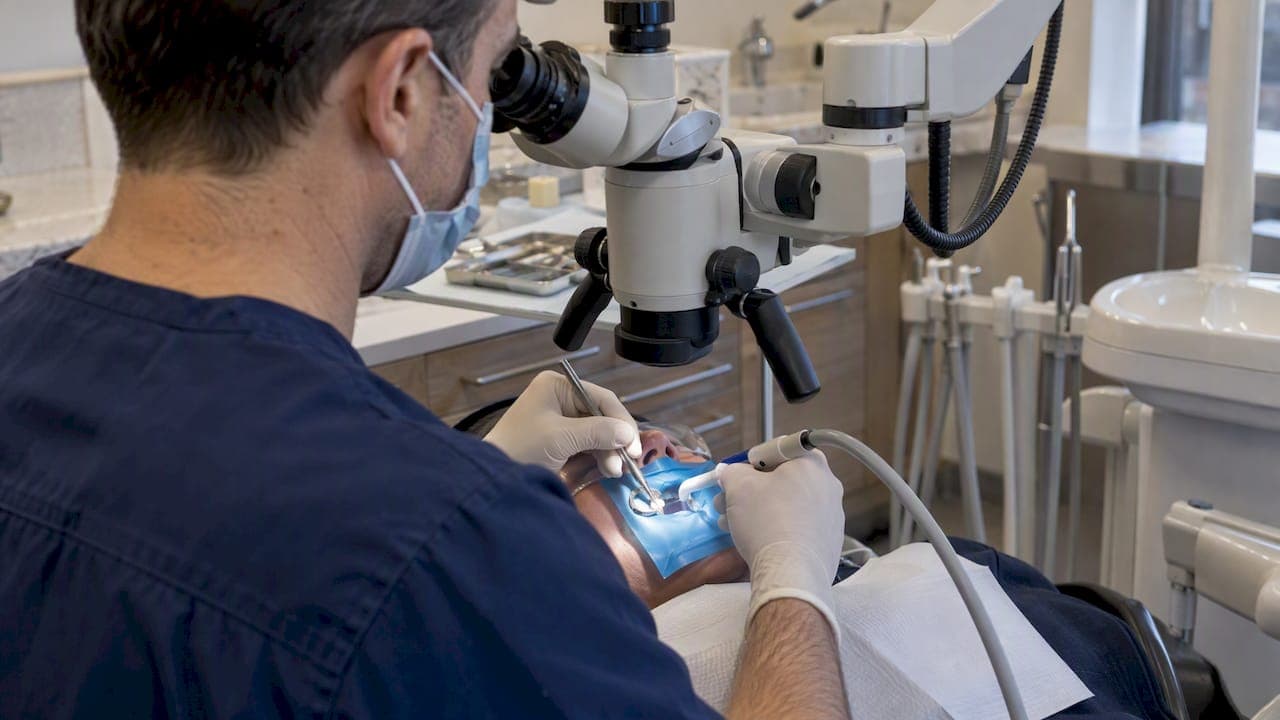
Root canal retreatment reopens a previously treated tooth, clears out infection or missed anatomy, and reseals the canal system so you can often keep your natural tooth rather than lose it. Modern nonsurgical retreatment succeeds in roughly 78% to 87% of cases, depending on how strictly success is measured. If a treated tooth is causing pain or shows signs of infection on an X-ray, the next step is a prompt evaluation with your dentist or an endodontist.
TL;DR:
- Success rates for nonsurgical retreatment range from 78% to 87%, but success can drop to around 36% when evaluated with CBCT scans using strict criteria.
- The main causes of retreatment failure include surviving microbes, microbes beyond the root tip, foreign material reactions, and true cysts resistant to non-surgical approaches.
- Retreatment involves removing old materials, locating missed anatomy with microscopes, disinfecting the canals, and sealing them again, often requiring one or two visits.
- Risks include instrument breakage, perforations, or inability to access problematic anatomy, with some cases requiring surgery or extraction instead.
- Costs are generally higher than initial root canals, with insurance coverage varying and pre-authorization recommended to avoid surprises.
Table of Contents
- What root canal retreatment is and why teeth need it
- Who is a candidate for retreatment versus surgery or extraction
- Step-by-step: what happens during nonsurgical root canal retreatment
- Success rates and prognosis: what the evidence actually shows
- Risks, complications, and limits of retreatment
- Pain, recovery, and the typical timeline after retreatment
- Cost and insurance: why retreatment usually costs more
- Questions to ask before committing to retreatment
- A patient-centered view on deciding whether to retreat
- How we handle endodontic care at CWD Dental Group
- FAQ
- Sources
What root canal retreatment is and why teeth need it
A root canal can fail years after the original procedure, and the reasons usually fall into four categories. AAE patient guidance describes retreatment as reopening the tooth, removing the old filling material, locating anatomy that was missed the first time, cleaning and refilling the canal system, and restoring the tooth. The goal is to remove whatever is keeping the tooth inflamed or infected.
Dentists generally group the underlying causes into:
- Intracanal microbes that survived the original cleaning or recolonized through a leaky seal.
- Extraradicular microbes that have moved beyond the root tip into surrounding tissue.
- Foreign-body reactions to material that extruded past the root during the first procedure.
- True cysts, which are fluid-filled lesions that may not resolve with retreatment alone.
Once a tooth develops post-treatment disease, there are really three paths forward: nonsurgical retreatment, surgical treatment such as an apicoectomy, or extraction. Retreatment addresses the problem through the existing access point in the crown. An apicoectomy instead approaches the root tip from outside the tooth, through the gum. Extraction removes the tooth entirely and opens the door to an implant or bridge. Dentists generally favor preserving the natural tooth when it is restorable, since no replacement fully matches the function and feel of your own tooth.
Who is a candidate for retreatment versus surgery or extraction
Retreatment tends to make sense when the problem is something a second attempt through the crown can fix: a missed canal, a root filling that falls short of the root tip, or a leaky temporary or permanent restoration letting bacteria back in. A tooth that is still structurally sound and can support a new restoration afterward is usually a good candidate.
Surgery may be the better first move in certain situations, particularly when the lesion's biology does not respond well to simple recleaning, when canal anatomy is too calcified or curved to access predictably, or when disassembling a crown and post would risk destroying a restoration that is otherwise functioning well. AAE's specialty guidance notes that retreatment is not always required before surgery, and that microsurgery can be an appropriate first option in selected cases. In fact, retreatment performed right before an apicoectomy can sometimes lower the surgery's success by introducing dentinal defects.
Extraction becomes the recommended path when the tooth has a vertical root fracture, insufficient remaining structure to hold a restoration, or when a patient's overall health or finances make repeated procedures impractical.

Step-by-step: what happens during nonsurgical root canal retreatment
Retreatment follows a more involved sequence than a first-time root canal, mostly because existing materials have to come out before any new work can begin.
- Evaluation and imaging. Your dentist takes periapical radiographs and, when the picture is unclear or surgery is being weighed, a CBCT scan for a three-dimensional view of the root and surrounding bone.
- Disassembly. If the tooth has a crown, post, or core, these are carefully removed or worked around to reach the canal system.
- Removing old filling material. The existing root canal filling is taken out using solvents, hand instruments, or rotary tools.
- Locating missed anatomy. A dental operating microscope and ultrasonic instruments help find extra canals or blockages that were missed originally.
- Cleaning and disinfecting. The canals are irrigated and shaped; if infection is significant, a medicated dressing may be placed and the tooth sealed temporarily until a follow-up visit.
- Obturation. Once the canal system is clean, it is refilled and sealed.
- Temporary seal and scheduling the permanent restoration.
Retreatment can sometimes be completed in one visit, but infected or complex cases often need two.
Pro Tip: Ask whether your case is likely to need one visit or two before the appointment starts, so you can plan your schedule accordingly.
The final step matters as much as the canal work itself. A high-quality crown or filling placed promptly afterward protects the tooth from recontamination and fracture, and delaying it is one of the more avoidable reasons retreatment fails.
Success rates and prognosis: what the evidence actually shows
Nonsurgical retreatment succeeds in an estimated 78% (strict criteria) to 87% (loose criteria) of cases. That range reflects how researchers define success, not just differences in technique. "Strict" criteria require complete radiographic healing with no remaining signs of a lesion, while "loose" criteria count teeth that are symptom-free and functional even if some healing is still in progress.
Imaging method changes the picture further. A CBCT-based meta-analysis found that when strict healing criteria are applied to CBCT scans rather than standard two-dimensional X-rays, success rates can drop sharply, in some analyses to around 36%, compared to roughly 87% under loose criteria. CBCT simply detects smaller lesions that a flat radiograph can miss, so a tooth that looks "healed" on a standard X-ray may show a persistent lesion on CBCT. This is why success figures vary so much between studies and why your dentist's estimate for your specific tooth matters more than any single published number.

The strongest predictors of a good outcome are a small or absent lesion before treatment, a root filling that reaches an adequate length, a well-sealed coronal restoration, and, consistently across reviews, operator experience and access to microscopes and ultrasonic instruments. Tooth type plays a role too: molars with complex canal systems are generally harder to retreat successfully than single-rooted front teeth.
Risks, complications, and limits of retreatment
Retreatment carries more procedural risk than a first-time root canal because it involves undoing someone else's prior work. During the procedure, a dentist may encounter a post that is difficult to remove without weakening the tooth, accidentally create a perforation while searching for a missed canal, break an instrument inside the canal, or simply be unable to locate problematic anatomy. AAE's clinical overview notes that post and core removal is one of the higher-risk steps, since ultrasonic instruments generate heat that must be carefully controlled to avoid damaging the surrounding periodontal tissue.
After treatment, the main risks are infection that persists despite cleaning, a root that fractures under the stress of a weakened tooth structure, or a case that ultimately needs surgery or extraction anyway. Microscopes, ultrasonics, and better irrigation protocols have reduced these risks compared to older techniques, but they have not eliminated them. When a tooth's restoration or anatomy makes safe disassembly unlikely, a dentist may recommend moving straight to surgical treatment rather than risking further damage through retreatment first.
Pain, recovery, and the typical timeline after retreatment
Retreatment is performed under local anesthesia, so you should not feel pain during the procedure itself. Afterward, mild to moderate soreness around the tooth and gum is common, typically peaking in the first day or two and fading over the following week. Over-the-counter pain relievers are usually enough; guidance on managing endodontic pain covers what to expect in more detail.
Your dentist will likely schedule a follow-up exam and a radiograph at several months, then again at a year or longer, since full radiographic healing can take months to a couple of years to show up clearly. Call your dentist promptly if you develop fever, facial swelling, or signs that an infection is spreading rather than resolving.
Cost and insurance: why retreatment usually costs more
Retreatment almost always costs more than the original root canal did. Removing an existing crown, post, or filling material takes extra chair time and specialized tools, the procedure is more technically demanding, and it is often performed by an endodontist rather than a general dentist. Imaging, including CBCT when it is indicated, adds to the bill as well. A detailed look at root canal costs and insurance breaks down what drives these numbers further.
Insurance coverage for retreatment varies by plan. Many policies cover only a portion of the cost, and some limit how often a given tooth can be treated under the same benefit or apply a separate "alternate benefit" clause that pays toward extraction instead if that is the lower-cost option. Before committing to treatment, ask your dental office for an itemized estimate, confirm your plan's frequency limits and annual maximum, and ask whether preauthorization from your insurer makes sense before scheduling.
Questions to ask before committing to retreatment
A good consultation should leave you with a clear picture of your options, not a vague recommendation. Bring these questions with you:
- Ask to see the imaging that supports the diagnosis, including whether a CBCT scan is recommended for your case.
- Ask for a realistic success estimate specific to your tooth, not a generic number.
- Ask what the alternatives are, including surgery or extraction, and the tradeoffs of each.
- Ask who will place the final restoration and when, since a delayed crown raises the risk of reinfection.
- Ask how many visits to expect and what happens if complications come up mid-treatment.
Be cautious if a provider cannot show you imaging, gives an oddly confident success percentage without caveats, or avoids discussing what happens after the canal work is done. A guide to choosing an endodontic provider covers additional questions worth asking a specialist.
A patient-centered view on deciding whether to retreat
The hardest part of retreatment is not the procedure itself, it is the uncertainty patients are asked to sit with while success rates swing from 36% to 87% depending on which study and which imaging method you read about. That range is not a contradiction; it is a reminder that a published statistic describes a population, not your tooth. A dentist who looks at your specific radiograph, your restoration, and your symptoms can give you a far more useful number than any systematic review can.
What tends to get underestimated is how much the final restoration matters. Patients often focus entirely on the canal work and treat the crown as an afterthought, when a delayed or poorly sealed restoration is one of the more preventable reasons retreatment fails. If you remember one thing from this process, make it that the work is not finished when the canal is sealed.
— Kayle
How we handle endodontic care at CWD Dental Group
We treat retreatment the way we treat every endodontic case: with a full evaluation first, same-day emergency scheduling when a tooth is actively causing pain, and restorative follow-up coordinated in-house. If a tooth you had treated years ago is acting up, we would rather see you quickly and get imaging in hand than have you wait and risk a harder case later.

We offer root canal therapy, retreatment evaluations, and restorative crowns under one roof, which keeps your treatment plan and your records in one place from diagnosis through the final restoration. If you book an evaluation with us:
- Bring any prior X-rays or treatment records from the original root canal if you have them.
- Bring your list of questions, including the ones in the checklist above.
- Let us know if you are in pain now, since we offer same-day emergency appointments for exactly this situation.
You can see our full range of dental services, including emergency care and restorative work, or reach out directly to get an evaluation scheduled.
This article is general information, not a substitute for advice from a qualified doctor. Consult a qualified healthcare professional about your own circumstances before acting on anything here.
FAQ
Is it worth retreating a root canal?
For a tooth that is still restorable, retreatment is often worth attempting because it can save the natural tooth with success rates in the 78% to 87% range under common success criteria. Whether it is worth it for your specific tooth depends on its structural condition, the cause of the original failure, and whether surgery or extraction might offer a more predictable outcome instead.
How painful is root canal retreatment?
The procedure itself is done under local anesthesia, so you should not feel pain while it is happening. Afterward, most patients experience mild to moderate soreness that peaks in the first day or two and improves over the following week, similar to recovery from the original root canal.
How many times can you retreat a root canal?
There is no fixed limit on how many times a tooth can be retreated, but each attempt removes more tooth structure and makes the procedure more technically demanding and less predictable. At some point, a dentist may recommend surgery or extraction instead of another round of nonsurgical retreatment, especially if structural risk outweighs the expected benefit.
Will insurance cover retreatment of a root canal?
Many dental insurance plans cover a portion of retreatment costs, but coverage often comes with frequency limits or an alternate benefit clause that pays toward extraction instead. Check your specific plan's limits and consider asking your dental office to request preauthorization before scheduling, since coverage details vary significantly by plan.
Sources
- Outcome of Contemporary Nonsurgical Endodontic Retreatment: A Systematic Review
- CBCT-Assessed Outcomes and Prognostic Factors of Primary Endodontic Treatment and Retreatment: A Systematic Review and Meta-Analysis
- Endodontic retreatment explained — American Association of Endodontists