
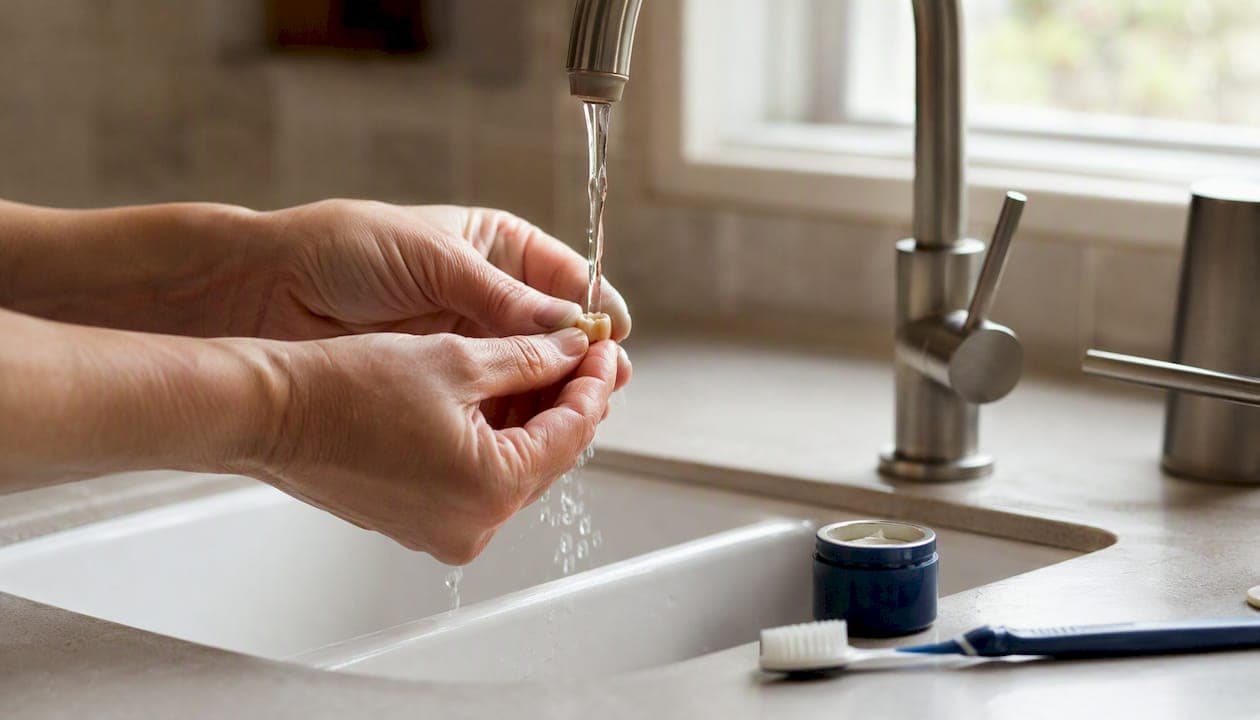
If your crown just fell out, retrieve it, rinse it gently, and set it somewhere safe before you do anything else. Do not swallow it, do not force it back onto the tooth with anything but a proper temporary cement, and call a dentist today or tomorrow. According to Healthline, the standard advice is to save the crown, clean the inside of it, dry both the crown and the tooth, and get to a dentist promptly, since recementation is often finished in a single visit. The American Dental Association echoes the same priority: protect the tooth and get seen. CWD Dental Group treats these calls as same-day emergencies whenever possible, which matters, because the longer that tooth sits exposed, the more sensitive and vulnerable it gets.
Here is what to do in the first few minutes:
- Find the crown. Check your food, your pillow, the sink. Rinse it under warm water. Do not rinse it down the drain.
- If you cannot locate it, do not panic. Swallowed crowns almost always pass through without incident, but watch for choking or breathing trouble.
- Cover the exposed tooth with a small piece of orthodontic wax or sugar-free gum if it feels sharp or sensitive against your tongue or cheek.
- Avoid chewing on that side. Stick to soft foods until you're seen.
- Call a dentist and describe what happened. Ask about same-day availability.
Key Takeaways
Saving the crown, protecting the exposed tooth, and calling a dentist within 24 to 48 hours gives you the best odds of a simple, single-visit fix.
| Point | Details |
|---|---|
| Retrieve and save the crown | Rinse it gently and store it somewhere dry rather than risk losing or swallowing it. |
| Use pharmacy cement first | Temporary dental cement is the most reliable over-the-counter option for reseating an intact crown. |
| Protect the exposed tooth | Orthodontic wax or sugar-free gum can shield sensitive areas until you're seen. |
| Watch for red flags | Spreading swelling, fever, severe pain, or breathing trouble means emergency care, not a wait-and-see approach. |
| Book with CWD Dental Group | Same-day emergency appointments help most patients get the original crown recemented in a single visit. |
This article is general information, not a substitute for advice from a qualified doctor. Consult a qualified healthcare professional about your own circumstances before acting on anything here.
Table of Contents
- Lost Dental Crown Temporary Fix: Step-by-Step Options
- What Temporary Materials Are Safe, and Which Ones Aren't
- Pain Relief and Warning Signs You Shouldn't Ignore
- When to Call the Dentist and What Happens Next
- Do's and Don'ts While You Wait
- A Quick Note From Our Team
- Same-Day Help When You Need It Most
- Sources
Lost Dental Crown Temporary Fix: Step-by-Step Options
Wash your hands before you touch anything that's going in your mouth. That's step zero, and skipping it is how a dental problem becomes an infection problem.
- Examine the crown. Look for cracks, chips, or a jagged edge. A crown that's still in one piece and undamaged is a good candidate for a temporary reseat. One that's fractured needs a dentist's attention, not a home fix.
- Clean it gently. Rinse under warm water. Don't scrub hard or use a hard-bristled brush; you just need to clear off debris from the inner surface.
- Dry both surfaces. Use a clean tissue or cotton swab to dry the inside of the crown and the visible tooth stump. Moisture keeps temporary cement from bonding properly.
- Reach for pharmacy temporary dental cement first. This is the preferred over-the-counter option for reseating a crown, and it can hold for several days to a week if applied correctly.
- No cement on hand? Try denture adhesive. It's not designed for this, but a small dab inside the crown can keep it in place overnight.
- Last resort: sugar-free gum. Chewed until soft, pressed thin, and used to hold the crown loosely in place or cover a sharp tooth edge. It won't bond anything, but it buys you a few hours of comfort.
To seat the crown, place it over the tooth and bite down gently on something soft, like a folded piece of gauze, to check the fit. If it feels like it's sitting too high or your bite feels off, take it back out and try again rather than forcing it. A crown that doesn't seat evenly can crack further or irritate your gum line.
Pro Tip: Test the fit by closing your teeth together lightly first, not with a hard chomp. If the crown rocks or one side lifts, it's not seated correctly, and clamping down harder will only make it worse.
If the tooth underneath is throbbing or the crown itself is cracked, skip the reseat attempt entirely and move straight to pain management and a call to your dentist.
What Temporary Materials Are Safe, and Which Ones Aren't
Pharmacies stock a handful of products made exactly for this situation:
- Temporary dental cement (various pharmacy brands), the most reliable option for reseating an intact crown.
- Denture adhesive, a workable backup when cement isn't available.
- Orthodontic wax, useful for smoothing a sharp edge or covering the tooth if you can't get the crown back on at all.
- Sugar-free gum, a genuine last resort for temporary coverage.
What dentists use is a different category entirely. Materials like TEMPSMART®, a dual-cure bis-acrylic provisional resin, ExperTemp, valued for its strength and easy trimming, LuxaCrown, built for long-term stability in demanding cases, and Integrity® Temporary Crown & Bridge Material, an automixed two-component system with low shrinkage, are all chairside-only products. They require precise mixing ratios, controlled curing, and equipment you don't have at home. Getting the mix wrong can generate heat near the tooth's pulp or create a bond so aggressive it damages the crown during removal. These aren't things to order online and experiment with.
| Factor | Over-the-counter options | Professional materials |
|---|---|---|
| Where to get it | Pharmacy or drugstore | Dental office only |
| Typical hold time | A few days to about a week | Weeks to months, designed for extended wear |
| Who should use it | Anyone, as a stopgap | Trained clinicians only |
| Application skill needed | Minimal | Precise mixing and curing required |
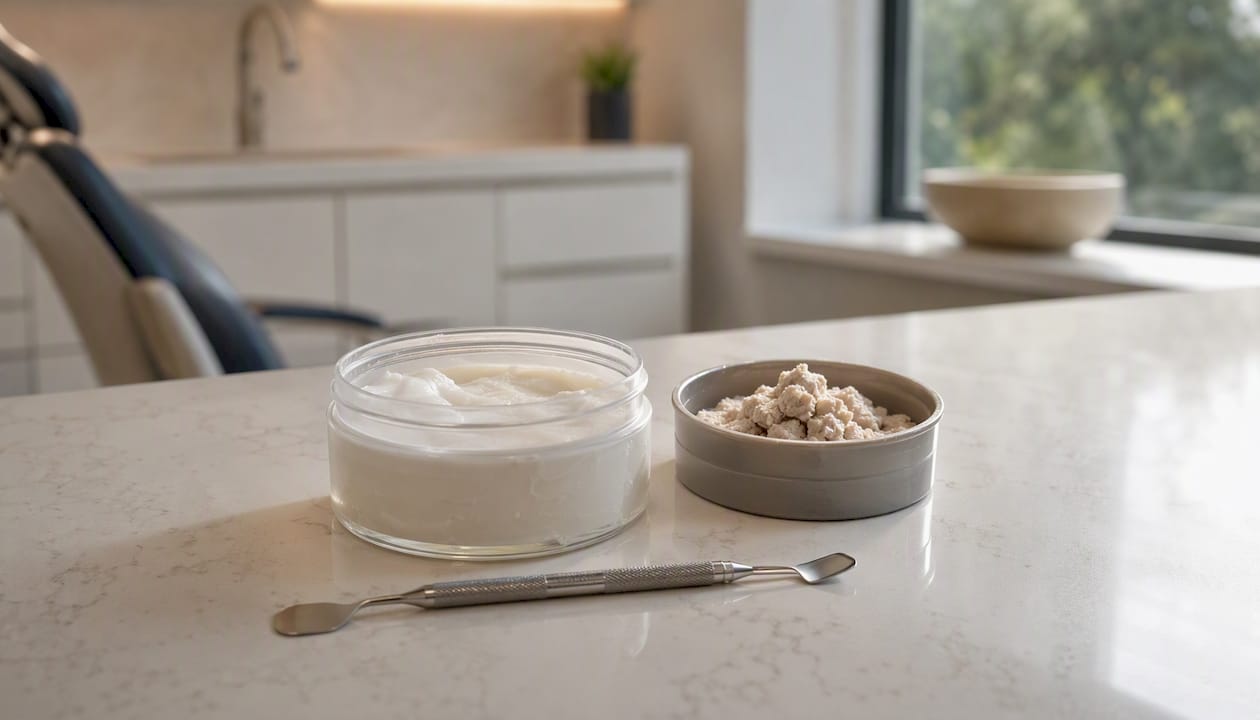
Never use superglue or any household adhesive on a crown or tooth. This isn't a matter of preference. These products are toxic in the mouth and can permanently damage both the crown and the underlying tooth, and once that damage is done, a simple recementation is off the table. Skip toothpaste as an adhesive too. It has no bonding properties and will just wash away.
Pain Relief and Warning Signs You Shouldn't Ignore
A little sensitivity is normal once a crown comes off, since the exposed tooth structure underneath reacts to air and temperature. Manage it with an over-the-counter analgesic like ibuprofen or acetaminophen, taken per the label. A cold compress against the cheek helps with any swelling, and a dab of clove oil applied carefully to the area (not swallowed) offers short-term topical numbing that people have relied on for generations.
That said, some symptoms mean this stopped being a "wait for an appointment" situation. Watch for:
- Facial swelling that's spreading, not staying put
- Fever
- Pain that keeps intensifying instead of leveling off
- Difficulty breathing or swallowing
- Bleeding that won't stop
- Any general sign you're feeling systemically unwell, not just locally sore
If the crown itself went missing and you can't find it anywhere, most cases resolve without incident. Practices generally advise monitoring for pain or a sense of blockage if you may have swallowed it, and reserving emergency care for actual breathing or swallowing difficulty. Roughly one in six American adults has untreated tooth decay at any given time, according to the CDC's oral health data, which is part of why a fallen crown shouldn't sit unaddressed. It's exposing a tooth that may already be compromised. If any red flag above shows up, skip the phone tag with a dental office and go to urgent or emergency care instead.
When to Call the Dentist and What Happens Next
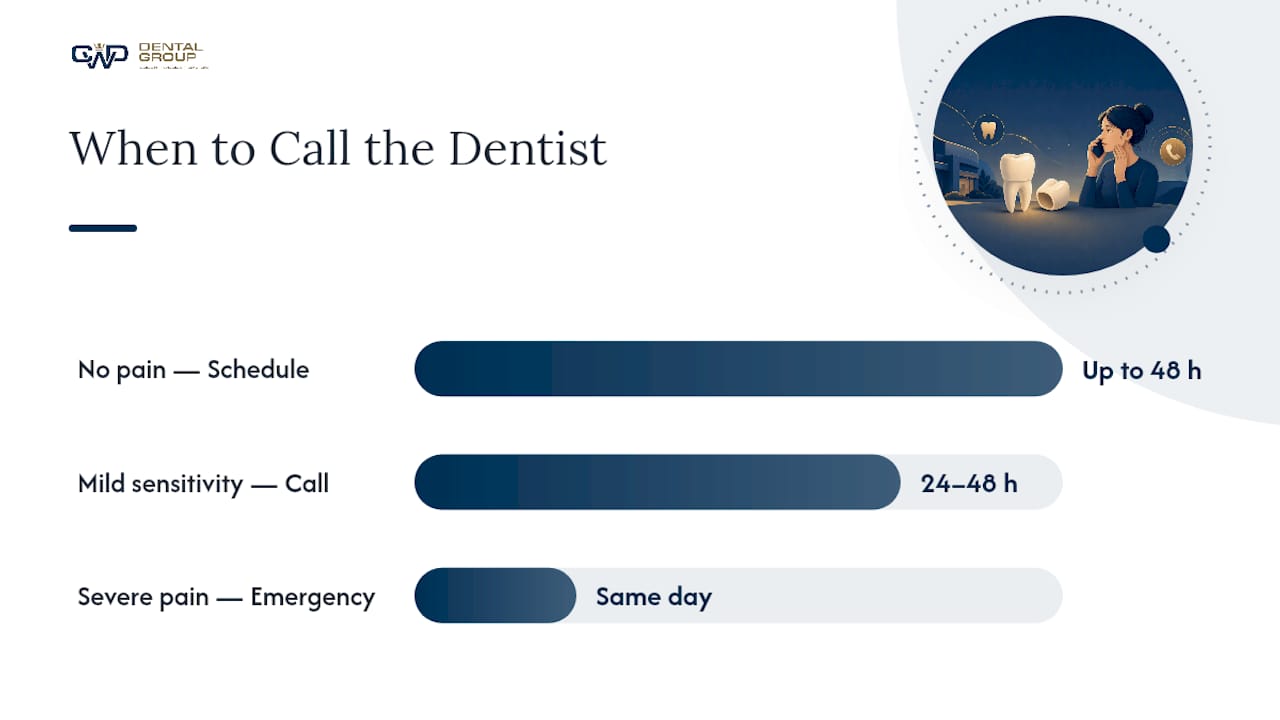
If you're dealing with red flags like swelling, fever, or serious pain, same-day care is not optional. Otherwise, aim to call within 24 to 48 hours. Waiting longer raises the odds of sensitivity, decay progressing, and a more complicated fix than the straightforward recementation you'd get by acting fast.
| Symptom Level | Recommended Action | Expected Clinic Timing |
|---|---|---|
| No pain, crown intact and saved | Call to schedule | Within 48 hours |
| Mild sensitivity, manageable discomfort | Call promptly | Within 24 to 48 hours |
| Severe pain, swelling, or fever | Seek emergency dental care | Same day |
At the appointment, expect the dentist to examine the crown and the tooth, possibly take an X-ray, and either recement the original crown or, if it's damaged beyond use, fit you with a new one. If the tooth and crown are both healthy, this is often a single, straightforward visit.
Bring the crown if you have it, your insurance card or ID, a quick rundown of your symptoms, and a mention of anything you used as a temporary fix, including any cement. That last detail matters more than people think. It tells the dentist exactly what's on the tooth surface before they start working.
Do's and Don'ts While You Wait
Do:
- Save the crown and keep it somewhere dry and clean, like a small container, not loose in your pocket.
- Rinse it gently, never scrub it.
- Use pharmacy temporary cement if you have it and the crown is intact.
- Chew on the opposite side of your mouth.
- Stick to soft foods and avoid extreme temperatures on that tooth.
Don't:
- Use superglue, nail glue, or any household adhesive.
- Press aspirin directly against the gum, hoping it'll help. It doesn't, and it can burn the tissue.
- Ignore pain or swelling that's getting worse, not better.
- Try to file, trim, or permanently alter the crown yourself.
If anything on the do-not list starts happening anyway, don't wait out the 48-hour window. Call the dentist immediately.
A Quick Note From Our Team
I've fielded enough of these calls at odd hours to know the panic is almost always worse than the actual damage. [Credentials placeholder: Kayle], a dental clinician contributor here, wants you to know something simple: a lost crown is rarely a true emergency unless it comes with the red flags covered above. Most of the time, it's a fixable inconvenience, not a crisis.
What I do want to stress is timing. [Case study placeholder] aside, the pattern holds across most patients we see: the ones who call within a day or two almost always get the original crown recemented in one visit. The ones who wait a week often need a new crown made from scratch. CWD Dental Group keeps slots open specifically for these situations, because a same-day appointment is often the difference between a five-minute fix and a longer rebuild.
Same-Day Help When You Need It Most
CWD Dental Group treats a lost crown as exactly the kind of situation same-day emergency appointments exist for. There's no reason to sit on a sore, exposed tooth for a week hoping it settles down. When you call or book online, our team gets you in fast, examines the tooth and the crown, and either recements what you've got or moves quickly toward a replacement.

Bring the crown if you found it, your insurance card or ID, and a quick note on anything you tried at home, like temporary cement or denture adhesive. That helps the team see the tooth's real condition without guessing what's already on it. If you're not sure whether your situation needs today's appointment or tomorrow's, call and describe your symptoms and our staff will guide you from there. You can also schedule directly online if you'd rather skip the phone call and lock in a time now.
Sources
- My Crown Fell Out, What Do I Do Next to Protect My Teeth? — Healthline
- Dual-Cure Composite for Temporary Crown & Bridge — TEMPSMART® (GC America)
- ExperTemp temporary crown and bridge material — Ultradent
- LuxaCrown from DMG | High-performance temporary solutions for long-term stability
- Dentsply Sirona - Integrity Temporary Crown & Bridge Material