
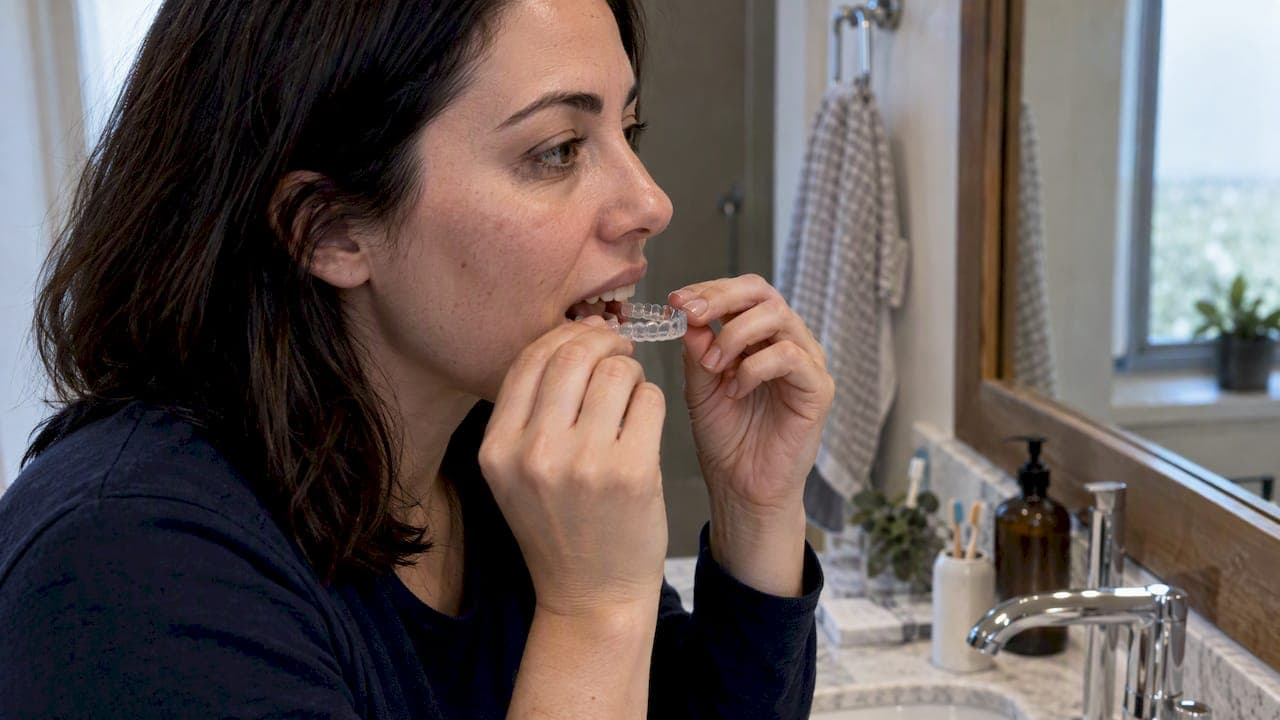
Most people feel tenderness, not sharp pain, in the first week of Invisalign. It usually shows up within hours of your first tray, peaks around day one to day three, and fades by the end of the week. It feels like pressure, tightness or a dull ache in teeth that are being asked to move. Sharp pain, swelling, or soreness that does not ease within a couple of days is a different story, and you should call your dentist.
Below is what a typical first week looks like, what the research says about how much it hurts, what actually helps, and which symptoms deserve a phone call.
TL;DR
- Expect pressure and tenderness, not sharp pain. It tends to peak in the first 24 to 72 hours and settle by about day seven.
- In one study, average pain scores peaked at 24 hours and dropped to roughly 1.6 out of 10 by day 7.
- Soft food, cold drinks, warm salt water rinses and acetaminophen are the usual first steps. Ask your dentist before taking anything else.
- Keep wearing the trays. Skipping wear to avoid soreness can slow treatment and make the next tray feel worse.
- Severe pain, significant swelling, sores that will not heal, or a bite that feels wrong are reasons to call, not wait.
Table of Contents
- Why Invisalign makes your teeth sore at all
- What the research says about first-week pain
- A realistic day-by-day timeline
- How to ease the soreness
- Do not skip wear to dodge the ache
- When soreness is not normal
- Why supervision matters
- Our perspective at CWD Dental Group
- Getting started with Invisalign in Tallahassee
- Frequently asked questions
- Sources
Why Invisalign makes your teeth sore at all
Clear aligners are custom-formed trays that apply steady pressure to move teeth in small steps. Each tray is shaped a fraction of a millimeter away from where your teeth sit now. When you snap it in, your teeth are pushed toward the new position, and the ligaments that hold each tooth in its socket react. That reaction is the ache you feel.
So the soreness is not a sign that something is going wrong. Invisalign's own guidance describes week one as mostly about adjusting, with gentle pressure as teeth begin to shift. The sensation is typically strongest in the teeth that have to move the most, which is why one front tooth can feel bruised while the rest feel fine.
The second source of discomfort has nothing to do with tooth movement. A new plastic tray has edges, and attachments (the small tooth-colored bumps your dentist bonds to certain teeth) give the tray something to grip. Both can rub your cheeks, tongue and lips until the soft tissue toughens up. If you are curious how attachments are placed, our post on Invisalign attachments at CWD Dental Group walks through the visit.
What the research says about first-week pain
You do not have to rely on other people's stories. Several clinical studies have measured it.
A prospective study that compared Invisalign with fixed braces tracked pain across the first week. Pain for Invisalign patients peaked at 24 hours with a mean score of 3.87 on a 10-point visual scale, then fell to 1.62 by day 7. That is moderate at its worst and close to negligible a week later. The same study found patients with fixed appliances reported significantly more discomfort.

The pattern holds elsewhere. A randomized trial comparing aligners with traditional brackets looked at discomfort levels directly, and a systematic review of pain between clear aligners and fixed appliances pooled the studies that exist. An earlier comparison of treatment impacts during the first week also looked at how each appliance affected daily life. Studies differ in design and population, so treat any single number as a ballpark, not a promise.
Expectations matter too. In one survey, 59% of orthodontists expected patients to have pain 24 hours after an appointment, yet 22% of patients said they never had any. Pain tolerance varies widely. Your neighbor's rough week says little about yours.
A realistic day-by-day timeline
This is a general pattern, not a guarantee. Your own week may be milder or a bit rougher.
| Day | What you will probably notice | What helps |
|---|---|---|
| Day 1 | Tight, pressured feeling within a few hours. Speech may sound slightly lispy. Extra saliva. | Soft dinner, cold water, a dose of acetaminophen if needed |
| Days 2 to 3 | Usually the sorest stretch. Chewing feels tender, especially on back teeth. | Soft foods, saltwater rinses, tray out only for meals |
| Days 4 to 5 | Ache eases. Cheeks and tongue adjust. Lisp fades. | Keep wearing the trays; use dental wax on rough spots |
| Days 6 to 7 | Mild or no discomfort. Trays feel normal. | Prepare for the next tray, which may bring a milder repeat |
That last row surprises people. Aligners are typically worn for about a week each, at least 22 hours a day, so every new set can bring a short, usually milder wave of pressure. Many people find tray two or three easier than tray one, because the mouth has already learned what to expect. Your dentist may set a different schedule for you, so follow what your treatment plan says.
How to ease the soreness
Change trays at night
Switching to a fresh set just before bed means you sleep through the first hours of pressure. Invisalign's guidance notes that putting in a new tray before bed can make the initial pressure less noticeable. Brush and floss first so you are not trapping food against sore teeth.
Eat soft for a few days
Yogurt, eggs, soup, pasta, mashed potatoes, smoothies and oatmeal ask very little of tender teeth. Take the trays out to eat, then brush and put them back in. Cold foods and drinks also feel good on sore gums, but take trays out before drinking anything other than water.

Rinse with warm salt water
The American Association of Orthodontists lists warm salt water rinses and over-the-counter pain relievers as first-line home care for orthodontic discomfort, and notes it should not last longer than a couple of days at a time.
Choose your pain reliever carefully
This is a place where a small choice matters. Ibuprofen and other NSAIDs are generally thought to interfere more with tooth movement than acetaminophen, which orthodontists often recommend instead. A review in the Michigan Dental Association journal reached a similar place, saying the evidence points toward acetaminophen as a preferred choice for orthodontic pain.
That does not make acetaminophen right for everyone. If you have liver disease, take other medications that contain it, or have been told to use a different drug, ask your dentist or pharmacist before you start. Follow the dose printed on the label.
Deal with rough edges
If a tray edge or attachment cuts into your cheek or tongue, orthodontic dental wax over the spot gives the tissue a break. A tray with a sharp edge you cannot tolerate is worth a call to the office. Do not trim or file it yourself unless your dentist tells you how.
Calm the tension
Clenching makes sore teeth worse, and many people clench without noticing when they are nervous about a new appliance. Slow breathing, a warm compress on the jaw and relaxing your tongue away from your teeth all help. If anxiety around dental care is what really bothers you, some people look into guided techniques such as hypnosis for dental anxiety alongside, never instead of, talking with their dentist.
Do not skip wear to dodge the ache
It is tempting to leave the trays out for a day when your teeth hurt. It usually backfires. Aligners need to be worn about 20 to 22 hours a day to keep a steady force on the teeth. Invisalign notes that force levels can fall by half within 24 hours, so teeth start to drift back toward where they were. Put the tray back in a day later and you get the same tightness all over again.
A proper fit matters just as much. The AAO advises making sure each aligner snaps on fully, with no gaps between the tray and the tooth surface. A gap means the tray is not applying the force it should, which can prolong treatment and may mean extra aligners later. If a tray will not seat, tell your dentist rather than forcing it. Our post on Invisalign refinements explains why some patients need additional sets and what that looks like.
When soreness is not normal
Mild, short-lived tenderness is expected. These are not:
- Sharp or throbbing pain that keeps you awake or keeps getting worse
- Soreness that has not eased after a couple of days
- Noticeable swelling of the gums, face or jaw
- Tongue or throat irritation, or sores that do not heal
- Jaw pain, or a bite that suddenly feels off
- A single tooth that hurts on its own, even with no tray in
The FDA says people using clear aligners should seek evaluation for new or worsening dental pain, jaw pain or bite problems. Call the dentist managing your treatment. If swelling comes with a fever, or you have trouble swallowing or breathing, treat it as an emergency and get care right away.
A tooth that aches on its own can also point to something unrelated to the aligner, such as decay or an infected nerve. Our guides on endodontic pain relief and signs you need a dental check-up can help you tell the difference.
Why supervision matters
Clear aligners are a medical device, not a gadget. The FDA notes that it has not authorized clear aligners sold directly to consumers without a prescription and supervision by a dentist or orthodontist. In practice, this means your teeth and gums should be examined before you start, and checked along the way. Cavities, gum disease and root problems should be dealt with first, because moving teeth through an unhealthy mouth can make everything worse.
It also means that if the first week feels wrong, a real person who has seen your X-rays and treatment plan can tell you whether it is normal. That is worth more than any forum thread.
Our perspective at CWD Dental Group
We hear the same question in nearly every Invisalign consultation: will it hurt? Our honest answer is that you will feel it, but it is usually a manageable kind of sore, and the first few days are the hardest part. We would rather you know that going in than hear "you won't feel a thing" and then panic on night two.
What we try to do differently is make comfort part of the plan, not an afterthought. We talk through the schedule with you, suggest starting a new tray in the evening, and tell you which rough spots are worth a call. We also see Tallahassee patients who have already started somewhere else and are unsure whether what they feel is normal. Our advice is the same every time: do not guess and do not suffer quietly. A quick call or visit is better than a week of worry.
Because we also handle emergencies and general dentistry under one roof, your Invisalign care is not separate from the rest of your mouth. If a sore tooth turns out to be a cavity, we can deal with it without sending you across town.
— Kayle
Getting started with Invisalign in Tallahassee
If you are weighing clear aligners, we offer Invisalign at CWD Dental Group as part of our cosmetic services, alongside whitening, bonding and veneers. A consultation is the place to ask how your own teeth are likely to feel, how long each tray is worn, and what a realistic timeline looks like. You can see everything we do on our services page. If a tooth hurts and you cannot wait, we offer same-day emergency appointments, and you can read about them on our emergency dentist page.
Pricing varies by case, so we do not publish a single figure. Ask our team about costs and insurance when you call.
Frequently asked questions
How long does Invisalign hurt in the first week?
For most people the soreness starts within hours, peaks in the first one to three days, and fades by around day seven. In one study, average pain was highest at 24 hours and much lower by day 7. If you are still sore after a couple of days with no improvement, call your dentist.
Does Invisalign hurt more than braces?
Research generally says no. The randomized trial comparing aligners and traditional brackets and the first-week study above both found aligner patients reported less discomfort than those with fixed appliances. Both are usually manageable and short-lived, though.
Can I take ibuprofen for Invisalign pain?
Many orthodontists prefer acetaminophen, because NSAIDs like ibuprofen are thought to interfere more with tooth movement. Whether a given medication is safe for you depends on your health and other prescriptions, so check with your dentist or pharmacist first.
Will every new set of aligners hurt?
Usually less than the first. Each new tray can bring a day or two of pressure, but most people find it milder as their mouth gets used to the routine. Changing trays at night helps you sleep through the worst of it.
Should I stop wearing my aligners if they hurt?
Not for ordinary soreness. Time out of the mouth lets teeth shift back, and the pressure then returns. If the pain is severe, or comes with swelling or a bite change, stop and contact your dentist the same day.
Sources
- Pain perception among patients treated with passive self-ligating fixed appliances and Invisalign aligners during the first week (PMC)
- Discomfort associated with Invisalign and traditional brackets: a randomized, prospective trial (PMC)
- Pain level between clear aligners and fixed appliances: a systematic review (PMC)
- A comparison of treatment impacts between Invisalign aligner and fixed appliance therapy during the first week (PubMed)
- Orthodontist and patient pain expectations (Virginia Dental Journal, ADA Commons)
- Preferred analgesia for orthodontic tooth movement: acetaminophen or NSAIDs? (Michigan Dental Association Journal)
- Handling orthodontic issues at home (American Association of Orthodontists)
- Clear aligners (American Association of Orthodontists)
- Invisalign Week 1 vs Week 2
- Clear dental aligners (FDA)