
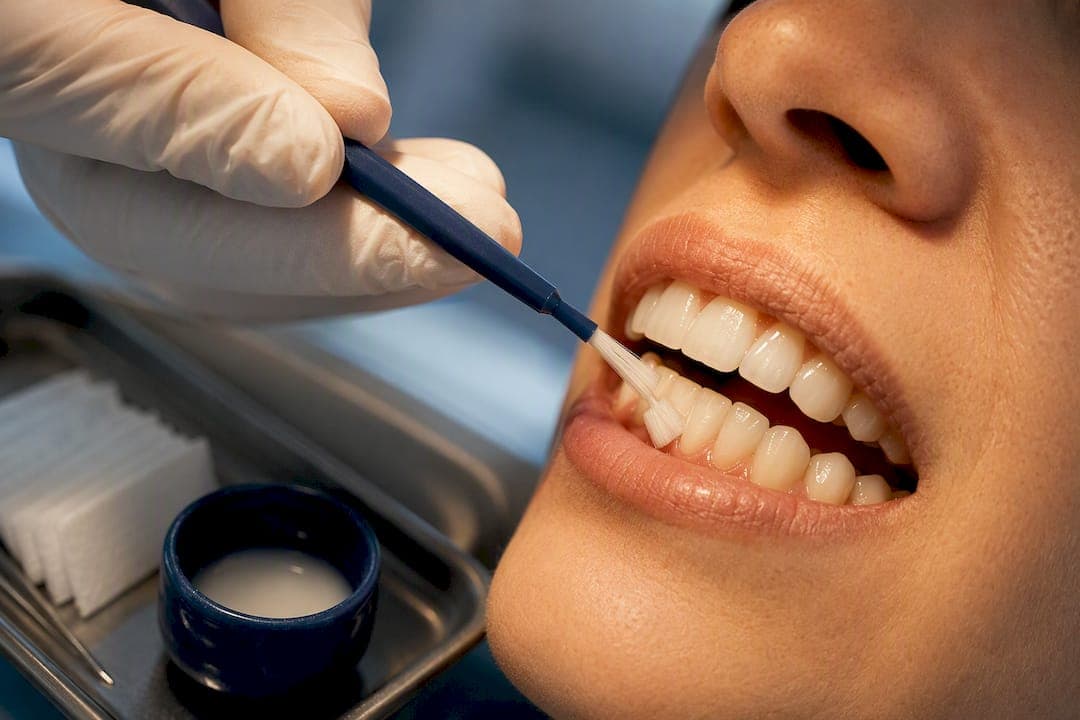
Yes, targeted professional fluoride helps many adults, particularly those with active decay, exposed root surfaces, dry mouth, or a heavy restoration history. The American Dental Association and independent evidence reviews both support this targeted approach rather than fluoride for every adult at every visit.
TL;DR:
- Fluoride varnish is the preferred professional treatment for most adults, especially those with root exposure, dry mouth, or high restoration counts, due to its safety and compatibility with existing dental work.
- Repeated applications over time significantly reduce the need for restorative procedures, particularly in high-risk groups like older adults with dry mouth or multiple restorations.
- Treatment frequency is risk-based, with higher-risk patients requiring more frequent visits, and a simple assessment of decay history, medication use, and gum recession can guide eligibility.
- Most adults tolerate varnish easily, with minimal aftercare, but benefits depend on ongoing maintenance combined with good home oral hygiene.
- Insurance coverage often supports fluoride treatments for high-risk adults when documented appropriately, emphasizing targeted use rather than routine application.
Table of Contents
- Why Adults Still Need Fluoride Treatment
- Varnish vs. Gel vs. Foam: What Your Dentist Actually Uses
- Who Should Get Professional Fluoride Treatment?
- What Happens at a Fluoride Appointment and How Often You Need One
- Does Fluoride Treatment Actually Work for Adults? The Evidence
- What the ADA and Major Studies Actually Recommend
- How to Decide: A Self-Screen and Questions for Your Dentist
- How CWD Dental Group Approaches Risk-Based Fluoride Care
- Prevention Beats a Single Fix
- Book a Caries Risk Assessment at CWD Dental Group
- Where This Information Comes From
- Sources
- FAQ
Why Adults Still Need Fluoride Treatment
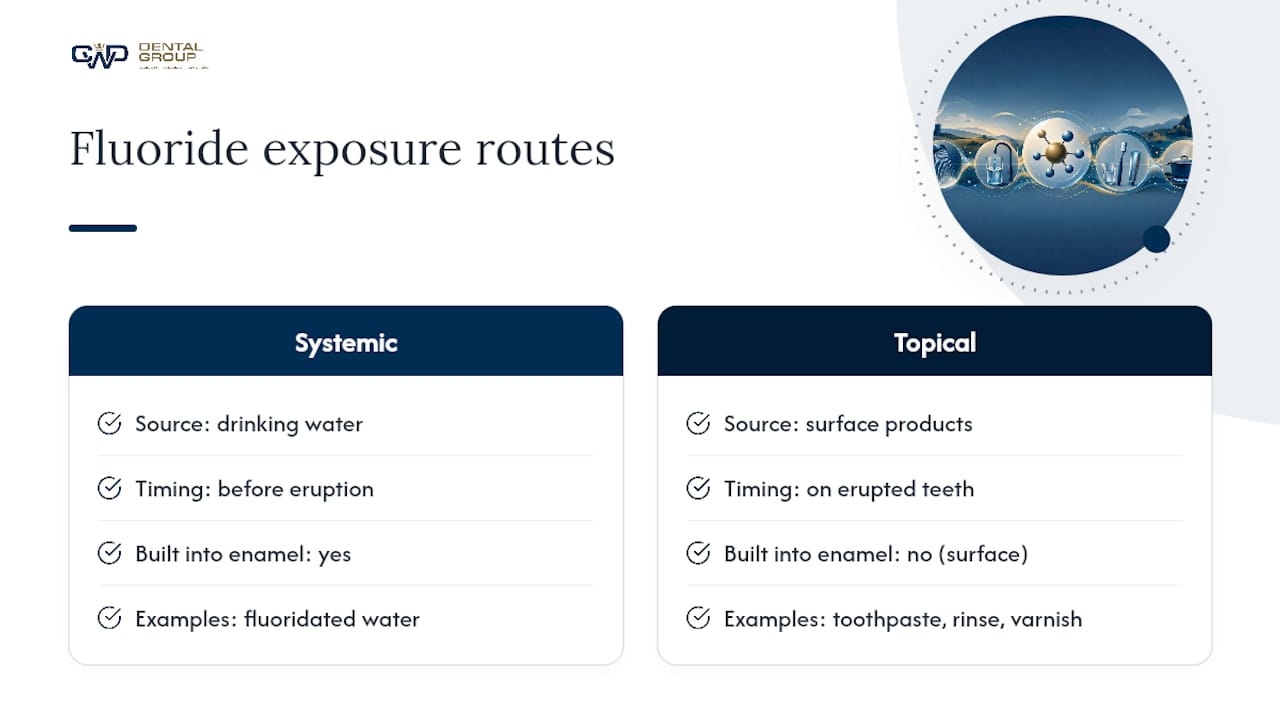
Fluoride works by pulling calcium and phosphate back into weakened enamel faster than acid can strip them out. That process, remineralization, is the whole point of a professional application. It also slows the demineralization that happens every time bacteria feed on sugar and produce acid, and it leaves a low-dose fluoride reservoir in saliva and plaque that keeps working for hours after you leave the chair.
There are two distinct exposure routes, and adults often confuse them. Systemic fluoride, from fluoridated water, gets built into tooth structure before teeth erupt. Topical fluoride, from toothpaste, mouth rinse, and in-office varnish or gel, acts directly on the surface of teeth you already have. The CDC confirms that both water fluoridation and topical fluoride are safe and effective, reporting cavity reductions among people who get adequate fluoride exposure. Daily brushing with fluoride toothpaste covers baseline systemic and topical needs for most people. Professional treatment adds a concentrated topical dose for teeth that need more help than a toothbrush can give.
Adults face specific risks that make this relevant well past childhood, such as gum recession exposing root surfaces, dry mouth caused by certain medications, margins around old fillings and crowns where decay can restart, and age-related changes that make teeth more vulnerable to acid attack.
None of this means every adult needs a varnish appointment every six months forever. It means the group of adults who benefit is larger and more specific than most people assume.
Varnish vs. Gel vs. Foam: What Your Dentist Actually Uses
Fluoride varnish, foam, gel, and rinse are not interchangeable. Each has a different application method, a different tolerance profile, and different compatibility with the crowns, veneers, and composite fillings many adults already have in their mouths.
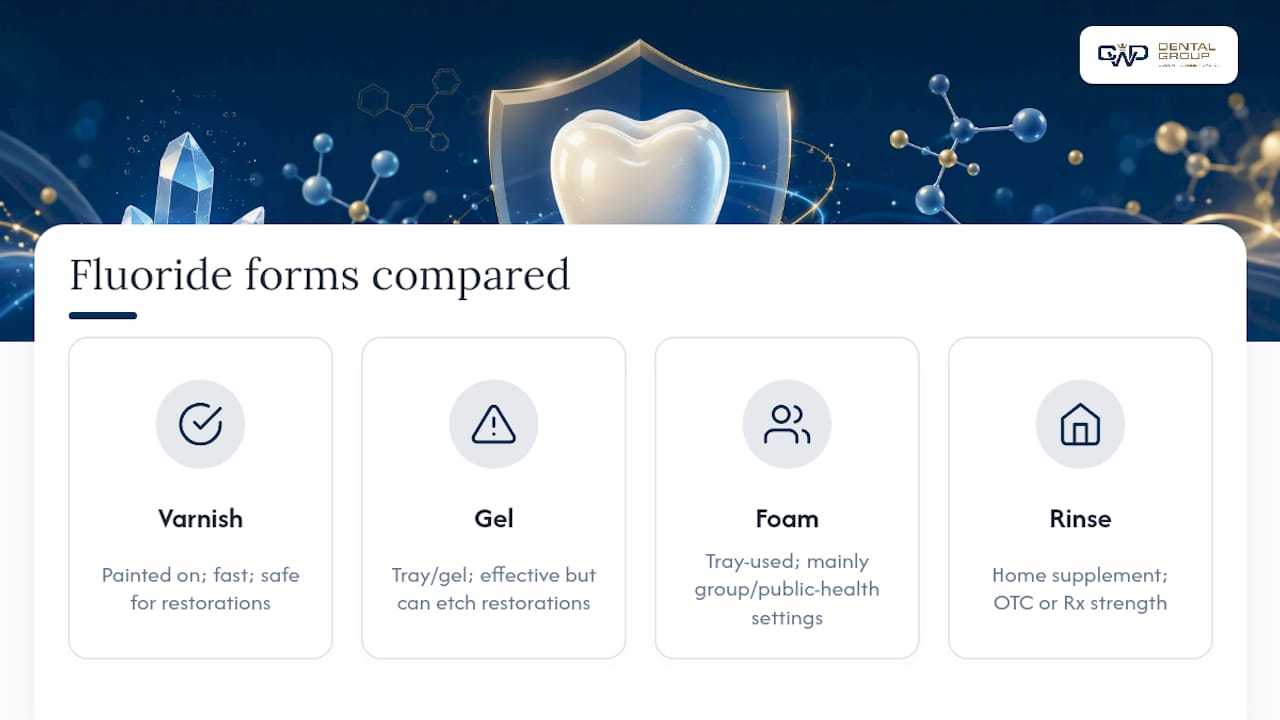
A dentist or hygienist paints a thin, sticky coating directly onto tooth surfaces with a small brush. It sets on contact with saliva in seconds, tastes mild, and works well around porcelain, ceramic, and composite restorations without damaging them.
It is effective at raising fluoride uptake, but the phosphoric acid in APF gel can etch or roughen some ceramic and composite restorative materials, which is a real consideration for anyone with visible front-tooth veneers or bonding.
Foam and supervised rinses show up less often in adult care. Foam requires a tray similar to APF gel and is used mainly in group or public health settings. Rinses, whether over-the-counter or prescription strength, work as a home-care supplement rather than a substitute for an in-office application.
For most adults with crowns, bridges, or cosmetic bonding, dentists lean toward varnish specifically because it is fast, well tolerated, and does not risk the restoration surface. That preference shows up consistently in clinical discussions among dental professionals, not just in marketing copy.
Who Should Get Professional Fluoride Treatment?
Risk, not age, drives the decision. A healthy 35 year old with no cavities in a decade may not need in-office fluoride at all, while a 60 year old on five medications with visible root exposure almost certainly does.
The risk factors that push a dentist toward recommending fluoride treatment include:
- Active decay or a new cavity diagnosed within the past one to two years.
- Xerostomia (dry mouth) from medications, radiation, or conditions like Sjögren's syndrome.
- Exposed root surfaces from gum recession or periodontal treatment.
- A history of head or neck radiation therapy, which alters saliva production long term.
- Multiple existing restorations, since margins around old fillings and crowns are common failure points.
- A diet high in fermentable carbohydrates combined with inconsistent brushing or flossing.
Dentists formalize this assessment through a framework called CAMBRA, short for Caries Management by Risk Assessment. It sorts patients into low, moderate, high, or extreme risk categories based on disease indicators, risk factors, and protective factors like fluoride exposure and saliva flow, then ties treatment frequency to that category rather than applying one blanket schedule to everyone.
Older adults and anyone managing several chronic prescriptions tend to land in the moderate-to-high risk bands more often than younger patients, mainly because dry mouth from medication is so common in that group.
Pro Tip: Keep a simple list of every medication you take to your next dental visit. Dry mouth is a side effect of hundreds of common drugs, and your dentist can only flag it as a caries risk factor if they know what you're on.
What Happens at a Fluoride Appointment and How Often You Need One
A varnish appointment is short. The dentist or hygienist typically cleans and lightly dries the teeth, isolates them with cotton or a suction device, then paints the varnish on with a small brush. The whole application often takes just a few minutes, and most adults tolerate it easily since it sets almost instantly and has a mild, sweet flavor compared to older gel treatments.
Aftercare is simple: avoid eating, drinking hot liquids, or brushing for about 30 minutes so the varnish has time to bond and release fluoride into the enamel. Tray-applied APF gel requires a bit more patience, since the tray sits in place for roughly four minutes and some patients find the taste or the gagging sensation less pleasant than varnish.
Frequency follows risk level, not a fixed calendar date, with shorter intervals for higher risk and longer intervals for lower risk; the ADA's clinical practice guideline supports this risk-based interval approach, leaving final decisions to the dentist's judgment.
Does Fluoride Treatment Actually Work for Adults? The Evidence
The short answer is yes for the adults who need it, with the caveat that the research base is thinner than most people expect.
A retrospective analysis of veterans receiving topical fluoride treatment found a significant decrease in the odds of needing caries-related restorative treatment, with the effect increasing with repeated applications over time.
That dose-response pattern from VA patient records is one of the most persuasive pieces of real-world evidence available, because it tracks actual treatment outcomes in high-risk adults rather than a small controlled trial. Fluoride varnish specifically shows promise for preventing root caries, a problem that barely existed a generation ago when fewer adults kept their natural teeth into their 70s and 80s.
Where the evidence gets more cautious: the systematic evidence summary from NCBI notes that adult trials are fewer and smaller than the pediatric trials that built fluoride's reputation in the first place, so certainty ratings for some adult outcomes land at low to moderate rather than high.
Benefits and downsides, side by side:
- Reduced new decay and slower progression of existing root caries in higher-risk adults.
- Temporary relief from tooth sensitivity for some patients.
- A brief yellow or off-white coating on teeth immediately after varnish, which brushes off within hours.
- A mild, temporary taste that some patients dislike, particularly with APF gel.
- Cost, since not every dental plan covers fluoride treatment for adult patients the same way it covers pediatric applications.
One safety point worth stating plainly: adult fluorosis from professional treatment is not a realistic concern, since fluorosis develops during tooth formation in childhood. Systemic fluoride toxicity from a single office visit is extremely rare and tied almost exclusively to swallowing large quantities, not to the small, controlled amount a dentist applies topically.
What the ADA and Major Studies Actually Recommend
Clinical guidance on adult fluoride treatment comes from a handful of overlapping sources, and they generally point in the same direction even when their confidence levels differ.
- The ADA's chairside guide recommends 2.26% fluoride varnish or 1.23% APF gel for patients age 6 and older, with expert opinion supporting varnish application at regular intervals tailored to adults with root caries or elevated risk.
- The NCBI evidence summary synthesizes multiple systematic reviews and concludes varnish may help prevent root caries in adults, noting that evidence certainty is lower for adults than for children due to fewer large trials in adults.
- The VA retrospective study provides real-world evidence that repeated topical fluoride applications are associated with fewer restorative procedures over time in a high-risk adult population.
- Together, these sources support a practice pattern where fluoride is offered selectively based on risk rather than applied automatically at every cleaning.
Clinicians balance these recommendations against patient preference, cost, and comfort. A patient who hates the taste of APF gel and has no restoration compatibility issues might simply switch to varnish. A patient who declines professional fluoride altogether can often still benefit from prescription-strength home products, discussed below.
How to Decide: A Self-Screen and Questions for Your Dentist
Before your next appointment, run through a short mental checklist. Have you had a new cavity in the past two years? Does your mouth feel persistently dry, or are you on medication known to cause that? Do you have exposed roots, several old fillings, or a crown placed more than five years ago? A yes to any of these is a reasonable trigger to raise fluoride treatment with your dentist directly, rather than waiting for them to bring it up first.
At the appointment, ask these four things:
- Which agent do you recommend for me, varnish or gel, and why?
- Will this interact with my crowns, veneers, or bonding?
- How often should I come back for reapplication based on my current risk?
- Are prescription home options like 0.5% fluoride gel, 0.09% rinse, or 5,000 ppm toothpaste worth adding to my routine?
Pro Tip: If cost is a concern, ask specifically whether your insurance covers adult fluoride treatment under a diagnosis code for high caries risk rather than as a routine cosmetic add-on. Coverage often depends on how the visit is coded, not just whether the treatment happened.
After the visit, track whether new decay shows up at your next checkup and keep the recommended interval on your calendar rather than letting it slide to whenever you remember.
How CWD Dental Group Approaches Risk-Based Fluoride Care
Our team treats fluoride the way the evidence suggests it should be treated: as a targeted tool, not a routine add-on for every patient. During a standard exam, we assess caries risk using the same factors covered above, medication history, root exposure, restoration count, and recent decay, before recommending an agent and interval specific to that patient.
For most adults, that means varnish, applied quickly and comfortably, with a follow-up interval set to match actual risk rather than a generic six-month default. Patients with ongoing decay activity get scheduled more frequently until their mouth stabilizes. Some dental practices offer same-day emergency appointments alongside routine preventive visits, so patients who notice a new area of sensitivity or decay between cleanings do not have to wait weeks to get it evaluated and treated.
Prevention Beats a Single Fix
Fluoride treatment works best as ongoing maintenance, not a one-time rescue. A single varnish application on a mouth with untreated dry mouth or poor home care will not hold the line for long. Pair it with consistent brushing, a look at your medication list, and a recall schedule matched to your actual risk, and the math changes: fewer fillings, fewer root canals, and less money spent reacting to problems that regular prevention would have caught first.
— Kayle
Book a Caries Risk Assessment at CWD Dental Group
The practice is built around getting patients seen and treated without the usual wait, whether that means a same-day emergency slot or a straightforward preventive visit to check whether fluoride treatment makes sense for you. If you recognized yourself in the risk factors above, root exposure, dry mouth, a mouth full of old fillings, that conversation belongs on your next appointment, not on a someday list.

Our team evaluates caries risk during routine cleanings and recommends varnish or other topical fluoride only when it actually fits your situation, never as an automatic upsell. Dental insurance plans may provide coverage for fluoride treatment when it is tied to a documented risk factor. Staff can often help explain what individual plans cover before a commitment is made. Visit our full range of dental services to see how preventive care fits alongside cleanings, restorations, and emergency treatment, or head straight to our teeth cleaning page to book a visit that can include a fluoride risk conversation from the start.
Where This Information Comes From
The clinical claims in this article are drawn from the following sources, each worth reading directly if you want the full detail behind a specific recommendation:
- ADA topical fluoride clinical practice guideline / chairside guide
- NCBI Bookshelf evidence summary on fluoride varnishes for dental health
- CDC water fluoridation and oral health FAQs
- Cleveland Clinic overview of fluoride uses, benefits, and side effects
- Retrospective VA study on topical fluoride effectiveness in high caries risk adults
This article is general information, not a substitute for advice from a qualified doctor. Consult a qualified healthcare professional about your own circumstances before acting on anything here.
Sources
- ADA topical fluoride clinical practice guideline / chairside guide
- SUMMARY OF EVIDENCE - Fluoride Varnishes for Dental Health: A Review of the Clinical Effectiveness, Cost-effectiveness and Guidelines
- Topical fluoride effectiveness in high caries risk adults (PMC9266354)
- Fluoride: Uses, Benefits & Side Effects — Cleveland Clinic
FAQ
Is fluoride treatment at the dentist worth it for adults?
For adults with active decay, dry mouth, exposed roots, or several restorations, yes.
Do adults still need fluoride treatments?
Not automatically, but many do, particularly those with risk factors like xerostomia, root exposure, or a recent cavity. Risk, not age alone, is what determines the recommendation.
What is the downside of fluoride treatment?
The main downsides are a temporary chalky coating after varnish, a mild taste some patients dislike, and cost if insurance doesn't cover it. Fluorosis is not a realistic concern for adults since it only develops during childhood tooth formation.
Can adults get fluoride treatment?
Yes, adults of any age can receive professional fluoride treatment, and the ADA specifically supports varnish or gel application for patients age 6 and older, with expert opinion favoring reapplication every three to six months for at-risk adults.