

A dental checkup findings report is a detailed clinical summary of your teeth, gums, and oral structures recorded after an exam. Most patients receive one after every visit but rarely know how to read it. That gap matters. Gum disease links to systemic inflammation affecting heart disease risk, which means your dental report tells you more than just whether you need a filling. Learning to understand dental checkup findings report terminology puts you in control of decisions that affect your whole body.
What are the common components of a dental checkup report?
A dental findings report follows a predictable structure once you know what to look for. The two main exam types are baseline and periodic. A baseline exam is your first comprehensive visit. It establishes your starting point. A periodic checkup lasts 20–30 minutes and focuses entirely on comparing your current oral health against that baseline.
Periodontal charting
Periodontal charting records the depth of the pockets between your gums and teeth at six points per tooth. The numbers your hygienist calls out during the exam go directly into this chart. Deeper numbers signal gum recession or bone loss.

Radiographic findings
X-ray results appear as a separate section describing what the dentist sees in the bone and roots. Terms like "hypodense area" or "periapical lucency" describe what the image looks like, not a final diagnosis. A cone beam CT (CBCT) scan report adds three-dimensional detail for complex cases.
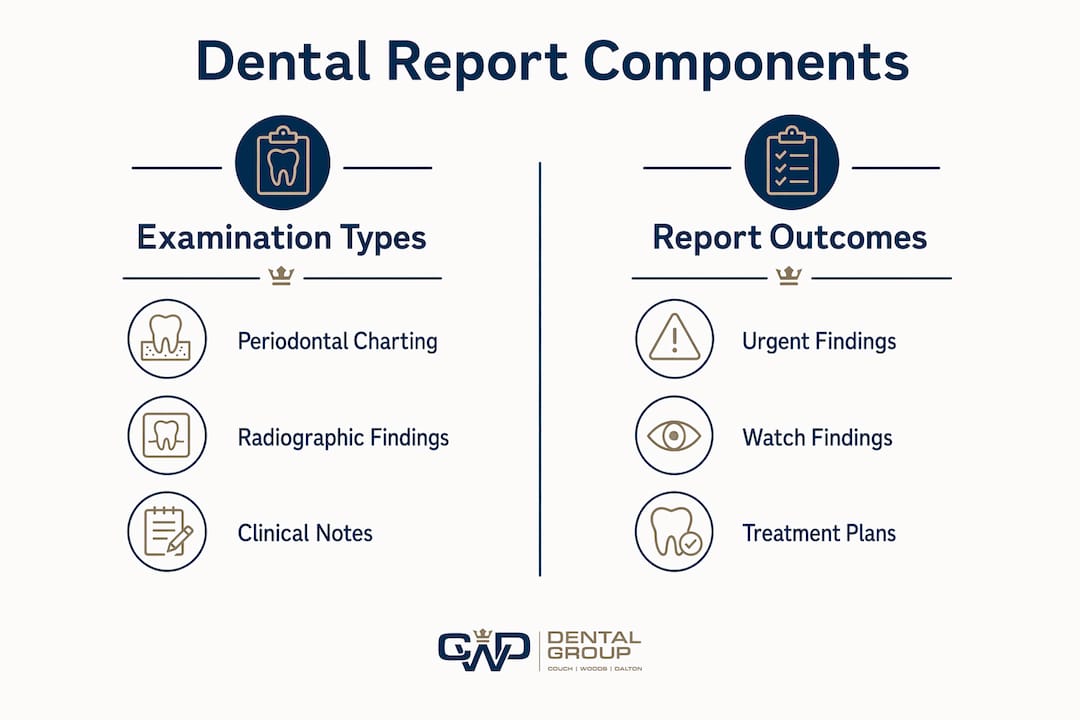
Clinical notes and photographs
Clinical notes capture what the dentist observed visually and by touch. Intraoral photographs document cracks, staining, or soft tissue changes over time. Both sections give you a before-and-after record across visits.
Treatment plan and insurance codes
The treatment plan section lists recommended procedures ranked by priority. Insurance codes in reports sometimes indicate coverage restrictions, not the dentist's actual recommendation. A "substitute" code means your insurer will pay for a cheaper option. You still choose which treatment you receive.
The key sections at a glance:
- Periodontal chart: pocket depths and bleeding scores per tooth
- Radiographic report: bone density, root health, and anatomical notes
- Clinical notes: visual and tactile exam observations
- Photographs: baseline images for tracking changes
- Treatment plan: prioritized procedures with urgency labels and insurance codes
How to interpret periodontal measurements
Pocket depth is the single most important number in your periodontal chart. Healthy gum pockets measure 1–3mm. Pockets at 4mm signal early gum disease. Pockets at 5mm or deeper indicate moderate to advanced periodontitis requiring active treatment.
Bleeding on probing (BOP) is the second key metric. Your hygienist uses a thin probe to gently touch the base of each pocket. Bleeding at that point means the tissue is inflamed. BOP greater than 10% is a clinical indicator of inadequate plaque control or active periodontitis. That threshold is low on purpose. Even one in ten sites bleeding is a sign your home care needs adjustment.
What the numbers mean in practice:
- 1–3mm, no bleeding: healthy gums, maintain current routine
- 4mm, no bleeding: early warning, increase flossing frequency
- 4mm with bleeding: early gum disease, professional cleaning likely needed
- 5mm or deeper with bleeding: active periodontitis, scaling and root planing may be required
- Widespread BOP above 10%: systemic plaque control issue, discuss home care protocol with your dentist
Gum disease classification follows directly from these measurements. Gingivitis is reversible with improved cleaning. Periodontitis involves bone loss and requires clinical intervention. Your report will use one of these terms, or a staging system from Stage I to Stage IV, to describe severity.
Pro Tip: Ask your hygienist to show you the BOP percentage on your chart and point out which specific teeth are bleeding. Seeing the exact locations makes it far easier to target your flossing and brushing.
What do urgency classifications in your report mean?
Every finding in a dental report falls into one of two categories: urgent or watch. Understanding the difference tells you what needs attention now and what needs monitoring later.
Urgent findings include active decay, infection, pain, swelling, and abscess. These require treatment within days or weeks, not months. Leaving an abscess untreated, for example, risks the infection spreading to surrounding bone or into the jaw. Urgent findings appear at the top of your treatment plan and often carry the highest priority codes.
Watch findings are areas your dentist wants to track before committing to treatment. Common examples include early enamel demineralization (a white spot on a tooth that has not yet become a cavity), a minor crack line with no symptoms, or slight wear on a back molar. Watch areas include a planned follow-up with documentation like photographs or X-rays to track any changes over time.
The distinction matters for your budget and your schedule. Urgent items cannot wait. Watch items need a review date, not immediate treatment. If your report lists something as "watch" without a specific follow-up timeline, ask your dentist to add one. That timeline is your safety net.
Pro Tip: Before leaving your appointment, ask your dentist to walk you through each urgent item and explain the consequence of delaying treatment by 30, 60, or 90 days. That conversation gives you a real picture of your risk window.
How to decode radiographic and clinical terms
Radiographic reports use density language that sounds alarming but describes physical properties, not severity alone. Here is what the most common terms actually mean.
| Term | What it describes | What it may indicate |
|---|---|---|
| Hypodense | Darker area on X-ray, lower density | Possible bone loss, infection, or cyst |
| Hyperdense | Brighter area on X-ray, higher density | Dense bone, calcification, or metal restoration |
| Periapical lucency | Dark halo around a root tip | Possible infection or abscess at root end |
| Cortical integrity | Condition of the outer bone layer | Intact = healthy; disrupted = possible pathology |
| Mucosal thickening | Swelling of sinus lining on CBCT | May indicate sinus infection or inflammation |
Hypodense areas around roots may indicate bone loss or infection, but professional interpretation is required before drawing conclusions. A dark area on an X-ray does not automatically mean you need an extraction. Context, tooth history, and clinical symptoms all factor into the final diagnosis.
Periapical lucency is one of the most misread terms. Patients see "lucency" and assume the worst. It means a low-density zone at the tip of a root. That zone can represent an old healed infection, an active abscess, or a normal anatomical variation. Only your dentist can tell the difference.
CBCT scan reports describe density and anatomy rather than pathology alone. Use the findings to ask informed questions, not to self-diagnose. The report is a map. Your dentist is the navigator.
Pro Tip: Ask your dentist to pull up the actual X-ray on screen and point to the area described in the report. Seeing the image while hearing the explanation makes the terminology click immediately.
Key Takeaways
Reading your dental report gives you the knowledge to make faster, better decisions about your oral health and your overall health.
| Point | Details |
|---|---|
| Pocket depth signals gum health | Depths above 3mm with bleeding indicate active gum disease requiring treatment. |
| BOP above 10% is a clinical warning | Bleeding on probing at more than 10% of sites means plaque control needs improvement. |
| Urgent vs. watch determines timing | Urgent findings need prompt treatment; watch findings need a documented review date. |
| Radiographic terms describe density | Hypodense and periapical lucency describe image properties, not automatic diagnoses. |
| Insurance codes are not clinical advice | Substitute codes reflect coverage limits, not your dentist's actual recommendation. |
What I've learned from patients who finally read their reports
Most patients fold their dental report in half and put it in their bag without reading a single line. I understand why. The language looks clinical, the numbers seem arbitrary, and nobody explains what to do with the information. That pattern is a missed opportunity.
The patients who get the best outcomes are the ones who ask one simple question before they leave: "Can you show me this on the X-ray?" That request changes the entire dynamic of the appointment. Patients who understand the clinical rationale behind their report make more informed decisions and follow through on treatment more consistently.
The systemic health connection is the part most people overlook entirely. Early detection from dental exams can contribute to managing systemic conditions, not just oral disease. A BOP score above 10% is not just a gum problem. It is an inflammation signal that your cardiologist would want to know about.
Seeking a second opinion is always reasonable when a treatment plan feels unclear or expensive. A good dentist will not take that personally. The report belongs to you. You have every right to take it to another provider for review. That is not distrust. That is informed consent in practice.
Check your family's dental checkup history against your current findings. Patterns across years reveal trends that a single report cannot show.
— Kayle
Get clear answers on your dental findings at Cwddentalgroup
Cwddentalgroup serves patients in Tallahassee who want straight answers about their dental reports, not more confusion. The team walks you through every finding, explains what each measurement means, and shows you the actual images behind the terminology.
If your report flagged an urgent finding like an abscess, infection, or severe pain, Cwddentalgroup offers same-day emergency dental care so you are not left waiting with an unresolved problem. For routine report reviews and preventive planning, the practice provides patient-focused consultations designed to make you feel informed and confident. Schedule your visit at cwddentalgroup.com and bring your most recent dental report with you.
FAQ
What does a dental checkup findings report include?
A dental checkup findings report includes periodontal pocket depths, bleeding on probing scores, radiographic results, clinical notes, intraoral photographs, and a prioritized treatment plan. It documents both urgent findings and watch areas for monitoring.
What is a healthy pocket depth reading?
Healthy gum pockets measure 1–3mm. Readings of 4mm or above indicate early to moderate gum disease, and depths of 5mm or more with bleeding suggest active periodontitis requiring clinical treatment.
What does "watch" mean on a dental report?
A watch finding is an area your dentist wants to monitor before treating. It includes a documented review timeline and follow-up imaging to track whether the condition progresses, stays stable, or resolves on its own.
What does periapical lucency mean on an X-ray report?
Periapical lucency describes a low-density zone at the tip of a tooth root visible on an X-ray. It may indicate an old healed infection, an active abscess, or a normal variation. Your dentist must evaluate clinical symptoms to determine the cause.
Should I get a second opinion on my dental treatment plan?
Yes, a second opinion is reasonable when a treatment plan is unclear, expensive, or involves complex procedures. The report belongs to you, and any qualified dentist can review it to confirm or clarify the recommended course of action.